

A-Level Religious Studies Remark: Results Day Guide
A-level religious studies remark guidance for 2026: understand reviews of marking, deadlines, risks and when challenging your result makes sense.
Results day can compress two years of work into one letter. If your Religious Studies result is unexpectedly low, an A-level Religious Studies remark may be worth considering, especially when you are close to a grade boundary or your university place depends on the outcome.
But act on evidence, not disappointment alone. The official service is a review of marking, not a completely fresh re-mark. Your school or college requests it, your written consent is required, and your mark can rise, fall or remain unchanged.
Your results-day decision checklist
Before requesting anything, check each of these:
- Confirm your overall mark and individual component marks.
- Use the correct exam board and subject route when checking grade boundaries.
- Ask your Religious Studies teacher whether the component result looks unusual.
- Request access to the marked script if time permits.
- Identify a plausible marking error, not simply an answer you hoped would score more.
- Consider how many marks you need and whether changing one component could affect the qualification grade.
- Tell your exams officer immediately if a university place is pending.
- Understand the fee, deadline and risk before giving written consent.
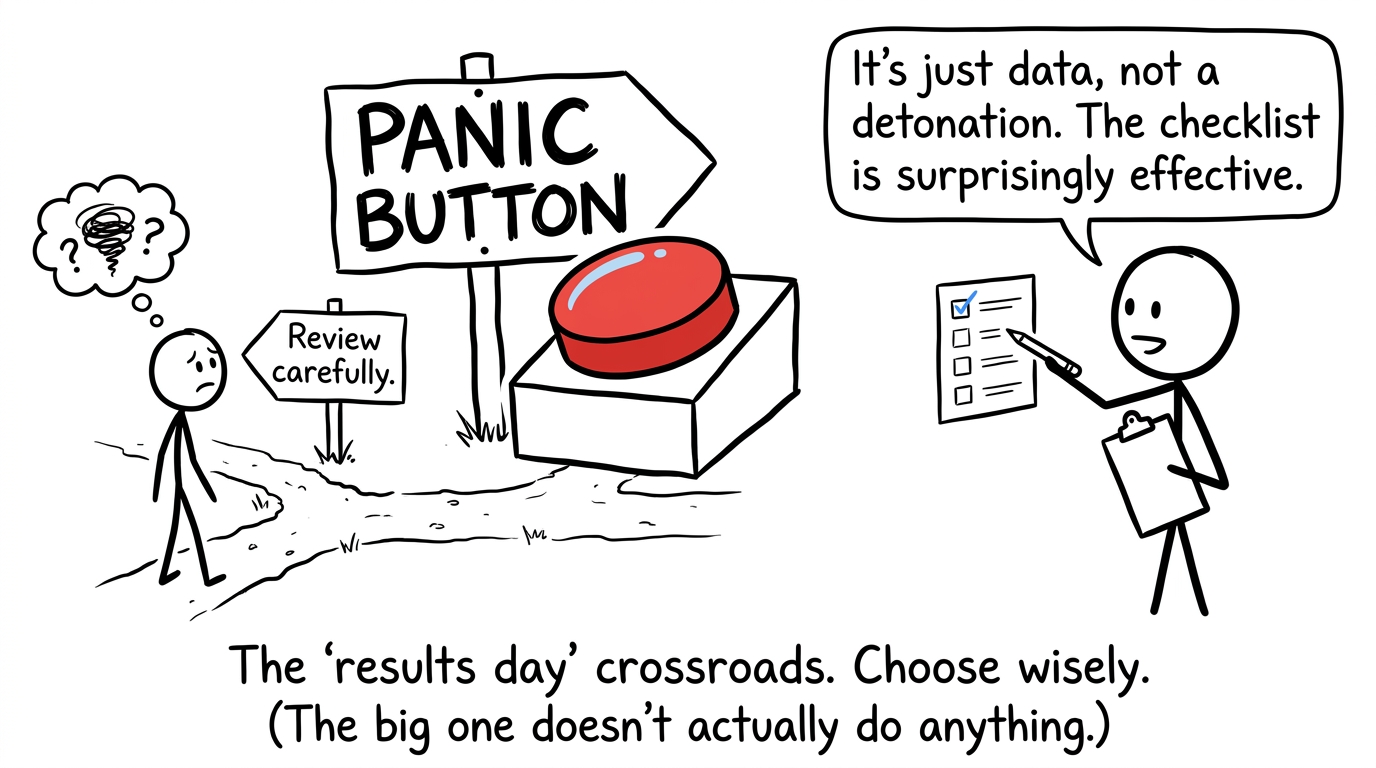 A student choosing between a calm review checklist and a giant panic button
How the A-level Religious Studies re-mark process works
The phrase "re-mark" is commonly used, but it can create the wrong expectation. During a review of marking, a reviewer considers the original marking and checks whether the mark scheme and marking procedures were applied correctly. They do not simply replace a reasonable academic judgement with the mark they personally would have awarded.
That distinction matters in Religious Studies. Extended responses involve analysis, evaluation, use of scholarship and sustained argument. Two teachers may have slightly different impressions of an essay, but a review changes marks only where a genuine marking error is identified.
Ask for your component marks
Begin with the marks for each paper rather than looking only at the final grade. A lower-than-expected result on one philosophy, ethics or study-of-religion component may deserve closer attention.
Then check the exact boundary for your board and route. MathsGenie provides subject-specific pages for AQA A Level Religious Studies grade boundaries, Edexcel Religious Studies grade boundaries, OCR Religious Studies grade boundaries and Eduqas Religious Studies grade boundaries.
Use the current series and correct option combination. Boundaries from a previous year are useful for context, but they do not determine your new result.
Discuss the script with a subject teacher
Ask your exams officer whether a priority copy of the marked script is available. A Religious Studies teacher can then look for specific warning signs, such as:
- part of an answer appearing unmarked;
- marks that do not match the annotations or total;
- an assessment objective apparently being overlooked;
- a response receiving a mark outside the reasonable range suggested by the level descriptors.
The strongest reason to request a review is evidence of a possible error. A predicted grade, previous mock result or narrow distance from a boundary does not itself prove that the marking was wrong.
Choose the appropriate service
A clerical re-check examines administrative matters such as whether every response was marked and whether marks were totalled and recorded correctly. A review of marking includes checks for administrative and marking errors.
For the June 2026 series, the JCQ deadline for an A Level Priority Service 2 review is 20 August 2026. It is intended for cases where progression, particularly a higher education place, depends on the outcome. The deadline for standard reviews of results is 24 September 2026.
Your school or college may impose an earlier internal deadline, so contact its exams officer rather than waiting for the final JCQ date. Current JCQ guidance gives a completion target of within 15 calendar days for a priority review and within 20 calendar days for a standard review.
Give consent and submit through your centre
Students cannot normally send a review request directly to AQA, Edexcel, OCR or Eduqas. Your school or college submits it, including for most private candidates through the centre where the examination was taken.
Written consent is required after results are published because the reviewed mark and final grade can be higher, lower or unchanged. Fees vary by exam board, component and centre policy, so ask the exams officer for the current cost before proceeding.
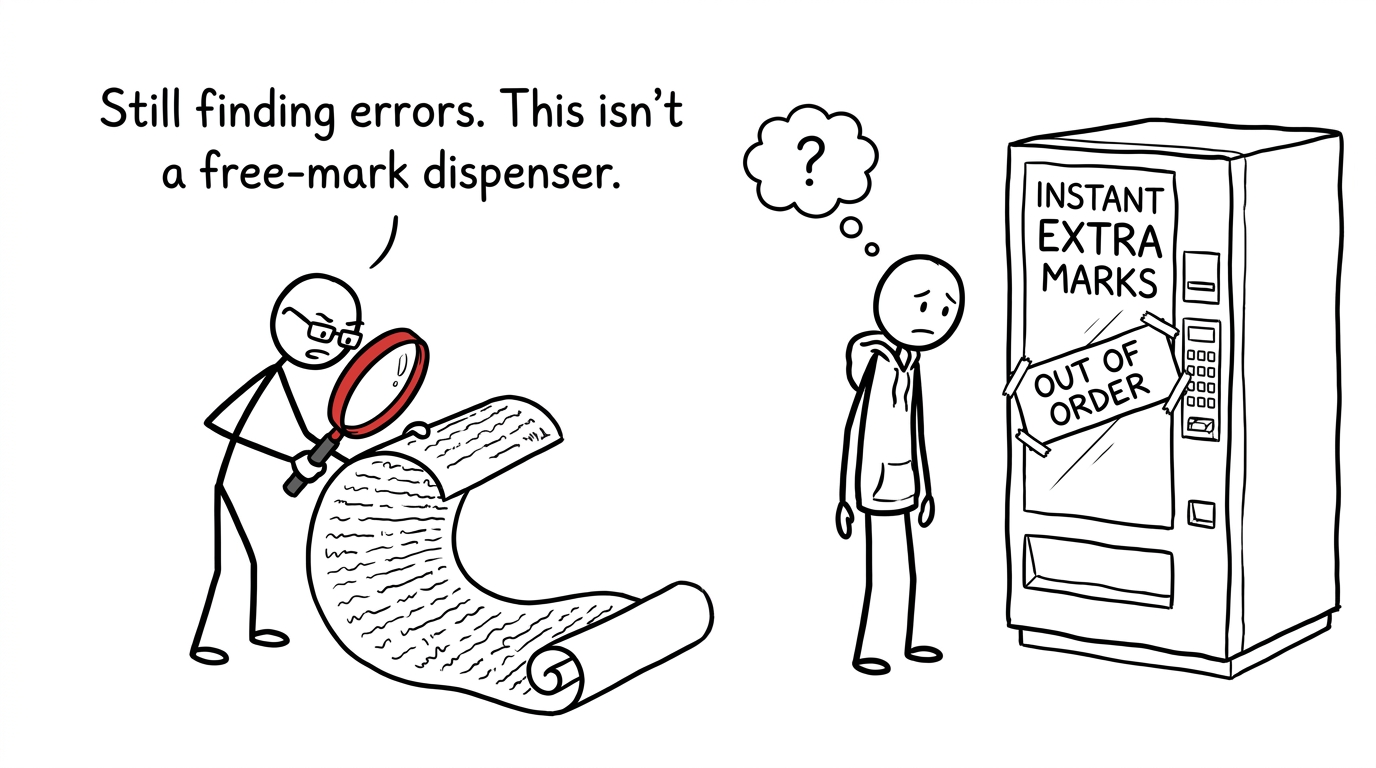 An examiner checking an essay while an instant extra marks machine remains out of order
When requesting a review makes sense
An A-level Religious Studies remark is most reasonable when several pieces of evidence align:
- you are close enough to the next boundary for a plausible mark change to matter;
- one component is sharply out of line with your other results;
- an experienced teacher identifies a credible application-of-the-mark-scheme issue;
- your script suggests an answer or section may have been missed;
- a required university or apprenticeship grade depends on the outcome.
Being one mark below a boundary makes the decision more consequential, but not automatically stronger. The central question remains: is there evidence that a marking error may have occurred?
You can compare boards and years through the complete GCSE, IGCSE and A Level grade boundaries hub, while remembering that only the boundary for your own board, route and examination series applies.
Appealing an A-level Religious Studies grade
An appeal is not the first step. If concerns remain after the review of marking, the school or college may appeal to the awarding organisation on permitted grounds, including an uncorrected marking error or a failure to follow procedures properly and fairly.
Under the JCQ appeals guide effective for the June 2026 series, an appeal must normally be submitted within 30 calendar days of the review outcome. A further appeal hearing may be available. After the awarding organisation's process is complete, eligible cases can be referred to Ofqual's Exam Procedures Review Service, which examines procedure rather than re-marking the script itself.
Speak to your head of centre or exams officer promptly. Appealing an A-level Religious Studies grade requires grounds and evidence; it is not simply another chance to ask for more marks.
Common mistakes to avoid
Assuming a review can only improve the grade
Marks and grades can go down as well as up. Read the consent information carefully.
Checking the wrong boundary
Religious Studies routes and component combinations differ. Match the board, series and option exactly.
Requesting every paper automatically
Reviews are submitted by component and may carry separate fees. Focus first on the paper for which the evidence is strongest.
Waiting for the published deadline
Centres often set earlier administrative deadlines. A pending university place requires particularly quick action.
Treating an appeal as a second review
An appeal needs valid grounds concerning an unresolved marking error or the way procedures were followed.
Make the decision calmly, then move forward
A disappointing result deserves attention, but not panic. Gather the component marks, check the correct boundary, seek informed advice and speak to the exams officer. If the evidence supports a review, submit it within the appropriate deadline; if it does not, you will still have made a reasoned decision.
Start with MathsGenie's A Level Religious Studies grade boundaries and select the relevant board-specific information. If you are also preparing for GCSE or A Level maths, use the GCSE Maths revision hub for free revision lessons, practice questions, past papers, predicted papers, mini tests, mark schemes and video solutions. One result matters, but the habit of responding to evidence will serve you through every examination that follows.











