

A-Level Religious Studies Lower Grade Than Expected?
A-level Religious Studies lower grade than expected? Check marks, request a review, explore Clearing or plan a focused resit calmly in 2026.

Opening a results envelope can turn two years of work into one letter. If you received an A-level Religious Studies lower grade than expected, the disappointment is real, but the grade does not make every decision for you. Your immediate next steps are to check your university status, speak to your school or college, review your component marks and then choose between a review of marking, Clearing or a resit.
Do not decide that your future has disappeared before you have checked the facts. A result is information. Painful information, perhaps, but still something you can act on.
Your results-day checklist
Start with these actions, in this order:
- Check your UCAS application status, but collect your actual grades from your school or college.
- Confirm whether your firm or insurance university has accepted you.
- Ask for your Religious Studies component marks and the relevant grade boundaries.
- Speak to your teacher and exams officer about accessing your scripts.
- Contact your preferred university if you narrowly missed its offer.
- Explore Clearing while considering any review of marking.
- If neither route is right, investigate a structured resit.
For 2026, A-level results day is Thursday 13 August. Schools can set internal post-results deadlines earlier than the exam boards, so speak to staff on results day wherever possible.
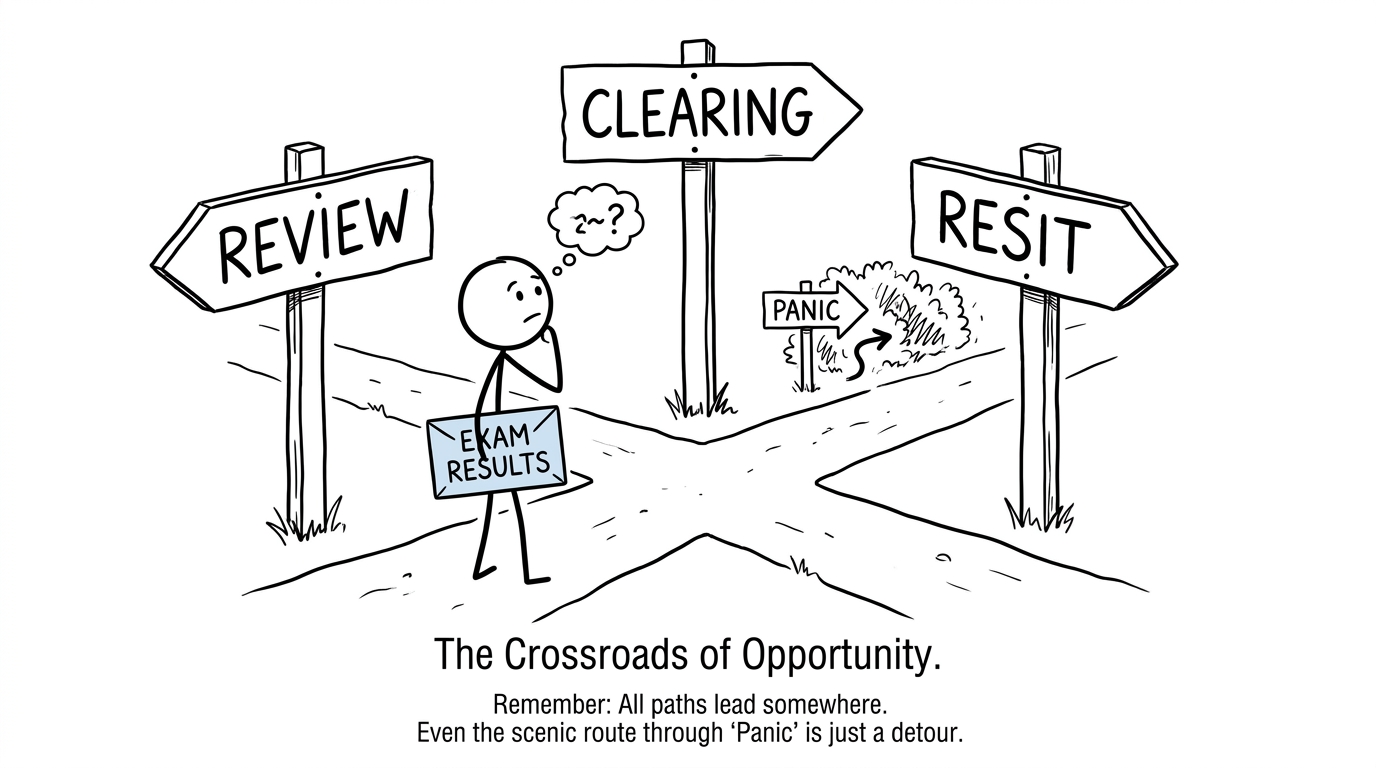 A student calmly choosing between review, Clearing and resit while ignoring the path marked panic
Pause before judging the result
An A-level Religious Studies disappointing result may come from several sources. You might have misunderstood the demands of an evaluation question, run out of time, used imprecise scholarship or received an unexpectedly low mark on one paper.
Ask your school for a breakdown by component. Compare each mark with your mock performance and the grade boundary, but do not assume that being close to a boundary proves a marking error. Grade boundaries themselves cannot be appealed simply because they seem high.
Your teacher may also be able to request copies of marked scripts. This matters in Religious Studies because a careful review can distinguish between an answer that deserved more credit and one that felt strong but did not sustain analysis, evidence or judgement.
Consider a review of marking
The process commonly called a “remark” is officially a review of marking. It is not an automatic fresh mark from the beginning. A reviewer checks whether the original examiner applied the mark scheme correctly and reasonably.
Normally, your school or college requests the service through your exam board. Written consent is required because your mark and grade can rise, stay unchanged or fall. There may also be a fee, depending on your centre and the outcome.
When a review may be sensible
Discuss a review with your teacher when:
- one component is unexpectedly far below your usual standard;
- your script appears to contain overlooked material;
- your teacher identifies a plausible misapplication of the mark scheme;
- a small change could affect your overall grade or university place.
If a university place depends on the result, ask immediately about a priority review. For the summer 2026 series, the awarding-body deadline for a priority A-level review is 20 August, while the standard review deadline is 24 September. Your centre may impose earlier deadlines.
A formal appeal usually comes only after the relevant review has been completed. If you remain concerned, ask your centre to explain the permitted grounds and timescale rather than treating “review” and “appeal” as interchangeable terms.
Contact your university before assuming the answer is no
Missing an offer does not always mean that the university has rejected you. Check your status first. If the decision is pending, contact admissions and ask whether you are still being considered.
Keep the conversation factual. Have your UCAS ID, course details, grades and component information ready. If you are requesting a priority review, tell the university and ask whether it can hold your place until the outcome. It is free to set its own response and deadline, so obtain any agreement in writing.
 A frightening university phone call turning out to be a very small balloon
Use Clearing as an active choice
Clearing is not a consolation shelf. It is the official UCAS route for finding courses with vacancies, including when you have not met the conditions of your offers. In 2026, Clearing runs from 2 July to 19 October.
Search by course content rather than university name alone. Religious Studies connects naturally with theology, philosophy, ethics, politics, history and interdisciplinary humanities courses, but inspect the modules carefully. Similar course titles can lead to quite different degrees.
Contact a university before adding it as your Clearing choice. Ask about entry requirements, modules, assessment methods, accommodation and whether the offer has a deadline. You can add only one Clearing choice at a time, and you should do so only after the university gives permission.
Do not abandon a confirmed place impulsively. Declining it removes that place, so speak to an adviser and confirm an alternative first.
Decide whether an A-level Religious Studies resit fits your goal
A resit can be a strong option if the grade prevents you from reaching a specific course, apprenticeship or personal target. It is less persuasive when it is driven only by embarrassment or pressure from comparisons.
Before committing, check:
- whether your school will accept resit candidates;
- whether you need another approved exam centre;
- which components must be retaken under your specification;
- the fees and registration deadline;
- whether your intended universities accept resit applicants;
- how you will obtain teaching, feedback and timed essay practice.
A-level resits are normally taken in the next summer examination series, subject to the relevant exam-board timetable. You may also need to reapply through UCAS and explain how you are using the year productively.
Build a Religious Studies resit plan
Begin with evidence, not a complete rereading of every textbook. Review your scripts and sort weaknesses into knowledge, analysis, evaluation and timing. Then build weekly sessions around those gaps.
Use the MathsGenie revision planner to schedule realistic blocks. Edexcel students can use the Edexcel A-level Religious Studies revision hub, then test essay planning and timing with Edexcel Religious Studies past papers.
For other specifications, use resources written for your board rather than mixing terminology and content. MathsGenie provides AQA A-level Religious Studies revision guides, while OCR students can revisit specification-focused material such as the OCR Religious Studies Insight revision guide.
The effective cycle is simple: revise one debate, plan an answer, write under time, compare it with the mark scheme, obtain feedback and rewrite the weakest section.
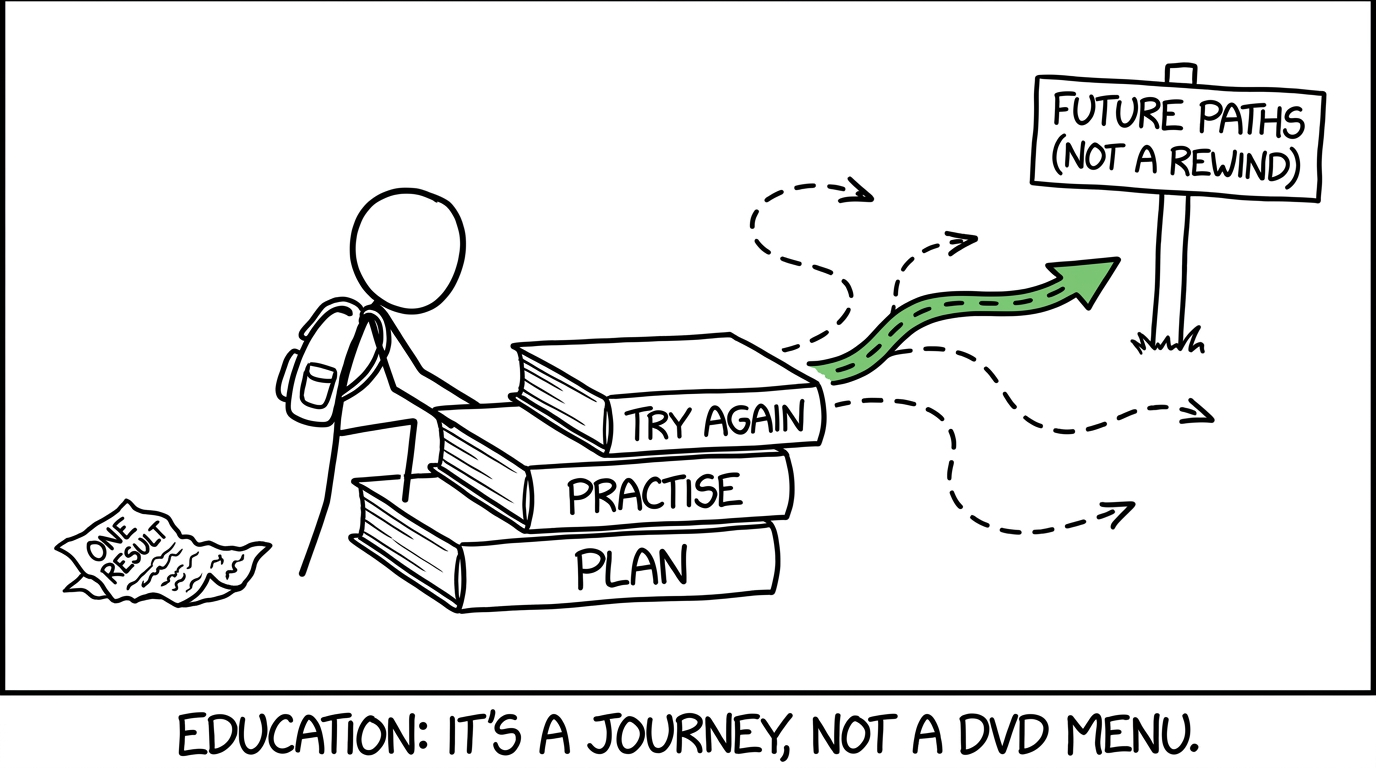 A student building new steps from planning, practice and trying again
Common mistakes after a disappointing result
Requesting every review without evidence
A grade can fall as well as rise. Discuss scripts and component marks with a teacher before giving consent.
Waiting while deadlines pass
Priority services move quickly, and schools often use earlier internal deadlines. Contact your exams officer immediately if a place depends on the outcome.
Treating Clearing as a rushed compromise
Course content, location, cost and assessment style still matter. A quick decision should remain an informed decision.
Planning a resit without changing the method
Repeating the same passive revision is unlikely to solve weaknesses in evaluation or timing. Use marked scripts, targeted revision lessons, past papers and mark schemes to create a different approach.
Letting one subject disrupt every other plan
If you are a younger student reading ahead while preparing for GCSEs, remember the broader lesson: results improve through diagnosis and response. The same process applies to GCSE maths revision: identify lost marks, practise the precise weakness and retest it.
Your next step is smaller than it feels
You do not need to solve the whole year on results morning. First establish whether your place is confirmed. Then examine the marks, discuss a review, explore Clearing and decide whether a resit serves a clear goal.
If resitting is the right route, begin with MathsGenie’s A-level Religious Studies resources. Use specification-matched revision guides, practice questions, past papers, mark schemes, mini tests and the revision planner to turn an upsetting result into a precise plan. One grade may close a particular door, but thoughtful next steps reveal how many doors were never locked.











