A-Level Religious Studies Grade Boundaries History
A-level Religious Studies grade boundaries history explained with AQA data from 2018 to 2025, yearly trends and sensible advice for using past papers.
A grade boundary can feel like a finish line that moves after you have started running. That is uncomfortable, but it is also slightly misleading. The A-level Religious Studies grade boundaries history shows that marks have shifted considerably across recent exam series, yet boundaries are not decided in advance and a higher boundary does not automatically mean an easier route to a grade.
The clearest recent pattern is not a steady rise or fall. Boundaries changed sharply around the pandemic, returned towards normal grading arrangements in 2023, and continued to move in 2024 and 2025. This guide explains those changes using published AQA figures, with context for Edexcel and OCR students.
The grade boundary checklist
Before interpreting any table, check four things:
- Exam board: AQA, Edexcel and OCR use different papers and total marks.
- Specification and option: boundaries can vary between routes within one board.
- Exam series: summer and autumn results should not be combined casually.
- Maximum mark: compare percentages cautiously when totals differ.
- Pandemic context: there were no normal summer examinations in 2020 or 2021.
A boundary is simply the minimum total mark required for a grade in that particular series. It is evidence about a past paper, not a guaranteed target for the next one.
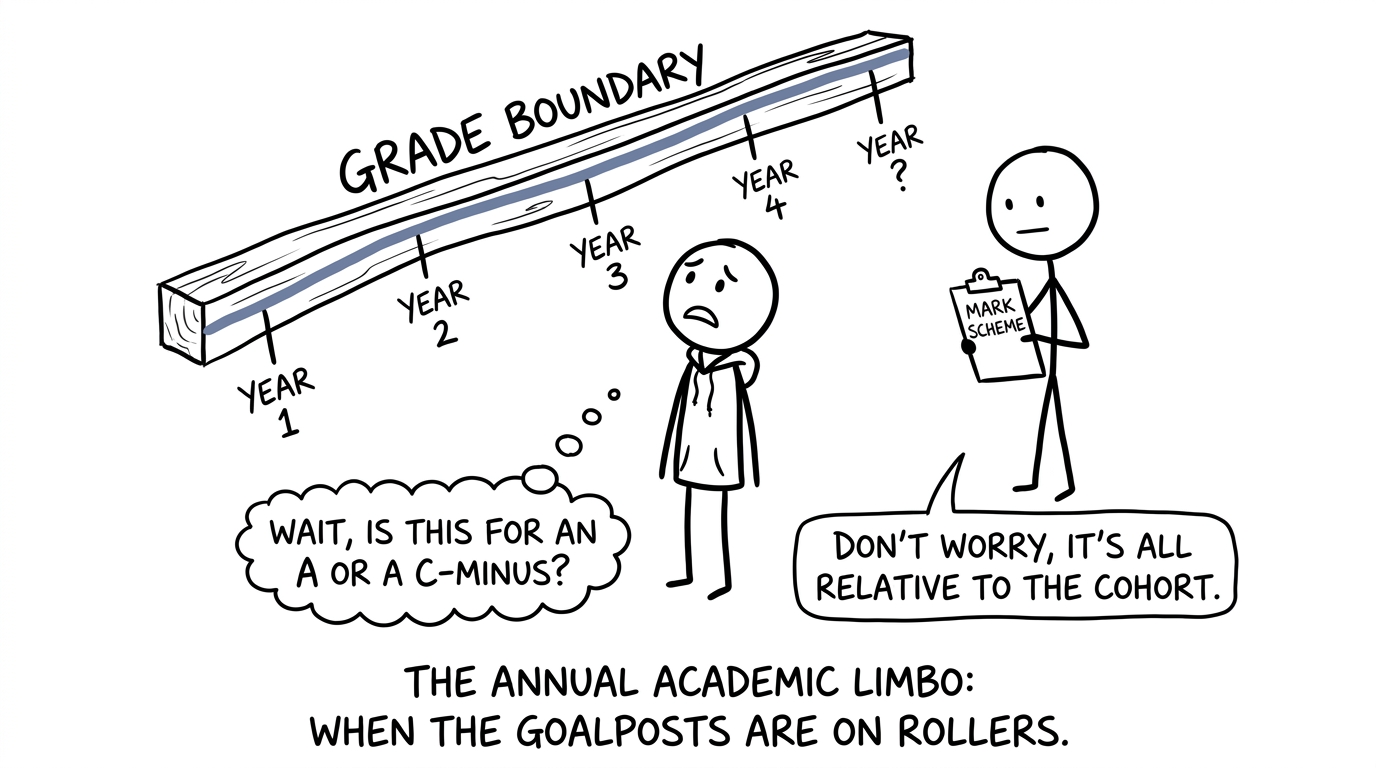 A student facing a moving grade-boundary limbo bar while a calm examiner holds a mark scheme
Past A-Level Religious Studies grade boundaries by year
For a consistent year-by-year comparison, the table follows AQA specification 7062, Option A, with a maximum mark of 200200200. Other AQA religion options sometimes differed by a few marks. The figures have been checked against published exam-board boundary documents; the latest complete summer series available is 2025.
| Year | A* | A | B | C | D | E | Commentary |
|---|---|---|---|---|---|---|---|
| 2018 | 168168168 | 140140140 | 114114114 | 888888 | 626262 | 363636 | The first useful baseline in this comparison. |
| 2019 | 181181181 | 157157157 | 128128128 | 999999 | 707070 | 424242 | Every displayed boundary rose from 2018. |
| 2020 | N/A | N/A | N/A | N/A | N/A | N/A | Summer examinations were cancelled; calculated grades were awarded. |
| 2021 | N/A | N/A | N/A | N/A | N/A | N/A | Summer examinations were cancelled; teacher-assessed grades were awarded. |
| 2022 | 165165165 | 143143143 | 116116116 | 898989 | 636363 | 373737 | Examinations returned under transitional grading arrangements. |
| 2023 | 167167167 | 143143143 | 115115115 | 878787 | 595959 | 313131 | Grading returned broadly to the pre-pandemic standard. |
| 2024 | 169169169 | 141141141 | 113113113 | 858585 | 575757 | 303030 | Upper and lower boundaries moved in different directions. |
| 2025 | 173173173 | 148148148 | 122122122 | 969696 | 717171 | 464646 | Boundaries rose across the grade range compared with 2024. |
You can inspect the complete option-by-option figures on the AQA A-Level Religious Studies grade boundaries page.
What the year-by-year changes tell us
2018 to 2019: a substantial rise
The A* boundary for AQA Option A increased from 168168168 to 181181181, while the A boundary moved from 140140140 to 157157157. That does not prove that the 2019 papers were simply easier. Exam boards set boundaries after reviewing students’ work and considering statistical evidence so that comparable performance receives a comparable grade.
The lesson is important: one year cannot become a permanent prediction. A student using the 2018 boundary as an exact target in 2019 would have been aiming too low.
2020 and 2021: a break in the series
Normal summer examinations did not take place in either year. Although additional autumn examinations produced some published boundaries, those series involved different circumstances and much smaller, self-selecting cohorts. They should not be inserted into a normal summer trend line as though nothing had changed.
Ofqual subsequently advised schools that pandemic-era boundaries should not be used as the main basis for indicative grades. For analysis, 2019 remains the clean pre-pandemic reference point.
2022: examinations returned
Summer examinations resumed in 2022, but grading was intentionally transitional. Ofqual described the national approach as a midpoint between 2019 standards and the more generous outcomes awarded in 2021.
This helps explain why 2022 deserves a label rather than a simple arrow saying “boundaries fell”. The figures belong to an exceptional grading context. They remain useful for practising the paper, but less useful for forecasting a future grade.
2023 to 2025: normal movement resumed
In 2023, grading returned broadly to pre-pandemic standards, with protection for the cohort built into the process. AQA’s A boundary stayed at 143143143, while several lower boundaries fell slightly from 2022.
In 2024, the A* boundary rose to 169169169, but the A boundary fell to 141141141. This is a neat warning against describing a whole series as simply “higher” or “lower”. Different parts of the grade scale can move differently.
By 2025, the AQA Option A boundaries had risen across every displayed grade. The A* threshold reached 173173173, still below 2019’s 181181181, while the E threshold increased sharply from 303030 to 464646. Recent A-level Religious Studies grade boundary trends are therefore uneven rather than linear.
Why boundaries vary between exam boards
AQA totals 200200200 marks for this specification, while OCR uses 360360360 and Edexcel uses 240240240. Edexcel also publishes different overall boundaries for different combinations of papers. Comparing raw marks between boards would therefore be meaningless.
The percentage calculation is:
Boundary percentage=boundary markmaximum mark×100\text{Boundary percentage}=\frac{\text{boundary mark}}{\text{maximum mark}}\times 100Boundary percentage=maximum markboundary mark×100Even percentages need care. Specifications differ in assessment structure, question choice and option combinations. Use the Edexcel A-Level Religious Studies grade boundaries or OCR A-Level Religious Studies grade boundaries for your own board rather than translating an AQA target.
Edexcel students can also begin from the Edexcel A-Level Religious Studies revision hub, where specification-specific resources sit together.
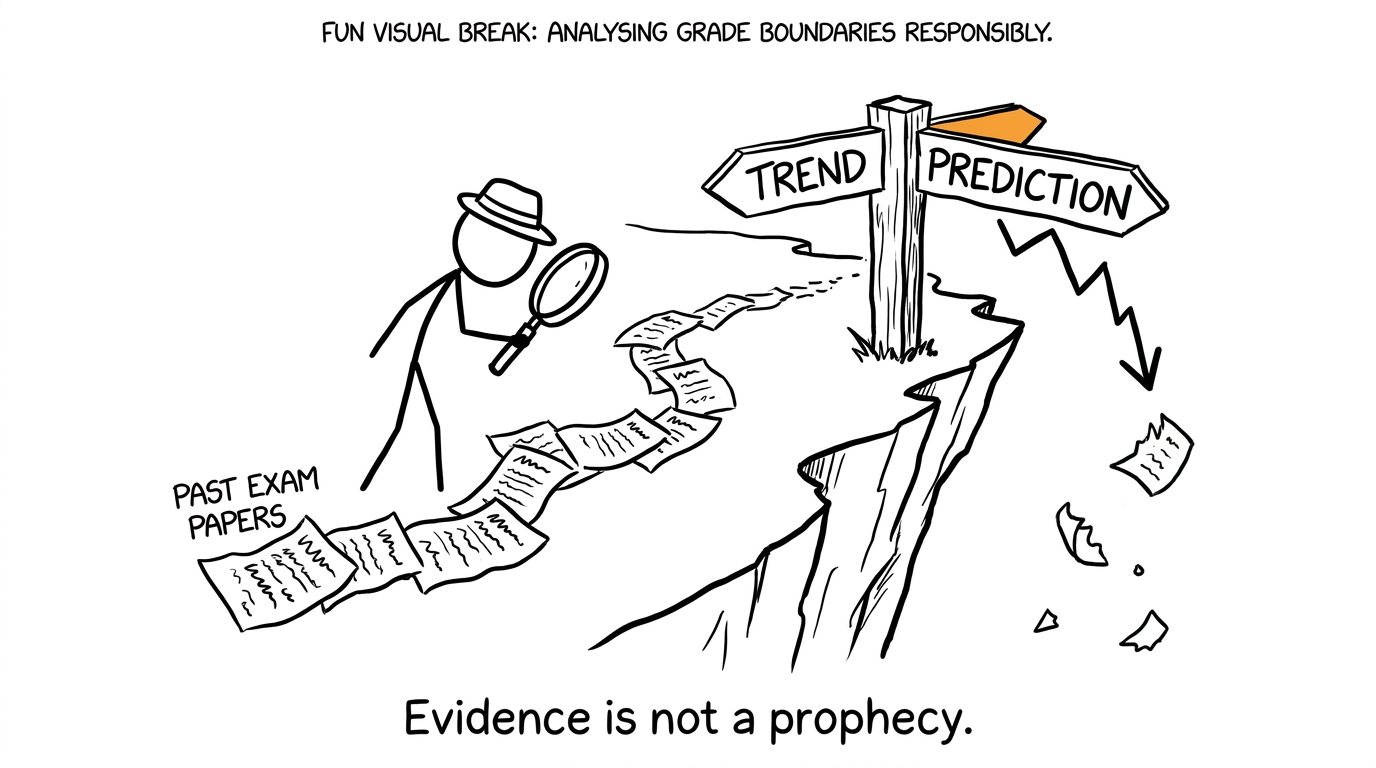 A student detective choosing between a trail marked trend and a cliff marked prediction
How to use boundary history sensibly
Past boundaries are most valuable after completing a paper under timed conditions. Mark it with the official mark scheme, record the raw total and compare it with the boundary for that exact series and option.
Then look beyond the grade. Identify whether marks were lost through missing knowledge, weak analysis, unsupported evaluation or unfinished answers. On AQA, AO1 contributes approximately 40%40\%40% and AO2 approximately 60%60\%60% overall, so descriptive knowledge alone cannot secure the strongest result.
Use several papers rather than trusting one score. The AQA A-Level Religious Studies past papers include papers and mark schemes organised by series. Students moving up from GCSE can also use the AQA GCSE Religious Studies revision hub to strengthen foundational knowledge before tackling A-level depth.
Common mistakes when analysing grade boundaries
- Predicting this year’s boundary from last year’s figure. Boundaries are set only after scripts have been assessed.
- Mixing boards or options. An Edexcel mark cannot be read against an AQA table.
- Treating 2020 and 2021 as ordinary summer series. Normal summer examinations were cancelled.
- Assuming a high boundary proves an easy paper. Awarding considers the quality of work and statistical evidence, not difficulty in isolation.
- Using a boundary as a revision target. Aim above it so normal variation in questions, marking and exam-day performance does not decide your grade.
- Checking only the total. The mark scheme and examiner expectations reveal what your next revision session should address.
Boundaries are a rear-view mirror, not a map
The history shows movement, disruption and recovery, but no dependable formula for the next series. Past boundaries tell you what happened after a particular cohort answered a particular set of papers. They cannot tell you precisely what mark will be needed next time.
Use them to interpret performance, not limit ambition. Start with MathsGenie’s free AQA A-Level Religious Studies past papers, complete a paper under timed conditions, mark it carefully and turn every lost mark into a specific revision task. Combine past papers with revision lessons, practice questions, mark schemes, predicted papers and mini tests. That is how an uncertain boundary becomes a manageable revision plan.