

A-Level Religious Studies Grade Boundaries 2026
A-level religious studies grade boundaries explained for 2026, including results day timing, exam-board totals, a worked example and next steps.
Waiting for a result creates a peculiar kind of uncertainty. Your essays have been written, the papers have been marked, yet the number needed for each grade still feels hidden. The essential fact about A-level religious studies grade boundaries is simple: they are minimum mark thresholds set after the papers have been taken and marked. Official 2026 boundaries are not available in advance.
A-level religious studies results day is Thursday 13 August 2026. Results and grade boundaries can be released to students from 8.00am. Until then, any boundary presented as an exact 2026 figure is an estimate, not an official threshold.
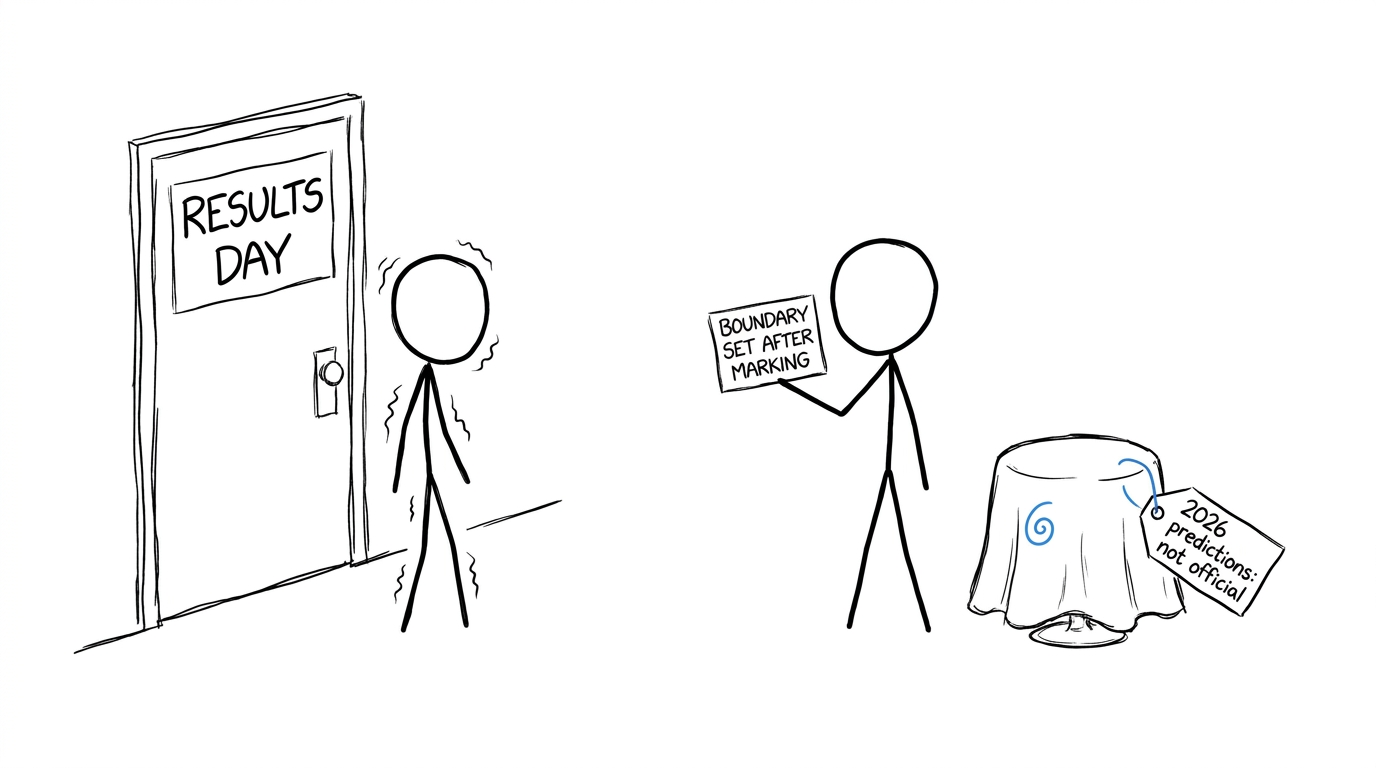 A student discovers that 2026 grade boundaries cannot be predicted officially
A quick results day checklist
Before opening several tables and trying to reconstruct your result, establish the basics:
- Confirm your exam board: AQA, Pearson Edexcel, OCR or Eduqas.
- Check your exact qualification and option or route.
- Use the overall subject boundary, not an isolated paper boundary.
- Remember that the boundary is the minimum mark for that grade.
- Treat every pre-results-day prediction cautiously.
- Speak to your school or college before requesting a review of marking.
The same calm approach is useful for GCSE results. MathsGenie's GCSE Maths Revision hub brings exam-board resources together so that students can find the correct course rather than compare unrelated papers.
How A-level Religious Studies grade boundaries work
An exam board first marks the completed papers. It then uses statistical evidence and expert judgement to establish boundaries while maintaining comparable standards between years. If a paper proves more demanding than a previous paper, its boundaries may be lower. If it proves less demanding, they may be higher.
That does not mean boards decide that a fixed proportion of students must fail. Ofqual's 2026 guidance confirms that there is no quota for the number of students who may receive each grade. The objective is to preserve the standard represented by each grade, not to force results into predetermined percentages.
Boundaries normally run from A∗A^*A∗ to EEE. A result below the minimum boundary for an EEE is unclassified and reported as UUU. Achieving the exact boundary mark is enough: if the published BBB boundary is 132132132, a total of 132132132 receives a BBB.
Your overall result comes from the total mark
Current Religious Studies A Levels are linear qualifications. Your component marks contribute to one overall subject grade rather than producing separate final grades for philosophy, ethics or the study of religion.
The maximum total differs by board:
| Exam board | Qualification structure | Maximum total |
|---|---|---|
| AQA | Two equally weighted written papers | 200200200 marks |
| Pearson Edexcel | Three equally weighted papers chosen from four | 240240240 marks |
| OCR | Three equally weighted written papers | 360360360 marks |
| Eduqas | Three equally weighted written components | 300300300 marks |
This is why a boundary from another board cannot be applied to your result. Even boundaries from different Edexcel paper combinations may differ because candidates can complete different routes.
Religious Studies A-level grade boundaries 2026
The official religious studies A-level grade boundaries 2026 will only be known on results day. Exam boards need evidence from completed and marked papers before deciding where each threshold belongs.
Previous boundaries can provide context, but they are not promises. They may help you understand the broad scale used by your board, yet adding or subtracting a few marks from last year's figures cannot reliably predict 2026.
This principle matters in maths revision too. A predicted paper is useful practice, not a forecast of every question. MathsGenie's GCSE predicted papers are designed for focused rehearsal, while genuine Edexcel A Level Maths past papers show how completed exam series were actually assessed.
Worked boundary example
Consider a hypothetical AQA candidate. These figures are illustrative and are not official 2026 boundaries.
Suppose the candidate receives:
- Paper 1: 636363 marks out of 100100100
- Paper 2: 717171 marks out of 100100100
The overall mark is:
63+71=134 63+71=134 63+71=134Suppose the fictional overall boundaries were:
| Grade | Illustrative minimum mark |
|---|---|
| AAA | 154154154 |
| BBB | 132132132 |
| CCC | 111111111 |
Because 134≥132134 \geq 132134≥132 but 134<154134 < 154134<154, the candidate receives a BBB.
Their percentage would be:
134200×100=67% \frac{134}{200}\times 100=67\% 200134×100=67%However, the grade is determined by comparing the total of 134134134 with the official raw-mark boundary, not by assuming that 67%67\%67% must always equal a particular grade.
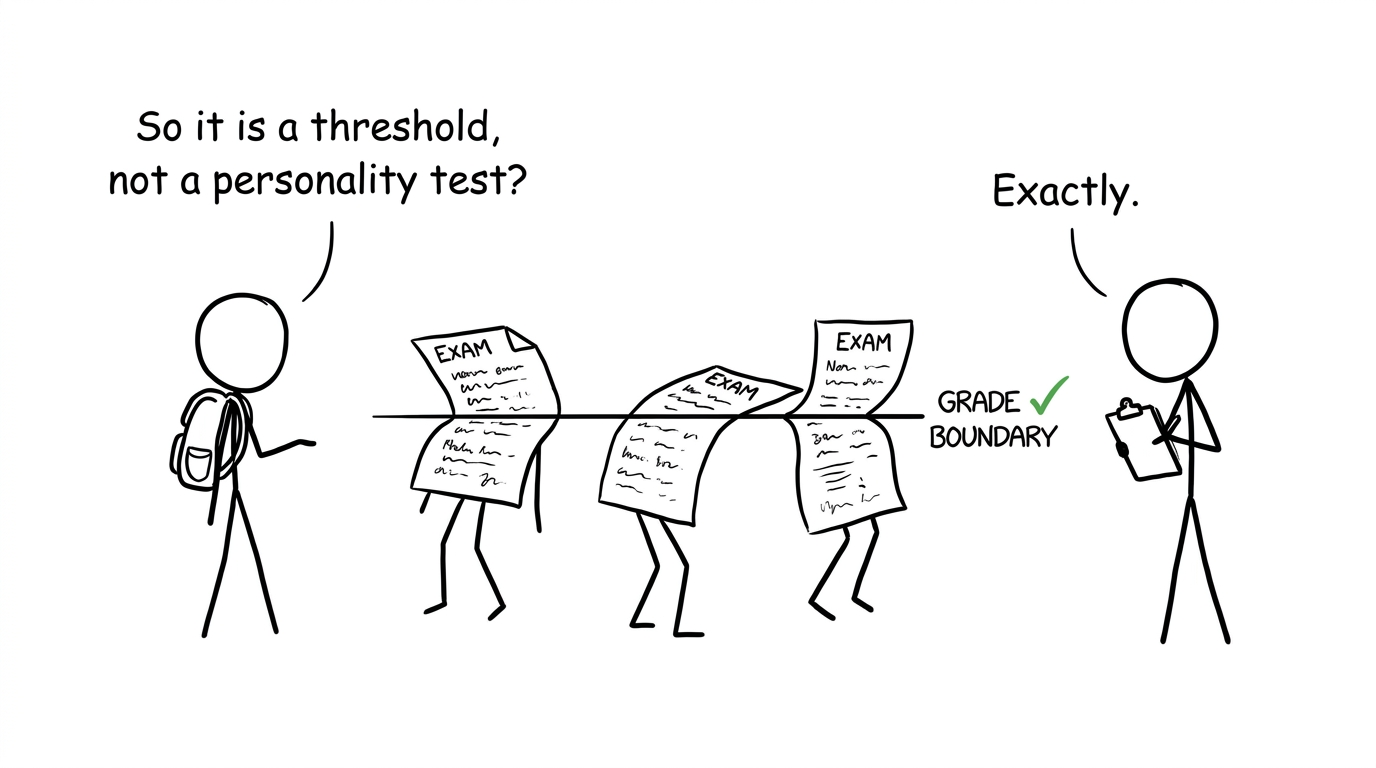 Exam papers discover that a grade boundary is a threshold rather than a judgement
What to do on A-level Religious Studies results day
Read the grade first, then check the component marks supplied by your centre. If your result meets your university offer, follow the instructions from your school, college and UCAS.
If it is lower than expected, avoid making an immediate decision from disappointment. Ask a teacher to compare your marks with the boundary and consider how close you are. A review of marking is not a free second attempt: marks can remain unchanged, rise or fall. Your centre can explain deadlines, fees and whether a priority service is appropriate.
If progression is uncertain, contact your chosen university promptly and use official UCAS guidance. One result can change the route without ending the destination.
Common mistakes when reading grade boundaries
Treating predicted boundaries as official
No website can know the final 2026 thresholds before the awarding process is complete. Look for the document published by your own board on results day.
Comparing percentages across exam boards
A percentage is only meaningful beside the specification, paper combination and boundary table used for your qualification.
Looking at one paper instead of the qualification total
Your final grade comes from the combined subject mark. A disappointing component does not automatically determine the overall result.
Assuming a review can only increase a mark
A review checks whether the mark scheme was applied correctly. The result may go up, go down or stay the same.
Continuing revision during the wait
Once the exams are finished, further revision cannot alter the marked scripts. Rest, organise your results-day information and focus on decisions you can still influence.
Turn uncertainty into a useful next step
Grade boundaries translate marks into grades; they do not measure every quality behind the work. On 13 August 2026, use the correct board table, compare your overall mark carefully and ask for informed advice before choosing your next step.
MathsGenie specialises in free GCSE and A Level maths, so it does not currently publish A-level Religious Studies revision guides. For your next stage of maths preparation, start with A Level Maths Revision or the Edexcel A Level Maths revision hub. You can combine revision lessons and practice questions with past papers, predicted papers, mini tests, mark schemes and video solutions, turning the next uncertain result into a preparation process you can control.











