

A-Level Psychology Results Day Questions Answered
A-level psychology results day questions answered clearly, including grade boundaries, UCAS, Clearing, marking reviews and practical next steps.
Results day has a strange way of making one letter feel larger than two years of work. Students want to know whether they have reached their next step; parents want to help without making a tense morning harder.
This guide answers the most common A-level psychology results day questions. The short version is simple: collect your results, check your UCAS status if relevant, compare your mark with the official grade boundaries, and speak to your school or college before making decisions about marking reviews or resits.
For students receiving results in England in 2026, A Level results day is Thursday 13 August. Your school or college will confirm when and how it will release individual results.
Your results-day checklist
Before the morning becomes busy, have these essentials ready:
- your school or college collection instructions
- your UCAS sign-in details and application number, if applicable
- contact details for your firm and insurance universities
- a charged phone, paper and a pen
- someone calm you can speak to
- your exams officer's contact details
Do not make a permanent decision during the first emotional minute. Read what is actually in front of you first.
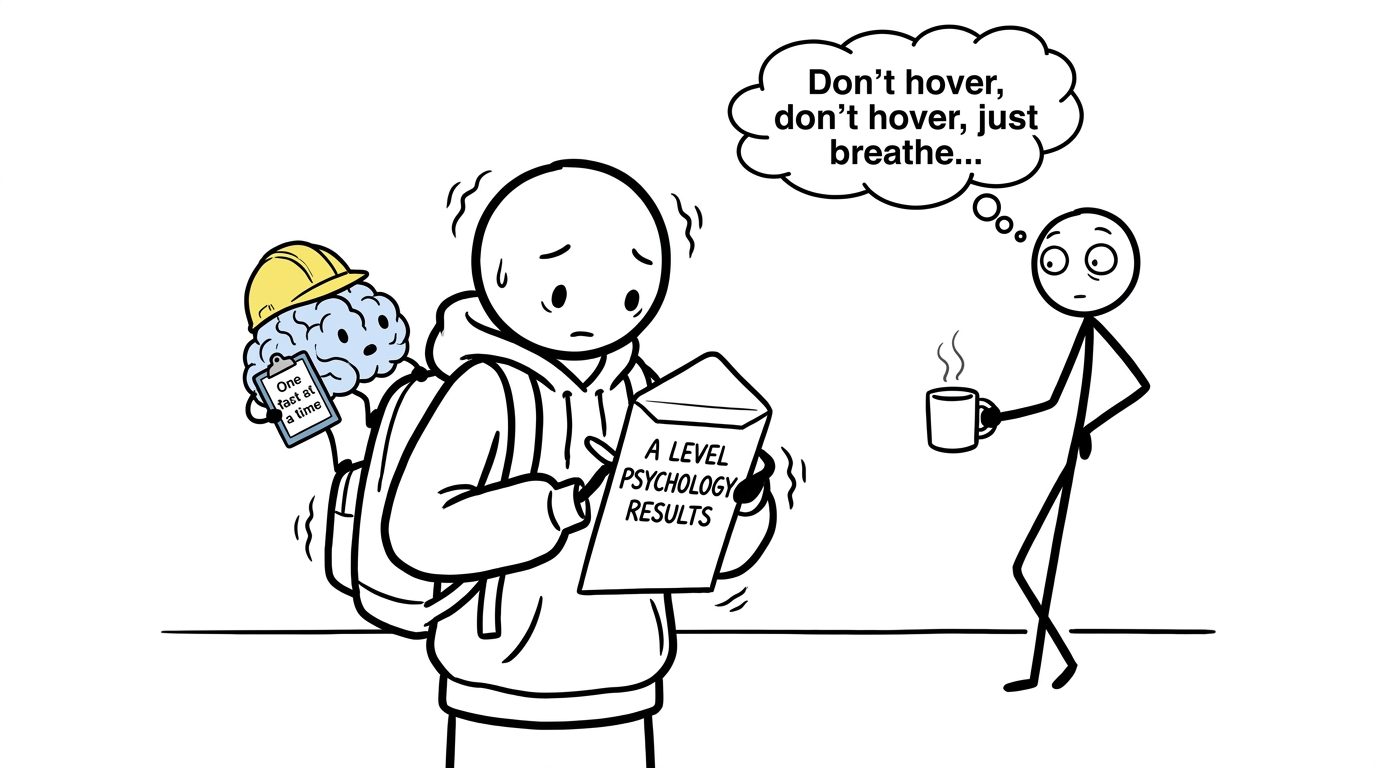 A student opens a results envelope while a tiny brain recommends taking one fact at a time
When is A Level Psychology results day in 2026?
A Level, AS and T Level results are released on Thursday 13 August 2026 in England. GCSE results follow on Thursday 20 August 2026.
Schools and colleges control their own collection arrangements, so check whether you must attend in person or receive results through an online portal or email. UCAS also updates application decisions that morning, but your school or college remains the source of your actual grades.
What will my Psychology result show?
A Level Psychology is graded A* to E. A result below the minimum standard for grade E is recorded as U, meaning unclassified.
Your results information may also include an overall mark or component marks, depending on the exam board and what your centre provides. Ask a teacher or exams officer if the breakdown is unclear. Knowing the mark matters because it shows how far you are from a grade boundary.
The exact assessment structure depends on your specification. The AQA A Level Psychology revision hub and OCR A Level Psychology revision hub provide board-specific topic and paper information.
How are A Level Psychology grade boundaries decided?
Grade boundaries are set after papers have been marked. They show the minimum mark required for each grade and can change between exam series because papers vary in difficulty. There is no fixed number of students who must receive each grade.
Do not assume that last year's boundary will apply this year. Use the official boundary for your exam board, specification and series. For AQA Psychology, for example, the qualification grade is based on the combined scaled mark across the papers rather than treating an illustrative paper boundary as a separate final grade.
Why is my grade different from my predicted grade?
A predicted grade is an informed estimate, not a guaranteed result. It may be based on mocks, classwork, teacher judgement and the evidence available when a university application was prepared.
Your final grade comes from the assessed work submitted to the exam board. A difference does not automatically mean that anything went wrong. However, a result that is unexpectedly low deserves a careful conversation with your teacher, particularly if one component appears unusual.
Students preparing for Psychology can develop a clearer picture of their performance through the AQA Psychology question bank, where topic practice can be checked against full mark schemes.
What should I do if I miss my university offer?
Check UCAS before assuming that the place has been lost. A university may still accept you even if you narrowly miss the stated conditions.
If your status is unclear, contact the university calmly and have your UCAS details available. You may be offered your original course, an alternative course or another route. If neither your firm nor insurance choice confirms you, you can investigate Clearing vacancies.
Clearing is not a judgement on your ability. It is a process for matching applicants with courses that still have places. Compare course content, location, accommodation and costs rather than accepting the first option because the morning feels urgent.
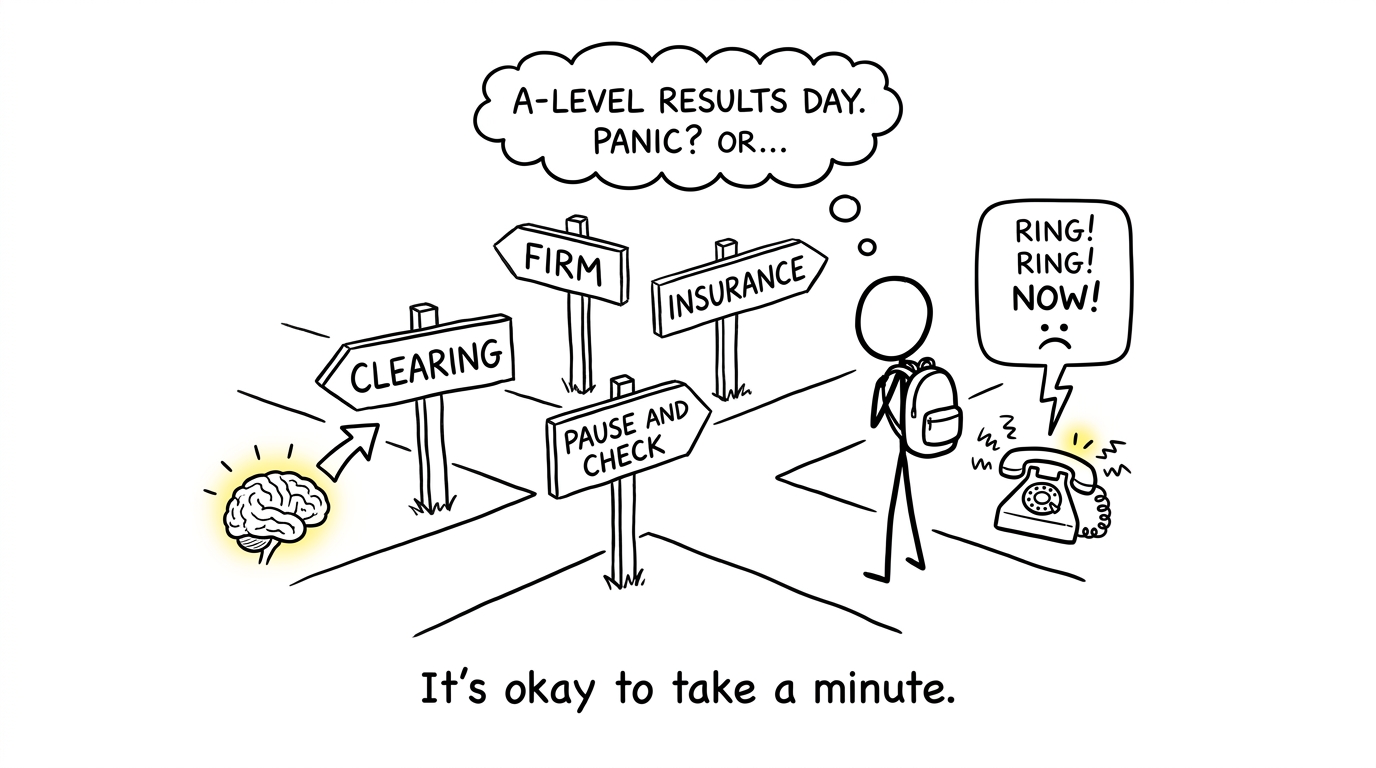 A student considers Firm, Insurance and Clearing while a tiny brain points towards Pause and Check
Can I ask for my Psychology paper to be remarked?
What students often call a remark is officially a review of marking. A reviewer checks whether the original marking applied the mark scheme correctly; the entire response is not simply marked again from scratch without reference to the first marking.
Speak to your teacher or exams officer first. Your centre may obtain a marked script to help decide whether a review is sensible. Most students cannot request the service directly from an exam board, although arrangements can differ for private candidates.
Your written consent is normally required because a mark can stay the same, rise or fall. Fees and deadlines vary, and priority services may be available when a higher education place depends on the outcome. Act promptly rather than relying on dates remembered from a previous year.
Is an appeal the same as a review of marking?
No. A review of marking is generally the first relevant step when there may have been a marking error. An appeal normally follows if the school or college believes an error remains after the review or that the correct procedure was not followed.
Ask your centre to explain the available post-results services, evidence, cost and risk. An unexpectedly disappointing grade is understandable grounds for a conversation, but it is not by itself proof of a marking error.
Should I resit A Level Psychology?
A resit may be reasonable if a higher grade is necessary for a specific course or career route and you have a realistic plan for improving. It also carries costs in time, examination entry and preparation.
Before deciding, check whether your intended university or employer accepts resits and whether you must resit the full qualification. Ask your school, college or another approved centre about current entry arrangements.
If you do resit, begin with diagnosis rather than rereading everything. Use AQA Psychology revision guides, targeted questions and AQA past exam papers with mark schemes to identify whether the lost marks came from knowledge, application, evaluation, research methods or timing.
Does Psychology contain much maths?
A Level Psychology includes quantitative skills, particularly within research methods and data handling. National subject requirements mean that at least 10%10\%10% of the assessment includes mathematical skills at Level 2 or above.
That can involve percentages, ratios, averages, graphs and interpreting data. GCSE students considering Psychology should therefore continue building secure numeracy rather than treating maths as a subject they will never meet again. The GCSE Maths revision hub provides exam-board resources for foundation and higher tier, while Psychology students can review research methods and data skills.
Common results-day mistakes
The most avoidable mistake is reacting before checking the facts. Other common errors include:
- comparing marks with an old grade boundary
- assuming a missed offer means automatic rejection
- requesting a marking review without understanding that marks can fall
- waiting too long to contact the exams officer
- confusing a review of marking with a formal appeal
- choosing a Clearing course without checking its content and practical details
- letting a parent make calls that the student should lead
Parents are most helpful when they create thinking space: keep notes, find contact details and ask what support is wanted. The student should remain at the centre of decisions about courses, reviews and resits.
Your next step with MathsGenie
A result is important, but it is information rather than a complete account of what you can do. Check the evidence, speak to the right people and make the next decision slowly enough to make it well.
If Psychology remains part of your plan, start with MathsGenie's free AQA A Level Psychology resources or OCR A Level Psychology resources. Use revision lessons and guides to rebuild understanding, practice questions and mini tests to expose gaps, then past papers, predicted papers and mark schemes to sharpen exam technique. Calm progress usually begins with one accurately identified weakness.










