

A-Level Psychology Resit: Results Day Revision Plan
A-level psychology resit plan for after results day: review scripts, diagnose lost marks and build focused revision for a more confident summer retake.
Results day can turn two years of work into one letter on a screen. If that letter is not what you needed, the first instinct is often to replay every question. A better response is quieter: check the result, understand your options and build an A-level psychology resit plan from evidence rather than disappointment.
For a linear A Level, resitting normally means taking the full qualification again in the next available summer series. Before committing, speak to your school or exams officer about your marked scripts, a possible review of marking, exam entry and the specification you will retake. Then use your scripts and past-paper performance to identify exactly where marks were lost.
Your psychology retake checklist
- Confirm your exam board and specification.
- Ask for access to your marked scripts where available.
- Discuss a clerical re-check or review of marking before the deadline.
- Check whether your school will enter you or whether you need a private candidate centre.
- Compare your scripts with the relevant mark schemes.
- Build a topic and skills audit.
- Schedule active recall, essay planning and timed questions.
- Complete full papers regularly and track whether weaknesses improve.
You can organise your resources through the free A Level Psychology revision hub, covering AQA, Edexcel, Eduqas, OCR and WJEC.
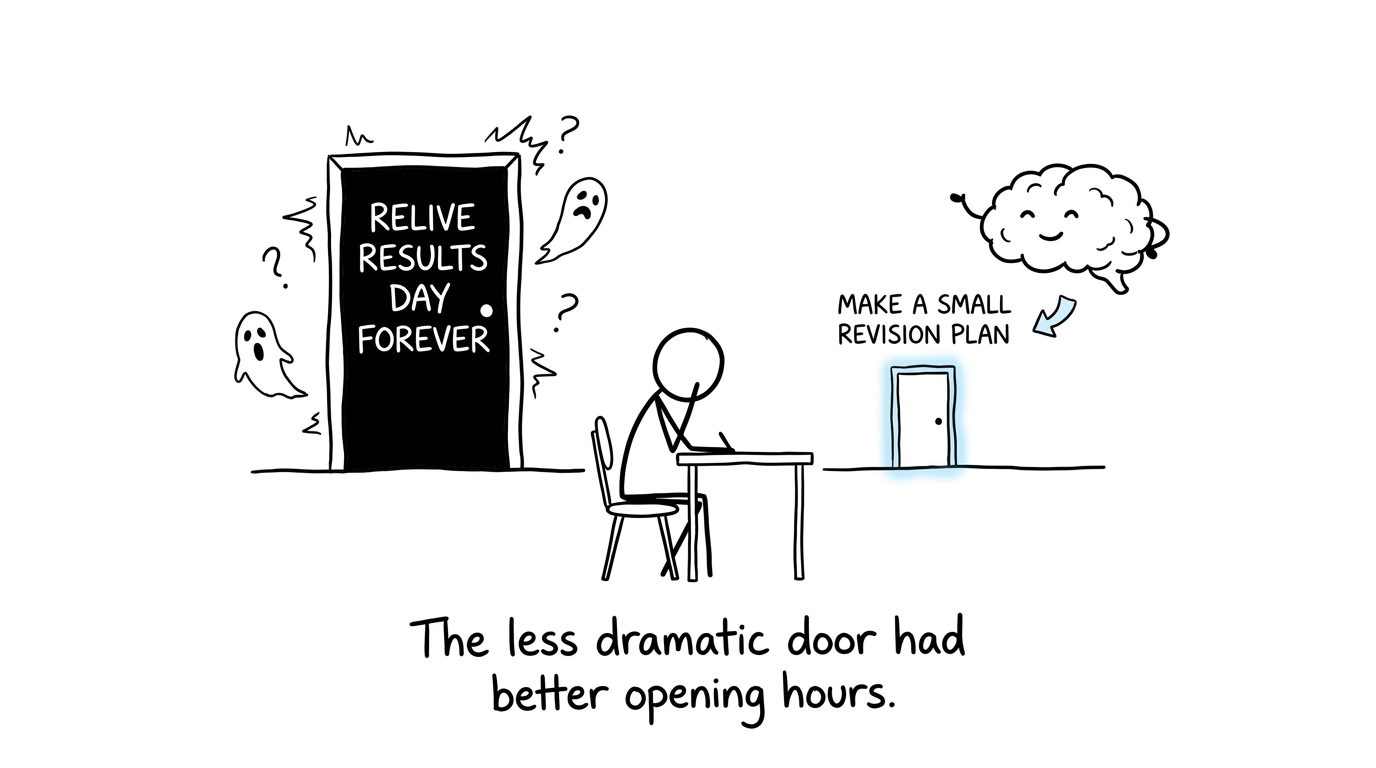 A student choosing the less dramatic door towards a small revision plan
The first milestone: make the right decision
For the summer 2026 series, A-level results are released on Thursday 13 August. The JCQ deadline for a priority review of marking is 20 August where a higher education place depends on the outcome, while the standard review deadline is 24 September. Deadlines change between exam series, so confirm the current dates with your exams officer immediately.
A review of marking is not another attempt at the paper. It checks whether the original mark scheme was applied correctly. Your mark may remain unchanged and, depending on the service and outcome, it may move in either direction. Looking at the script with a teacher can help you decide whether a review is sensible.
If you choose to resit, confirm three practical details during the first week:
- Entry: will your former school accept you, or must you find another centre?
- Specification: are you retaking AQA, Edexcel, OCR, Eduqas or WJEC?
- Progression: does your intended university or course have a policy concerning retakes?
Do not assume that all Psychology specifications contain the same topics or paper structures. Start from the correct board hub, such as AQA A Level Psychology revision, Edexcel A Level Psychology revision or OCR A Level Psychology revision.
Weeks one to four: diagnose the lost marks
Resitting A-level Psychology should not mean repeating last year's revision more intensely. If the method produced an incomplete result, repetition alone is unlikely to repair it.
Mark each weakness under one of five headings:
- knowledge and accurate terminology;
- application to an unfamiliar scenario;
- analysis and evaluation;
- research methods and data handling;
- timing and extended-response structure.
Next, create a paper audit. For every dropped mark, record the topic, question type and reason. “Attachment” is too broad. “Could recall Bowlby's theory but did not evaluate the supporting evidence” is useful because it tells you what to practise.
Use the AQA Psychology past papers if that is your board. Complete one paper or selected sections without notes, mark them strictly and use the result as your baseline. Your first score is not a prediction. It is a map.
Autumn milestone: rebuild knowledge through retrieval
From September to December, aim to reconstruct the course systematically. Divide the specification into weekly blocks, but revisit older material so that it is not forgotten as soon as you change topic.
A productive session might contain:
- brief closed-book recall;
- checking and correcting gaps;
- one focused set of exam questions;
- mark-scheme analysis;
- a short return to an older topic.
Flashcards work when you retrieve an answer before turning the card over. Notes work when you close them and reproduce the argument. Simply rereading a model essay can feel fluent without proving that you could create one under exam conditions.
The AQA Psychology question bank lets you target individual topics rather than waiting until you are ready for a complete paper. OCR students can use the corresponding OCR Psychology question bank, while Edexcel students can work from the Edexcel Psychology question bank.
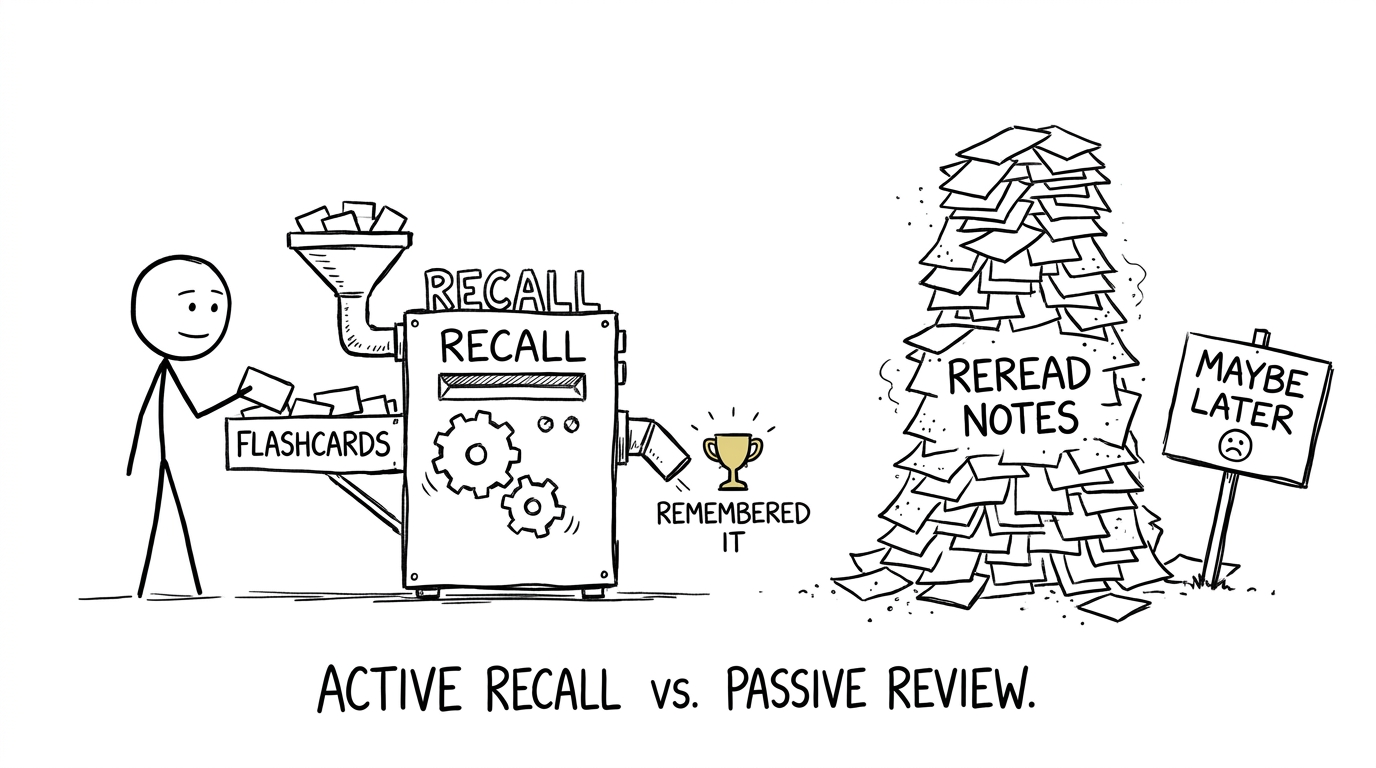 A recall machine producing remembered knowledge while reread notes wait nearby
January to March: turn knowledge into marks
By January, shift the balance towards exam performance. Knowledge is necessary, but Psychology papers also reward selecting relevant material, applying it precisely and sustaining evaluation.
Plan extended responses before writing all of them. A plan should identify the required knowledge, the argument's direction, relevant evidence and how each evaluative point answers the question. Then write selected responses under timed conditions and compare them with the level descriptors in the mark scheme.
Research methods should appear every week. Practise identifying variables, selecting designs and sampling methods, considering reliability and validity, interpreting data and explaining ethical issues. These skills can appear in unfamiliar contexts, so memorising definitions without application is not enough.
At the end of each month, repeat part of your original diagnostic paper using fresh questions. The milestone is not hours completed. It is fewer repeated errors.
The final months: complete full papers
From spring onwards, use timed papers to combine knowledge, judgement and stamina. Begin with individual sections if necessary, then progress to complete papers in the correct time for your current specification.
After each paper:
- mark every response using the official criteria;
- identify where the answer stopped meeting the question;
- rewrite one weak paragraph or response;
- practise several questions testing the same skill;
- revisit that weakness within a week.
Do not use predicted papers as a substitute for full specification coverage. They are useful rehearsal, but any assessable topic may appear. Past papers, question banks and specification checklists should remain the foundation of your A-level Psychology retake revision.
Common mistakes when resitting A-level Psychology
Revising everything equally
A familiar topic can absorb hours because it feels comfortable. Give more time to areas with clear evidence of lost marks while maintaining shorter retrieval practice elsewhere.
Memorising essays word for word
A memorised response may not fit the wording or scenario. Learn accurate content and flexible argument structures instead.
Ignoring the command word
“Outline”, “explain”, “discuss” and “evaluate” require different responses. Underline the command word and scope before planning.
Marking too generously
An idea you intended to communicate cannot earn marks if it is not visible in the answer. Use the mark scheme literally and ask a teacher to moderate occasional responses.
Delaying exam-centre arrangements
Private candidate availability, entry procedures and fees vary. Confirm arrangements early rather than assuming you can enter shortly before the deadline.
A resit is a new process, not a repeat
The useful question after results day is not, “How can I work twice as hard?” It is, “Which actions will recover the marks I missed?”
Start by confirming your result-day options and exam entry. Diagnose your scripts. Rebuild knowledge through retrieval, develop application and evaluation through focused questions, then prove the improvement under timed conditions.
MathsGenie gives you a free route through that process with Psychology revision lessons, flashcards, practice questions, question banks, mark schemes, mini tests, past papers and predicted papers. Choose your board from the A Level Psychology revision resources, then begin with one diagnostic paper and one honest list of weaknesses.











