

A-Level Psychology Remark: Results Day Guide
A-level psychology remark guidance: understand reviews, inspect your script, check 2026 deadlines and decide whether challenging your grade is sensible.
Results day can reduce two years of work to a single, uncomfortable question: was that grade right? If you are considering an A-level psychology remark, speak to your school or college immediately, check how far your total is from the relevant grade boundary and ask whether a psychology teacher can inspect your marked scripts. A review is most sensible when there is credible evidence that the mark scheme was applied incorrectly, not simply because your result was lower than expected.
For the June 2026 series, the awarding-body deadline is 20 August 2026 for a priority A-level review and 24 September 2026 for the standard service. Your centre may set an earlier internal deadline.
Your results-day decision checklist
Before requesting an A-level psychology review of marking, establish:
- your total mark and confirmed grade;
- the boundary for the grade you wanted;
- your mark on each individual paper;
- which paper appears unexpectedly low;
- whether your university place depends on the outcome;
- whether a teacher can inspect your script first;
- the fee, centre deadline and possible outcomes;
- whether you accept that your mark could rise, stay unchanged or fall.
Use the grade boundaries for your own board and exam series. MathsGenie provides dedicated pages for AQA A-level Psychology grade boundaries, Edexcel A-level Psychology grade boundaries, OCR A-level Psychology grade boundaries and Eduqas A-level Psychology grade boundaries.
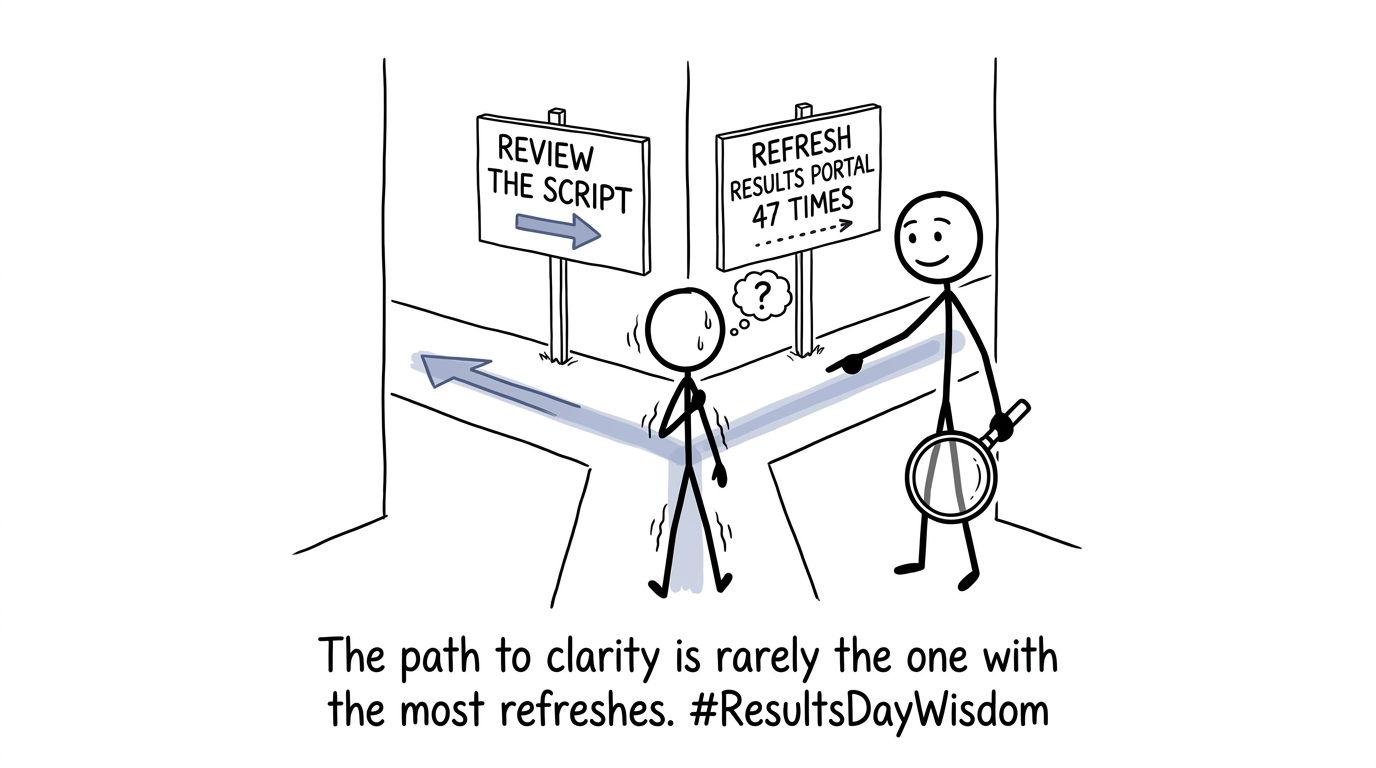 A student choosing between reviewing a script and repeatedly refreshing the results portal
How the A-level psychology re-mark process works
“Remark” is the familiar word, but the official service is a review of marking. The reviewer does not automatically mark the entire paper again from scratch. They check the original marking to decide whether the mark scheme and marking procedures were applied correctly.
This distinction matters in Psychology. Essays and extended responses involve academic judgement. A reviewer cannot add marks merely because another reasonable examiner might have preferred a slightly higher level. The original mark changes when the reviewer identifies a marking or administrative error.
Ask for access to your scripts
Your exams officer can usually request copies of your marked papers. Ask for these promptly, especially if you need to decide before a priority-review deadline.
A Psychology teacher can then look for specific warning signs, such as:
- an answer or additional page that appears unmarked;
- an incorrect total;
- credit apparently missing for relevant knowledge;
- application to a scenario that was not recognised;
- evaluation that appears inconsistent with the published level descriptor;
- an unusually low paper mark compared with your other components.
Long answers should be checked across the assessment objectives used by your specification, rather than judged only by how convincing the essay sounds. Strong evidence is more useful than a general feeling that you “usually get higher marks”.
Choose the relevant paper
Reviews are requested by component, not automatically for the whole qualification. If one paper is substantially weaker than the others, your teacher may recommend reviewing that component alone. If concerns appear across several papers, each requested component may carry a separate fee.
Edexcel students can use the A-level Psychology predicted grade calculator to see how component marks combine. Always compare your official result with the boundary for the same series rather than borrowing a boundary from an earlier year.
Give consent and let your centre submit the request
Normally, your school or college submits the request to the exam board. Written candidate consent is required because the reviewed mark can go down as well as up. Ask your exams officer for the correct form, cost and internal deadline.
Fees vary by board and component. Exam boards commonly waive the review fee when the overall qualification grade changes, but you should confirm the precise policy with your centre before agreeing.
Use the priority service when a place is pending
The priority review is intended for urgent A-level cases, particularly where a higher education place depends on the result. For June 2026, requests must reach the awarding body by 20 August 2026, and the service has a target completion time of 15 calendar days.
Contact your university or college as well as your exams office. Tell the admissions team that a priority review has been requested, but do not assume that the institution must hold your place.
The standard June 2026 review deadline is 24 September 2026, with a target completion time of 20 calendar days. These are awarding-body deadlines; a school may require your decision sooner so that it can process the request.
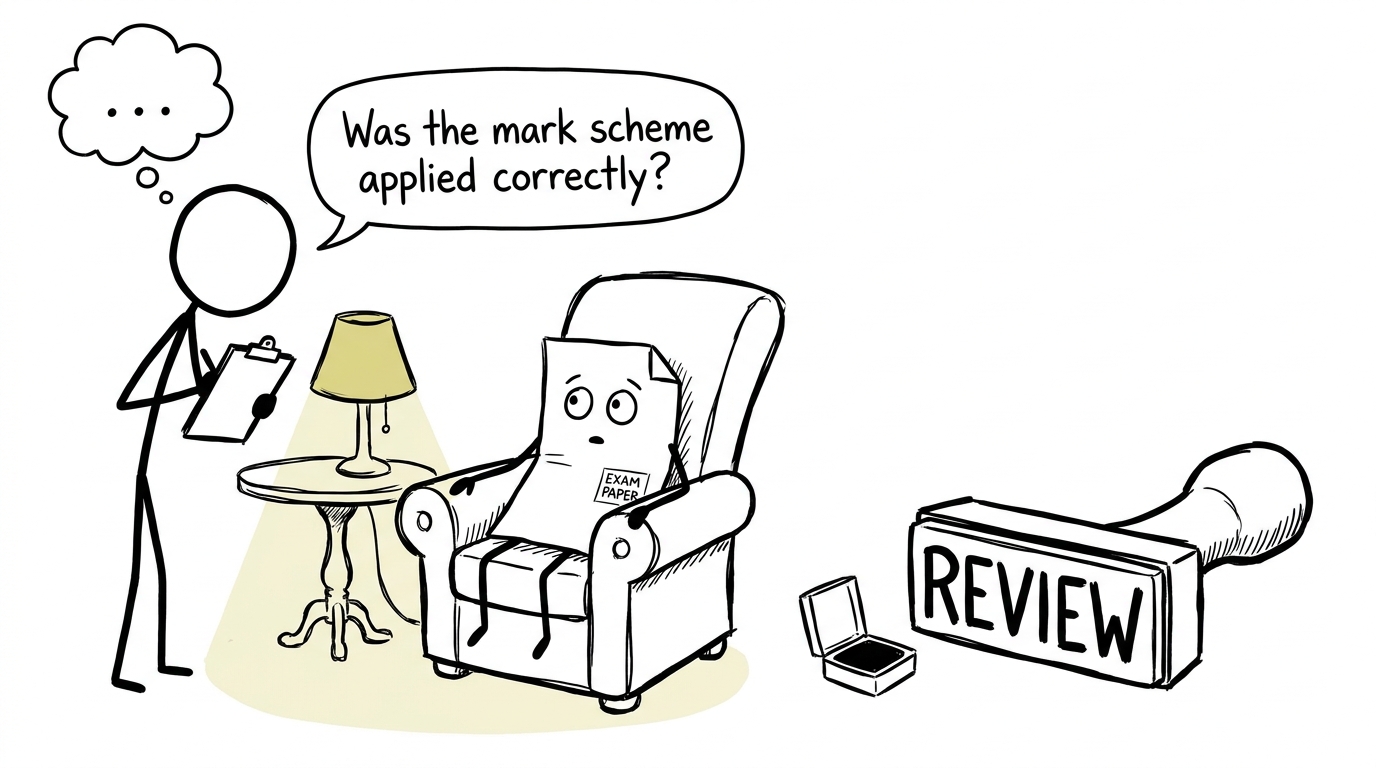 An examiner questioning an exam paper about whether the mark scheme was applied correctly
When requesting a review is reasonable
A review may be worth discussing when you are close to the next boundary and a teacher finds a plausible marking issue. It can also be appropriate when one component is sharply out of line with the rest of your performance.
Being close to a boundary alone is not evidence of an error. Exam boards cannot award an extra mark because a student narrowly missed a grade, received a higher predicted grade or needs the result for university.
The risk also deserves attention. Your component mark could decrease, although your overall grade may remain unchanged if there is enough distance from the lower boundary. Make the decision using both boundaries, the script and informed subject advice.
Appealing an A-level psychology grade
An appeal is not the first stage of challenging a result. Your centre would normally request a review of marking before appealing. If it then believes the review contained a procedural or marking error, it can submit an appeal within the applicable deadline, generally 30 calendar days after the review outcome.
Appeals cannot challenge the grade boundary itself. They need identifiable grounds, so keep the outcome letter and ask your teacher and exams officer whether the evidence supports taking the case further.
Common mistakes to avoid
- Calling it a guaranteed re-mark: it is a review of whether the original marking was correct.
- Missing the centre deadline: schools often close requests before the official exam-board date.
- Reviewing every paper automatically: target the component where there is credible concern.
- Relying only on predicted grades: predictions do not prove a marking error.
- Ignoring the downside: written consent is required because marks and grades can fall.
- Using last year’s boundary: boundaries can change between exam series.
- Confusing a review with an appeal: the appeal stage normally follows the review outcome.
Make the decision with evidence, not panic
A result can feel final before you have had time to understand it. It is not always unchangeable, but the best decisions are calm and specific: obtain the marks, check the correct boundary, inspect the script and ask whether there is evidence of error.
Start with MathsGenie’s Psychology grade-boundary posts for AQA, Edexcel, OCR or Eduqas. If maths is also part of your next step, explore MathsGenie’s free GCSE and A-level maths revision for revision lessons, practice questions, past papers, predicted papers, mini tests, mark schemes and video solutions.











