A-Level Psychology Lower Grade: Your Next Steps
A-level psychology lower grade than expected? Follow a calm results-day plan covering reviews of marking, Clearing, resits and focused revision.
Opening an A Level result can shrink two years of work into one letter. If you received an A-level psychology lower grade than expected, pause before making a permanent decision in a temporary emotional state. Check your university application, speak to your school or college, and compare your marks with the published grade boundaries. Your main options are a review of marking, UCAS Clearing, accepting an alternative offer, or retaking Psychology.
A disappointing result matters, but it does not define your ability or close every route. The useful question now is not, "What does this grade say about me?" It is, "Which next step gives me the best realistic outcome?"
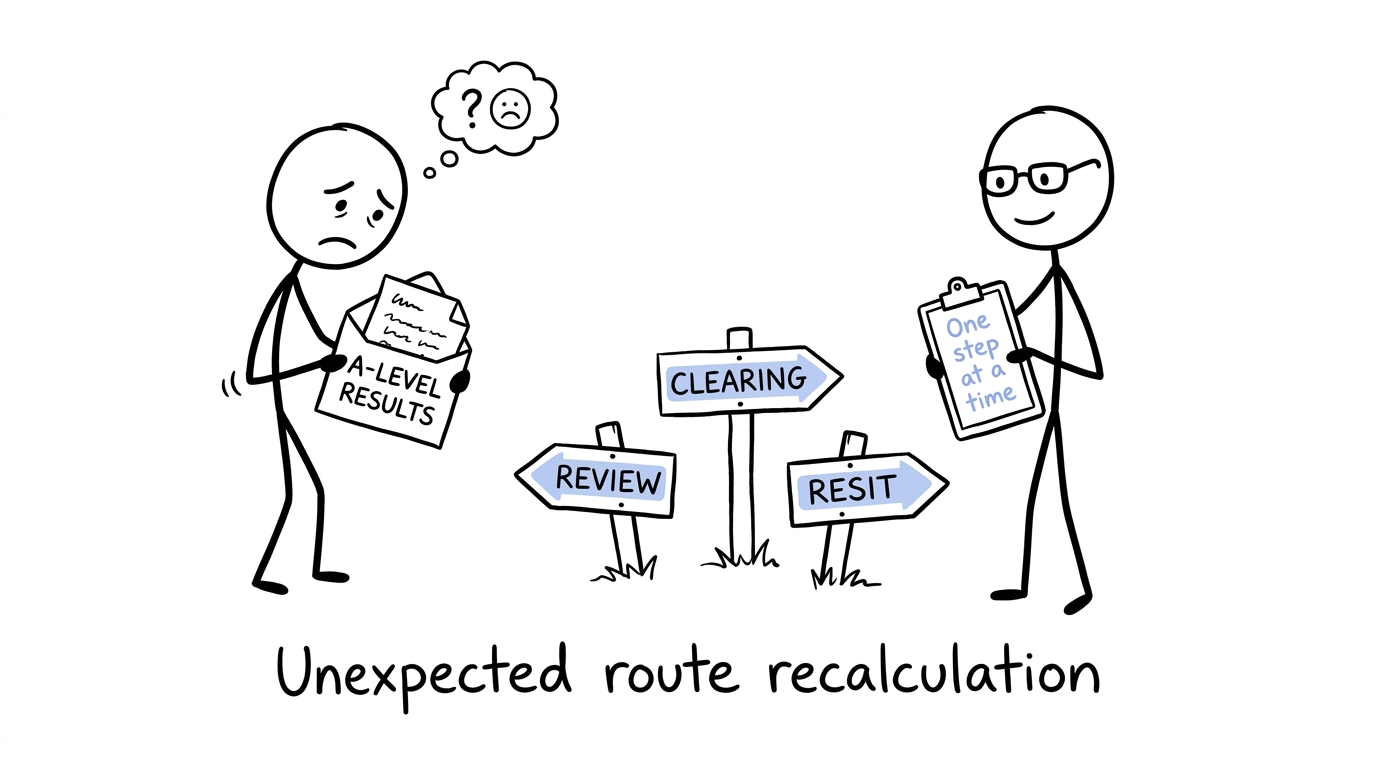 A student discovering that an unexpected result can lead to several routes
Your immediate results-day checklist
Work through these actions in order:
- Check your status in the UCAS Hub before assuming that you have lost your place.
- Collect your component marks from your school or college.
- Compare those marks with your exam board's official grade boundaries.
- Ask your Psychology teacher whether any paper appears unexpectedly low.
- Contact your firm or insurance university if your decision is pending.
- Speak to the exams officer about scripts and reviews of marking.
- Explore Clearing without accepting the first available course.
- Consider a resit only after reviewing the other routes.
In 2026, A Level results day is Thursday 13 August. Official guidance says awarding organisations aim to complete priority reviews by 3 September, but a university is not automatically required to hold a place while you wait. Contact its admissions team immediately if a review could affect your offer.
Check what your result changes
A lower Psychology grade creates different problems for different students. It may mean that you missed a university condition, fell below a personal target, or simply performed less well in one paper than expected.
First, check UCAS. Universities sometimes accept applicants who narrowly miss an offer, or they may propose a related course. If your application is still pending, call the admissions team rather than releasing yourself into Clearing. Ask whether it needs your marks, whether it will reconsider you, and whether it can wait for a priority review.
If your place is already confirmed, think carefully before changing direction. An underwhelming Psychology result may feel painful without actually preventing your preferred next step.
Decide whether to request a review of marking
The term "remark" is widely used, but the formal service is usually called a review of marking. It checks whether the original marker applied the mark scheme correctly. It is not an instruction to award extra marks because your predicted grade was higher.
Ask your teacher to look at the component results and, where possible, obtain the script. A review may be worth considering when:
- one paper is strikingly inconsistent with your other papers;
- you are close to the next grade boundary;
- your teacher identifies answers where the mark scheme may not have been applied correctly;
- a higher grade could secure a university place.
For the June 2026 series, the JCQ deadline for an A Level priority review of marking is 20 August 2026. The standard review deadline is 24 September 2026. Your school may set an earlier internal deadline, so contact its exams officer promptly.
You must provide written consent because your mark and final grade can rise, remain unchanged, or fall. There may also be a fee. Ask your centre about its process and the charges for your exam board rather than relying on figures from another school.
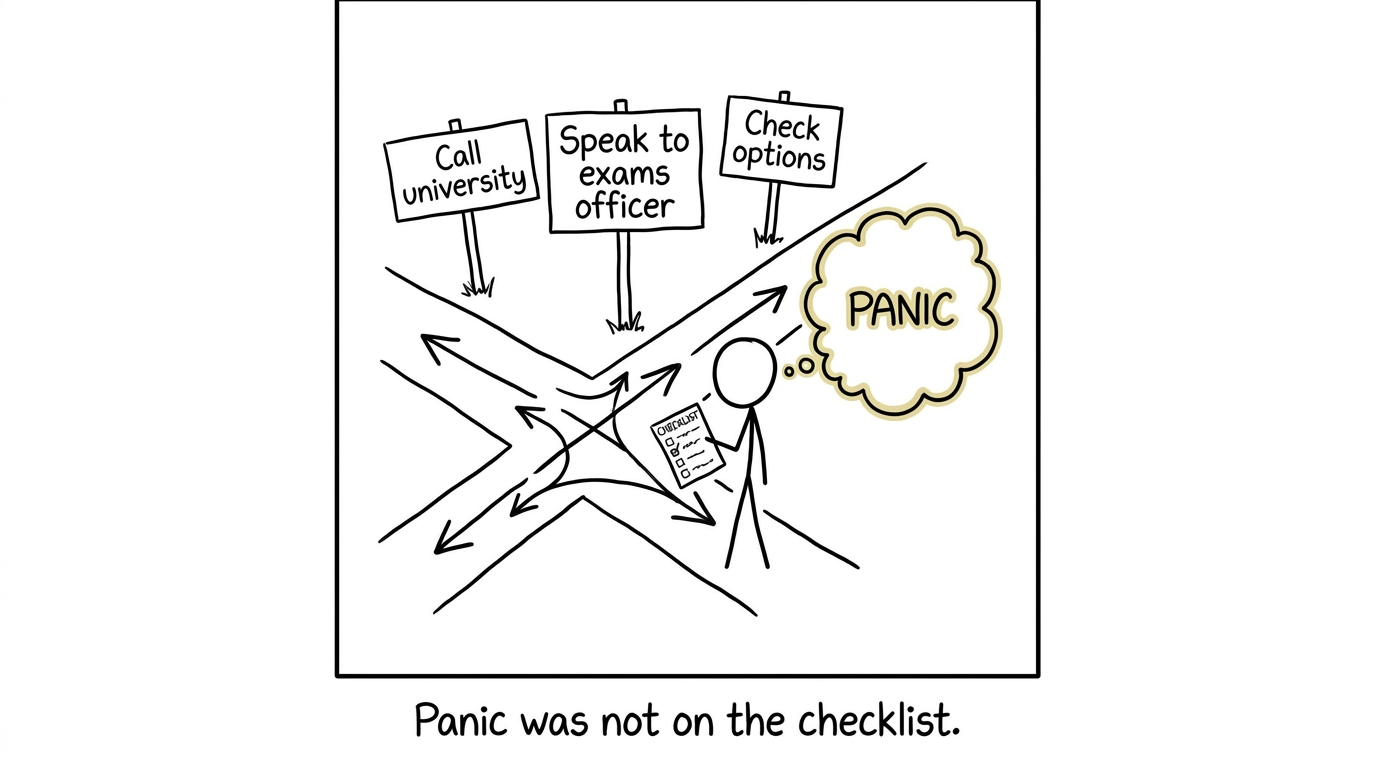 A calm results-day checklist sending the panic cloud away
Use Clearing as a considered choice
Clearing is not a lesser version of university admission. It is the official UCAS process through which universities fill remaining places.
Search for courses that you would genuinely be willing to take. Compare the modules, assessment methods, professional accreditation where relevant, location, accommodation and entry requirements. Psychology degrees can differ considerably in their balance of research methods, biological psychology, social psychology and optional modules.
Contact a university before adding a Clearing choice. UCAS guidance says you should obtain permission or an informal offer first. You may contact several institutions, but you can add only one Clearing choice at a time. Once that choice is confirmed, it becomes your accepted place.
Prepare your UCAS Personal ID, Clearing number, results and a few questions before calling. Explain your interest in the course rather than concentrating only on the grade you missed.
Consider retaking A Level Psychology
A resit can be sensible when the grade blocks a clear goal and you believe another exam series, supported by a different revision method, could produce a stronger result. It should be a plan, not a reflex.
Ask your school or an approved exam centre:
- whether it accepts former students or private candidates;
- which specification you will enter;
- whether you must retake every written paper;
- what teaching or feedback will be available;
- what entry and centre fees apply;
- whether your intended universities accept resit applicants for that course.
Most current A Levels are linear, so a Psychology retake normally involves entering the full qualification and sitting its required papers again. Confirm the exact rules with your exam board and centre.
Specification changes make this especially important. AQA introduced updated Psychology content for first teaching from September 2025, with the first full A Level examinations on the updated specification in summer 2027. A student resitting AQA Psychology in 2027 should therefore check the updated specification rather than automatically reusing an old topic list.
Start with MathsGenie's free A Level Psychology revision resources, where you can select AQA, Edexcel, Eduqas, OCR or WJEC resources. Use the relevant lessons, revision guides, worksheets, question banks and past papers instead of revising from memory alone.
Turn the disappointing result into useful evidence
A retake plan should begin with diagnosis. Separate your lost marks into four categories:
- Knowledge: key studies, theories or terminology were missing.
- Application: knowledge was not connected closely enough to the scenario.
- Evaluation: discussion lacked development, evidence or balance.
- Exam execution: timing, question interpretation or answer structure reduced the mark.
Build a weekly schedule with the MathsGenie revision planner. Alternate content recall with timed exam questions, then compare every answer with the mark scheme. Past papers should produce a list of weaknesses, not merely another score.
Research methods also require confidence with data, percentages, graphs and interpretation. If these skills caused problems, use the GCSE Maths revision hub to repair foundations or the A Level Maths revision hub for more advanced statistical confidence. Students taking A Level Maths alongside a resit can use the Edexcel A Level revision tools or AQA A Level Maths resources.
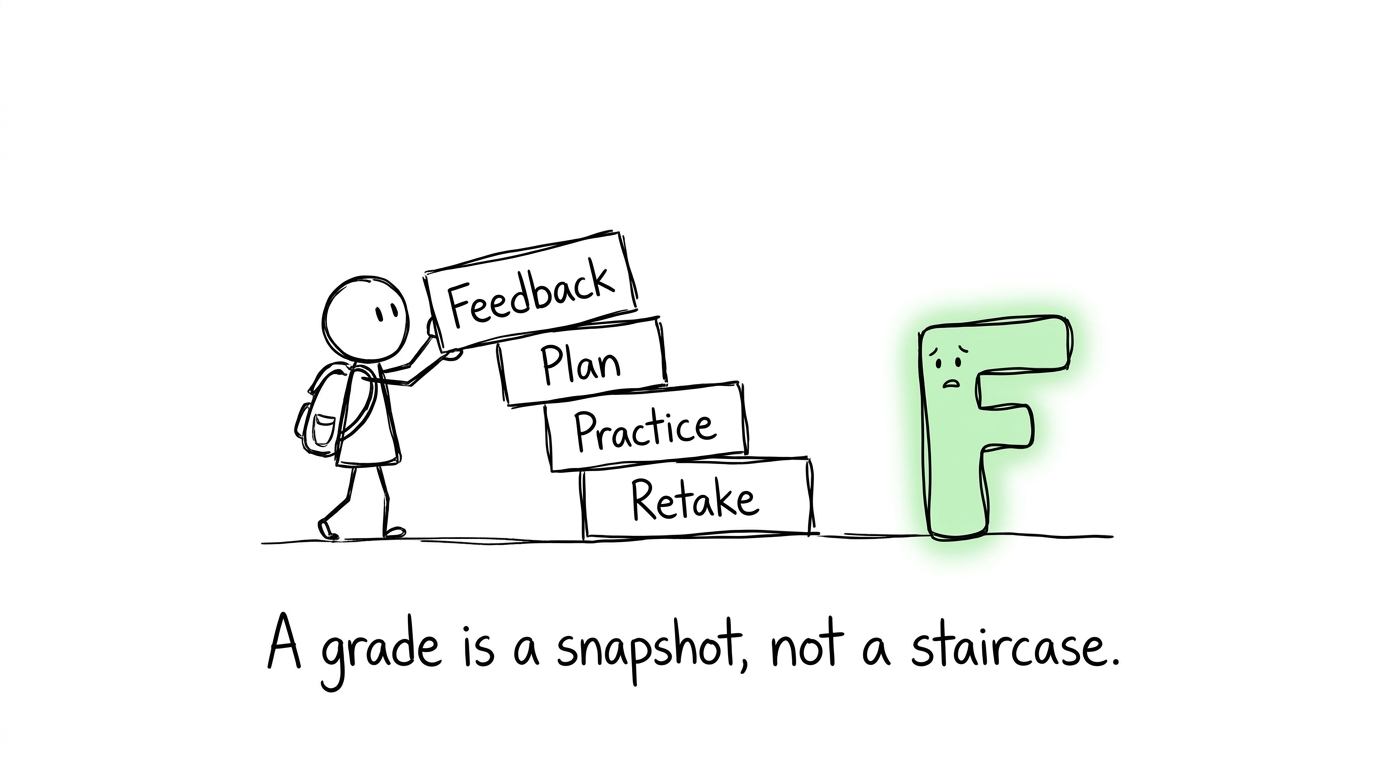 A student building a stronger route from feedback, planning and practice
Common mistakes after a disappointing result
Acting before checking UCAS
A missed grade does not always mean a rejected application. Read your status and contact the university before surrendering a place.
Requesting every paper for review
A review makes most sense when component marks, the boundary and teacher judgement provide a reason. Remember that grades are not protected.
Treating Clearing as a race
Vacancies can move quickly, but accepting an unsuitable course creates a larger problem. Investigate the course before adding it as your choice.
Retaking with the same revision method
More hours do not automatically correct weak evaluation, poor timing or passive rereading. Use feedback, mark schemes and timed practice to change the process.
Using the wrong specification
Confirm your exam board and resit specification before buying materials or building a topic list. This is particularly important where content has changed.
Your result is information, not identity
An A-level psychology disappointing result deserves an honest response, not a panicked one. Check its practical effect, investigate a review, speak to universities, explore Clearing carefully and consider a resit with full knowledge of the commitment.
For your A-level psychology next steps, begin with the A Level Psychology revision hub. If a resit is right for you, combine specification-matched revision lessons with practice questions, past papers, mark schemes and regular timed work. MathsGenie gives you the free resources to turn one difficult results day into a clearer, better-prepared next attempt.