

A-Level Psychology Grade Boundaries: Results Day 2026
A-level psychology grade boundaries explained for 2026 results day: learn how total marks become grades, when boundaries appear and what to do next.
Results day has a strange kind of suspense. The exams ended weeks ago, yet one question can keep circling: was my mark enough? The short answer is that a-level psychology grade boundaries are the minimum total marks needed for each grade. They are set after papers have been marked and, for summer 2026, will be published on results day rather than confirmed in advance.
In England, A-level results day is Thursday 13 August 2026. Until then, any claimed psychology A-level grade boundaries for 2026 are estimates, not official thresholds.
A-level psychology results day checklist
Before interpreting your result, check:
- your exam board and specification code;
- your final qualification grade;
- any component marks supplied by your school or college;
- the official overall subject boundaries for your specification;
- whether a paper-level boundary is only described as notional;
- the next step required by your university, college or employer.
AQA, Pearson Edexcel, OCR and Eduqas set separate boundaries because their papers, mark totals and assessment structures differ. Never compare your AQA total directly with an OCR or Edexcel boundary.
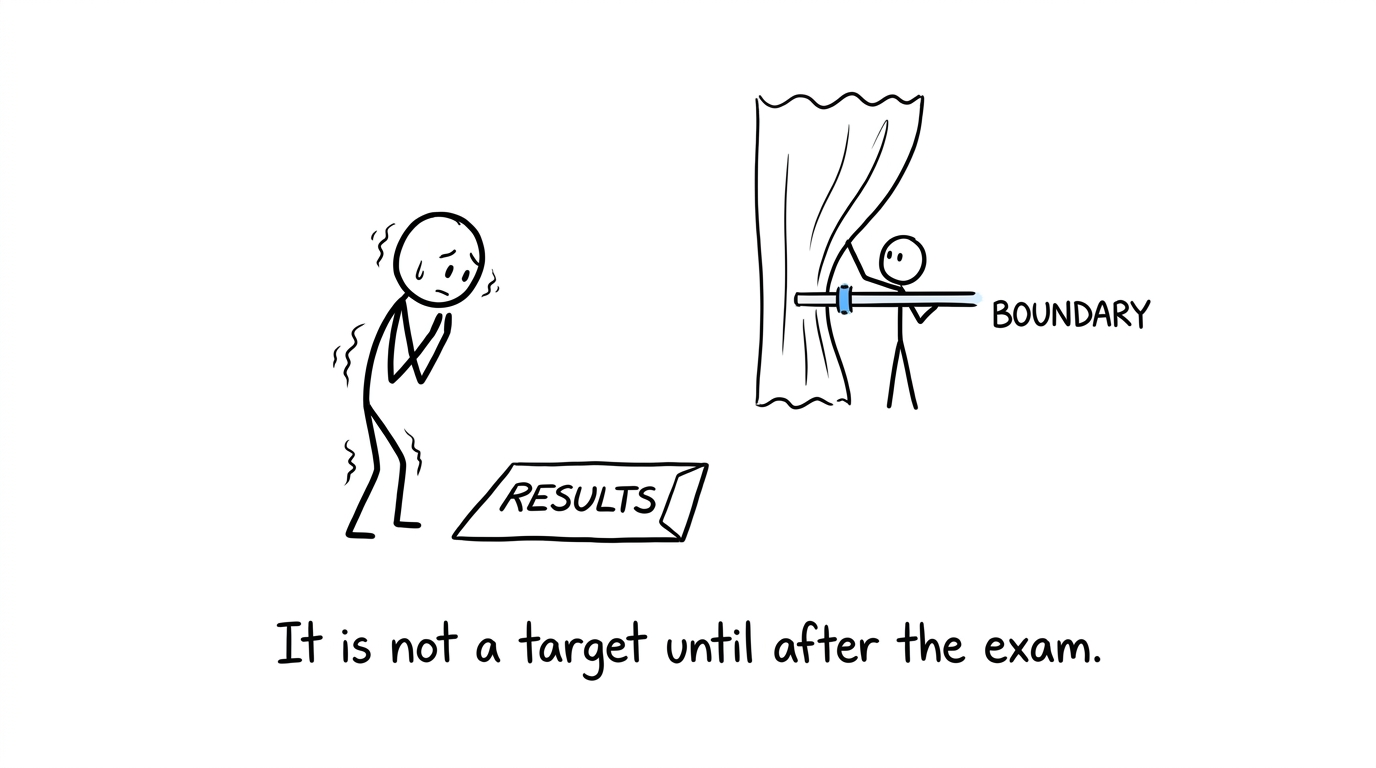 A student waiting while an examiner adjusts a grade boundary
How A-level psychology grade boundaries work
A grade boundary is a cut-off mark. If the boundary for a grade were 190190190, a total of 190190190 would receive that grade, while 189189189 would fall into the grade below.
Boundaries are not designed to make a fixed percentage of students pass or fail. Ofqual confirms that there are no grade quotas. Instead, exam boards use statistical evidence, comparisons with previous years and reviews of students’ work to maintain a comparable standard.
This explains why boundaries move. A more demanding set of papers may lead to lower boundaries; more accessible papers may lead to higher ones. The grade standard is intended to remain comparable even when the raw mark needed changes.
Your overall total matters most
A linear A Level is awarded using performance across the complete qualification. Your marks from the required papers are combined and compared with the overall boundary.
For example, AQA Psychology specification 718271827182 has three papers worth 969696 marks each, producing a maximum total of:
96+96+96=28896+96+96=28896+96+96=288Each paper contributes approximately 33.3%33.3\%33.3% of the qualification. Pearson Edexcel and OCR use different maximum marks and paper weightings, so always use the table for your own specification.
Exam boards may also publish notional component boundaries. These help describe performance on an individual paper, but the paper does not normally receive a separate qualification grade. A weaker paper can be balanced by stronger marks elsewhere.
 Three psychology papers joining into one results envelope
Worked grade boundary example
Imagine an AQA Psychology student receives these marks:
- Paper 1: 676767 marks
- Paper 2: 616161 marks
- Paper 3: 656565 marks
Their overall total is:
67+61+65=19367+61+65=19367+61+65=193Now suppose an illustrative boundary table shows these fictional figures for explaining the method, not predicted 2026 boundaries:
| Grade | Minimum mark |
|---|---|
| A | 194 |
| B | 170 |
Because:
170≤193<194170\leq193<194170≤193<194the student receives a B. They are one mark below the A boundary, even though one paper might have reached a notional A threshold.
You can also express the total as a percentage:
193288×100≈67.0%\frac{193}{288}\times100\approx67.0\%288193×100≈67.0%However, the exam board compares the actual mark of 193193193 with the published raw or scaled boundary. It does not simply apply a permanent percentage rule.
If interpreting percentages feels less familiar, MathsGenie’s GCSE percentages revision guide explains the underlying calculation clearly.
What to expect from psychology A-level grade boundaries 2026
The exact 2026 boundaries cannot responsibly be predicted before awarding is complete. Previous boundaries can provide context, but they are not targets or promises.
When the tables appear, use this process:
- find your exam board;
- check the correct specification code;
- locate the overall qualification row;
- compare your total mark with each minimum boundary;
- treat component boundaries as guidance unless the board states otherwise.
Do not panic if your percentage sounds lower than the percentage you associate with that grade in school assessments. A-level grades are awarded using the boundaries for that particular examination series, not a universal classroom percentage scale.
What to do after receiving your result
First, pause. A grade is important, but it is only useful once connected to the next decision.
If you have met your offer or progression requirement, follow the instructions from your university, college or employer. If you have missed a required grade, speak to your school or college promptly. Staff can help you understand your marks, contact institutions and explain which post-results services may be appropriate.
If you are continuing with psychology, avoid revising everything indiscriminately. Start with evidence. Identify whether marks were lost through knowledge, application, evaluation, research methods or extended writing.
MathsGenie’s AQA A Level Psychology revision hub brings together lessons, exam-style questions, worksheets, past papers, mark schemes and revision tools. The AQA Psychology revision guides provide topic-by-topic explanations matched to the specification.
For quantitative skills, use the Edexcel Psychology research methods guide. Students wanting deeper statistical practice can also explore hypothesis testing revision and variance and standard deviation.
Common mistakes when reading grade boundaries
Using another exam board’s figures
An OCR total cannot be interpreted using an AQA table. Check the board and specification code before looking at any marks.
Treating past boundaries as confirmed predictions
Last year’s thresholds show what happened after last year’s papers. They do not reveal the 2026 boundaries.
Adding notional paper grades
Three notional B grades do not mechanically produce a B. Add the marks, applying any stated scaling, and compare the total with the qualification boundary.
Confusing a boundary with an average
A boundary is the minimum mark for a grade. It is not the average mark achieved by everyone receiving that grade.
Focusing only on the percentage
Percentages are useful for understanding scale, but the published mark threshold decides the result. Check whether the exam board reports raw or scaled marks.
Turn the result into a useful next step
A-level psychology results day can make one mark feel enormous. Yet the boundary is only a line used to translate a body of work into a grade. Understand the line first, then decide what the result requires from you.
Use MathsGenie’s free A Level Psychology revision guides to review specific topics, then test your understanding with practice questions, mini tests, past papers, predicted papers, mark schemes and video solutions. Calm, targeted revision remains more valuable than guessing where a future boundary might sit.











