

A-Level Psychology Grade Boundaries History: 2017-25
A-level psychology grade boundaries history from 2017 to 2025, with AQA marks, pandemic context and practical advice for using past papers wisely.

A grade boundary can look like a fixed target. Then you open another year’s mark scheme and discover that it has moved.
That is the central lesson from A-level psychology grade boundaries history: boundaries change because exam papers and cohort performance change. They are not decided before students sit the examination. For AQA Psychology, the mark needed for an A has ranged from 177177177 to 198198198 out of 288288288 across the summer examination years from 201720172017 to 202520252025.
If you are a GCSE student considering Psychology, or a teacher analysing past results, use these figures as context rather than a prediction.
Grade boundary checklist
Before comparing years, remember:
- The table below covers AQA A-level Psychology specification 718271827182.
- AQA awards the qualification from a total of 288288288 marks.
- A boundary is the minimum mark required for that grade.
- Summer examinations did not take place in 202020202020 or 202120212021.
- Boundaries from different exam boards are not directly interchangeable.
- A future boundary cannot be known until marking and awarding are complete.
Students can find papers matching these years in the AQA A-level Psychology past papers collection.
Past A-level Psychology grade boundaries
The following figures come from AQA’s published subject-level boundary tables. Percentages are rounded to one decimal place and are included only to make comparisons easier.
| Year | Maximum mark | A* | A | B | C | D | E | A boundary as a percentage |
|---|---|---|---|---|---|---|---|---|
| 201720172017 | 288288288 | 217217217 | 193193193 | 164164164 | 135135135 | 106106106 | 787878 | 67.0%67.0\%67.0% |
| 201820182018 | 288288288 | 214214214 | 190190190 | 161161161 | 132132132 | 104104104 | 767676 | 66.0%66.0\%66.0% |
| 201920192019 | 288288288 | 205205205 | 181181181 | 152152152 | 123123123 | 959595 | 676767 | 62.8%62.8\%62.8% |
| 202020202020 | No summer examinations | N/A | N/A | N/A | N/A | N/A | N/A | N/A |
| 202120212021 | No summer examinations | N/A | N/A | N/A | N/A | N/A | N/A | N/A |
| 202220222022 | 288288288 | 202202202 | 177177177 | 143143143 | 109109109 | 757575 | 424242 | 61.5%61.5\%61.5% |
| 202320232023 | 288288288 | 219219219 | 194194194 | 159159159 | 124124124 | 909090 | 565656 | 67.4%67.4\%67.4% |
| 202420242024 | 288288288 | 220220220 | 196196196 | 163163163 | 130130130 | 979797 | 646464 | 68.1%68.1\%68.1% |
| 202520252025 | 288288288 | 222222222 | 198198198 | 163163163 | 128128128 | 949494 | 606060 | 68.8%68.8\%68.8% |
These are qualification boundaries, not targets for individual papers. Notional paper boundaries can help teachers assess mocks, but the final grade is based on the total mark across the qualification.
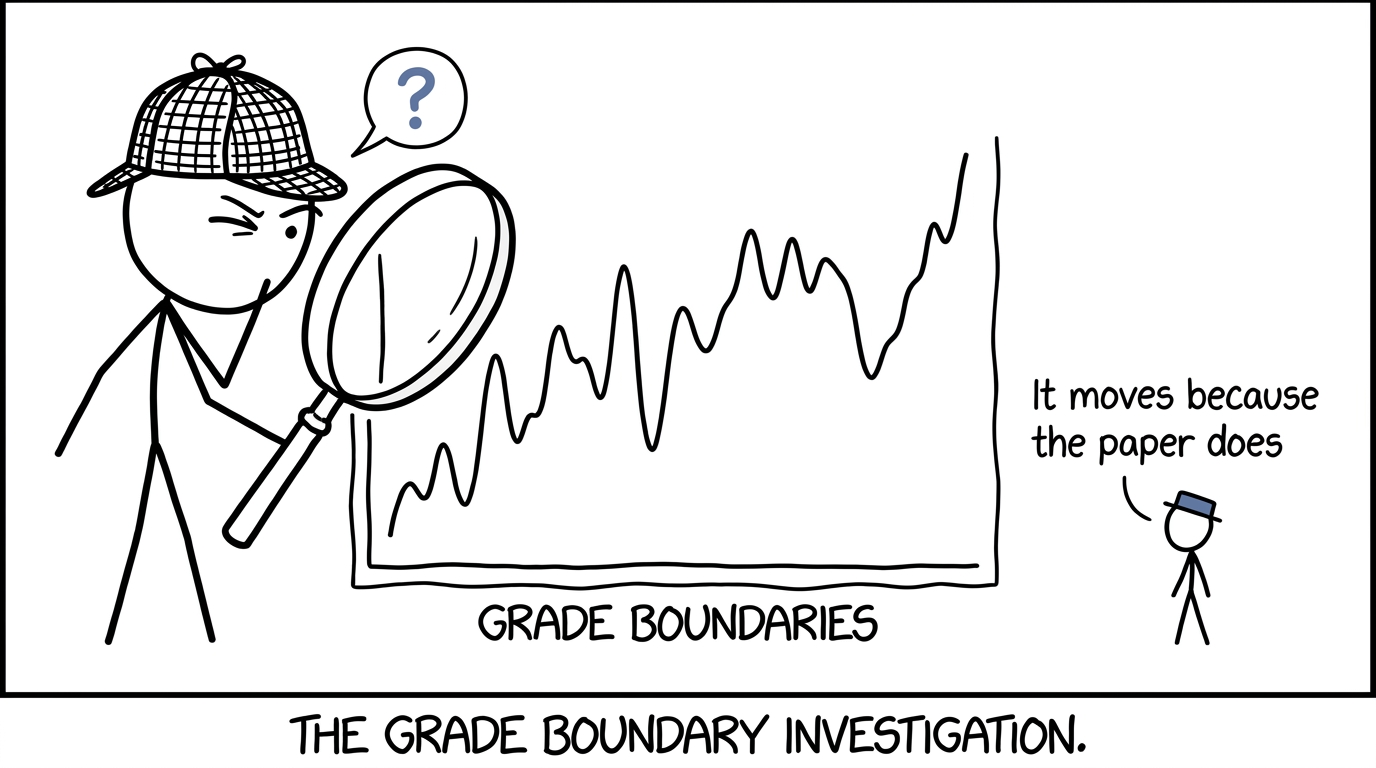 A student detective investigating a moving grade-boundary chart
What the year-by-year changes show
From 2017 to 2019
The A boundary fell from 193193193 marks in 201720172017 to 181181181 in 201920192019. The A* boundary also fell, from 217217217 to 205205205.
That does not prove that Psychology became easier or that standards fell. A lower raw boundary usually indicates that students found the particular assessments more demanding, although awarding decisions consider evidence beyond a simple judgement about difficulty.
The disruption of 2020 and 2021
There were no summer A-level examinations in England in 202020202020 or 202120212021. Grades were awarded through exceptional arrangements, so there are no normal summer boundaries to place beside 201920192019.
Autumn examination series existed for some candidates, but those boundaries describe unusually small and unrepresentative entries. Treating them as ordinary summer data would distort the trend.
The transitional year of 2022
Examinations returned in 202220222022, but Ofqual used a transitional grading approach. National outcomes were intended to sit broadly between 201920192019 and the more generous teacher-assessed outcomes of 202120212021.
For AQA Psychology, an A required 177177177 marks, the lowest summer A boundary in this table. Ofqual later advised schools not to use exceptional pandemic-era boundaries as the main basis for indicative grades under normal arrangements.
The return towards normal grading
In 202320232023, grading returned to pre-pandemic standards, with protection recognising national disruption. The A boundary rose sharply to 194194194, while A* rose to 219219219.
The boundaries then moved more gently: an A required 196196196 in 202420242024 and 198198198 in 202520252025. This recent rise is real, but three years do not establish a dependable forecast. The next paper may be more or less accessible.
Understanding A-level Psychology grade boundary trends
The safest conclusion is not that boundaries always rise. It is that raw marks respond to each examination series.
Between the lowest and highest A boundaries shown, the difference is:
198−177=21 198-177=21 198−177=21That is substantial enough to make a predicted boundary unreliable. Yet the underlying grade standard is intended to remain comparable. Senior examiners review students’ work and statistical evidence before confirming where boundaries should sit.
Different boards must also be kept separate. Edexcel, OCR and Eduqas use their own specifications, assessment structures and totals. A raw AQA mark cannot be transferred to another board by comparing percentages alone.
For AQA preparation, begin with the A-level Psychology revision hub, revisit uncertain content through AQA Psychology revision lessons, then practise weak areas in the topic question bank.
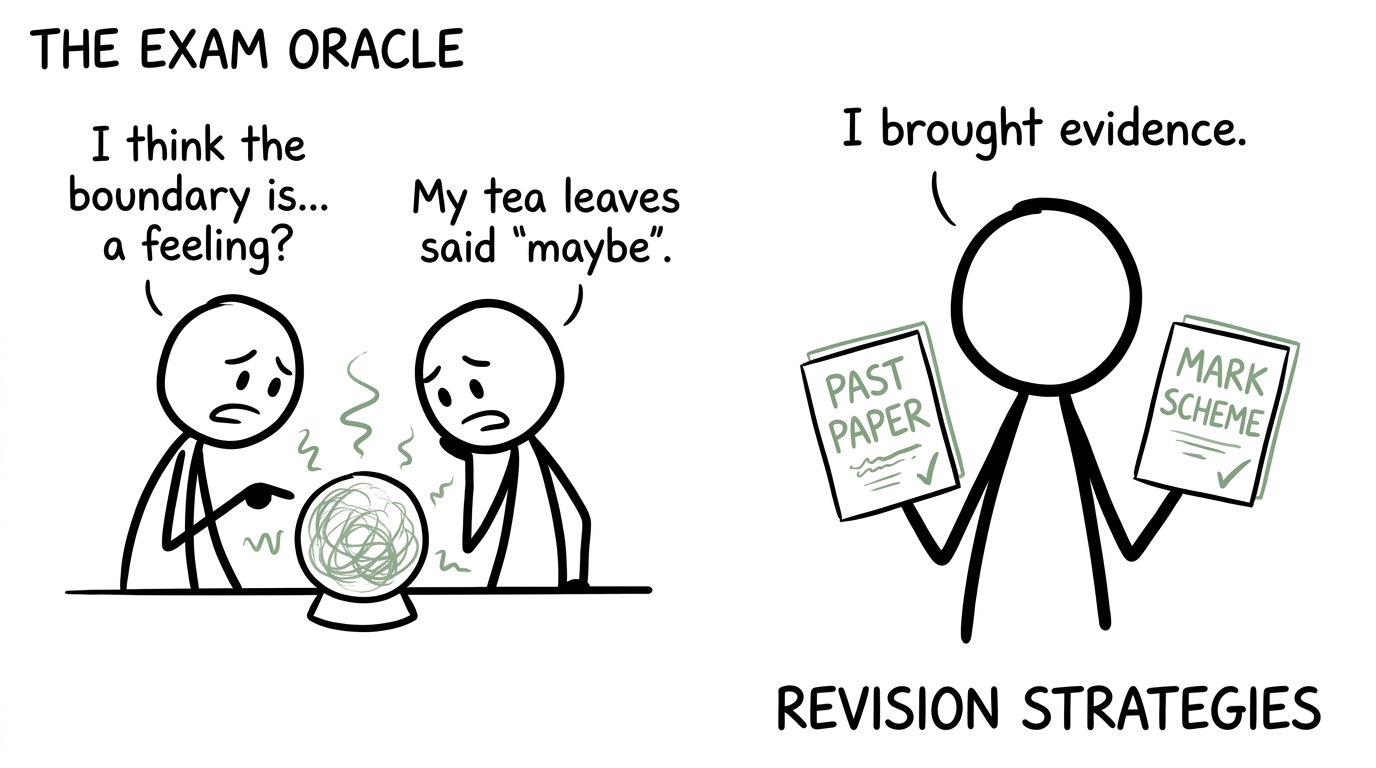 Students choosing between a crystal ball and evidence from past papers
How to use boundaries in revision
A boundary is most useful after completing a paper, not before it.
Complete one paper under timed conditions, mark it carefully, and record lost marks by topic and assessment objective. Use the historical boundary only as a rough snapshot of performance on that specific paper. Then repair the underlying weaknesses with lessons and practice questions.
GCSE students can develop the same habit now. The GCSE Maths revision hub brings together board-specific lessons and questions, while GCSE predicted papers offer further exam-style practice. The principle is identical: a score is information, not a verdict.
Common mistakes when interpreting boundaries
- Predicting the next boundary from one year: each paper produces new evidence.
- Mixing boards: AQA, Edexcel, OCR and Eduqas assessments are not equivalent.
- Using notional paper boundaries as final grades: only the total qualification boundary determines the award.
- Treating pandemic years as normal: 202020202020, 202120212021 and the transitional arrangements of 202220222022 need context.
- Chasing the exact boundary: aiming only for last year’s minimum leaves no margin for marking errors or annual movement.
- Converting marks to percentages carelessly: always divide by the correct maximum mark.
Build evidence, not predictions
The history of past A-level Psychology grade boundaries is useful because it removes a comforting illusion: nobody can know the next boundary in advance. What you can know is where marks were lost, which topics need attention and how the mark scheme rewards a response.
Start with MathsGenie’s AQA A-level Psychology past papers. Complete a paper, use its mark scheme, return to the revision lessons and practise targeted questions. Past papers and predicted papers are most valuable when they lead to a specific improvement; not another guess about a moving line.











