

A-Level Politics Career Paths After Results Day
A-level politics career paths explained: match your results to realistic degrees, apprenticeships and jobs, plus calm results-day advice for students.
Results day has a strange habit of making one envelope feel like a complete verdict on your future. It is not. A-level politics career paths stretch across government, law, journalism, communications, business, charities and education. Your grade may affect your immediate options, but it does not assign you a permanent destination.
The useful question is not simply, “What job can I get with Politics?” It is, “Which route now gives me the best chance to build the skills that job requires?” That route might be a degree, an apprenticeship, entry-level work or a planned year gaining experience.
For students looking further ahead from GCSE, there is another lesson here: keeping English and maths secure matters. Many courses, apprenticeships and employers ask for GCSE passes in both subjects, even when the eventual career is centred on politics.
Your results-day checklist
Before making a decision:
- Check your UCAS Hub before assuming that a missed grade means a lost place.
- Read the exact conditions attached to your firm and insurance offers.
- Speak to your school or college adviser before declining a confirmed place.
- Compare course modules, placement opportunities and costs, not only university names.
- Search current apprenticeship vacancies because availability changes throughout the year.
- Separate disappointment about a grade from the quality of the alternatives available.
For 2026 applicants, A-level results day is Thursday 13 August. UCAS sends most results to universities, which then confirm their decisions. If you do not hold a place, Clearing can connect you with courses that still have vacancies.
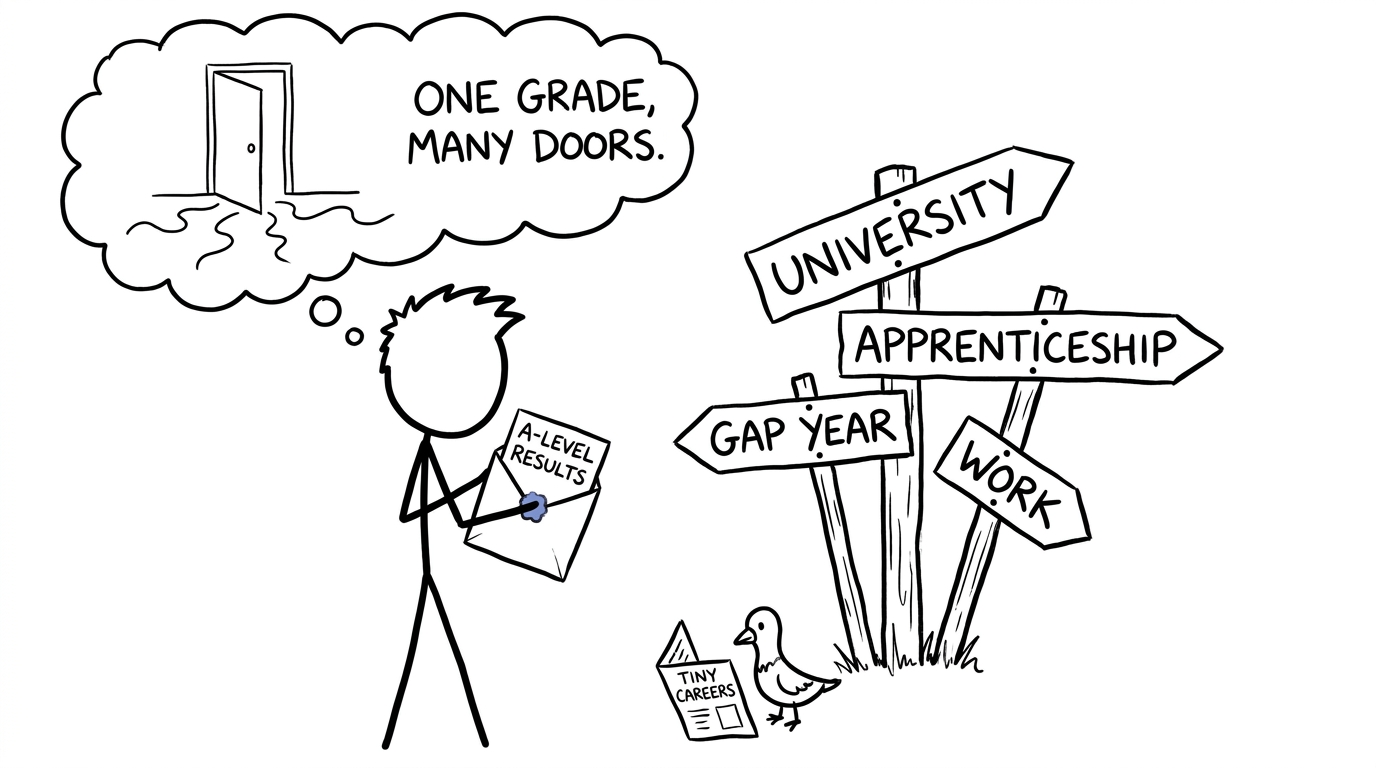 A student discovering several sensible routes after results day
What does A-level Politics prepare you to do?
Politics develops knowledge of institutions, elections, political ideas and competing arguments. More broadly, it asks you to research evidence, recognise bias, compare interpretations and reach a justified conclusion.
Those abilities are useful well beyond Parliament. They support work involving policy, people, law, public information and organisational decisions. Politics also teaches an important professional habit: understanding why reasonable people may interpret the same evidence differently.
Your grade is evidence of performance in one qualification. It is not a professional licence. Most jobs after A-level Politics require further training, experience or both.
Career and course pairings to consider
Government and public policy
Possible courses: Politics, public policy, international relations, economics or a joint honours degree.
Possible careers: policy officer, parliamentary researcher, local government officer, Civil Service manager or public affairs adviser.
Policy work can involve gathering evidence, consulting affected groups, drafting briefings and evaluating whether a policy works. University is one route, but not the only one. The Civil Service also recruits apprentices, including into policy and administration pathways when vacancies are available.
Strong numerical confidence helps here. Budgets, polling data and public statistics cannot be understood through persuasive writing alone. GCSE students can build that foundation through the free GCSE Maths revision hub, covering Edexcel, AQA, OCR, Eduqas, WJEC and CCEA resources.
Law and legal services
Possible courses: Law, politics and law, history, philosophy or another degree followed by professional qualification.
Possible careers: solicitor, barrister, paralegal, legal executive or compliance officer.
Politics is relevant because law is created, interpreted and challenged within political institutions. However, an A-level in Politics does not itself qualify you to practise law. Solicitors must complete the required professional route, including the Solicitors Qualifying Examination and qualifying work experience. Solicitor degree apprenticeships provide another possible pathway.
Entry requirements vary considerably between providers, so check every course rather than relying on a general grade range.
Journalism and political communications
Possible courses: Journalism, politics, media, English or communications.
Possible careers: journalist, researcher, press officer, campaign assistant, communications officer or public relations executive.
This route suits students who enjoy turning complicated events into accurate, accessible explanations. Journalism apprenticeships also exist, while government and other organisations recruit communications apprentices when schemes open.
The strongest candidates do more than hold opinions. They verify claims, meet deadlines and write for a defined audience.
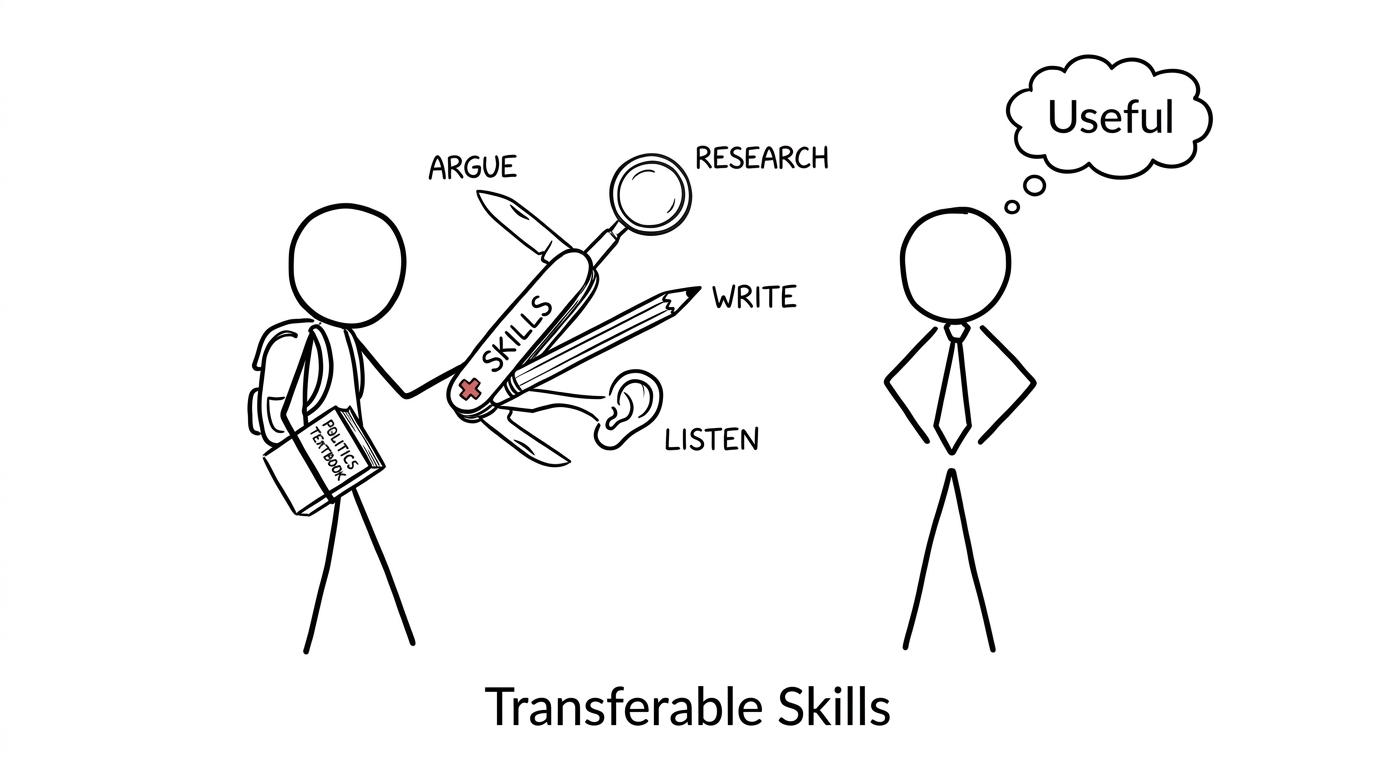 A Politics student revealing a Swiss-army knife of transferable skills
International relations and the charity sector
Possible courses: International relations, politics, development studies, languages or social policy.
Possible careers: charity campaigns officer, NGO researcher, humanitarian programme assistant or international policy analyst.
Languages, volunteering and experience of working with different communities can strengthen this route. Some international roles are highly competitive and may eventually require postgraduate education, specialist knowledge or substantial experience.
Business, research and education
Possible courses: Business management, economics, politics, sociology or education.
Possible careers: market researcher, management consultant, human resources officer, teacher or social researcher.
Politics students learn to analyse stakeholders and explain why institutions behave as they do. Those habits transfer naturally into organisations. Teaching requires additional professional training, while research-heavy careers often benefit from statistics and data-analysis skills.
What if your Politics grade is different from expected?
A higher grade may widen your course choices, but it should not push you towards a course you do not actually want. A lower grade may change the route without ending the ambition.
First, check whether your university has confirmed your place. If not, look at your insurance choice and then Clearing. You could also consider a related course, a foundation year, an apprenticeship, employment with training, or resitting after discussing the implications with your school.
Before contacting a university, prepare your grades, UCAS details and two or three specific questions about the course. Clearing is a decision process, not a race to accept the first unfamiliar option.
If you are still preparing for A-level Politics, use the Edexcel A-level Politics revision hub or AQA A-level Politics revision resources. Edexcel students can also practise with Politics past papers and mark schemes and interpret results using the A-level Politics grade boundaries.
Common mistakes when choosing a route
Treating the grade as an identity. A result describes an exam performance, not your ceiling.
Assuming Politics only leads to becoming an MP. Elected office is one unusual destination among many careers involving policy, law, media and research.
Ignoring entry requirements. Courses with similar names can request different grades and GCSE subjects.
Choosing by title alone. Compare modules, assessment methods, placements and graduate destinations.
Forgetting maths. Many apprenticeships expect GCSE English and maths. Build confidence with GCSE mini tests, then use predicted papers and revision resources to practise under pressure.
Turn the result into a next step
A Politics grade opens possibilities because the subject builds ways of thinking, not because it guarantees one occupation. Choose a destination that interests you, identify the training it requires, and work backwards to the most realistic next step.
MathsGenie can support both sides of that journey. Use its free Politics lessons, past papers and mark schemes to prepare for A-level results, while GCSE and A-level Maths revision strengthens the numerical skills valued across policy, law, research and business. Start with one lesson, practise with exam questions, mark honestly, and return to the gaps. Careers are rarely decided in one morning, but good preparation gives you more routes when that morning arrives.










