

A-Level Physics Results Day Questions Answered
A-Level Physics results day questions answered for 2026, covering grade boundaries, reviews of marking, UCAS Clearing and practical next steps.
Results day compresses two years of work into one line on a screen or sheet of paper. That is why even straightforward decisions can suddenly feel difficult. This guide answers the most common A-Level Physics results day questions for students and parents, from understanding grade boundaries to requesting a review of marking.
The short answer is simple: check the official result, compare it with any university offer, speak to your school or college before making irreversible decisions, and act promptly if something appears wrong. One Physics grade matters, but your next decision often matters more.
Your results-day checklist
- Check how and when your school or college will release results.
- Have your UCAS sign-in details and university contact information ready.
- Read the overall Physics grade and practical endorsement separately.
- Ask your exams officer for component marks if they are not shown.
- Check the correct exam board's grade boundaries.
- Discuss a review of marking before requesting one.
- Contact your university promptly if an offer is unresolved.
- Keep Clearing and other routes open while gathering facts.
When is A-Level results day in 2026?
A-Level results day in England, Wales and Northern Ireland is Thursday 13 August 2026. Results can be released to candidates from 8:00am, although each school or college controls its own collection, email or portal arrangements.
UCAS application information also updates that morning. Check both your results and UCAS status because a university may accept you even if you narrowly miss the published offer. GCSE results follow on Thursday 20 August 2026, which is useful context for younger students beginning to think about sixth-form subjects.
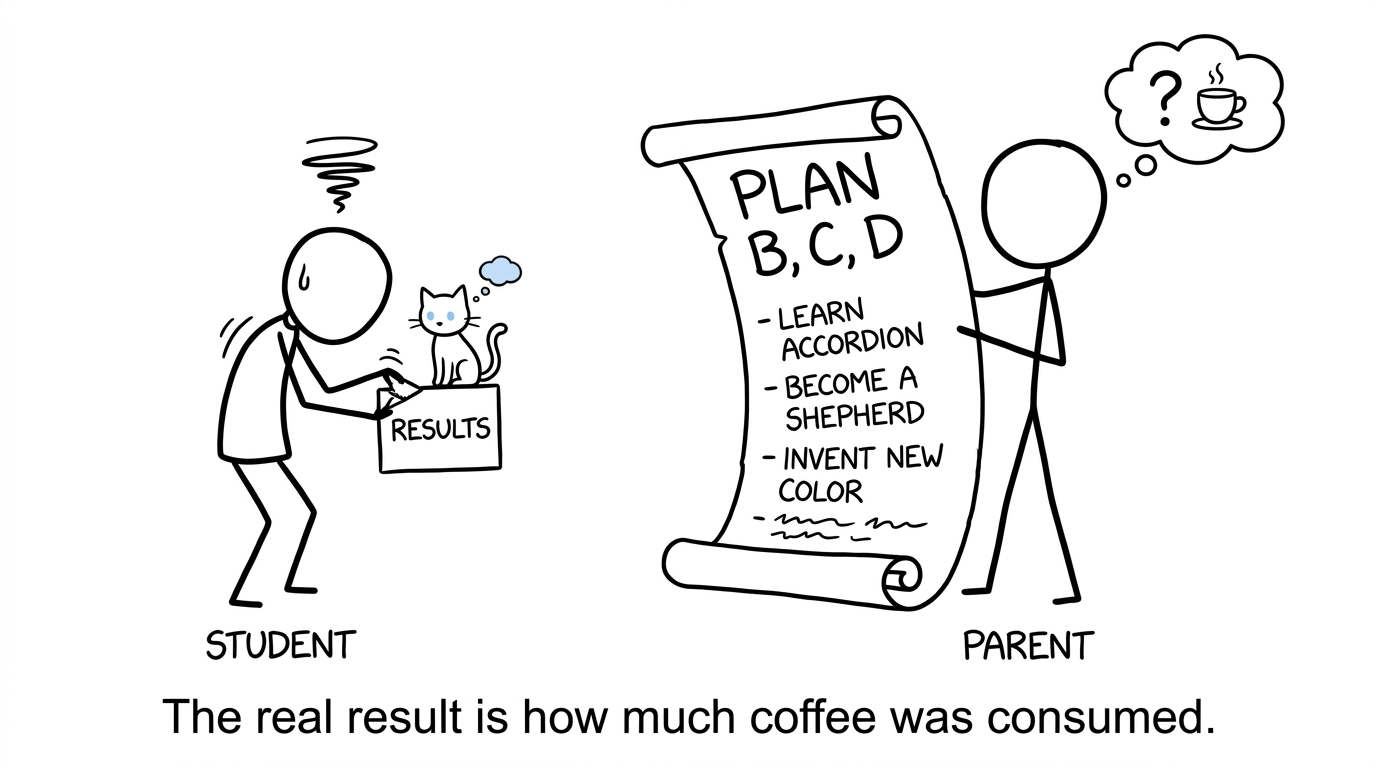 A nervous student opens a results envelope beside an oversized family backup plan
What will my A-Level Physics result show?
Your statement normally shows the qualification, exam board and overall grade from A* to E, or U where the minimum standard for E has not been reached. Depending on your centre's system, it may also show marks or component information.
For A-Level Physics in England, the practical skills endorsement is reported separately as Pass or Not classified. It does not contribute to the overall A-Level grade. Practical knowledge can still be assessed in written papers, so the endorsement and examination result measure different things.
If any entry information looks wrong, tell your exams officer immediately rather than trying to resolve it directly with the exam board.
How are Physics grade boundaries decided?
Grade boundaries are the minimum marks required for each grade. Exam boards set them after papers have been marked because students may find one year's examination slightly harder or easier than another.
That means last year's boundary is useful context, not a promise. There is no fixed percentage for an A or A*, and there is no quota limiting how many students can receive each grade. Use the boundary published for your exact specification and examination series.
MathsGenie's A-Level Physics revision hub lets you select AQA, Edexcel, Eduqas, OCR A, OCR B or WJEC resources. Students taking Eduqas can also consult the Eduqas Physics grade-boundary page.
Why is my grade different from my predicted grade?
A predicted grade is an informed estimate used during the application process. It is not an examination result and does not constrain the grade that an exam board can award.
Your final result depends on your assessed work and that series' grade boundaries. A difference does not automatically indicate a marking error. First compare your component marks, boundaries and performance across the papers. A teacher who knows your work can help identify whether the result is surprising enough to investigate.
What should I do if I miss my university offer?
Check UCAS before assuming that the place has been lost. Universities can accept applicants who narrowly miss an offer, and a pending status may mean that a decision has not yet been made.
If you are not accepted, contact the university calmly and have your UCAS ID, grades and course details ready. Then consider your insurance choice and Clearing. For 2026 entry, UCAS Clearing runs from 2 July to 19 October. Contact a university before adding a Clearing choice and only add it after receiving permission or an offer.
Do not decline an existing place merely to explore alternatives. Declining it cancels that place, so discuss the consequences with your school, college or university first.
Can I ask for my Physics paper to be remarked?
The formal service is called a review of marking, not simply a remark. A reviewer checks whether the original marker applied the mark scheme correctly; the paper is not automatically marked again from the beginning.
Requests normally go through your school or college. You must provide written consent because marks and grades can go down, remain unchanged or go up. A clerical re-check instead examines matters such as whether all pages were marked and marks were recorded correctly.
For the June 2026 series, the deadline for a priority A-Level review is 20 August 2026. The standard review deadline is 24 September 2026. Centres need processing time, so speak to the exams officer well before either deadline. If a university place depends on the outcome, tell the university immediately and ask how long it can hold the place.
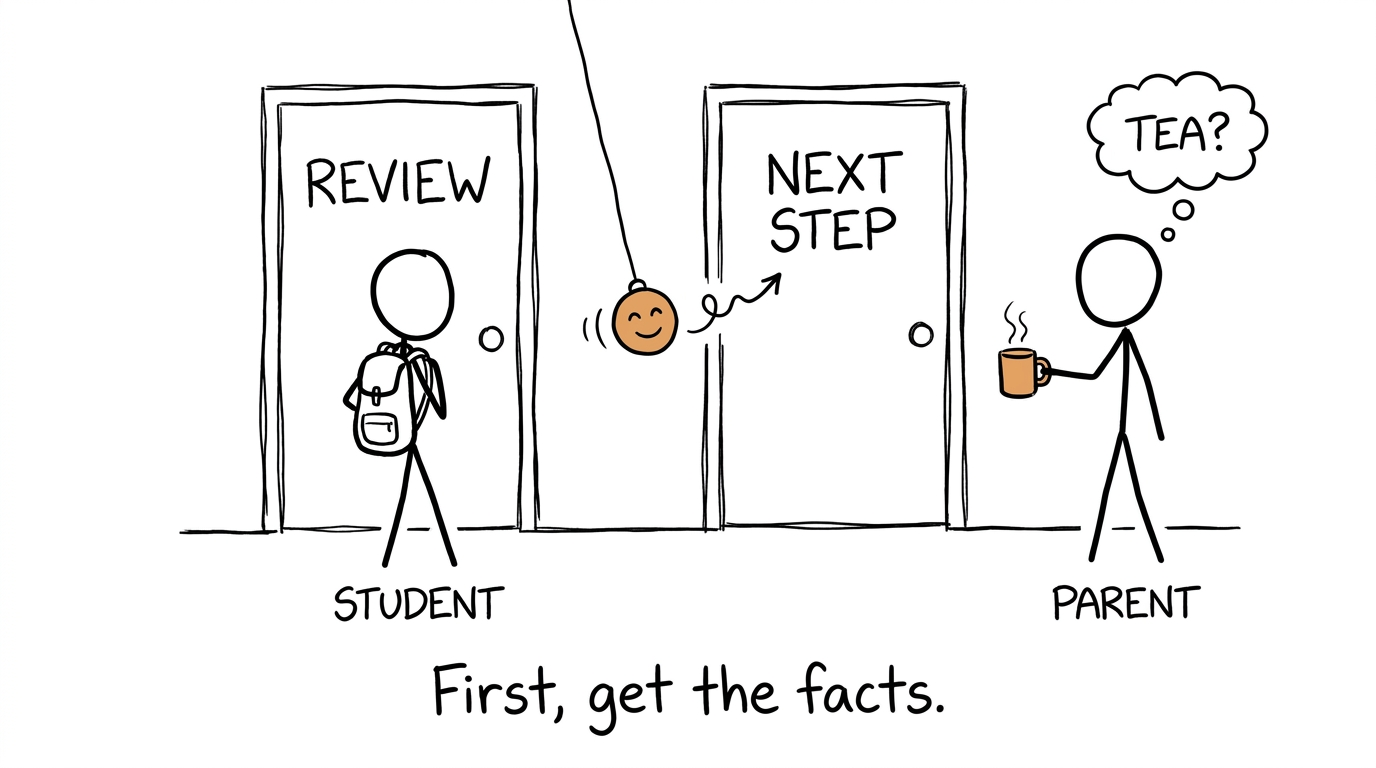 A student chooses between review and next-step doors while a parent offers tea
Is a review worthwhile if I am close to a boundary?
Closeness alone does not prove that marking was incorrect. Physics includes calculations with relatively objective marking alongside explanations where applying a level-based or detailed mark scheme may require professional judgement.
Ask a teacher to consider the script, component marks and likely risk. A review may make sense where there is evidence that the mark scheme was not applied correctly or where a small change has an important consequence. Remember that the final mark can fall as well as rise.
What happens if the review does not resolve the issue?
An appeal is not the first stage. A review of results must normally be completed before your centre can appeal. An appeal considers whether the exam board followed its procedures properly and applied them fairly; it is not another opportunity to request a different academic judgement without grounds.
Internal candidates usually act through their school or college. Ask the exams officer about the evidence, deadline, possible cost and risk before proceeding.
What if I need to resit A-Level Physics?
A resit is a route forward, not a judgement on your ability. Discuss examination entry, practical endorsement arrangements and university implications with your centre because availability and policies vary.
Revision should begin with evidence. Use the correct board page: AQA A-Level Physics revision, Edexcel A-Level Physics revision, Eduqas A-Level Physics revision or OCR A A-Level Physics revision. Topic lessons, question banks, past papers, predicted papers, mini tests and mark schemes make it possible to turn a disappointing mark into a precise revision plan.
Common results-day mistakes
The most damaging mistakes are usually rushed decisions rather than disappointing grades:
- comparing marks with a friend who took another specification;
- treating an old grade boundary as the current boundary;
- assuming a review can only raise a mark;
- waiting until the deadline before contacting the exams officer;
- declining a university place before confirming another option;
- letting a parent take over calls when the university needs to speak to the applicant;
- beginning a resit with general rereading instead of analysing paper-level weaknesses.
A result is information, not the whole story
A strong result deserves celebration. An unexpected one deserves calm investigation. In both cases, the useful question is the same: what is the next sensible action?
Start with the official facts, involve your teachers and keep every viable route open until you understand the consequences. Then use MathsGenie's free A-Level Physics resources to prepare for the next stage through revision lessons, practice questions, past papers, predicted papers, mini tests and mark schemes. Results day closes one chapter, but it does not decide how well the next one can go.










