A-Level Physics Resit UCAS Application Guide
A-level physics resit UCAS application advice: declare grades correctly, explain your retake clearly and show universities clear evidence of progress.
Results day can compress months of work into one uncomfortable moment. If your Physics grade is below what you need, however, a resit does not have to become the story of your entire application. For an A-level physics resit UCAS application, declare both attempts accurately, check each course's resit policy and frame the retake through action, evidence and academic progress rather than apology.
The strongest explanation is usually brief. Universities need to understand what happened, what changed and why you are now better prepared for the course.
Your resit application checklist
- Enter your original Physics result in the UCAS Education section.
- Add the Physics qualification again with the new result marked as pending.
- Obtain a realistic predicted grade from your referee or exam centre.
- Check the resit policy for every individual course before applying.
- Ask your referee to confirm relevant extenuating circumstances where appropriate.
- Use your personal statement to demonstrate preparation and progress.
- Build a measurable revision plan using exam questions, past papers and mark schemes.
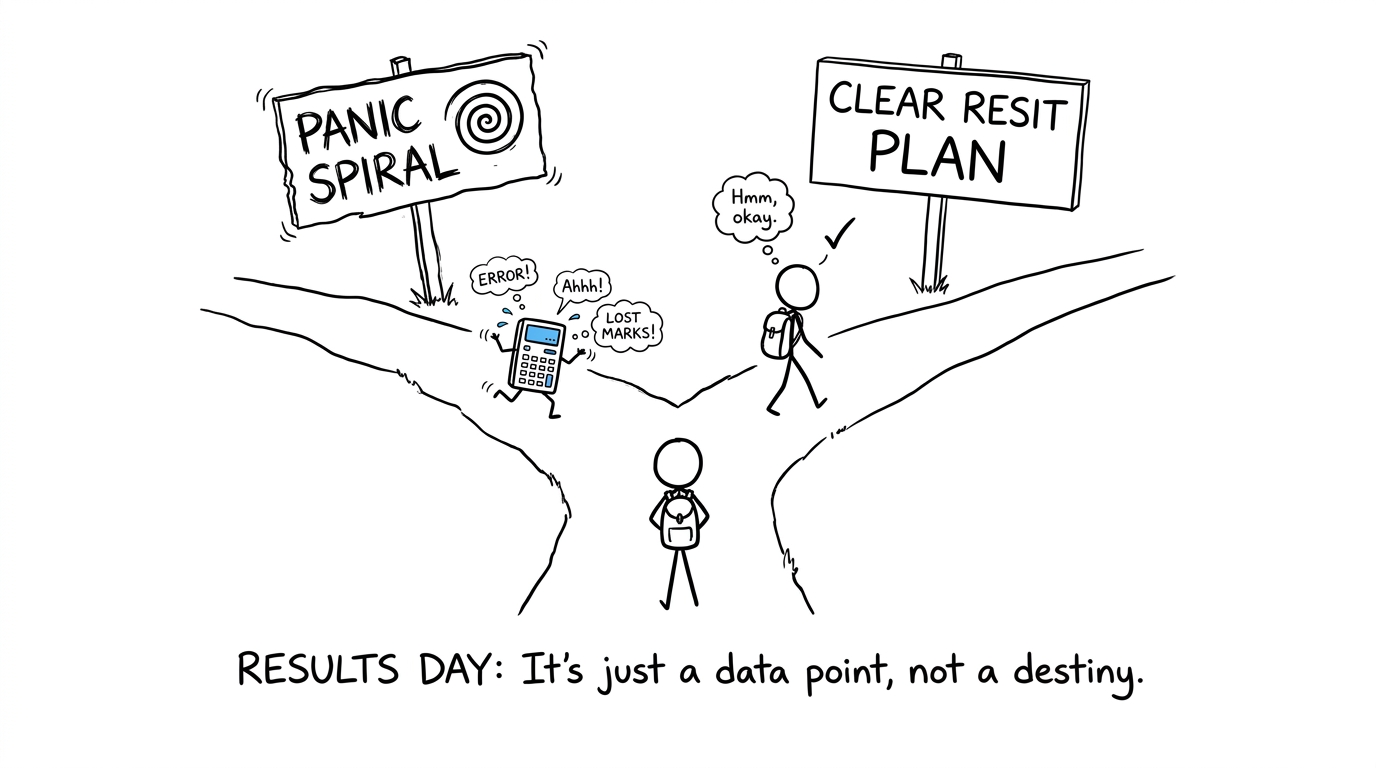 A student choosing a clear resit plan instead of a panic spiral
Declare the Physics retake correctly
UCAS requires applicants to enter all completed and current qualifications from secondary education onwards. That includes unsuccessful grades, previous attempts and qualifications awaiting results.
In practice, you will normally enter A Level Physics twice:
- once as a completed qualification with the grade already awarded;
- once as a pending qualification with the expected resit date.
Do not replace the original result with your predicted resit grade. Concealing the first attempt creates a far more serious problem than the resit itself. Ask your school, college, referee or UCAS adviser to check the Education section before submission, particularly if you are sitting through a different exam centre.
Your referee should also provide a predicted grade for the pending qualification. Discuss this early because a useful prediction should be supported by recent assessments, completed papers and consistent work.
Check university resit policies before writing
There is no single UK-wide admissions rule saying that every university must treat resits identically. Policies can vary between institutions and even between courses at the same university. Highly competitive degrees may impose first-sitting requirements, ask for higher retake grades or consider resits only alongside documented mitigating circumstances.
Check the current entry requirements on each university's official course page. If the wording is unclear, email its admissions team and ask a precise question:
I achieved [grade] in A Level Physics and plan to retake the full qualification in [exam series]. Would your department consider an application with a pending resit grade, and would a different offer apply?
Keep the reply. It is better to discover a restriction before using one of your UCAS choices.
How to approach explaining a resit on UCAS
For applications from the 2026 entry cycle onwards, the UCAS personal statement is divided into three questions. The overall allowance remains 4,000 characters, including spaces, and each answer must contain at least 350 characters.
A Physics retake fits most naturally into the second question about how your qualifications and studies have prepared you. You do not need to devote a whole answer to it. Admissions tutors still need evidence of subject interest, academic readiness and suitability for the course.
Use a simple three-part structure
A useful explanation contains:
- Context: a short, factual account of the result or circumstances.
- Response: the specific changes you have made.
- Evidence: recent work showing that those changes are effective.
This turns explaining a resit on UCAS from a defence of the past into evidence about your present approach.
Example wording to adapt
If no major extenuating circumstances applied, you might write:
My initial A Level Physics result did not reflect the standard required for my chosen course. Retaking the qualification has led me to replace broad revision with targeted exam-question practice, systematic analysis of mark schemes and regular timed papers. This process has strengthened both my subject knowledge and my ability to evaluate errors independently.
If verified circumstances affected your performance, a concise version could be:
My original Physics result was affected by circumstances outlined in my academic reference. Since returning to consistent revision, I have completed regular timed assessments and focused particularly on [relevant topic or skill]. The experience has made my preparation more structured and has reinforced my commitment to studying [course].
Use only details that are true. Replace general claims with evidence you can discuss confidently if interviewed.
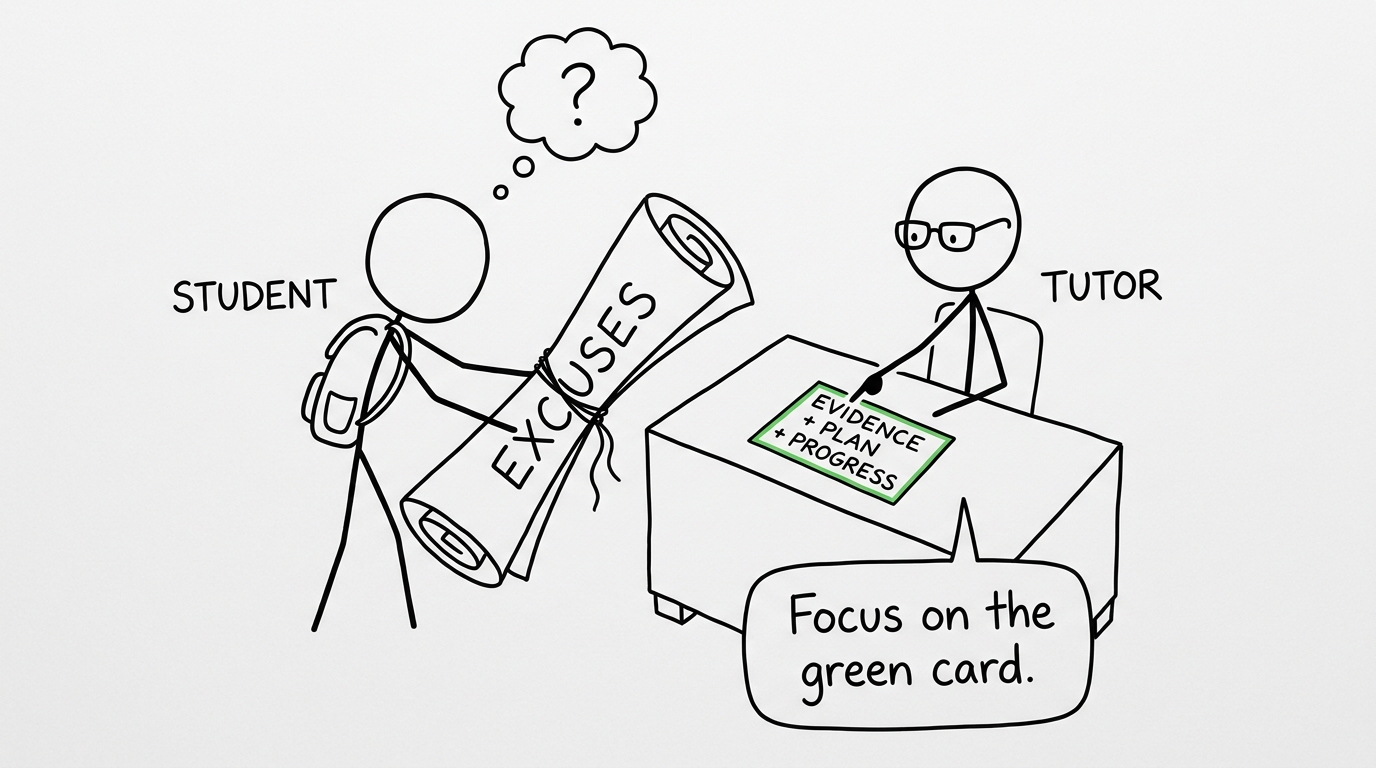 An admissions tutor preferring a concise evidence and progress card to a giant scroll of excuses
Let your referee provide sensitive context
You should not feel obliged to place detailed medical, family or personal information in your statement. UCAS references include space for an adviser to explain circumstances that affected education or achievement.
Speak to your referee well before the deadline. Explain what may be shared and provide appropriate evidence if requested. A referee can establish the context objectively, leaving your own answers free to focus on Physics, preparation and future potential.
If circumstances arise after submission, contact the relevant university admissions teams and ask how they want the information supplied.
Turn the retake plan into credible evidence
Saying that you are determined is easy. Showing a changed process is more persuasive.
Start with the A Level Physics revision hub, then select resources matched to your specification. MathsGenie provides dedicated support for AQA A Level Physics, OCR A A Level Physics and other boards, while the Edexcel Physics revision guides keep revision tied to examinable content.
A practical weekly cycle is:
- revisit one weak topic through a revision lesson or guide;
- complete topic-based practice questions without notes;
- mark the work carefully and record why each mark was lost;
- return to the same weakness several days later;
- complete timed past papers and mini tests as the exam approaches.
Physics also depends heavily on algebra, graphs and proportional reasoning. Use the A Level Maths revision resources when the obstacle is mathematical rather than physical. A Level predicted papers can support final preparation, but they should complement specification coverage and past papers rather than replace them.
For GCSE students looking ahead, the same habit begins now: learn from a lesson, attempt questions, mark honestly and reattempt. The GCSE Maths revision hub provides a clear place to build that routine.
Common mistakes when explaining a Physics resit
Hiding or replacing the original grade
UCAS requires both completed and pending qualifications. Enter the information accurately.
Writing a long apology
A personal statement is not an appeal letter. Give necessary context briefly, then concentrate on response and evidence.
Blaming teachers or the exam board
Even where teaching disruption occurred, neutral wording is more effective. Let your referee verify the circumstances.
Claiming resilience without demonstrating change
Describe observable actions such as timed papers, an error log, topic assessments or a revised revision schedule.
Assuming every course accepts retakes
Never rely on a university-wide summary or an old forum post. Check the current policy for the exact course and entry year.
Make the next result the product of a better system
A resit is one line in an academic record, not a complete judgement of your ability. Declare it honestly, explain it proportionately and give universities evidence that your approach has changed.
Then make that evidence real. Begin with MathsGenie's free A Level Physics resources, identify your weakest topics and build a steady cycle of revision lessons, practice questions, past papers, predicted papers, mini tests and mark-scheme review. A positive application starts with clear wording, but it becomes convincing through the work behind it.