

A-Level Physics Resit: Your Results Day Plan
A-level physics resit plan for after Results Day: review scripts, secure an exam centre, rebuild weak topics and use past papers effectively.
Results Day can make one grade feel larger than it is. It appears final, but often it is simply evidence: a snapshot of what happened across a few papers under pressure. If you are considering an A-level physics resit, act calmly and in the right order. Check whether a post-results review is sensible, confirm your exam board and centre, diagnose where marks were lost, then follow a staged revision plan built around questions and timed papers.
Resitting A-level Physics is not about repeating the same year more intensely. It is about making your next attempt more deliberate.
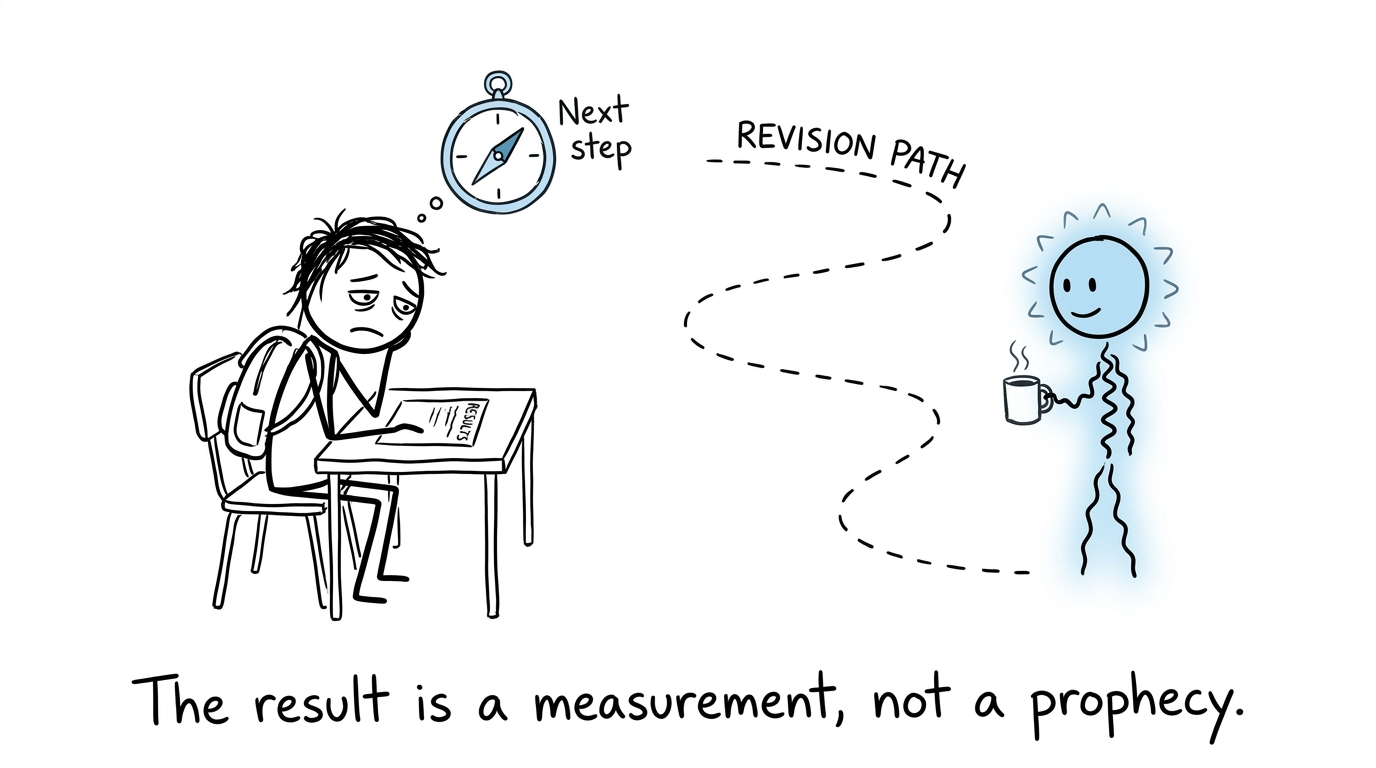 A student follows a next-step compass after Results Day
Your immediate resit checklist
Before reopening every textbook, settle the administrative details:
- Ask your school or college about access to your marked scripts.
- Discuss whether a clerical re-check or review of marking is appropriate.
- Confirm your exam board and specification: AQA, Edexcel, OCR or Eduqas/WJEC.
- Find an approved centre willing to enter you for the next available series.
- Ask about entry deadlines, centre fees and practical endorsement arrangements.
- Check how a resit could affect university, apprenticeship or employment plans.
- Download the correct specification and list every examinable topic.
Post-results deadlines are short and change between exam series, so contact your exams officer promptly. A review of marking checks whether the mark scheme was applied correctly; it is not a fresh attempt at the paper.
If you apply through UCAS, you must declare completed qualifications, previous results and qualifications being retaken. Individual universities may also have their own policies, so ask admissions teams directly rather than relying on assumptions.
Milestone one: diagnose the original result
Your first task is not revision. It is diagnosis.
Use your scripts, paper breakdowns and teacher feedback to classify lost marks into four groups:
| Type of loss | What to investigate |
|---|---|
| Knowledge | Definitions, principles or required practical knowledge you could not recall |
| Application | Familiar content presented in an unfamiliar context |
| Mathematical method | Algebra, graphs, units, proportional reasoning or significant figures |
| Exam performance | Timing, command words, incomplete explanations or unanswered questions |
A single question may expose more than one weakness. For instance, knowing a relationship but being unable to rearrange it is different from not recognising which relationship applies.
Create an error log with the topic, mistake, cause and next action. Students following AQA can begin with the AQA A-Level Physics revision area, while the main A-Level Physics revision hub directs students to resources for AQA, Edexcel, Eduqas, OCR A, OCR B and WJEC.
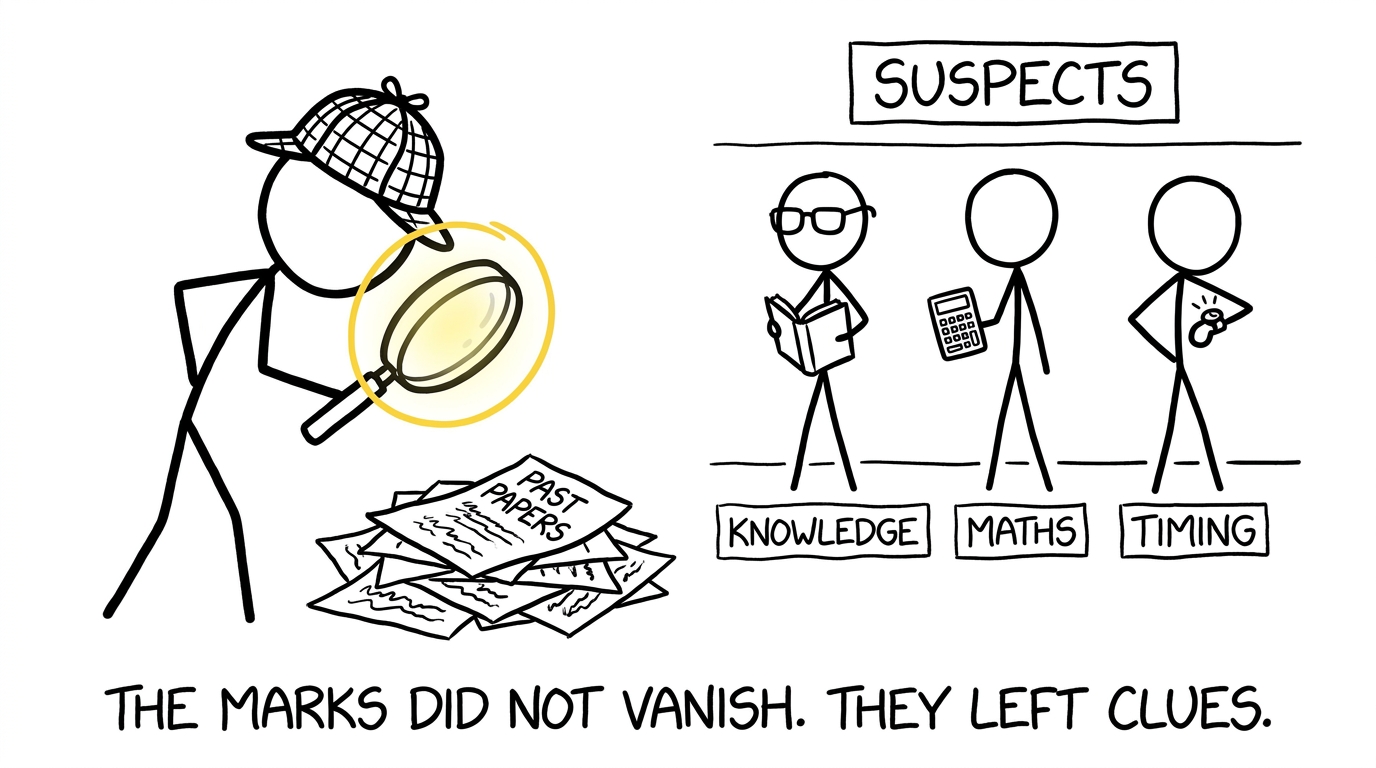 A student detective investigates where the marks went
Milestone two: rebuild topics and mathematical fluency
Spend the first phase of your A-level physics retake revision repairing individual topics. Work from your weakest areas, but revisit stronger content often enough to prevent it fading.
A useful weekly structure is:
- two sessions rebuilding weak theory;
- two sessions answering topic questions;
- one session on practical skills, data and uncertainties;
- one mixed retrieval session;
- one short review of the error log.
Physics calculations often depend on rearranging formulae, standard form, gradients and proportionality. Practise writing units at each stage and check whether the scale of an answer is physically plausible. If the maths repeatedly causes errors, the Edexcel A-Level Maths revision resources can help you repair related algebra, mechanics and graph skills.
Do not make note-taking the centre of your plan. Read briefly, close the resource, retrieve the idea from memory, then answer questions. AQA students can build targeted sets through the AQA A-Level Physics question bank. OCR A students can use the OCR A Physics question bank, while Edexcel students can revisit specification-matched explanations in the Edexcel Physics revision guides.
Milestone three: connect topics under exam conditions
Once individual topics are becoming secure, introduce mixed questions. Real papers rarely announce the exact method required. They test whether you can select relevant physics while ignoring distracting information.
Use this revision loop:
- attempt questions without notes;
- mark them strictly with the official mark scheme;
- identify why each mark was lost;
- revise only the underlying weakness;
- retry the missed questions several days later.
For written explanations, compare the precision of your wording with the mark scheme without memorising isolated phrases. For calculations, check formula selection, substitution, powers of ten, units and significant figures.
The aim is not merely to recognise a correct solution. It is to produce one independently.
Milestone four: move to full past papers
In the final phase, complete full papers using your board's permitted materials and published timing. Use the MathsGenie A-Level Physics past-paper hub to select the correct board and specification.
Record both your mark and the pattern beneath it. A rising score is encouraging, but repeated weaknesses are more useful. If electricity questions remain unreliable across several papers, return to targeted practice before attempting another full paper.
Reserve some papers for genuine mock conditions. Earlier papers can be used by topic; later papers should measure timing, stamina and decision-making. Predicted papers and mini tests, where available, can add unfamiliar practice, but official past papers and mark schemes should remain central.
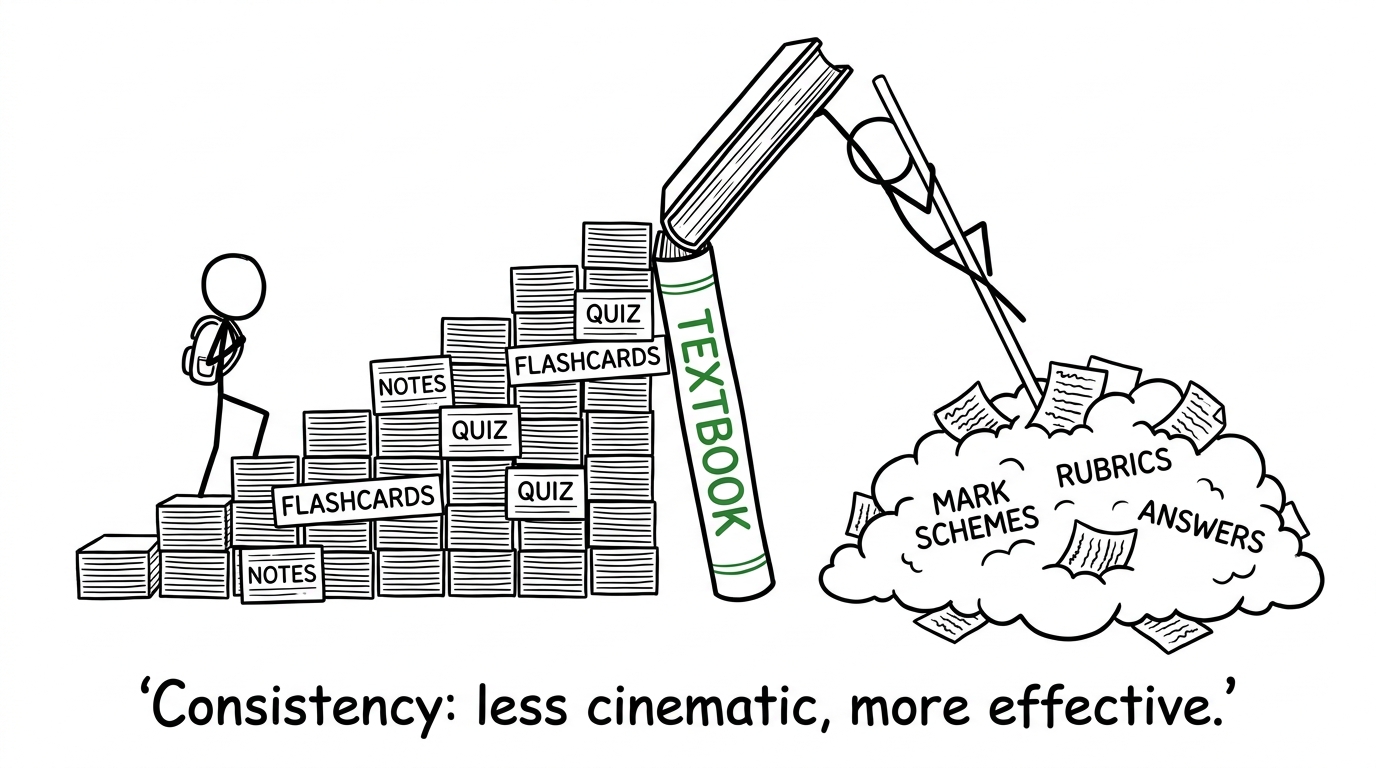 Small consistent revision steps beat one dramatic leap
Check the practical endorsement
In reformed A-level sciences in England, the practical skills endorsement is reported separately from the examination grade. A previous endorsement grade can generally be carried forward when the written qualification is retaken, including between compatible JCQ awarding bodies.
This is not automatic in every personal situation. Ask your new centre to confirm the entry process, whether your previous endorsement will be carried forward and which candidate details it needs. If you did not previously achieve the required endorsement outcome, arranging practical assessment may be more complicated and should be discussed before paying an entry fee.
Even when an endorsement is carried forward, revise required practical methods. Written papers can assess experimental design, controls, uncertainty, graph interpretation and evaluation.
Common mistakes when resitting A-level Physics
Revising everything equally
Your original performance provides a map. Give more time to recurring weaknesses while maintaining stronger topics through retrieval practice.
Changing exam board without checking the specification
Specifications differ in content, options and paper structure. Changing board may create new material to learn and requires careful discussion with the centre.
Completing papers without reviewing them
A marked paper is only useful if it changes the next revision session. Log errors, repair the skill and retry the question.
Ignoring mathematical weaknesses
Losing marks through unit conversions or algebra is not inevitable. Isolate the skill, practise it, then return to physics questions. Timed work from A-Level Maths past papers can also strengthen disciplined written methods.
Waiting too long to find a centre
Private-candidate availability, fees and practical arrangements vary. Begin enquiries early and obtain written confirmation of what the centre will provide.
Turn the result into a plan
A resit year can feel uncertain because the destination is months away. The solution is to measure smaller things: topics repaired, questions retried, practical skills reviewed and papers completed under honest conditions.
Start at the MathsGenie A-Level Physics revision hub. Choose your exam board, diagnose one weak topic and begin with targeted practice questions before progressing to past papers, predicted papers and mini tests where available. Use every mark scheme as feedback and every mistake as the next item on your revision planner. That is how resitting A-level Physics becomes a structured project rather than a repeat of the past.











