

A-Level Physics Remark: Results Day Guide
A-level physics remark guide for 2026: understand reviews of marking, check your script, weigh grade-boundary risk and meet results-day deadlines on time.
Results day can turn several months of uncertainty into one number. When that number is lower than expected, the natural response is immediate: ask for an A-level physics remark. But speed should not replace evidence.
The best first move is to contact your school or college, confirm how many marks you are below the required grade and ask whether a physics teacher can inspect your marked scripts. A review is worth considering when the script shows a possible marking error and recovering the marks could change your grade. It is not a reliable way to gain marks simply because the result feels disappointing.
Your results-day decision checklist
Before requesting anything, check:
- your total mark and the official boundary for the grade you need;
- which individual physics paper appears unexpectedly low;
- whether your university or apprenticeship place depends on the result;
- whether a teacher has inspected the marked script;
- whether there is evidence that the mark scheme was applied incorrectly;
- the exam board and your centre's internal deadline;
- whether you accept that your mark can rise, stay unchanged or fall.
MathsGenie's A Level grade boundaries hub is a useful starting point. Use the boundary from your actual exam series and specification rather than comparing your result with previous years.
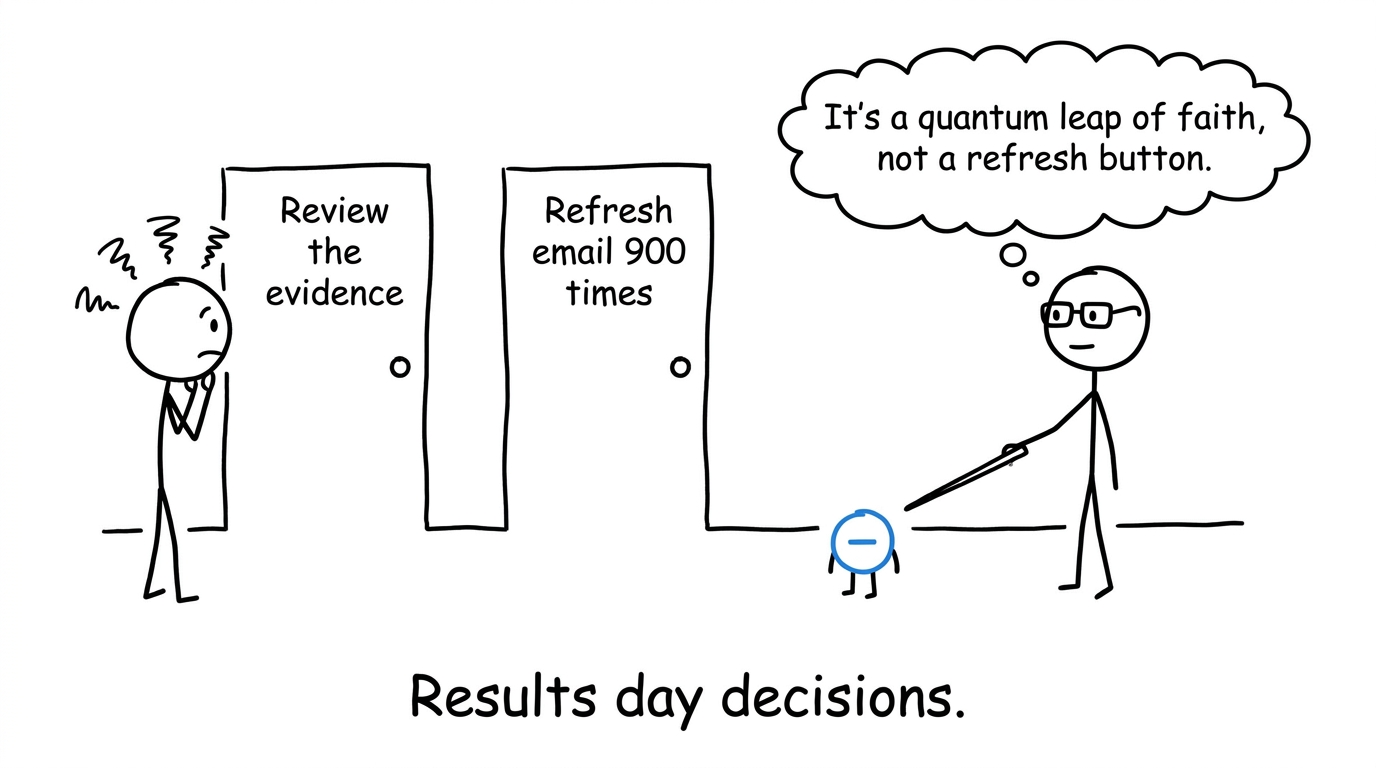 A student chooses between reviewing evidence and endlessly refreshing an email inbox
How the A-level physics re-mark process works
The everyday word “remark” is slightly misleading. The official service is normally called a review of marking. A reviewer checks the original marking to decide whether the mark scheme was applied correctly and whether any marking or administrative errors need correcting. It is not a completely fresh assessment in which a second examiner freely replaces every judgement.
Speak to your exams officer
Most students cannot submit a request directly to the exam board. Your school or college normally handles it, while private candidates may be able to contact the awarding organisation or the centre that entered them.
Ask for your component marks, exam board, available services, fees and internal deadlines. Schools often set deadlines earlier than the published board deadline so that staff have time to process requests.
Calculate the gap to the next grade
If your total mark is MMM and the next grade boundary is BBB, the number of marks required is:
B−MB-MB−MBeing one mark below a boundary does not prove an error, but it makes a well-supported review more consequential. Being several marks away does not make a change impossible, although stronger evidence would usually be needed across one or more papers.
Check the relevant subject page, such as AQA A Level Physics grade boundaries, the Edexcel Physics grade calculator, OCR A Level Physics grade boundaries or Eduqas A Level Physics grade boundaries.
Request and inspect the script
Access to Scripts allows your centre to obtain your marked paper. Written candidate permission is required. Ask a physics teacher to compare the response with the mark scheme and examiner guidance, paying particular attention to:
- questions or pages that may have been missed;
- correct calculations or valid alternative methods awarded too few marks;
- extended explanations where the marking appears inconsistent with the scheme;
- transferred or totalled marks that appear incorrect;
- practical or data-analysis responses where acceptable reasoning may have been overlooked.
Physics contains objective calculations alongside extended explanations requiring examiner judgement. A teacher's subject knowledge is therefore more useful than simply counting ticks.
Choose the correct service
A clerical re-check checks matters such as whether all responses were marked and whether marks were recorded and totalled correctly. A review of marking includes administrative checks and examines whether the mark scheme was applied correctly.
For the June 2026 series, A Level results are released on Thursday 13 August. The JCQ deadline for standard reviews is 24 September 2026, but board and centre arrangements must always be checked. AQA's published deadline for a 2026 priority review is 20 August. Priority reviews are intended for cases where a higher or further education place depends on the outcome.
Standard reviews are normally completed within 202020 calendar days and priority reviews within 151515 calendar days. Fees vary by board and service. Your school can explain what you must pay and when a fee is waived or refunded.
Give informed consent
Your school needs your written consent because the reviewed mark can go up, remain unchanged or go down. There is no grade protection. Discuss that risk carefully if the existing grade already secures your next step.
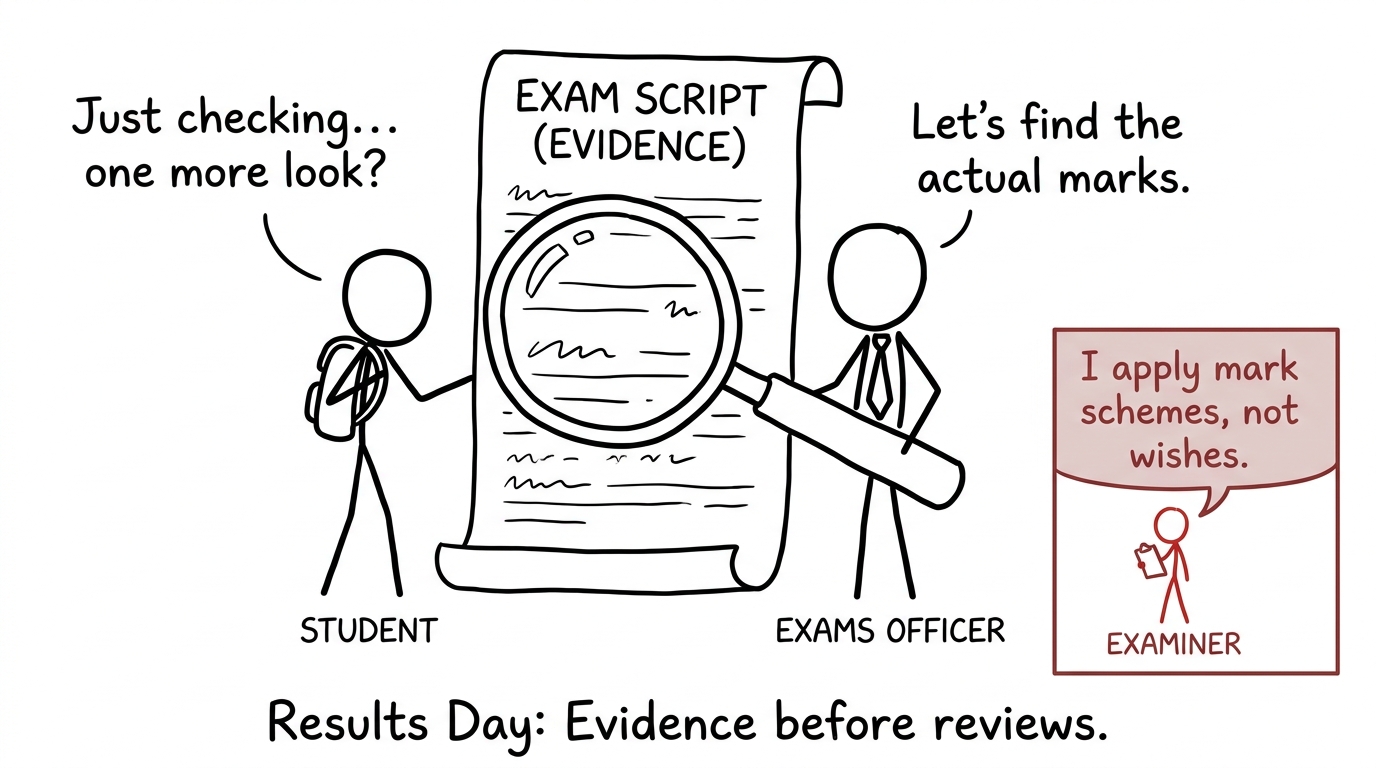 A student and exams officer inspect a giant exam script with a magnifying glass
When appealing an A-level physics grade is appropriate
An appeal is not usually the first stage. If concerns remain after the review, the centre may appeal on permitted grounds, such as an unresolved marking error or a procedural failure. You cannot appeal simply because you dislike the grade boundary, and the setting of a boundary is not itself appealable.
If your school declines to request a review, ask for its internal appeals procedure. Schools and colleges must give students an opportunity to challenge such a decision.
Common mistakes when requesting a physics review
Treating a remark as a gamble
A review corrects errors; it does not award sympathy marks. Base the decision on the script, mark scheme and teacher advice.
Reviewing every paper automatically
Reviews apply to individual components. Identify the paper containing plausible missed marks rather than paying to review every paper without evidence.
Using last year's boundary
Boundaries can change between series. Always use the boundary attached to your own result and specification.
Missing the centre's deadline
The exam board's date is not necessarily your school's date. Contact the exams officer immediately, especially when a university place is pending.
Assuming the mark cannot fall
Written consent matters because an error must be corrected in either direction.
Make the next decision evidence-led
Results day rewards calm administration more than frantic refreshing. Check the boundary, obtain the script, ask a physics teacher to identify specific concerns and submit the correct service before your centre's deadline.
Start with MathsGenie's A Level Physics grade boundaries, then speak to your exams officer. If you are preparing for future exams, use MathsGenie's A Level Maths revision resources to strengthen the algebra, graphs and mechanics behind physics through revision lessons, practice questions, past papers, predicted papers, mini tests, mark schemes and video solutions.











