

A-Level Physics Marks per Grade: 2025 Thresholds
A-level physics marks per grade: check the latest 2025 raw mark thresholds for AQA, Edexcel, OCR and Eduqas, and understand your result clearly.
Results day has a peculiar kind of suspense. You may know your total mark, yet still need the line that gives it meaning. If you are searching for A-level physics marks per grade, the latest available official thresholds are from the June 2025 exam series. The table below shows the minimum overall raw marks required for each grade.
Boundaries for the June 2026 series have not yet been published. Exam boards set them after marking, so earlier thresholds are useful evidence, not guaranteed targets. GCSE students considering A-level Physics should notice something important too: unlike GCSE grades 999 to 111, A levels use grades A* to E.
A-level Physics grade thresholds at a glance
Before reading the figures, check three details:
- your exam board and specification;
- the correct exam series;
- your total mark across the qualification, not one paper.
A boundary is the lowest mark that earns the stated grade. Marks below the E boundary receive a U.
| Exam board and route | Maximum mark | A* | A | B | C | D | E |
|---|---|---|---|---|---|---|---|
| AQA Physics, depending on option | 250250250 | 181181181 to 190190190 | 148148148 to 155155155 | 123123123 to 129129129 | 989898 to 103103103 | 747474 to 777777 | 505050 to 515151 |
| Edexcel Physics | 300300300 | 227227227 | 199199199 | 169169169 | 139139139 | 109109109 | 808080 |
| OCR Physics A | 270270270 | 206206206 | 179179179 | 151151151 | 123123123 | 969696 | 696969 |
| OCR Physics B | 270270270 | 203203203 | 174174174 | 145145145 | 116116116 | 878787 | 595959 |
| Eduqas Physics | 320320320 | 262262262 | 234234234 | 196196196 | 158158158 | 120120120 | 828282 |
These are June 2025 overall subject boundaries. You can inspect the full board-specific records on MathsGenie's AQA A-level Physics grade boundaries, Edexcel A-level Physics grade boundaries, OCR A-level Physics grade boundaries and Eduqas A-level Physics grade boundaries pages.
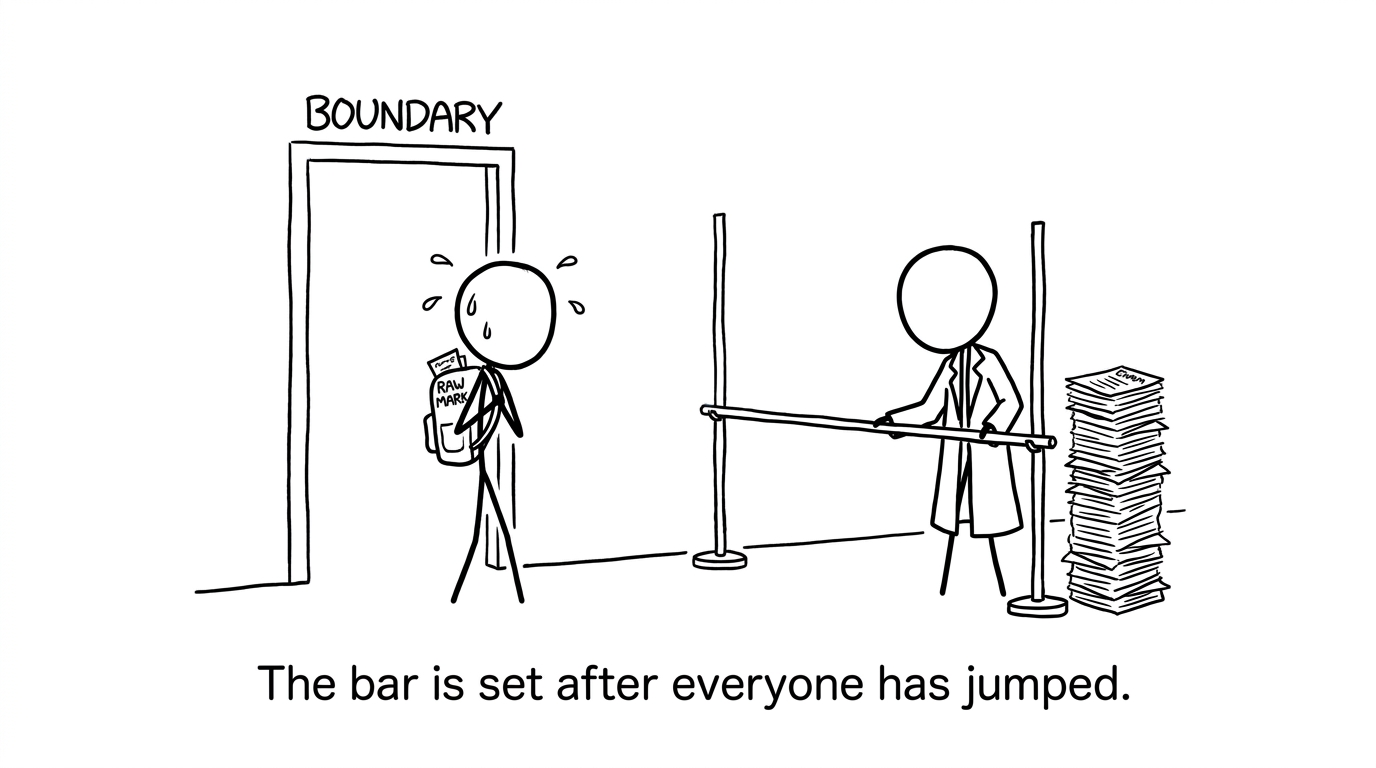 A results-day boundary being adjusted after the papers are marked
Why AQA has a range rather than one mark
AQA Physics specification 740874087408 includes five optional-topic routes: Astrophysics, Medical Physics, Engineering Physics, Turning Points in Physics and Electronics. Each route had slightly different 2025 boundaries.
For example, the A* boundary ranged from 181181181 for Medical Physics to 190190190 for Engineering Physics. You must therefore match your result to the option you actually completed. Treating the lower end of the range as a universal AQA threshold could give you the wrong grade.
Edexcel has one overall route in the table, while OCR Physics A and OCR Physics B are different specifications. Similar names do not make their marks interchangeable.
What A-level Physics raw marks mean
A raw mark is the mark awarded for your assessed work before it becomes an overall qualification grade. For a linear A level, the relevant grade comes from the overall subject total after the board's aggregation or weighting rules have been applied.
The percentage represented by a boundary can be found using:
boundary percentage=boundary markmaximum mark×100\text{boundary percentage}=\frac{\text{boundary mark}}{\text{maximum mark}}\times 100boundary percentage=maximum markboundary mark×100Percentages can help with revision planning, but results are awarded from the board's published mark boundary rather than a universal rule such as “A* always means 90%90\%90%”. It does not.
The practical endorsement is also reported separately from the A-level grade. It does not simply add extra marks to the written-paper total shown above.
Why grade boundaries change
Exam boards aim to keep the standard represented by a grade consistent even when papers vary in difficulty. They review evidence from the completed exam series and then establish the boundaries. That is why the 2025 Edexcel A* boundary was 227227227 out of 300300300, while the 2024 boundary was 231231231.
A lower threshold does not automatically mean that the qualification became easier. It may reflect a more demanding set of papers. Equally, a past threshold cannot tell you exactly what will be required in a future series.
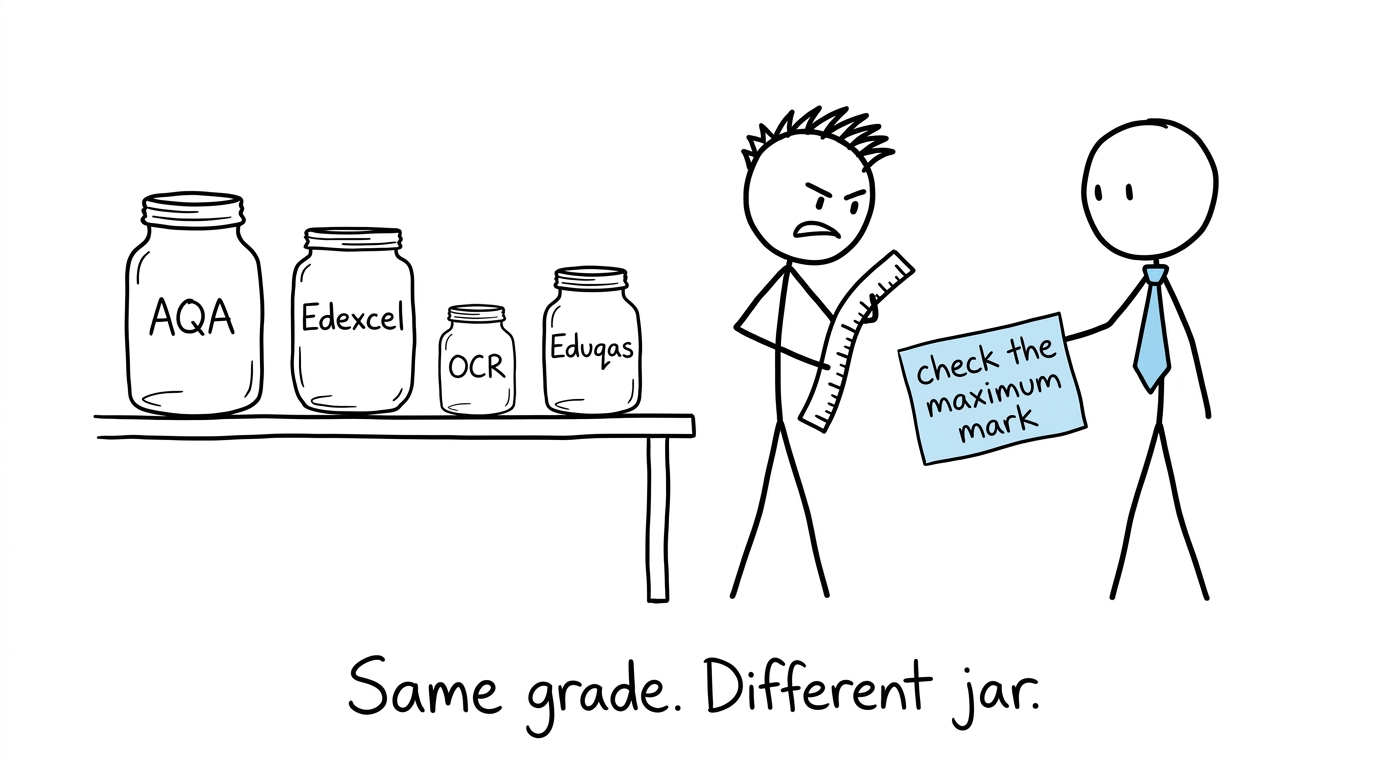 Four exam-board jars showing why maximum marks must be checked
How to use thresholds before results day
Boundaries are best used as a range for planning, not as a promise. Mark a complete past-paper set, add the relevant paper totals and compare your score with the boundary from that same year and specification. The Edexcel Physics predicted-grade calculator makes this comparison easier for Edexcel students.
Then look beyond the letter. The most useful information is where marks disappeared: an omitted unit, an unclear explanation, a graph-reading error or an unfinished calculation. Build those weaknesses into a realistic MathsGenie revision planner.
For GCSE students thinking ahead, strong algebra, rearranging, standard form, graphs and proportional reasoning provide essential preparation. MathsGenie's free GCSE Maths revision hub lets you strengthen those skills through revision lessons, questions and past papers.
Common mistakes when checking Physics marks
- Using a component boundary as the final grade. Per-paper boundaries are often notional; the overall subject total awards the qualification grade.
- Checking the wrong year. Compare a June 2025 paper set with June 2025 thresholds.
- Ignoring the AQA option. Each optional route can have a different overall boundary.
- Comparing raw totals directly across boards. A mark out of 250250250 cannot be compared fairly with one out of 320320320 without considering the maximum and specification.
- Assuming boundaries never move. They are established for each exam series after marking.
Turn the mark into a next step
A grade boundary answers one question: where your total sits. It cannot tell you why marks were lost or what to practise next.
Use MathsGenie's A-level Physics grade-boundary pages to check the exact year, board and route. Then make the result useful: organise your revision, strengthen the underlying maths, and work through free revision lessons, practice questions, past papers, predicted papers, mini tests, mark schemes and video solutions. The number matters on results day. The habits behind it matter much longer.










