

A-Level Physics Grade Boundaries History: 2019-2025
A-Level physics grade boundaries history from 2019 to 2025, with AQA trends, pandemic context and practical advice for smarter past-paper revision.
A grade boundary can look like a fixed target. It is not. It is the minimum raw mark needed for a particular grade in one specification and exam series, set after the papers have been marked. That distinction explains much of the A-Level physics grade boundaries history: boundaries move because paper demand and student performance vary, while exam boards work to maintain comparable grading standards.
For students and teachers analysing recent results, the clearest conclusion is simple: past boundaries provide context, not a prediction. Use them to interpret past-paper marks, but prepare for a range rather than one supposedly certain target.
A quick checklist before comparing boundaries
- Compare the same exam board, specification and optional route.
- Use the overall qualification boundary, not a notional paper boundary.
- Check that every paper mark has been included.
- Compare raw marks as percentages when total marks differ.
- Treat 2020 and 2021 separately because normal summer exams did not take place.
- Never assume that the next boundary will match the latest one.
MathsGenie's A-Level Physics revision hub lets you choose the correct exam board before opening papers and revision resources.
Past A-Level Physics grade boundaries by year
The table below follows AQA A-Level Physics with the Astrophysics option. Keeping one route consistent makes the trend meaningful. AQA's optional routes can have slightly different boundaries, so these figures must not be applied automatically to Electronics, Engineering, Medical Physics or Turning Points.
| Summer series | Maximum mark | A* boundary | A boundary | Context |
|---|---|---|---|---|
| 2019 | 250250250 | 198198198 | 171171171 | Last normal summer series before the pandemic |
| 2020 | Not applicable | Not applicable | Not applicable | Summer exams cancelled |
| 2021 | Not applicable | Not applicable | Not applicable | Summer exams cancelled |
| 2022 | 250250250 | 167167167 | 137137137 | Transitional grading year |
| 2023 | 250250250 | 164164164 | 129129129 | Return towards pre-pandemic grading standards |
| 2024 | 250250250 | 171171171 | 138138138 | Normal examined series |
| 2025 | 250250250 | 182182182 | 152152152 | Latest published summer series |
You can check every optional route on the AQA A-Level Physics grade boundaries page.
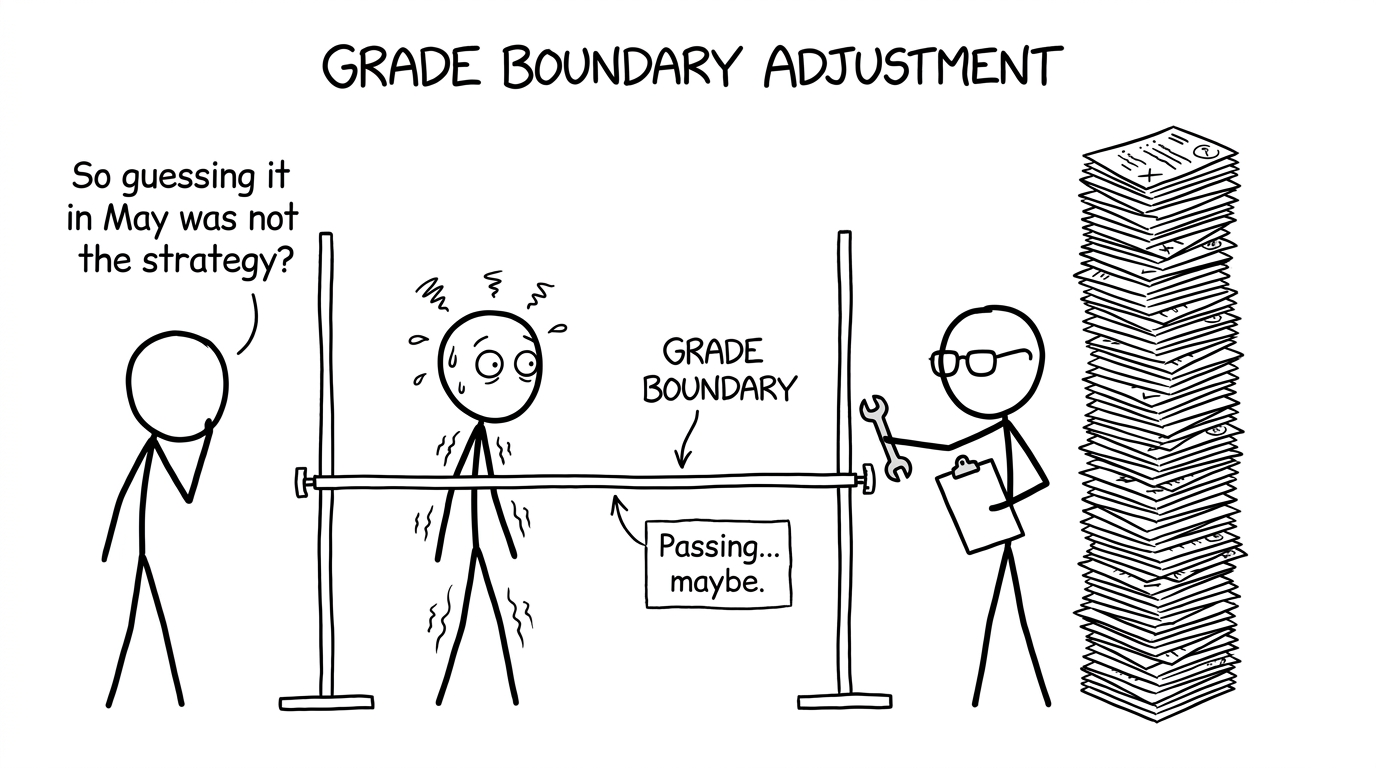 A student discovering that grade boundaries are adjusted after papers are marked
What the year-by-year changes tell us
2019: a useful baseline
In 2019, the Astrophysics A* boundary was 198198198 out of 250250250, equivalent to 79.2%79.2\%79.2%. The A boundary was 171171171, or 68.4%68.4\%68.4%.
This is an important comparison year because it was the final summer series before pandemic disruption. It is not, however, a universal benchmark for how difficult an A-Level Physics paper must be. It records the boundary appropriate to that particular assessment and cohort.
2020 and 2021: a break in the series
Normal summer examinations were cancelled in both years. Grades were awarded through alternative arrangements, so there are no directly comparable summer raw-mark boundaries to place beside 2019 or 2022.
Autumn examination series did take place for some candidates, but mixing autumn figures with the main summer sequence can obscure rather than clarify the trend. For a clean historical comparison, mark these years as a break.
2022: transitional grading
Summer exams returned in 2022. Ofqual described the year as a transition between the more generous outcomes of 2021 and pre-pandemic grading. Advance information and other adaptations also affected the assessment context.
The AQA Astrophysics A* boundary was 167167167, equal to 66.8%66.8\%66.8%. That was substantially below 2019, but it does not mean an A* had permanently become easier. Boundaries are responses to evidence from the series, not promises for future candidates.
2023: low raw boundaries, restored standards
The 2023 A* boundary fell slightly to 164164164, or 65.6%65.6\%65.6%, while the A boundary fell to 129129129, or 51.6%51.6\%51.6%. At the same time, the national grading approach returned towards pre-pandemic standards, with protection for disruption.
This is why raw boundaries and grading standards should not be treated as identical ideas. A demanding paper can require fewer raw marks while the intended standard of the qualification remains controlled.
2024 and 2025: boundaries rose
The A* boundary increased to 171171171 in 2024 and 182182182 in 2025. The corresponding percentages were 68.4%68.4\%68.4% and 72.8%72.8\%72.8%. The A boundary also rose from 138138138 to 152152152.
These recent A-Level physics grade boundary trends show movement, not a dependable upward law. Five examined series are not enough to predict the next paper, and exam boards do not announce final boundaries in advance.
Comparing different exam boards properly
AQA, Edexcel, OCR and Eduqas assess approved A-Level Physics specifications, but their paper structures and total raw marks are not identical. For example, AQA totals 250250250 marks, Edexcel totals 300300300, and OCR Physics A totals 270270270. Directly comparing raw boundaries would therefore be misleading.
Convert a boundary into a percentage using:
Boundary percentage=boundary markmaximum mark×100\text{Boundary percentage}=\frac{\text{boundary mark}}{\text{maximum mark}}\times 100Boundary percentage=maximum markboundary mark×100Even percentages need context. Specifications, optional content and assessment structures differ. Use the OCR A-Level Physics grade boundaries for OCR results and the wider grade boundaries collection to locate the correct board.
How to use grade-boundary history in revision
The useful purpose of a boundary is to interpret a completed paper. Choose an assessment from the A-Level past-paper collection, sit every required component under timed conditions, mark it honestly, and then apply the boundary from that exact series.
For AQA, start with the AQA A-Level Physics past papers. OCR students can use the OCR A Physics revision resources, including topic questions, papers and mark schemes.
Do not revise to scrape last year's boundary. Build a safety margin. A student targeting an A should aim to perform securely above several recent A boundaries, while tracking why marks disappear: physics knowledge, algebra, units, graphs, practical analysis or timing.
This is especially relevant for GCSE students considering A-Level Physics. Skills from GCSE Maths revision, including rearranging formulae, standard form, proportional reasoning and interpreting graphs, become part of everyday physics work.
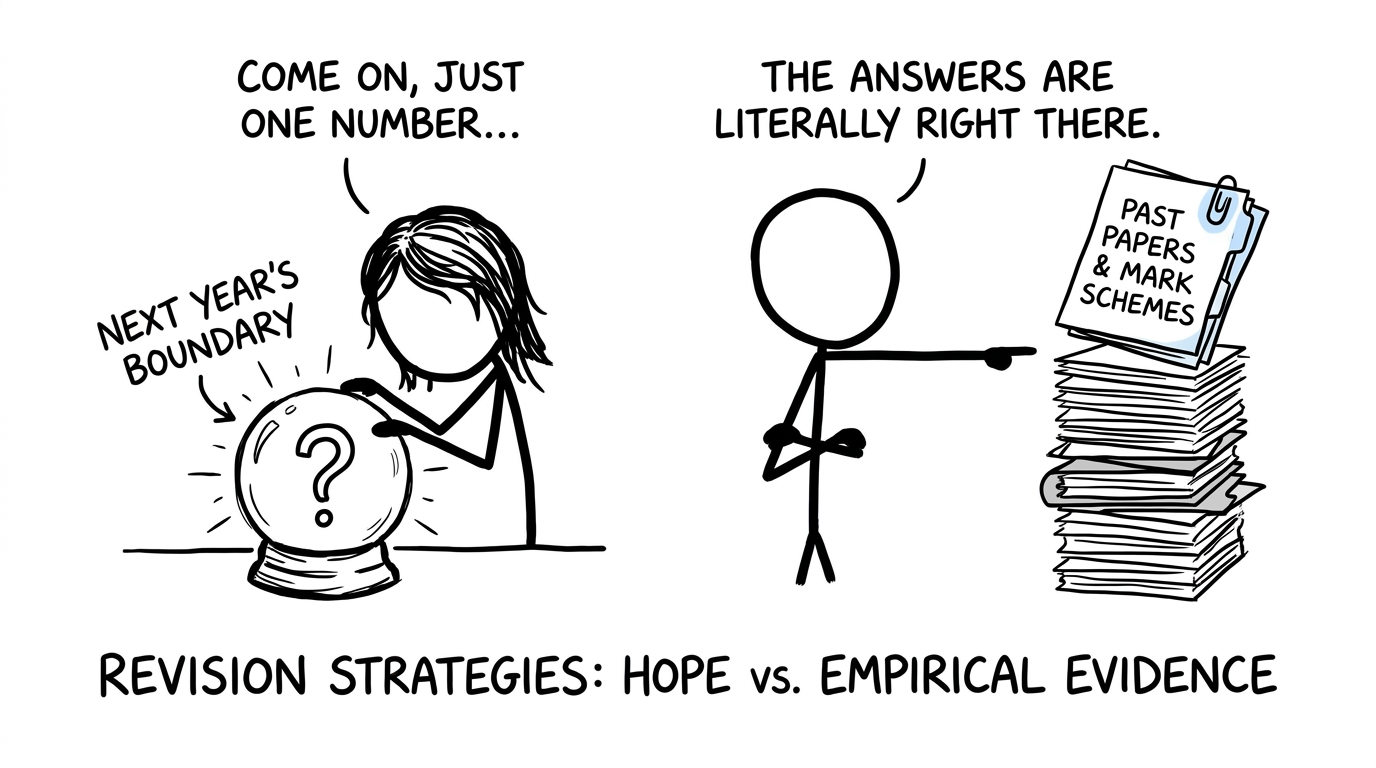 A crystal ball loses an argument with past papers and mark schemes
Common mistakes when reading grade boundaries
Comparing different specifications
An AQA boundary cannot be applied to an Edexcel, OCR or Eduqas paper. Always match the board, qualification code, series and option.
Treating component boundaries as final grades
Paper-level boundaries are often notional. Your qualification grade normally depends on the combined weighted total across the required components.
Assuming a lower boundary means easier grading
A low raw boundary may indicate that the assessment was more demanding. It does not automatically show that the required standard was reduced.
Predicting the next boundary from one year
A change from 2024 to 2025 cannot reveal the 2026 boundary. Final boundaries are set only after evidence from the completed assessments has been considered.
Marking generously
A boundary is only useful when the raw mark is reliable. Follow the mark scheme closely, including units, significant figures, written reasoning and acceptable alternatives.
Turn the trend into a revision decision
The history is interesting, but its lesson is practical: boundaries move, so resilient knowledge matters more than a guessed target. Complete papers from several years, compare each score with its matching boundary, and repair the topics that repeatedly cost marks.
Start with MathsGenie's free A-Level Physics revision hub. Use revision lessons and practice questions to strengthen weak areas, then test the improvement with past papers, predicted papers, mini tests, mark schemes and available solutions. The boundary tells you where one grade began. Careful revision determines how far above it you can finish.











