

A-Level Physics Career Paths After Results Day
A-level physics career paths explained: explore realistic degree, apprenticeship and career options in engineering, healthcare, data, energy and space.
Results day can make one letter feel unusually powerful. Yet a Physics grade is not a verdict on your future. It is information, evidence that helps you choose the next sensible step. The main A-level physics career paths include physics, engineering, healthcare science, energy, space, computing, data and teaching. You might enter through university, a higher or degree apprenticeship, a foundation year or another technical course.
For GCSE students, this matters before results day arrives. Physics-related routes are strongly mathematical, so the algebra, graphs, trigonometry and proportional reasoning you practise now can preserve choices later.
Your results-day route map
Use this short checklist before making a decision:
- Compare your result with the conditions of your university or apprenticeship offer.
- Read the exact entry requirements for every course; they vary considerably.
- Check whether A-level Maths is required alongside Physics.
- Consider foundation years and related courses rather than assuming one missed grade ends the route.
- Compare university with higher and degree apprenticeships.
- Ask what work you would actually enjoy, not just which course title sounds impressive.
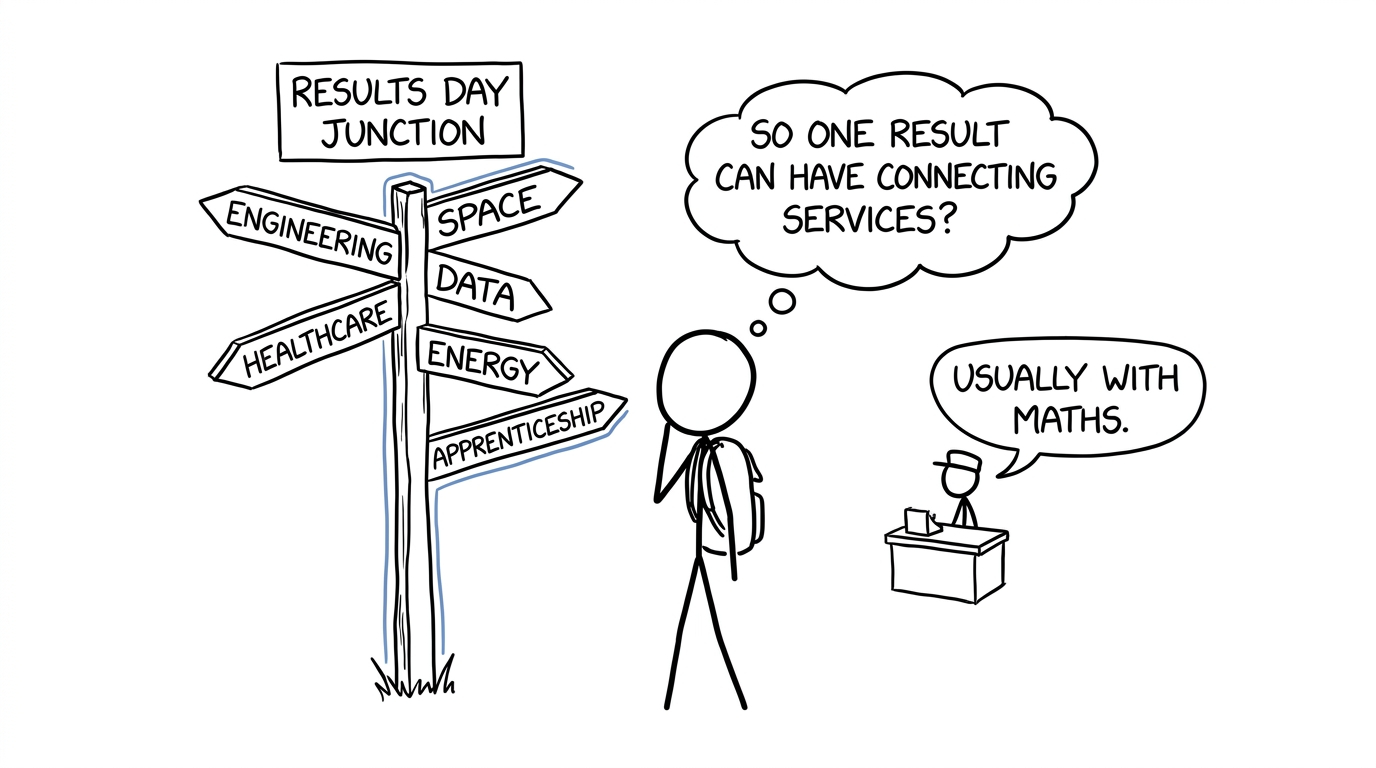 A student discovers that results day has connecting services to many careers
What does A-level Physics actually open up?
A-level Physics rarely qualifies someone for a specialist profession by itself. Instead, it provides access to further training while demonstrating useful abilities: analysing evidence, modelling systems, handling uncertainty, interpreting graphs and solving unfamiliar problems.
The mathematical element is substantial. Current UK A-level Physics specifications require at least 40%40\%40% of assessment marks to involve mathematical skills at Level 2 or above. That includes algebra, data handling, graphs, geometry and trigonometry. It is why a strong GCSE Maths foundation matters even when Physics is the long-term goal.
Students still building that foundation can use the GCSE Maths revision hub for exam-board resources and the AQA GCSE Physics course to see how mathematical methods appear inside scientific questions.
Career and course pairings to consider
Physics and scientific research
Possible course: Physics, astrophysics, theoretical physics or mathematical physics
Possible careers: Research physicist, laboratory scientist, materials scientist or science communicator
Physics degrees normally develop experimental work, programming and advanced mathematical modelling. Professional research roles often require postgraduate training, so this is usually a long route rather than a job entered immediately after A-levels.
Universities commonly ask for A-level Maths and Physics, but required grades differ. Some offer an integrated foundation year where the standard subject or grade requirements have not been met.
Engineering and technology
Possible course: Mechanical, aerospace, electrical, electronic, civil or general engineering
Possible careers: Design engineer, aerospace engineer, systems engineer, robotics engineer or renewable-energy engineer
Engineering converts physical principles into working systems. Mechanics can lead towards structures, vehicles and machines; electricity and fields connect with electronics, power networks and control systems.
Physics is valuable here, but course requirements are not interchangeable. Many engineering degrees require A-level Maths, while the requirement for Physics depends on the discipline and institution. Always inspect the current course page rather than relying on a general careers list.
Medical physics and healthcare science
Possible course: Physics, medical physics, biomedical engineering or healthcare science
Possible careers: Medical physicist, clinical scientist, imaging specialist or healthcare science practitioner
This route applies radiation, imaging, measurement and computing to diagnosis and treatment. Medical physicists may work with scanning technology, radiotherapy equipment and patient-safety systems. Becoming a registered clinical scientist requires approved education and professional training beyond A-level.
It suits students who like precise technical work but also want their decisions to have a direct human purpose.
Data, computing and quantitative work
Possible course: Physics, computer science, data science, mathematics or a related degree apprenticeship
Possible careers: Data analyst, software engineer, modelling scientist or machine-learning engineer
Physics students learn to move between measurements, equations and explanations. That way of thinking transfers well to programming and data. However, A-level Physics alone does not guarantee entry to every computing or data role. Coding experience, suitable further qualifications and a portfolio may also matter.
If this direction interests you, protect your mathematical fluency. The Edexcel A Level Maths revision course provides lessons, question banks, worksheets and exam practice for the next stage.
Energy, climate and environmental technology
Possible course: Physics, environmental physics, energy engineering, geophysics or electrical engineering
Possible careers: Renewable-energy engineer, energy analyst, geophysicist or climate modeller
Energy careers involve generation, storage, transmission and efficiency. Some roles are principally engineering; others concentrate on research, software, forecasting or environmental measurement. Read course modules carefully because two similarly named degrees can contain very different amounts of fieldwork, laboratory science and maths.
Space and aerospace
Possible course: Astrophysics, aerospace engineering, space science or electronic engineering
Possible careers: Satellite engineer, spacecraft systems engineer, astronomer or remote-sensing analyst
Space attracts attention, but the realistic job market is broader than becoming an astronaut. Satellites need electronics, software, materials, communications, testing and data analysis. A course with strong transferable engineering or computing content can therefore lead to space-sector work while keeping other industries open.
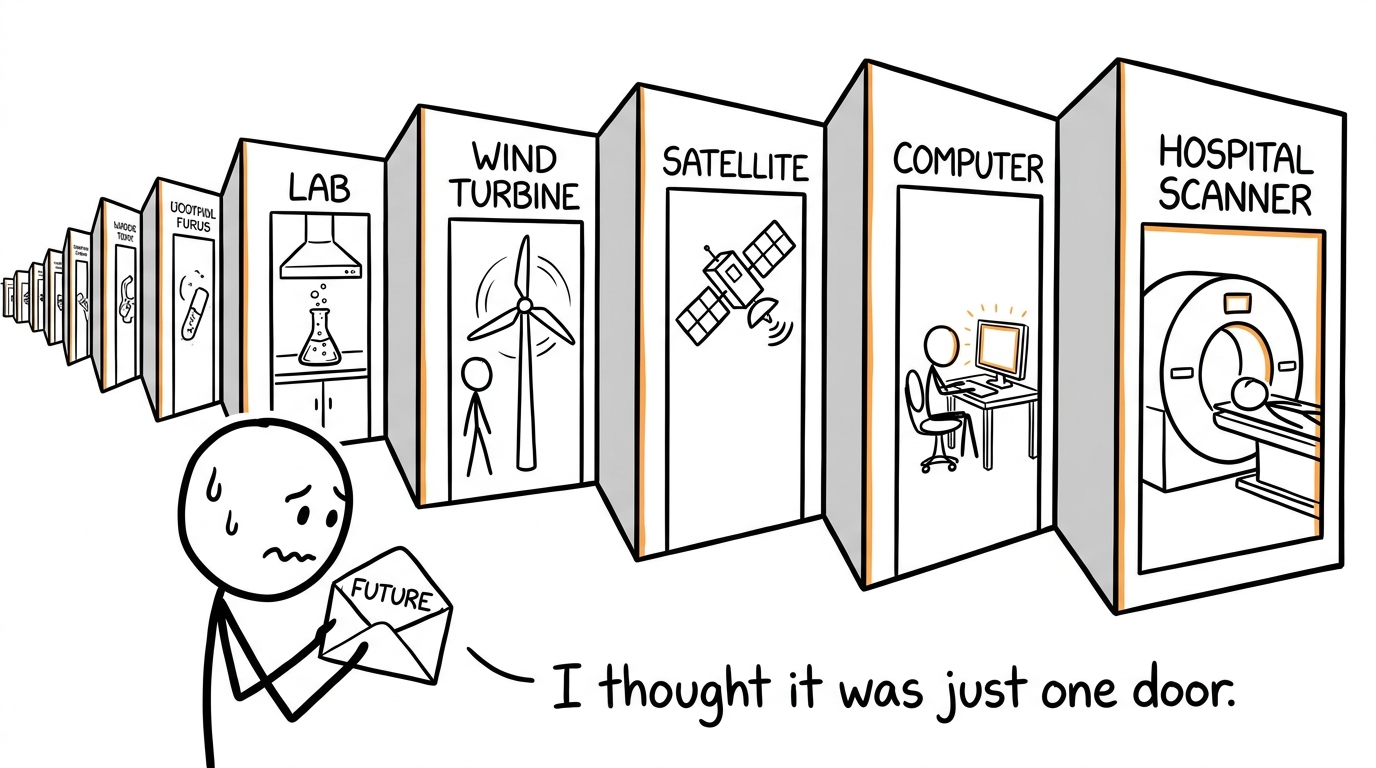 One results envelope unexpectedly unfolds into many career doors
University is not the only route
Higher and degree apprenticeships combine paid work with structured training. Physics-related possibilities can include nuclear science, robotics, space systems, engineering, laboratory science and data. Vacancies and entry requirements depend on the employer, and applications can involve interviews, aptitude tests or assessment centres.
The choice is not simply “degree or lesser option”. It is a choice between learning environments. University may offer broader academic exploration and independent research. An apprenticeship offers workplace experience, a salary and training connected to a particular role. The better route is the one that fits your goals and preferred way of learning.
What to do if your grade is different from expected
First, separate disappointment from decision-making. Check your confirmed offers and speak directly to the relevant university, college or employer. Do not assume that a missed condition automatically means rejection, and do not assume that a place is secure until its status is confirmed.
Possible next steps include:
- considering a related course with different requirements;
- applying through Clearing where suitable places are available;
- exploring an integrated foundation year;
- resitting where that is genuinely necessary for a specific goal;
- applying for apprenticeships or taking a planned year to strengthen an application.
If you are checking how your marks relate to a grade, use the relevant official information rather than guessing from previous years. MathsGenie also provides an AQA A Level Physics grade-boundaries page for organised reference.
Common mistakes when choosing a Physics route
Treating one grade as a complete career forecast
A result affects immediate options, but careers are built through several decisions: qualifications, experience, technical skills and the ability to adapt.
Looking only at course titles
Read modules, assessment methods, accreditation information and placement options. “Physics”, “engineering physics” and “medical physics” can lead through different curricula.
Forgetting the Maths requirement
Many physics and engineering degrees require A-level Maths. GCSE students should therefore check sixth-form subject requirements early and strengthen higher-tier algebra, graphs and trigonometry.
Assuming every Physics career requires a Physics degree
Engineering, computing, mathematics and apprenticeships can lead into sectors that use physics. Start with the work you want to do, then investigate credible routes towards it.
Revising passively
Reading feels safe, but questions expose what you can actually apply. Use the A Level Physics revision hub, choose your exam board, then combine revision guides with timed questions. AQA students can use the AQA Physics question bank, while Edexcel students can work through the Edexcel Physics revision guides.
Turn the next result into a wider choice
The best reason to revise is not to collect a letter. It is to retain options. Every graph interpreted correctly and every equation rearranged confidently makes the next course slightly more accessible.
Start with the MathsGenie A Level Physics resources. Use revision lessons to rebuild understanding, practice questions to find weak areas, and mark schemes to learn what examiners reward. Then test that knowledge with past papers, predicted papers and mini tests. Results day cannot promise one perfect career, but careful preparation can give you several good paths from which to choose.










