

A-Level Maths Results Day Questions Answered
A-level maths results day questions answered for 2026, including grades, UCAS offers, Clearing, marking reviews, resits and next steps.
Results day can make a few seconds feel unusually heavy. A student opens an envelope; a parent watches their expression; months of work suddenly become one letter on a page. Yet most A-level maths results day questions have practical answers. In 2026, A-level results are released at 8:00 am8{:}00\text{ am}8:00 am on Thursday 13 August. Your school or college will explain how to collect them, while UCAS will show what has happened to any university application.
The most important rule is simple: do not make a rushed decision alone. Teachers, examinations officers and university admissions teams can help you understand what the result means and what to do next.
Your results-day checklist
Before results day, have these ready:
- your UCAS sign-in details and application number;
- your firm and insurance offer conditions;
- your school or college's collection arrangements;
- contact details for your choices;
- a short list of possible Clearing courses;
- a charged phone and somewhere to record names and advice.
Students still preparing for GCSEs can use the same principle: uncertainty feels smaller when there is a plan. The GCSE Maths revision hub brings exam-board resources, questions and papers together in one place.
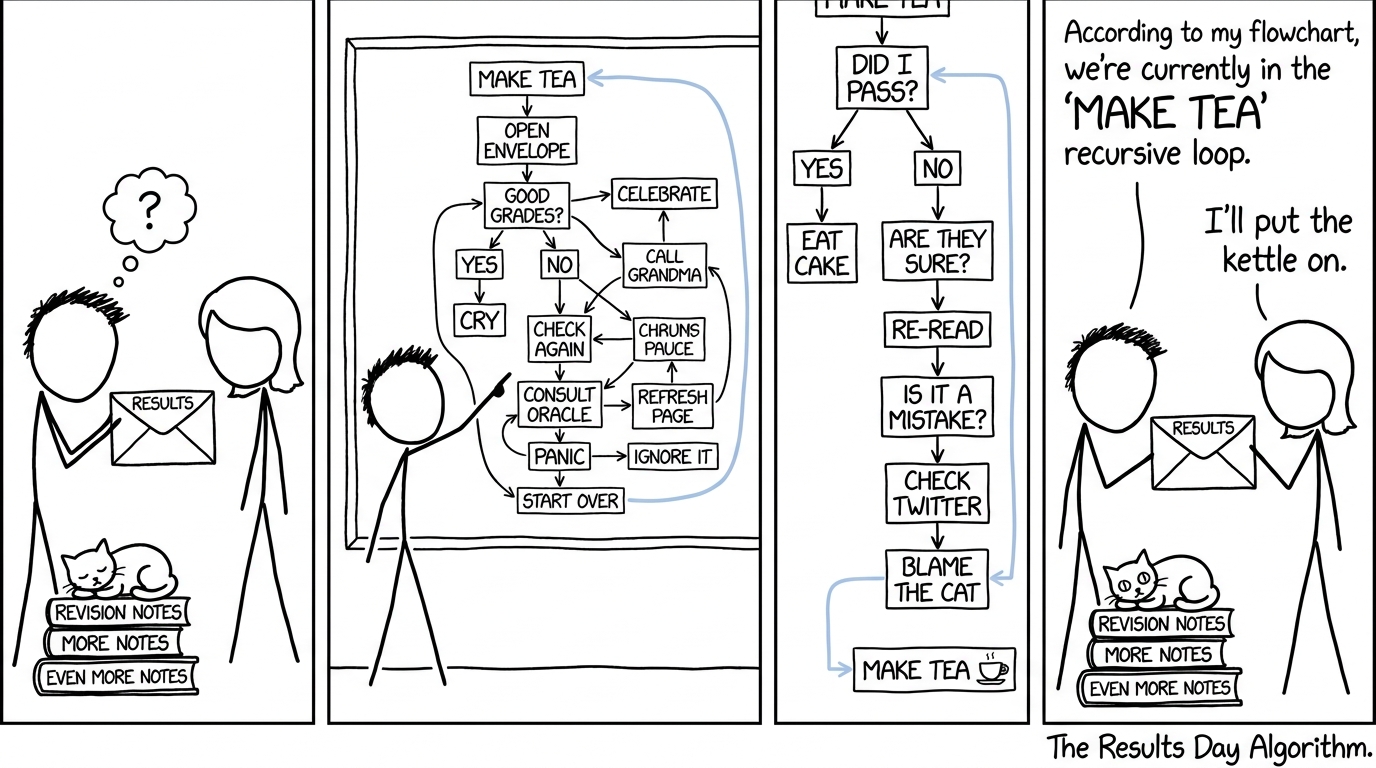 Student and parent facing a results envelope beside an overcomplicated flowchart
When is A-level maths results day in 2026?
A-level, AS and T Level results are released to students at 8:00 am8{:}00\text{ am}8:00 am on Thursday 13 August 2026 in England, Wales and Northern Ireland. Exact collection or online-access arrangements depend on your school or college, so check its instructions rather than assuming the building will open at a particular time.
GCSE results follow on Thursday 20 August 2026. That matters to younger students because the same calm process applies: collect the facts, speak to the right person and avoid treating the first emotion as the final verdict.
Where will I see my A-level maths grade?
Your official grade comes from your school or college, usually through a results slip, portal or email. UCAS does not replace that result. It shows the status of your university application, such as whether your firm or insurance place has been confirmed.
Check both, but remember that they answer different questions. Your results slip tells you what you achieved. UCAS tells you what a university has decided.
What do marks and grade boundaries mean?
Your result may include a grade, component marks and an overall mark. Grade boundaries are set after papers have been marked because exam boards must consider the difficulty of that year's assessment. They can therefore change between years and between specifications.
A higher boundary does not automatically mean marking was unfair, and there is no fixed quota limiting how many students can receive each grade. Ask your teacher to compare your component marks with the published boundaries for your exact exam board and specification.
If you are preparing for a future sitting, Edexcel A-level maths past papers are useful because their mark schemes show how marks are awarded, not merely whether a final answer is correct.
What happens if I meet my university offer?
If you meet the conditions and your place is confirmed, read the UCAS status carefully and wait for your university's next instructions. These may cover enrolment, accommodation or documents that still need to be supplied.
Do not decline a confirmed place simply to explore alternatives. Declining normally releases the place and can also affect your insurance choice. Speak to an adviser and the relevant university before changing anything.
What if I miss my A-level maths offer?
Missing an offer does not always mean an immediate rejection. A university may still accept you, keep the decision pending or propose a different course, start date or entry route.
First, check UCAS. If the decision is pending, contact the university calmly and ask what information it needs. If neither your firm nor insurance choice accepts you, you may use Clearing. Have your grades and course questions ready before calling.
This is a decision point, not a judgement on your ability. One grade can alter a route without ending the destination.
Why does UCAS still say my place is conditional?
The university may be waiting for a result, checking whether all conditions have been met or considering applicants who narrowly missed an offer. Look for messages in your application and email inbox, then contact admissions if the position remains unclear.
Avoid entering Clearing or declining anything while a choice is still considering you unless you have received clear advice. A pending decision may simply require patience or missing information.
How does Clearing work?
Clearing lists courses with vacancies for applicants who do not hold a place or who become eligible for another reason. In 2026 it runs from 2 July to 19 October, although availability changes as courses fill.
Research the course rather than focusing only on the university name. Ask about modules, accommodation, travel, professional accreditation and whether your maths background meets the entry requirements. Only add a Clearing choice after the university has given you permission to do so.
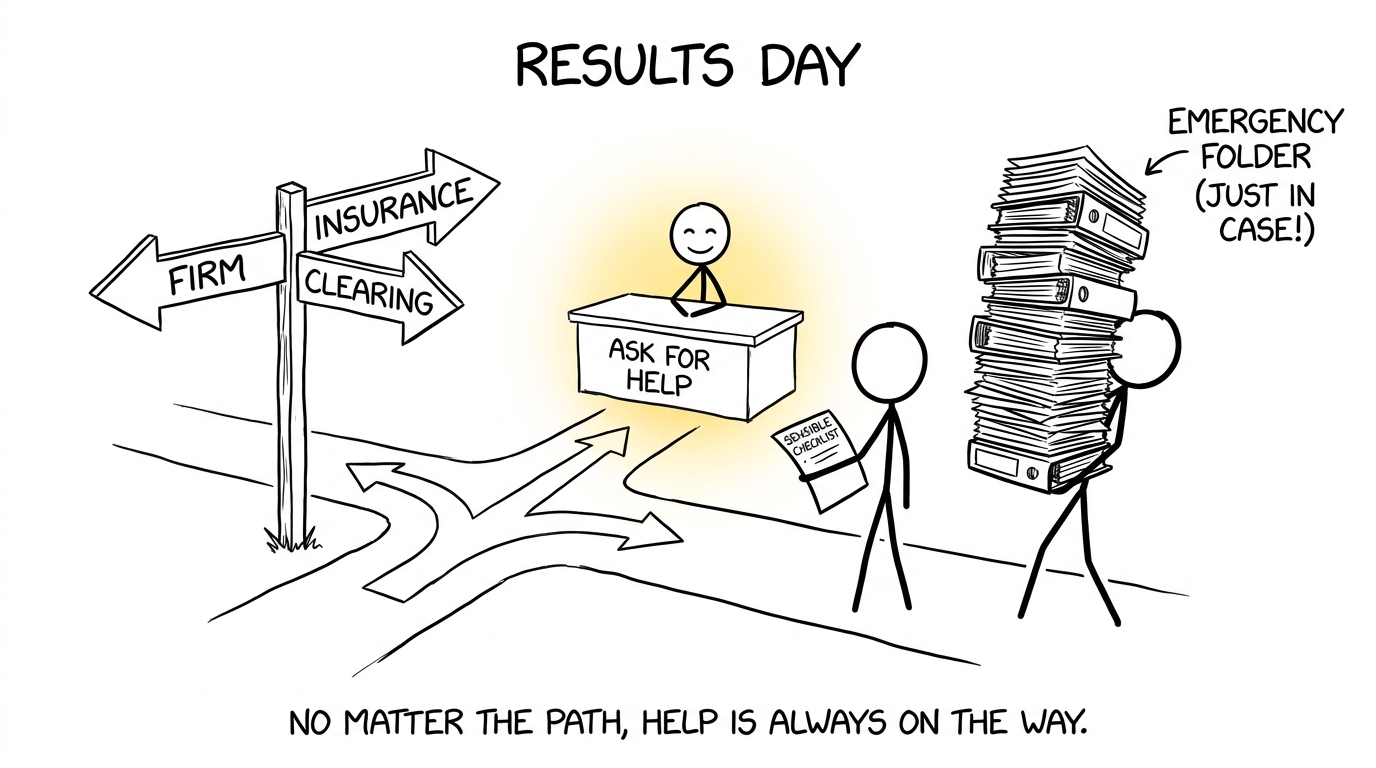 Results-day signpost pointing towards firm, insurance and Clearing routes
Can I request a review of marking?
Speak to your school or college immediately if the result appears inconsistent with your performance, particularly when a university place depends on it. Staff can request access to your script and advise whether a review is reasonable.
A review checks whether the original marking correctly applied the mark scheme; it is not an automatic fresh re-mark. Your mark can rise, remain unchanged or fall, and a changed mark can move the grade in either direction. Written consent is normally required, and fees may apply.
For the June 2026 series, awarding bodies must receive priority A-level review requests by 20 August and standard review requests by 24 September. Your centre may set an earlier internal deadline. A grade boundary itself cannot be appealed.
Should I resit A-level maths?
A resit may be sensible if a particular grade is essential for your next step and you have a realistic improvement plan. Before deciding, check university policies, examination-entry arrangements, costs and whether you need to resit the full qualification.
Revision should begin with diagnosis rather than repetition. Use the Edexcel A-level maths revision hub for lessons, topic questions, videos and papers, or explore the broader A-level maths topic resources. A difficult area such as calculus can then be targeted through resources including A-level integration revision.
How can parents help on results day?
The best support is calm, practical and led by the student. Help organise documents, write down advice and provide space to think. Universities usually need to speak directly to the applicant unless nominated access has been arranged.
Try not to compare results with friends or turn the first conversation into a post-mortem of every exam. The useful question is not, “How did this happen?” It is, “What information do we need next?”
Common results-day mistakes
Several avoidable mistakes make an emotional morning harder:
- relying on UCAS without collecting the official grades;
- assuming a missed offer means the university has rejected you;
- declining a confirmed place before checking the consequences;
- requesting a marking review without accepting that marks can fall;
- missing a centre's internal post-results deadline;
- choosing a Clearing course without researching its content;
- treating predicted grade boundaries as official boundaries.
For GCSE students watching older siblings go through this process, preparation starts much earlier. Combine topic practice with GCSE predicted papers, then use mark schemes to identify where marks are being lost. AQA students can find tier-specific support in the AQA GCSE maths revision hub.
Turn the result into a next step
A result matters, but it is information rather than identity. Read it accurately, ask for advice and take one decision at a time.
If the next step is A-level revision or a resit, make MathsGenie your starting point. Use free revision lessons to rebuild understanding, practice questions and mini tests to expose weak areas, then past papers, predicted papers, mark schemes and video solutions to prepare under exam conditions. Results day closes one chapter. A sensible plan opens the next.











