A-Level Maths Results Day: AQA vs OCR Boundaries
A-level maths AQA vs OCR grade boundaries compared using 2025 data, with results-day guidance, percentage context and revision steps for students.
Results day compresses two years of work into a few seconds. Before opening an envelope or logging into a portal, it is natural to wonder whether another exam board had lower boundaries. The short answer to the A-level maths AQA vs OCR grade boundaries question is that OCR Mathematics A had lower raw boundaries than AQA in summer 2025. But that does not prove OCR was easier. Boundaries respond to the difficulty of each paper and are confirmed only after marking.
For students awaiting results in 2026, A-level results day is Thursday 13 August. The 2026 boundaries are not known in advance, so the latest complete comparison is summer 2025.
Results-day comparison checklist
Before comparing two sets of boundaries, check:
- the exam series and year;
- the exact specification, especially OCR Mathematics A versus OCR Mathematics B (MEI);
- the maximum available mark;
- the overall subject boundary, not a notional paper boundary;
- percentages when maximum marks differ.
MathsGenie's A Level grade boundaries hub brings the main exam boards together, while the dedicated pages provide the detail behind each qualification.
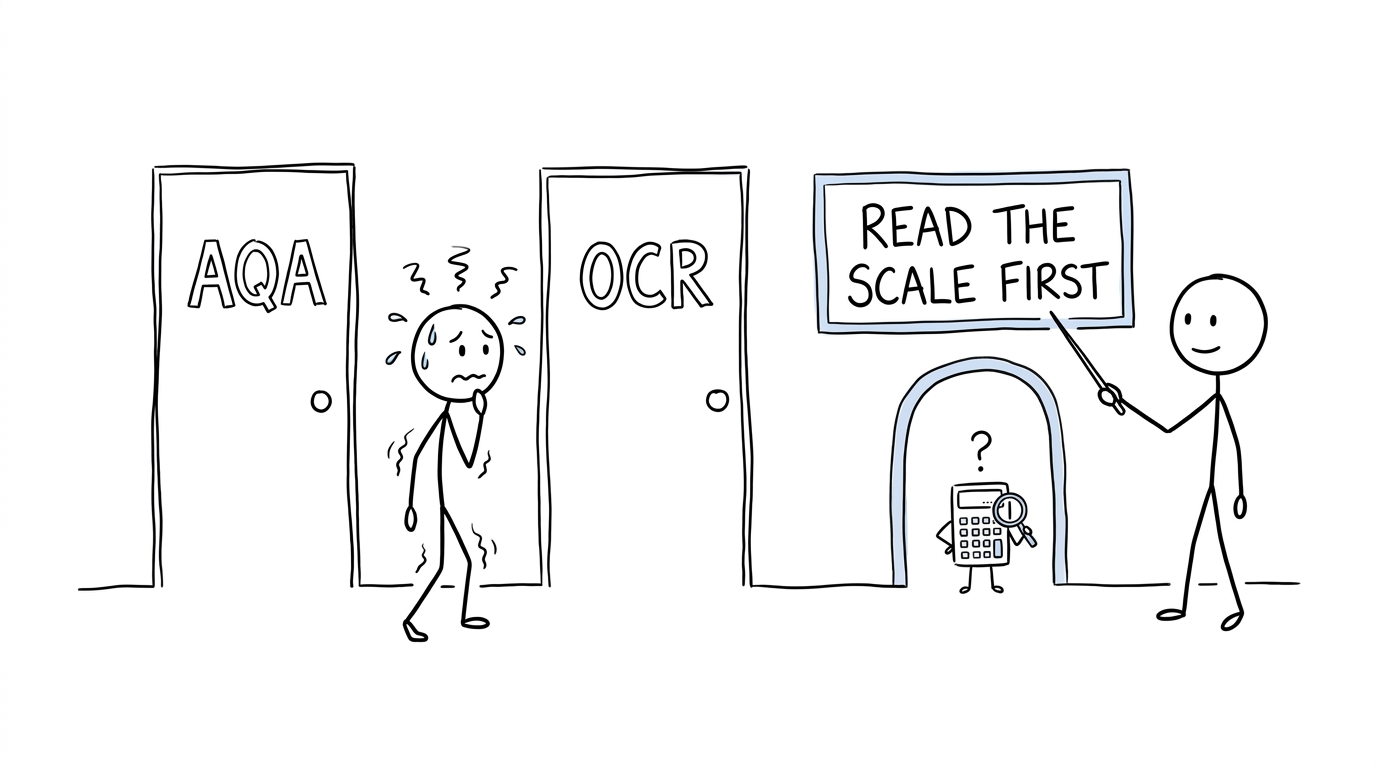 A student choosing between AQA and OCR doors while a teacher advises reading the scale first
AQA vs OCR A-Level Maths grade boundaries
These are the confirmed overall subject boundaries for June 2025. OCR offers Mathematics A and Mathematics B (MEI), so both are included.
| Board and specification | Maximum mark | A* | A | B | C | D | E |
|---|---|---|---|---|---|---|---|
| AQA Mathematics | 300300300 | 260260260 | 221221221 | 183183183 | 145145145 | 108108108 | 717171 |
| OCR Mathematics A | 300300300 | 242242242 | 196196196 | 163163163 | 130130130 | 979797 | 646464 |
| OCR Mathematics B (MEI) | 275275275 | 226226226 | 190190190 | 159159159 | 128128128 | 979797 | 666666 |
You can explore the complete historical figures on the AQA A Level grade boundaries page and the OCR A Level grade boundaries page.
For AQA and OCR Mathematics A, both totals are out of 300300300. In 2025, the A* boundary was 260260260 for AQA and 242242242 for OCR Mathematics A, a difference of 181818 raw marks. At grade A, the difference was 252525 marks.
OCR Mathematics B (MEI) is out of 275275275, so its raw totals should not be compared directly with a qualification out of 300300300.
Comparing boundaries as percentages
A percentage comparison places qualifications with different maximum marks on a common scale:
boundary percentage=grade boundarymaximum mark×100\text{boundary percentage}=\frac{\text{grade boundary}}{\text{maximum mark}}\times 100boundary percentage=maximum markgrade boundary×100| Grade | AQA Mathematics | OCR Mathematics A | OCR Mathematics B (MEI) |
|---|---|---|---|
| A* | 86.786.786.7 per cent | 80.780.780.7 per cent | 82.282.282.2 per cent |
| A | 73.773.773.7 per cent | 65.365.365.3 per cent | 69.169.169.1 per cent |
| B | 61.061.061.0 per cent | 54.354.354.3 per cent | 57.857.857.8 per cent |
| C | 48.348.348.3 per cent | 43.343.343.3 per cent | 46.546.546.5 per cent |
| D | 36.036.036.0 per cent | 32.332.332.3 per cent | 35.335.335.3 per cent |
| E | 23.723.723.7 per cent | 21.321.321.3 per cent | 24.024.024.0 per cent |
The table makes comparison fairer, but it still does not rank exam boards by difficulty. Ofqual requires boards to maintain comparable standards. Boundaries move because papers cannot have precisely identical difficulty every year, and examiners consider statistical evidence alongside samples of students' work.
What the figures mean on A-level maths results day
A grade boundary is the minimum overall raw mark needed for a grade. AQA Mathematics uses three papers worth 100100100 marks each. OCR Mathematics A also has three papers worth 100100100 marks each, while OCR Mathematics B (MEI) uses a different assessment structure and total.
Your final grade is based on the combined qualification mark. A boundary shown for an individual component may be notional or illustrative rather than a separate grade awarded for that paper. Always identify your specification code and use the overall row.
If you know your paper marks, the AQA predicted grade calculator and OCR predicted grade calculator can combine them using the correct historical boundaries. They are useful for checking published results, but past thresholds cannot predict a future series exactly.
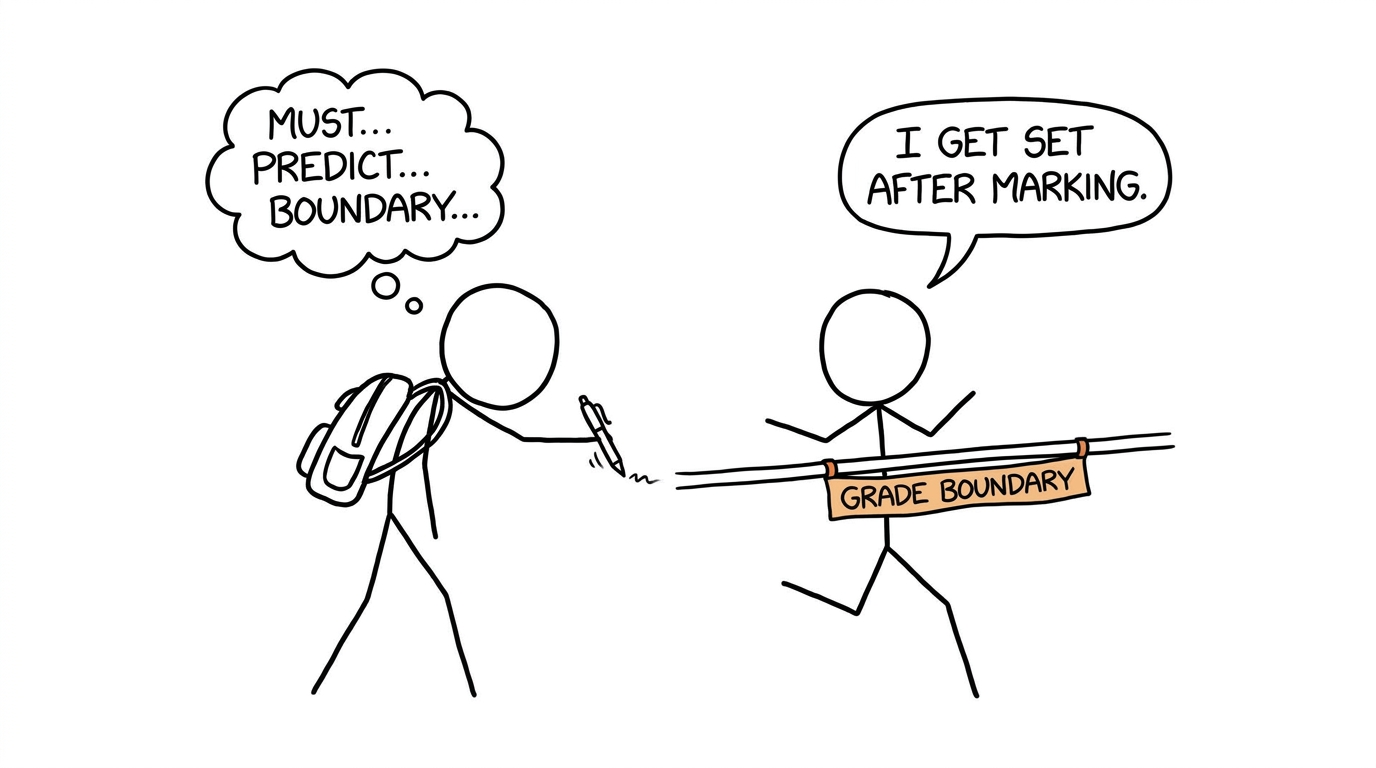 A moving grade-boundary finish line explains that it is set after marking
What GCSE students should take from the comparison
If you are currently preparing for GCSE maths, do not choose an A-level course simply because one board had lower boundaries in one year. Schools and colleges usually select the specification, and the raw threshold adjusts to the challenge of that examination series.
A better question is whether you enjoy the algebra, graphs and problem-solving that become more demanding at A Level. Explore the free A Level Maths revision lessons and topic questions to see how GCSE higher-tier ideas develop. The jump becomes less mysterious when you can see the next step.
For current A-level students, historical boundaries are best used as planning ranges rather than promises. Complete papers under timed conditions, mark them carefully, and record whether lost marks came from knowledge, method, accuracy or time. MathsGenie's AQA A Level past papers and mark schemes support that process, while A Level predicted papers offer further exam-style practice.
Common mistakes when comparing AQA and OCR
Treating a lower boundary as an easier qualification
A lower boundary often reflects a more demanding paper. It does not mean students received the same grade for weaker mathematical understanding.
Comparing OCR MEI raw marks directly with AQA
OCR Mathematics B (MEI) is out of 275275275, while AQA is out of 300300300. Convert both to percentages before drawing even a cautious comparison.
Using the wrong year
Grade boundaries belong to a specific exam series. A June 2025 figure cannot be applied to a 2026 result.
Adding paper-level grades
A-level maths grades come from the total qualification mark. Do not turn three component estimates into three grades and average them.
Revising to the exact boundary
Aiming for last year's minimum leaves no room for a harder paper, marking errors or an unfinished question. Build a sensible margin through regular practice.
The useful takeaway
The 2025 data show that OCR Mathematics A had lower raw and percentage boundaries than AQA across grades A* to E, while OCR Mathematics B (MEI) sat between them at several grades. That describes one examination series; it does not show that one board offers an easier route.
On results day, check the exact board, specification, year and overall mark before interpreting your grade. Before results day, focus on what remains controllable: revision lessons, timed past papers, predicted papers, practice questions, mini tests and careful use of mark schemes and video solutions. Start with MathsGenie's AQA Maths boundaries or OCR Maths boundaries, then use the revision planner to turn the comparison into a practical next step.