

A-Level Maths Resit UCAS Application Guide
A-level maths resit UCAS application advice: declare results honestly, explain what changed, show your revision plan and reapply confidently to university.

Results day can make two years of work feel as though they have been compressed into one letter. If that letter is below the grade you needed, an A-level maths resit UCAS application is a valid next step. The essential approach is simple: declare every result accurately, check each course's resit policy, explain the change briefly and show credible evidence of a stronger plan.
A resit is not the whole story of your application. What matters is whether admissions teams can see honesty, academic readiness and purposeful improvement.
Your resit application checklist
Before submitting your application:
- enter your original Maths result and your pending retake
- confirm your exam board and resit arrangements
- check the resit policy for every individual course
- arrange a realistic predicted grade with your referee
- explain what has changed without making excuses
- provide evidence of structured revision
- ask your referee to add relevant context
UCAS requires applicants to declare completed qualifications, unsuccessful grades, pending qualifications and results from multiple sittings. Do not replace the original grade with only the hoped-for resit grade.
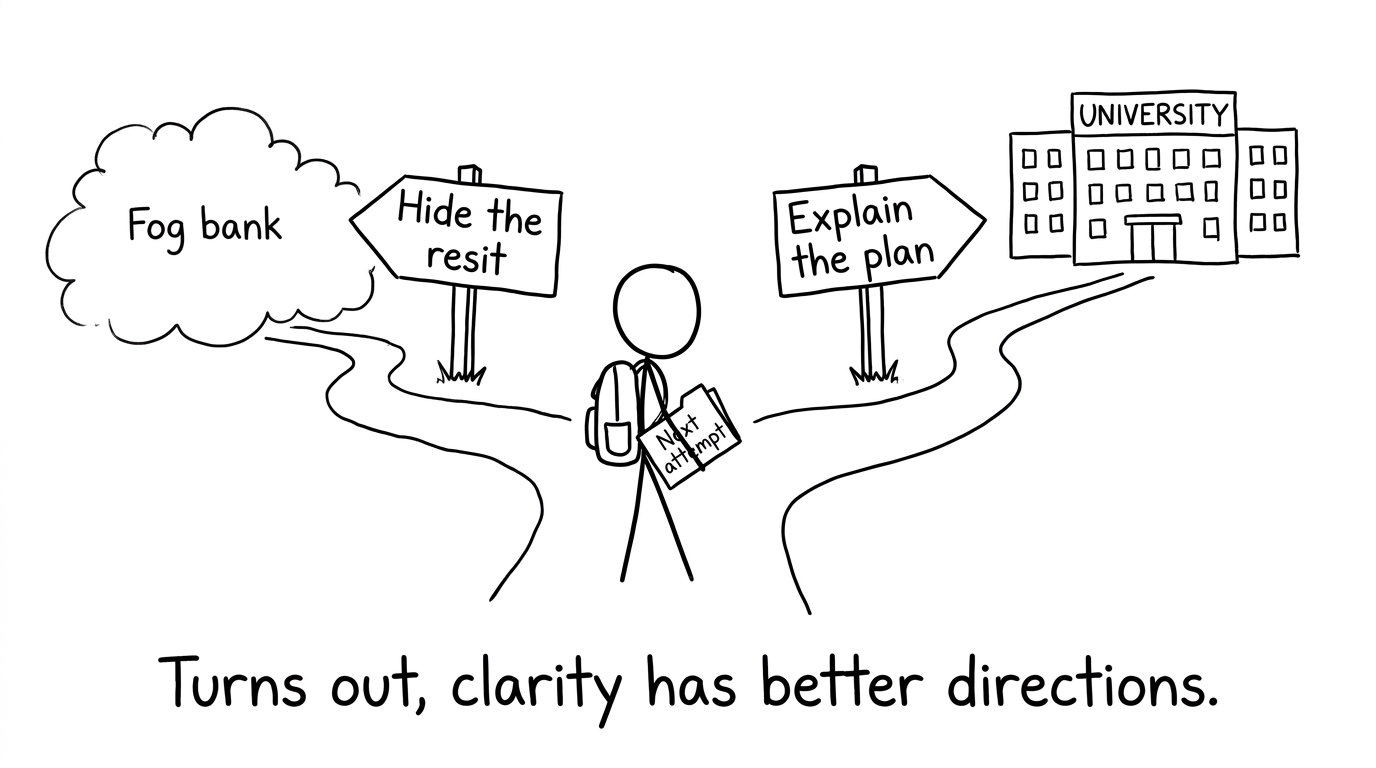 A student choosing between hiding a resit and explaining a clear plan
What to do after A-level results day
A-level results day in 2026 is Thursday 13 August. Before committing to a retake, check whether your firm or insurance university has accepted you, is still considering you or has offered an alternative course. You can also investigate Clearing and speak to your school about a review of marking if there is a genuine reason to question the result.
If a resit remains the right choice, contact your school, college or an approved exam centre promptly. Confirm the specification, entry arrangements and any non-exam assessment requirements. AQA, Edexcel and OCR courses are not interchangeable, so revise for the board under which you will sit the examination.
Then research universities course by course. Resit rules vary, particularly for highly competitive degrees such as medicine. Never assume that one university's policy applies to another, and ask admissions teams directly if published guidance is unclear.
How to enter an A-level Maths retake on UCAS
Your education section should show both attempts clearly:
- add the original A-level Maths qualification with its achieved grade
- add the retake as a separate qualification with the result shown as pending
- use the correct examination centre, awarding organisation and expected qualification date
- include every other required completed and pending qualification
Your referee can supply a predicted resit grade. That prediction should be supported by current performance rather than aspiration alone, perhaps through timed assessments, mock papers or consistent topic-test results.
Use the A Level Maths revision hub to select the correct exam board. Separate resources are available for Edexcel A Level Maths, AQA A Level Maths and OCR MEI A Level Maths.
Explaining a resit on UCAS positively
For 2026 entry onwards, the UCAS personal statement uses three structured questions with a combined limit of 4,000 characters. The second question asks how your qualifications and studies have prepared you for the course. That may be the natural place to mention a relevant Maths retake, but the explanation should not dominate your answer.
A useful structure has three parts.
State the position plainly
Use one calm sentence. Avoid hiding the result, but do not turn it into a dramatic opening.
Example wording:
I am retaking A-level Mathematics to strengthen the quantitative foundation required for this course.
Explain what changed
Focus on specific actions. “I am working harder” is impossible to evaluate; a routine built around diagnostic papers, targeted topic practice and timed retesting is concrete.
Example wording:
Reviewing my first result showed that my revision had not included enough timed, mixed practice. I now use past papers to identify weaker topics, complete focused question sets and retest them under examination conditions.
Connect improvement to the degree
End with academic relevance rather than a request for sympathy.
Example wording:
This process has improved my independence, accuracy under pressure and willingness to analyse errors, all of which will support the mathematical demands of the degree.
Only use wording that is true. Admissions tutors are not looking for a polished slogan. They need a credible account of what you learnt and why the next outcome could be different.
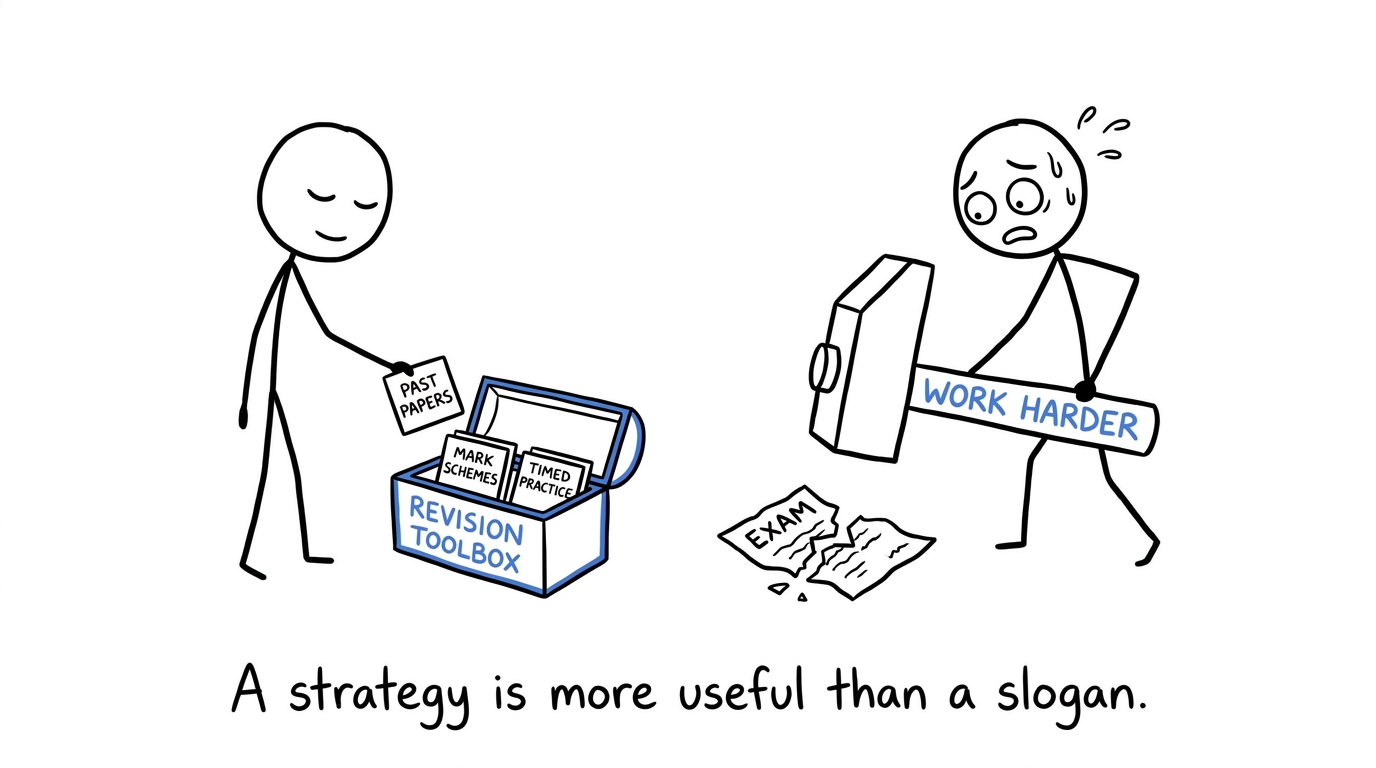 A student building a revision toolbox while another tries to use one giant tool
Let your reference carry important context
If illness, bereavement, caring responsibilities, disrupted education or another serious circumstance affected your first sitting, discuss it with your referee. The reference is often a better place for verified context because it can explain the situation independently.
Your own answer can remain concise and forward-looking. Do not share sensitive detail merely because you think an application needs a dramatic explanation. Ask each university whether it has a separate mitigating-circumstances process, and follow that process carefully.
Turn the explanation into evidence
A convincing A-level Maths retake application needs a revision system behind the words. Start with a timed paper, mark it accurately and create a short error log. Categorise each lost mark as a knowledge gap, an incomplete method or an examination-technique problem. Then revise the exact issue before attempting similar questions again.
MathsGenie's Edexcel past papers combine papers with mark schemes, while the AQA past-paper collection covers complete examination series. Topic lessons, practice questions and video solutions help you repair gaps before returning to full papers. Predicted papers are most useful later, once they supplement rather than replace official past-paper practice.
Record dates, paper marks, recurring errors and corrected topics. This gives your teacher better evidence for a predicted grade and gives you something truthful to describe when explaining the resit on UCAS.
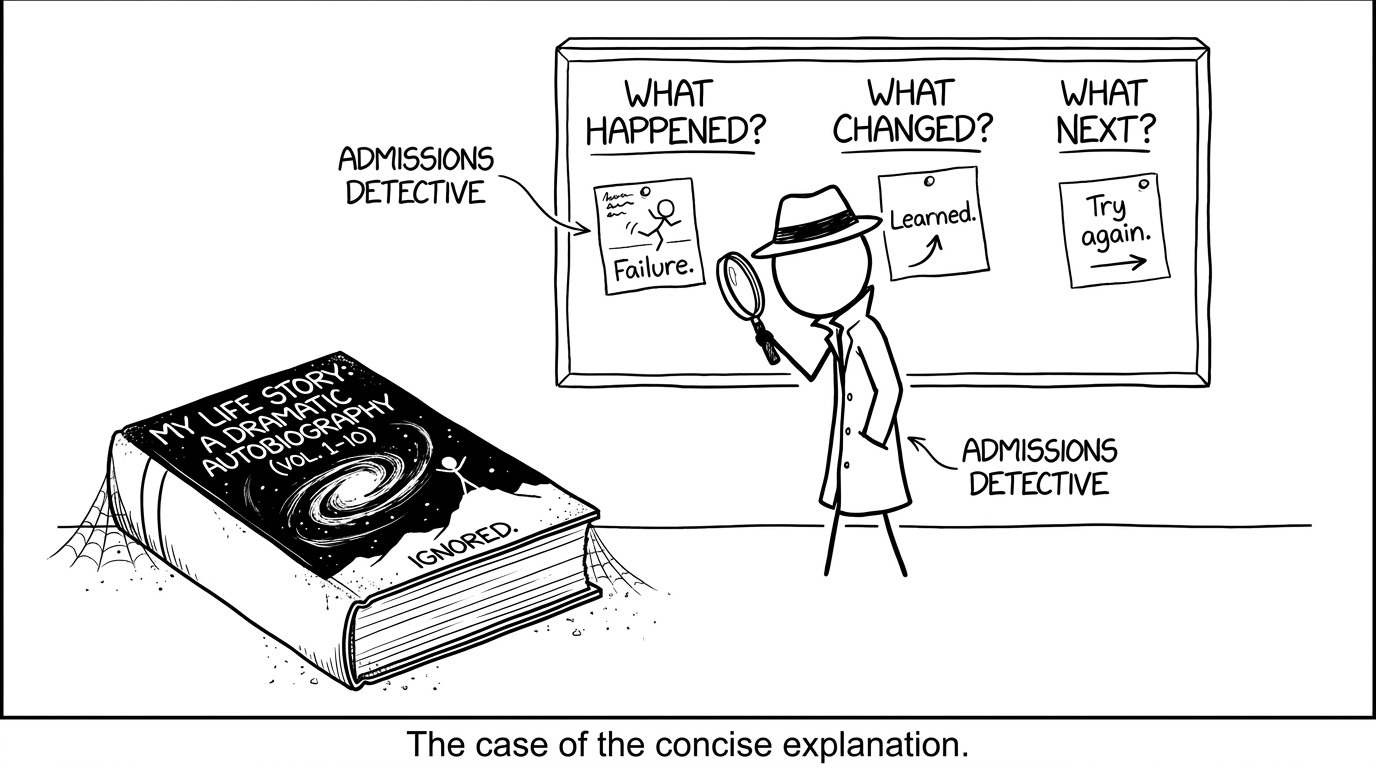 An admissions form detective investigating three concise clues
Common mistakes to avoid
Omitting the original result
UCAS expects all relevant qualifications and attempts to be declared. Missing information can create a more serious problem than the resit itself.
Writing a long defence
Your application still needs to show why you suit the course. Explain the resit briefly, then return to subject knowledge, preparation and academic interests.
Blaming the paper or exam board
A difficult paper affected the whole cohort. Concentrate on factors you can evidence and changes you can control.
Making unsupported promises
A predicted grade is not proof by itself. Build evidence through marked assessments and properly timed papers.
Applying without checking policies
A university may accept resits generally while a particular course applies additional conditions. Check the current course page and seek written clarification where necessary.
Make the second attempt different
A resit can be framed positively, but only when the plan beneath it is real. Declare the result, keep the explanation proportionate and demonstrate how your approach has become more disciplined.
Begin with the free MathsGenie A Level Maths resources. Use revision lessons to rebuild understanding, practice questions to develop fluency, and past papers, predicted papers, mark schemes and video solutions to measure progress. Your UCAS explanation then becomes more than wording. It becomes a concise account of work already under way.










