

A-Level Maths Remark: Results Day Guide
A-level maths remark guidance for results day: understand reviews of marking, 2026 deadlines, risks and when requesting one may be worthwhile.
Results day can turn a few marks into something that feels much larger. If your result is below the grade you expected, an A-level maths remark may be worth considering, but only after checking the evidence. The official service is called a review of marking. It checks whether the mark scheme was applied correctly; it is not a fresh re-mark from the beginning.
For summer 2026, A Level results are released on 13 August. Speak to your school or college immediately if a university place depends on the outcome because the exam-board deadline for a priority review is 20 August 2026. Your centre may set an earlier internal deadline.
Your results-day decision checklist
Before requesting a review, ask:
- How many marks separate me from the next grade boundary?
- Which individual paper was weaker than expected?
- Has my maths teacher examined the marked script?
- Can they identify a possible marking or clerical error?
- Does a university, apprenticeship or course place depend on the grade?
- Am I prepared for the mark and grade to rise, stay unchanged or fall?
- What are my centre's deadline and fee arrangements?
Check the official boundary for your exact board and series rather than relying on estimates. MathsGenie publishes the latest A Level Maths grade boundaries and an Edexcel A Level grade calculator to help you understand your position.
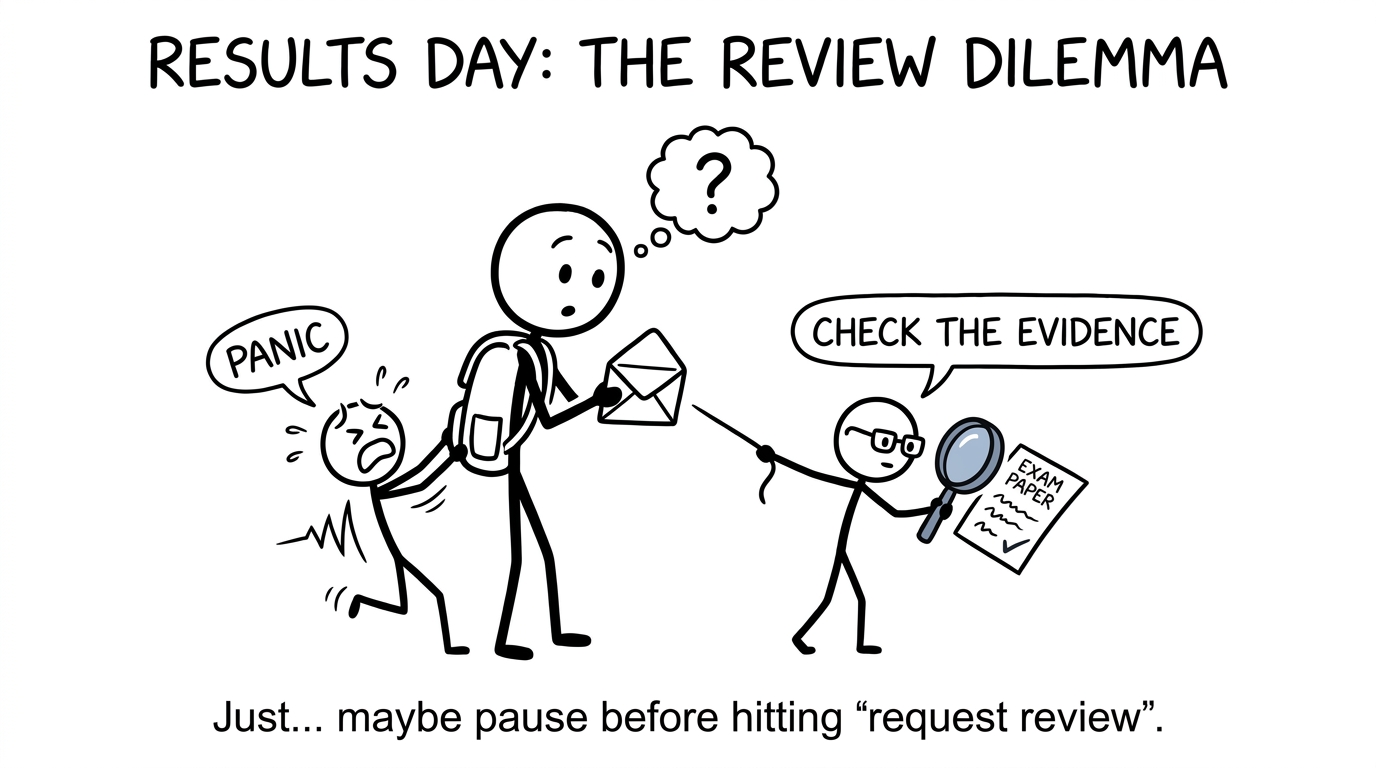 A student choosing between panic and checking the evidence on results day
How the A-level maths re-mark process works
Speak to your school or college
Students normally cannot submit a review directly to AQA, Pearson Edexcel, OCR or Eduqas. Contact your maths teacher and exams officer as soon as possible. Private candidates may be able to approach the awarding organisation directly or work through the centre that entered them.
Your centre must obtain your written consent. That matters because there is no grade protection for a review of marking: your result can go up, remain unchanged or go down.
Confirm your marks and grade boundary
Find your total mark, the boundary above it and, where available, your component marks. Being one or two marks short does not prove that marking was wrong. It simply means a small justified correction could affect the final grade.
A large gap does not automatically rule out a review either, but the evidence needs to be stronger. The decision should rest on the script, not disappointment alone.
Request access to the marked script
Ask whether your centre can obtain your marked papers through the exam board's Access to Scripts service. A maths teacher can then compare your work with the mark scheme and look for:
- an unmarked page or response;
- marks that may not have been totalled or recorded correctly;
- a valid alternative method that appears to have been overlooked;
- method or accuracy marks that may have been applied inconsistently;
- follow-through work that deserves consideration under the mark scheme.
Mathematics can feel completely objective, but multi-stage solutions still require examiners to interpret working against detailed marking instructions. A teacher who understands those instructions is better placed to judge the script than a raw mark alone.
If your university place is at risk, do not allow a script request to make you miss the priority-review deadline. Ask your exams officer what can be obtained quickly.
Choose the appropriate service
A clerical re-check checks matters such as whether all responses were marked and whether marks were added and recorded correctly.
A review of marking includes clerical checks and asks a reviewer to decide whether the original mark scheme was applied correctly. It does not mean every solution is marked again without reference to the original decision.
A priority review of marking is the faster A Level service, generally used when a higher-education place is pending. For the June 2026 series, the JCQ deadline is 20 August 2026. The deadline for a standard review is 24 September 2026.
Exam boards charge different fees, and your centre decides whether to pass a fee to you. Ask for the current cost and refund policy before consenting.
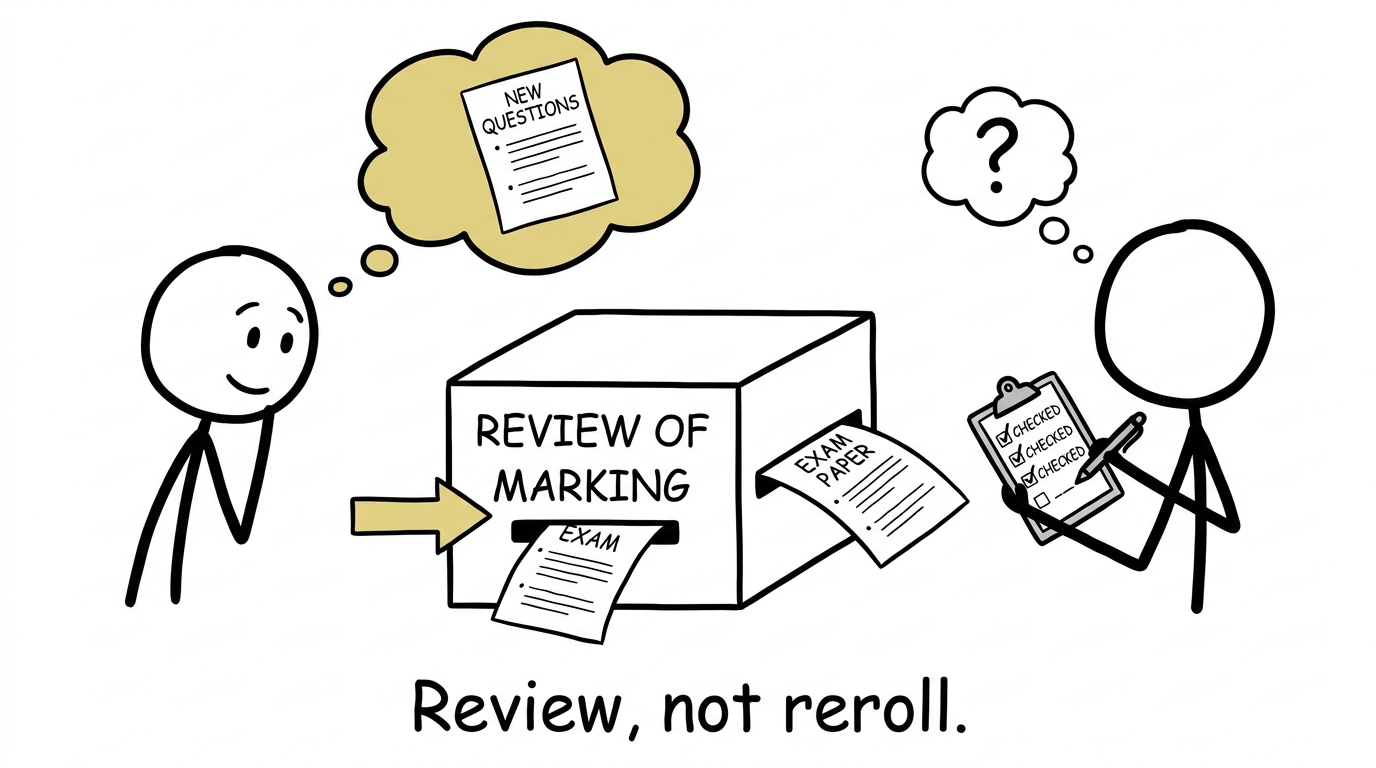 An exam paper going through a review machine rather than being randomly rerolled
Wait for the reviewed outcome
If an error is found, the mark must be corrected. That correction may increase or reduce the component mark, and it may or may not change the overall qualification grade.
While waiting, keep your university or other destination informed. Follow its instructions rather than assuming it will automatically hold your place.
When requesting a maths review makes sense
A review is most persuasive when several pieces of evidence point in the same direction: you are near a boundary, one paper is unexpectedly low, and a teacher has identified a specific part of the script where the mark scheme may not have been applied correctly.
It may be less sensible when the request is based only on a predicted grade or previous mock results. Predictions describe expectations; they do not establish a marking error. Likewise, feeling that an exam went well is useful context, but not evidence on its own.
Students currently preparing for GCSE can learn something important here. Clear working protects access to method marks and makes later checking easier. Build that habit through GCSE Maths revision, then carry it into the Edexcel A Level Maths revision hub.
Appealing an A-level maths grade
Appealing an A-level maths grade is a later stage, not another name for requesting the initial review. If concerns remain after the review outcome, your school or college can appeal on permitted grounds, such as a marking error that remains or a failure to follow the correct procedure.
Under the JCQ appeals process, an appeal against a review outcome must normally be submitted within 30 calendar days of that outcome. A grade boundary itself cannot be appealed. If the awarding organisation's final appeal process has been completed, a centre in England may ask Ofqual's Exam Procedures Review Service to examine whether procedures were followed; Ofqual does not re-mark the paper or directly award a new grade.
Common mistakes to avoid
- Calling it a re-mark without understanding the service. It is a review of whether the original marking was correct.
- Missing your centre's deadline. Schools often close requests before the published exam-board date.
- Requesting every paper automatically. Use component marks and script evidence to identify the paper that raises concern.
- Assuming a close boundary guarantees success. Marks change only when an error is found.
- Ignoring the downside. Your mark and final grade can fall.
- Treating a formal appeal as the first step. The review of marking normally comes first.
Make the next decision calmly
Results day rewards speed, but not panic. Check the boundary, contact your exams officer, inspect the script where time permits and ask your teacher for a mark-scheme-based judgement.
Whatever the outcome, MathsGenie remains your free route forward. Use A Level past papers with mark schemes, A Level predicted papers and the revision planner alongside revision lessons, practice questions, mini tests and video solutions. Start by checking the A Level Maths grade boundaries, then make your review decision from evidence rather than hope.











