

A-Level Maths Lower Grade Than Expected: Next Steps
A-level maths lower grade than expected? Explore marking reviews, Clearing, university offers and how to plan a focused resit with confidence today.
Results day has a strange way of making one letter feel larger than the two years that produced it. If you received an A-level Maths lower grade than expected, pause before deciding what it means. Your immediate next steps are practical: check your university status, speak to your school or college, review your marks by paper and then choose between a review of marking, Clearing or a resit.
A disappointing result can change a plan. It does not remove your ability to make another one.
Your results-day action checklist
Keep the first few hours simple:
- Check UCAS Hub, but also read your actual results breakdown.
- Contact your firm or insurance university if your place is unclear.
- Speak to your Maths teacher and examinations officer.
- Ask whether your marked scripts can be accessed.
- Check your school's deadlines and fees for post-results services.
- Explore Clearing without rushing into the first available course.
- Consider a resit only after understanding why the original result fell short.
For 2026 applicants, A Level results day is Thursday 13 August. Clearing is already open by results day, but course availability changes, so use the current information shown in UCAS Hub and contact universities directly.
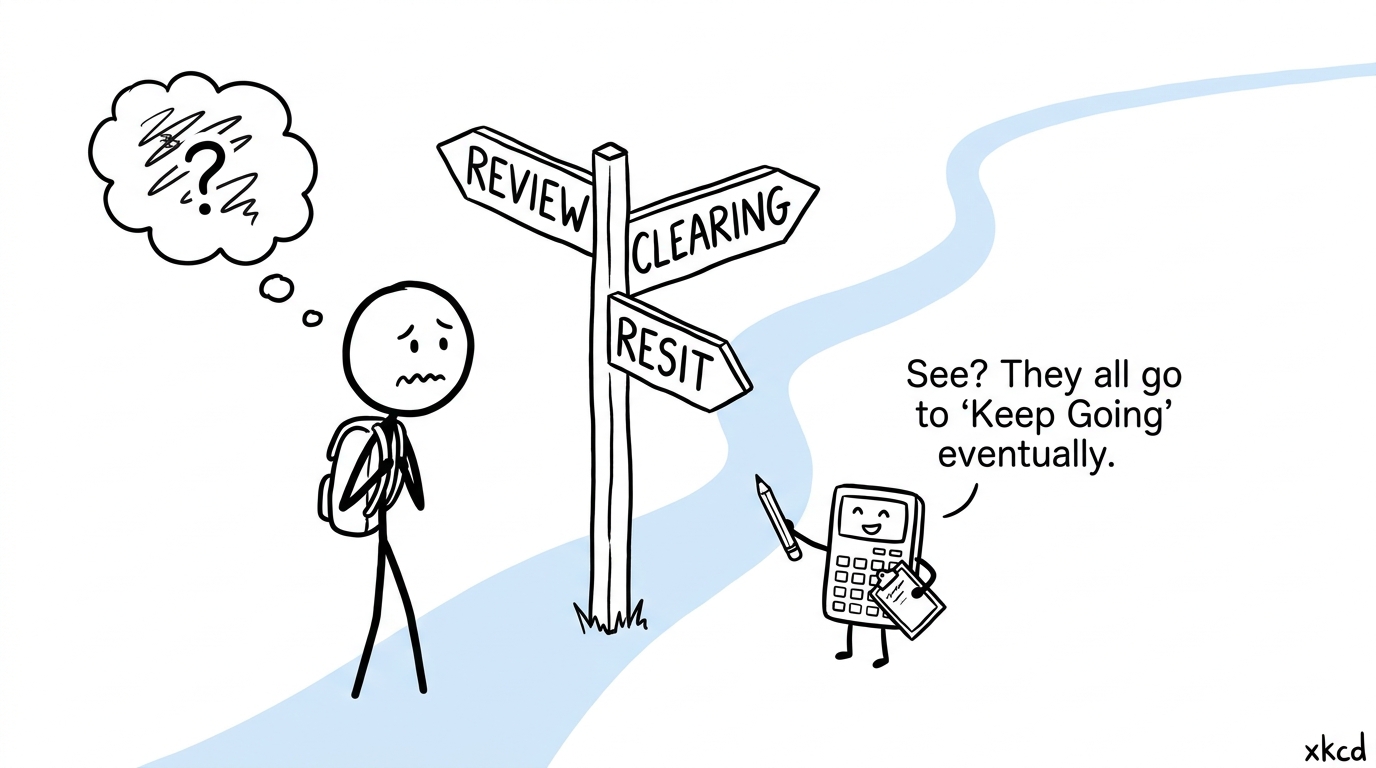 A student choosing calmly between a review, Clearing and a resit
Check what the result actually changes
An A-level Maths disappointing result does not automatically mean that your university place has gone. Universities sometimes confirm applicants who narrowly miss an offer, depending on the course, the wider application and available places.
Start with your UCAS status. If it has not updated, telephone the university admissions team rather than assuming the answer is no. Have your UCAS ID, grades and course details ready. Ask a precise question: is your application still being considered, and when should you expect a decision?
If you have been accepted, think carefully before rejecting the place. Do not release yourself into Clearing merely because another course looks possible. First research the alternative course, accommodation, location, costs and professional accreditation. A verbal indication from another provider is not the same as a confirmed place.
If you are reading ahead as a GCSE student, this is worth remembering now: results matter, but understanding the available process matters too. Building strong foundations through free GCSE and A Level maths revision gives you more choices later.
Should you ask for a remark?
Students often say "remark", but the formal service is normally a review of marking. It checks whether the original mark scheme was applied correctly. It is not an instruction to award a more generous mark.
Ask your teacher to examine three things:
- how far your overall mark is from the next grade boundary;
- which paper produced the unexpected mark;
- whether your script shows a plausible marking or administrative error.
Your school or college can usually request access to your marked script before deciding. For internal candidates, the centre normally submits the review and must obtain your written consent. Private candidates should speak to the centre that entered them or check the relevant awarding body's procedure.
A review can leave the mark unchanged, raise it or lower it. There may also be a fee, although arrangements vary by exam board and centre. If a university place depends on the outcome, ask immediately about the priority A Level review service and tell the university what is happening.
For the 2026 series, the JCQ deadline for awarding bodies to receive standard GCE reviews of results is 24 September 2026. Your school will set an earlier internal deadline, so do not wait. Grade boundaries themselves cannot be appealed simply because they feel high.
Use Clearing as a considered option
Clearing is not a lesser route. It is a way of matching applicants with courses that still have places. The important distinction is between acting quickly and acting blindly.
Before contacting a university:
- read the course modules rather than relying on its title;
- check entry requirements and whether your Maths grade is acceptable;
- compare accommodation and travel arrangements;
- prepare questions about teaching, assessment and course transfers;
- keep written notes of names, times and any offer conditions.
You might find the original subject at another university, a related course with different requirements or a foundation year. Each has different consequences. A foundation year adds time and cost, while a related course may lead towards a different career. Discuss the choice with someone calm, but make the decision yourself.
Only add a Clearing choice after the university has given you permission to do so. Follow the live instructions in UCAS Hub because timings and vacancies can change.
Decide whether an A Level Maths resit is worthwhile
A resit can make sense when the required grade is essential for your chosen course, apprenticeship or career, and when you can identify what needs to change. It is less useful when it is driven only by embarrassment.
Before committing, confirm:
- whether your school will accept you as a resit candidate;
- whether you need to use another examination centre;
- which exam board and specification you will take;
- examination entry deadlines and fees;
- whether your intended universities accept resit applicants;
- what you will do alongside revision during the year.
Check the current rules with your centre and awarding body rather than assuming that arrangements are identical across Edexcel, AQA, OCR and Eduqas.
Your preparation should begin with diagnosis. Use the A Level Maths revision hub to choose the correct exam board, then separate your performance into pure mathematics, statistics and mechanics. For board-specific preparation, open the Edexcel A Level Maths resources or OCR A Level Maths resources.
Build a resit plan from evidence
A longer revision year is not automatically a better one. Improvement comes from changing the feedback loop.
Begin with an untimed paper to identify forgotten content. Relearn those topics through revision lessons and videos, then complete focused practice questions. Once your methods are reliable, move to timed sections and full papers.
The Edexcel A Level Maths past papers include mark schemes and solutions, helping you see where marks are actually awarded. Record errors by type: missing knowledge, an unsuitable method, inaccurate algebra, calculator use, poor interpretation or time pressure.
Later, use A Level predicted papers for additional exam-style practice. Predicted papers are preparation tools, not promises about what will appear. Past papers should remain central because they show the established standard and wording of real examinations.
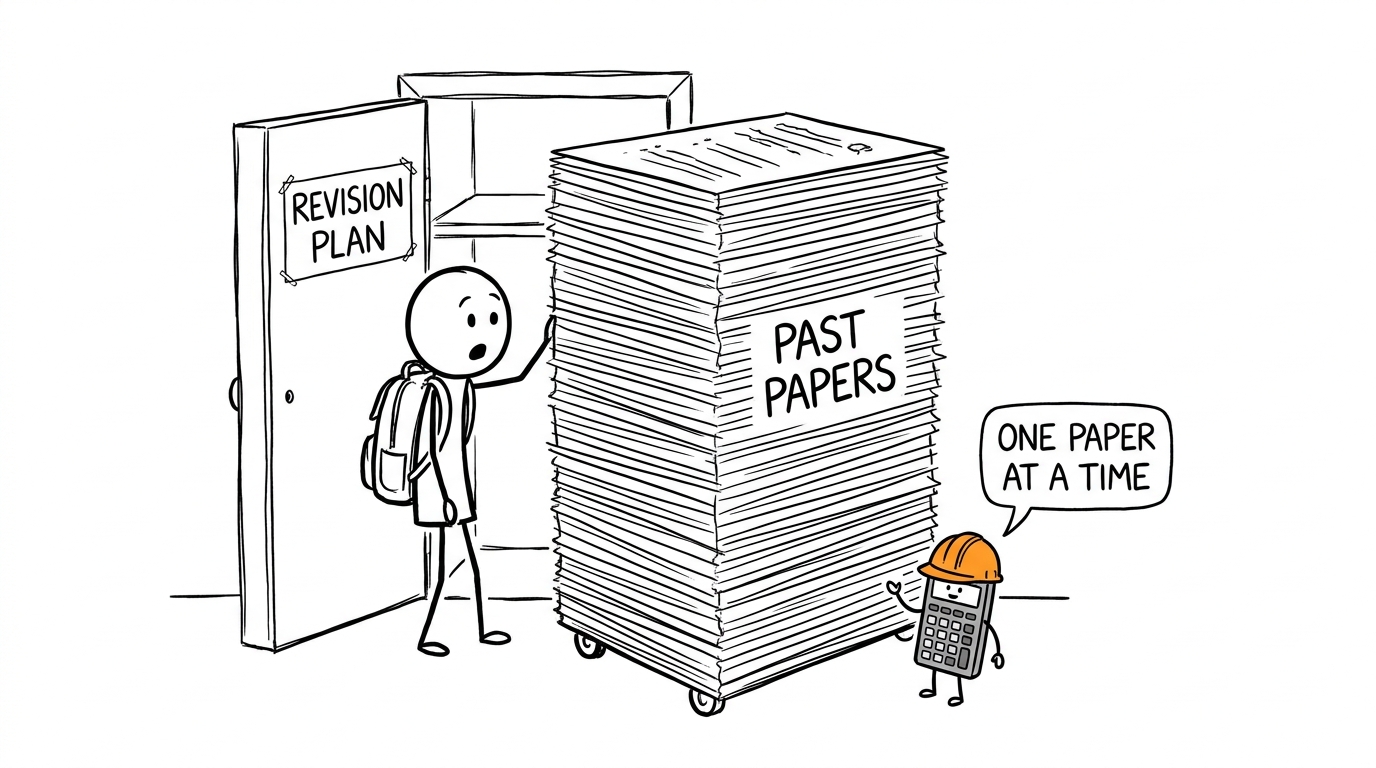 A student discovering an enormous but organised resit plan
Common mistakes after a disappointing Maths result
Requesting a review based only on hope
Being close to a boundary matters, but it does not prove an error. Ask a teacher to inspect the paper and consider where a mark could realistically change.
Waiting for UCAS to solve everything
If your status is unclear, contact the university. If you may need a priority review, contact your examinations officer immediately.
Choosing Clearing by university name alone
The course content will shape several years of work. Compare modules, assessment, support and future options, not just the institution's reputation.
Resitting with the same revision routine
Repeating the same notes and hoping for a different grade is not a plan. Use marked papers, mini tests and targeted questions to decide what to practise next.
Your result is information, not identity
An underwhelming grade deserves an honest response, not a panicked one. Establish what it changes, investigate whether the marking should be reviewed, explore Clearing carefully and choose a resit only when it supports a clear goal.
If resitting is your best route, start with MathsGenie's free A Level Maths revision resources. Use revision lessons to repair gaps, practice questions and mini tests to strengthen methods, then past papers, mark schemes, video solutions and predicted papers to rebuild exam performance one paper at a time.











