

A-Level Maths Grade Boundaries: Results Day 2026
A-level maths grade boundaries explained for 2026 results day, including how marks become grades, when tables appear and what to do if you are close.
The hardest part of results day often happens before you open the envelope. You remember the unfinished question, the awkward mechanics problem and the answer you changed with seconds remaining. Then you search for A-level maths grade boundaries, hoping that one number will settle everything.
The short answer is reassuring: grade boundaries convert your total mark into a grade, and they are adjusted to reflect the difficulty of that year's papers. The final maths A-level grade boundaries 2026 will not be available until results day because exam boards set them after the papers have been marked.
For students in England, A-level results day is Thursday 13 August 2026.
Results day checklist
Before interpreting your result:
- confirm your exam board and specification;
- find your overall qualification grade and total mark;
- use the official 2026 subject boundary, not a previous year's figure;
- distinguish an overall boundary from a notional paper boundary;
- speak to your school or college if something appears wrong;
- remember that being below one boundary still means you have achieved the grade beneath it.
You can also open the free A Level Maths revision hub to find board-specific resources and understand how the papers fit together.
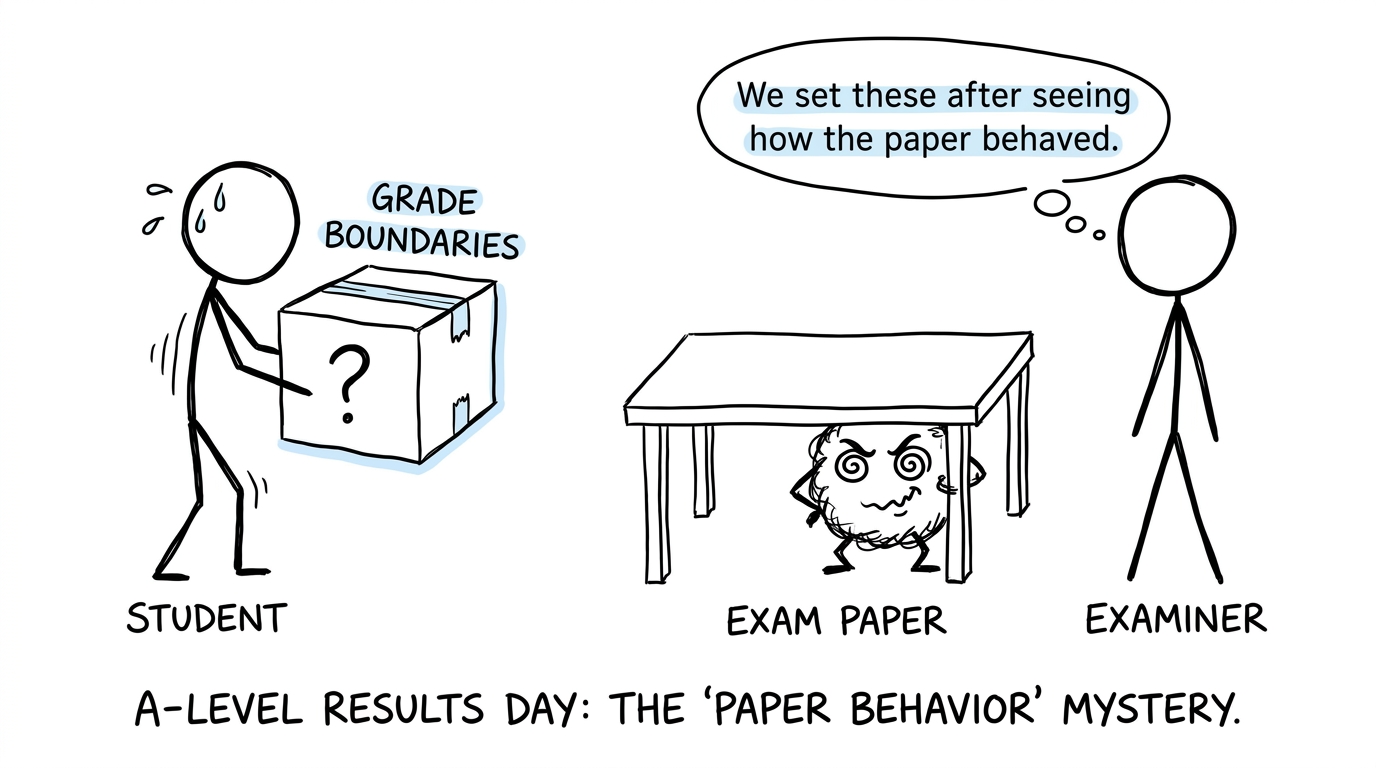 A nervous student waits while an exam paper hides behind a grade-boundary box
What are A-level maths grade boundaries?
A grade boundary is the minimum mark needed for a particular grade. If the AAA boundary is 205205205, a total of exactly 205205205 earns an AAA. A total of 204204204 falls below that boundary and is compared with the boundary for grade BBB.
For linear A-level qualifications, the important figure is normally your total mark across the qualification. AQA, Edexcel and OCR Mathematics A each use three papers worth 100100100 marks, producing a total of 300300300 marks. Other specifications can use different totals, so always check the correct subject code rather than assuming every course is identical.
Exam boards set boundaries after marking. They examine statistical evidence, compare performance with previous years and review work around possible thresholds. If a paper proves harder than intended, boundaries may be lower. If it proves easier, they may be higher.
This does not mean grades are handed out according to a fixed quota. Ofqual states that there is no cap on how many students can receive a particular grade. The aim is to maintain a comparable standard from one year to the next.
Why the 2026 boundaries cannot be predicted exactly
Past boundaries are useful context, but they are not promises. A high boundary last year does not force a high boundary this year, and a difficult Paper 1 does not guarantee a particular adjustment.
The exam board needs evidence from the completed scripts before deciding how difficult the assessment was in practice. That is why confident online claims about exact 2026 boundaries before results day should be treated as speculation.
Official exam-board tables are released on results day. Your school or college receives results earlier under embargo, but it cannot disclose them before the permitted release time.
Students can prepare by checking the right board page on MathsGenie:
How your three paper marks become one grade
Your performance is not usually judged by requiring the same grade on every paper. The marks are combined first, which means a stronger pure paper can compensate for a weaker statistics or mechanics paper.
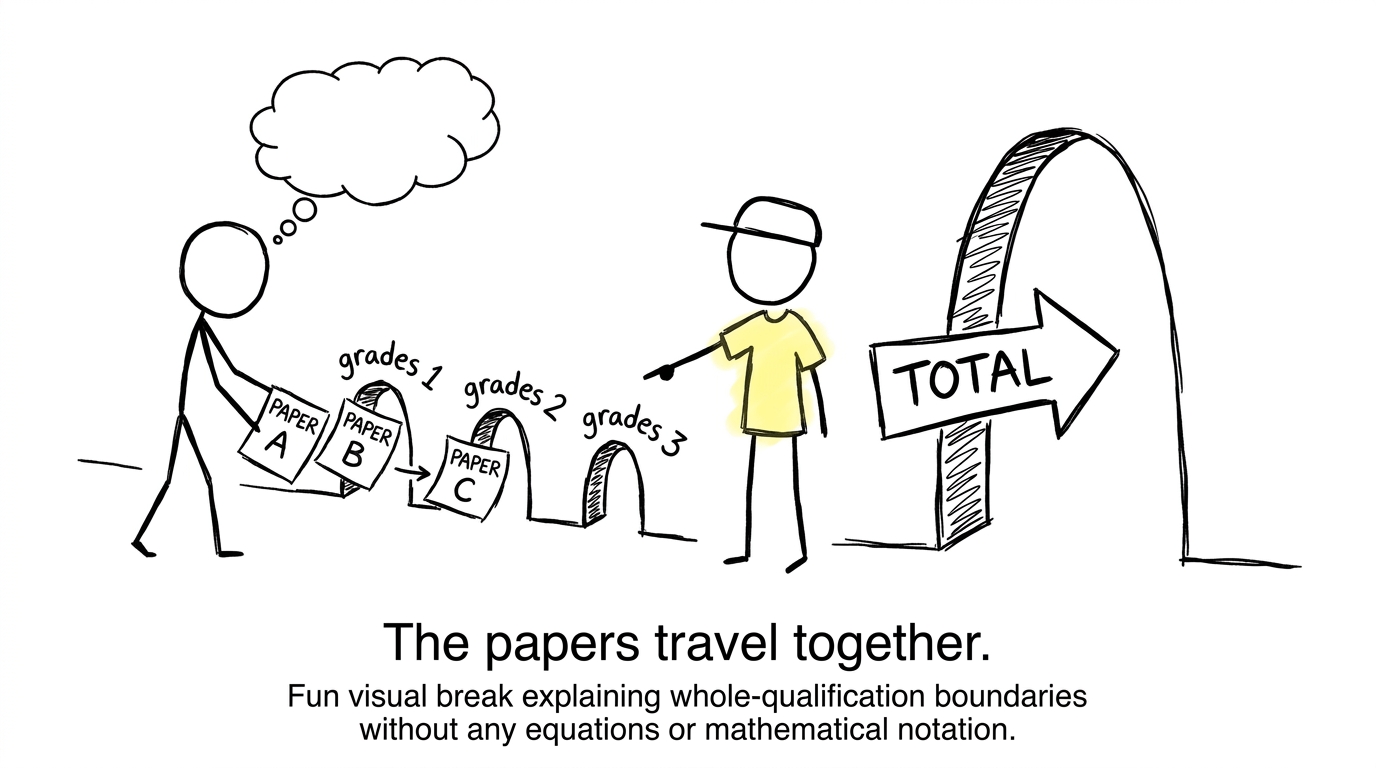 Three exam papers discover that they must travel together through the total-mark door
Worked boundary example
Suppose a fictional specification has three papers, each worth 100100100 marks. A student receives:
78+70+60=20878 + 70 + 60 = 20878+70+60=208Imagine the hypothetical overall boundaries are:
| Grade | Minimum total mark |
|---|---|
| A∗A^*A∗ | 245245245 |
| AAA | 205205205 |
| BBB | 170170170 |
| CCC | 135135135 |
| DDD | 100100100 |
| EEE | 656565 |
The total of 208208208 reaches the AAA boundary but not the A∗A^*A∗ boundary, so the final grade is AAA.
These figures are invented purely to explain the calculation. They are not the 2026 boundaries. Notice, too, that the student did not need an AAA-level performance on every individual paper. The combined total determined the result.
Some boards publish notional component boundaries for individual papers. These can help teachers analyse performance, but they do not replace the official whole-qualification boundary.
What to do on A-level maths results day
First, read the result before trying to reconstruct every exam answer. Check the qualification title, exam board, grade and any marks supplied by your centre.
If you have met your university or apprenticeship conditions, follow the instructions from the provider. If you have narrowly missed a required grade, speak to your school, college and university before making assumptions. A university may still confirm a place, but that decision belongs to the institution.
If a mark appears inconsistent, your exams officer can explain post-results options. A review of marking checks whether the mark scheme was applied correctly; it is not simply a request for a more generous mark. The result can rise, remain unchanged or fall, so discuss the evidence, cost and deadline with your centre first.
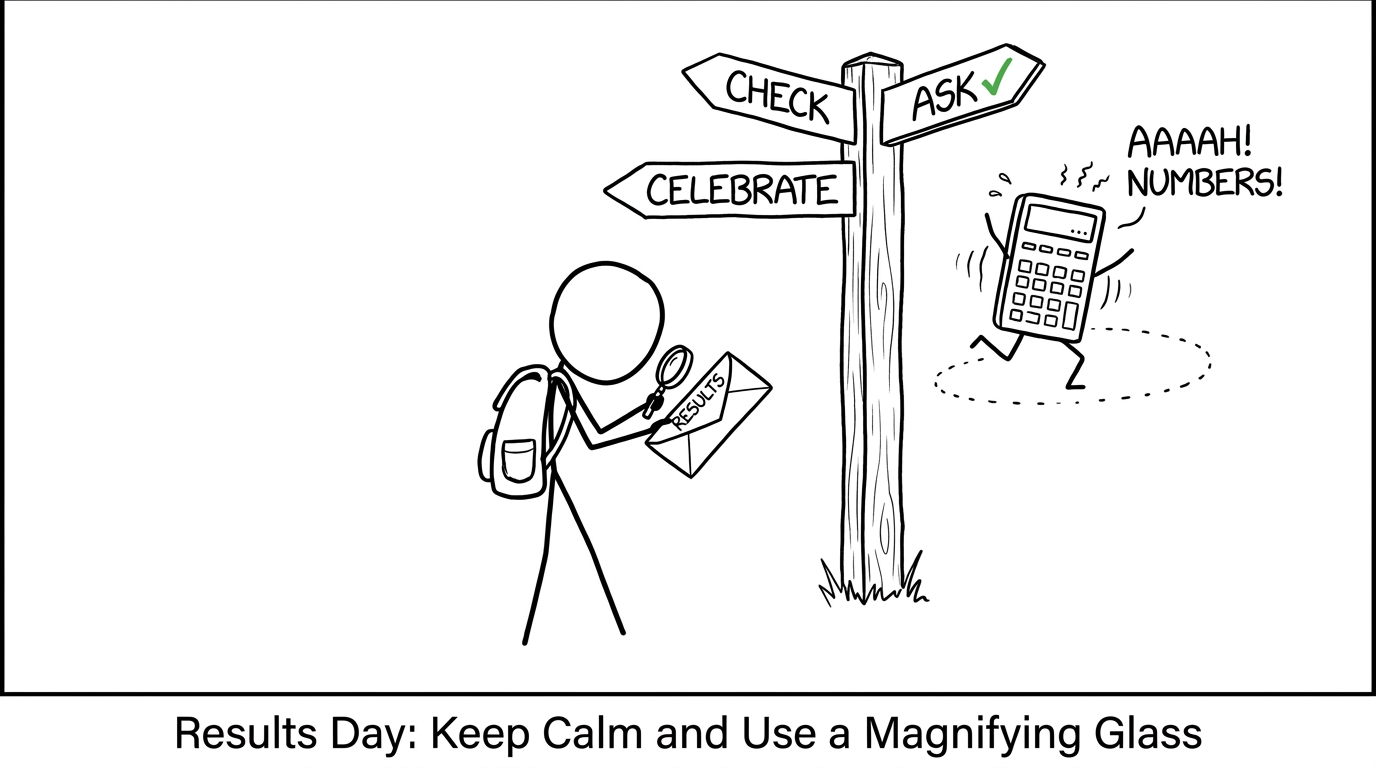 A student calmly chooses between celebrating, checking and asking while a calculator panics
Common mistakes when reading grade boundaries
Using last year's boundary as a forecast
Previous boundaries show what happened under previous papers. They cannot reveal the exact threshold for 2026.
Looking at the wrong specification
Edexcel, AQA, OCR, OCR MEI and Eduqas use different codes and assessment structures. Match the table to the qualification shown on your results information.
Treating paper boundaries as final grades
A notional boundary for one component is an analytical guide. Your qualification grade normally comes from the combined weighted total.
Assuming one mark below means failure
If the AAA boundary is 205205205 and your total is 204204204, you have missed an AAA by one mark, but you still receive the grade associated with the next boundary reached.
Requesting a review without advice
Being close to a boundary can justify checking your options, but proximity alone does not prove a marking error. Reviews can move marks in either direction.
Turn results into the next useful step
A result is a judgement about completed papers, not a permanent judgement about your mathematical ability. Once the uncertainty ends, the useful question changes from “What might my boundary be?” to “What should I do next?”
If you are continuing with maths, begin with the AQA A Level revision guides or OCR A Level revision guides, depending on your specification. Edexcel students can use past papers with mark schemes and Edexcel predicted papers to turn weak areas into a practical plan.
MathsGenie brings together free revision lessons, revision guides, practice questions, past papers, predicted papers, mini tests, mark schemes and video solutions. Start with the topic or paper that cost you marks, practise it carefully, and make the next result less mysterious than this one.











