A-Level Maths Grade Boundaries History and Trends
A-level maths grade boundaries history explained, with year-by-year Edexcel, AQA and OCR trends from 2019 to 2025 and practical revision advice.

A grade boundary can feel like a finish line that moves while you are running towards it. One year, an A∗A^*A∗ appears to require a manageable total; another year, the same grade sits considerably higher. The A-level maths grade boundaries history shows that these changes are real, but they do not mean that one cohort was automatically stronger or that another received an easier qualification.
Grade boundaries are set after papers have been taken and marked. They reflect evidence about paper difficulty and student performance, alongside the grading standard for that year. The short answer is simple: recent boundaries rose sharply after 202220222022 for several specifications, but historical figures cannot predict the boundary for a future paper.
A quick checklist before comparing boundaries
When analysing past A-level maths grade boundaries:
- compare the same exam board and specification;
- use the overall qualification boundary, not a single paper boundary;
- check the maximum available mark;
- treat 202020202020 and 202120212021 separately because normal summer exams were cancelled;
- remember that a higher boundary may indicate a more accessible paper;
- never use an old boundary as a guaranteed target for your own exam.
MathsGenie's A-level grade boundaries hub lets you check different boards and years without mixing unrelated qualifications.
A-level maths grade boundaries by year
The table compares overall June boundaries for Edexcel Mathematics, AQA Mathematics and OCR Mathematics A. Each qualification shown is marked out of 300300300. Only the A∗A^*A∗ and AAA thresholds are included so that the main trend remains clear.
| Year | Edexcel A∗A^*A∗ / AAA | AQA A∗A^*A∗ / AAA | OCR A A∗A^*A∗ / AAA |
|---|---|---|---|
| 201920192019 | 217217217 / 165165165 | 231231231 / 185185185 | 216216216 / 161161161 |
| 202020202020 | No normal summer exams | No normal summer exams | No normal summer exams |
| 202120212021 | No normal summer exams | No normal summer exams | No normal summer exams |
| 202220222022 | 217217217 / 164164164 | 220220220 / 171171171 | 193193193 / 149149149 |
| 202320232023 | 244244244 / 196196196 | 248248248 / 201201201 | 209209209 / 161161161 |
| 202420242024 | 251251251 / 205205205 | 259259259 / 222222222 | 216216216 / 168168168 |
| 202520252025 | 258258258 / 214214214 | 260260260 / 221221221 | 242242242 / 196196196 |
These figures come from the published exam-board boundary documents and can be explored through MathsGenie's dedicated Edexcel A-level Maths boundaries, AQA A-level Maths grade calculator and OCR A-level Maths boundaries.
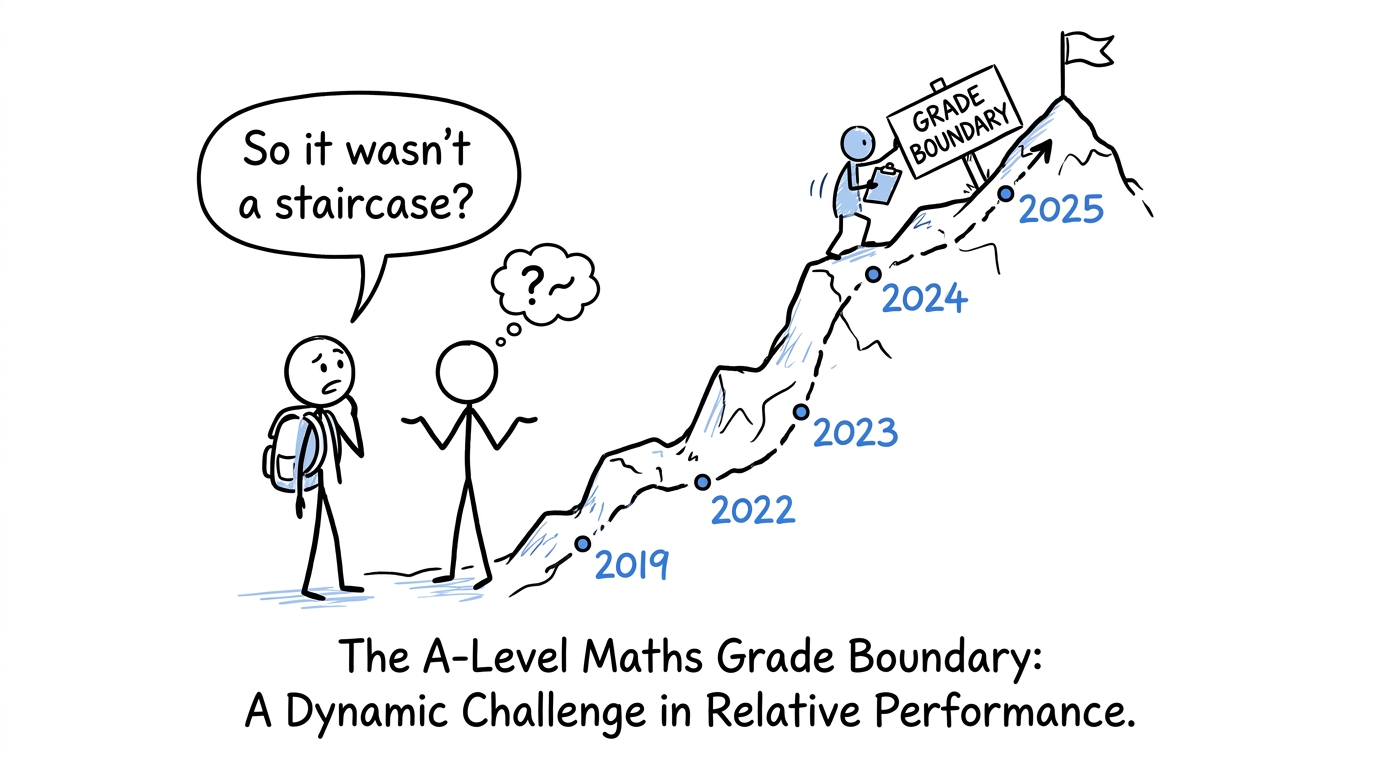 A student discovers that grade boundaries follow a moving mountain trail
What changed from year to year?
The 2019 reference point
The 201920192019 series provides a useful pre-pandemic comparison. Even then, the three boards did not share identical boundaries. An A∗A^*A∗ required 217217217 marks with Edexcel, 231231231 with AQA and 216216216 with OCR A.
That difference does not show that one board was inherently easier. The papers, question structures and performance of each entry differed. Boundaries make results comparable within a specification; they are not a league table of exam boards.
Why 2020 and 2021 need a warning label
Students in England did not sit normal summer A-level examinations in 202020202020 or 202120212021. Grades were awarded through alternative arrangements, including centre-assessed and teacher-assessed grades. Some autumn series had published boundaries, but presenting those as ordinary summer results would create a misleading trend.
This is why a responsible account of A-level maths grade boundary trends leaves a visible gap rather than drawing a smooth line through those years.
The transitional 2022 series
Examinations returned in 202220222022, while Ofqual used a transitional grading approach designed to sit between 201920192019 and 202120212021 outcomes. This wider policy context matters when interpreting the comparatively low thresholds.
OCR A, for example, required 193193193 marks for an A∗A^*A∗, compared with 216216216 in 201920192019. That does not mean the qualification suddenly became easier. Boundaries respond partly to how demanding the assessed papers prove to be.
The rise from 2023 to 2025
In 202320232023, grading returned broadly to pre-pandemic standards, with protection for the cohort built into the awarding process. Boundaries rose across all three specifications shown.
The upward movement then continued in many cases. Between 202220222022 and 202520252025, Edexcel's A∗A^*A∗ threshold increased by 414141 marks:
258−217=41 258-217=41 258−217=41AQA rose from 220220220 to 260260260, while OCR A rose from 193193193 to 242242242. Yet the boards did not move identically. AQA's AAA boundary fell slightly from 222222222 in 202420242024 to 221221221 in 202520252025, even as its A∗A^*A∗ boundary rose by one mark. Grade-boundary movement is not a single national staircase.
What the trends mean for revision
A historical boundary is best treated as context, not a prediction. If you complete a 202320232023 paper, mark it using the 202320232023 mark scheme and compare the total with the 202320232023 boundary. Applying the 202220222022 threshold would give a distorted result.
For students currently taking GCSE Maths, the same principle already applies to grades 999 to 111: boundaries move after examiners review performance. A Level changes the content and grading scale, but not the need to build a safety margin rather than aim for one fragile cut-off mark.
Start with GCSE Maths revision resources if you are still strengthening algebra, graphs and trigonometry. Students moving towards sixth form can then explore Edexcel A-level Maths revision, including lessons, topic questions, videos, mini tests and revision tools.
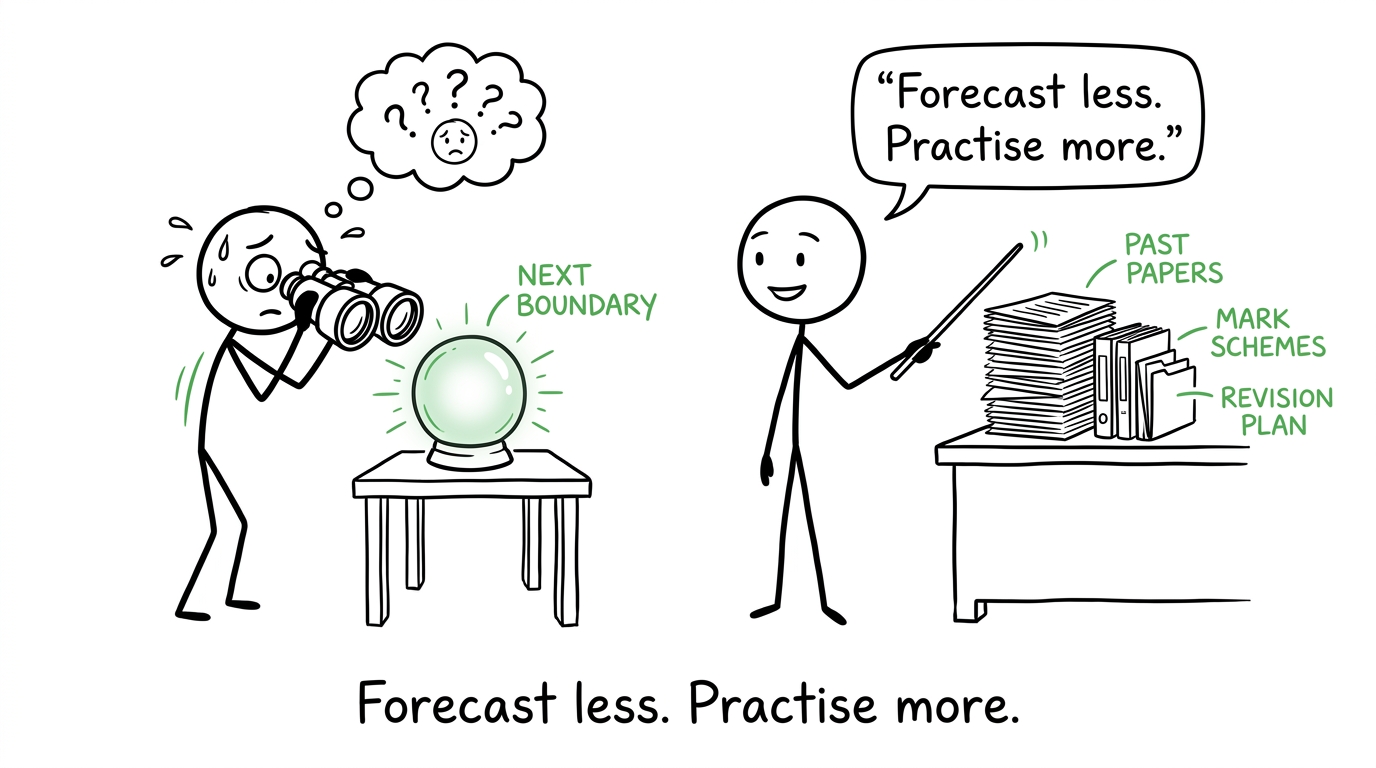 A student abandons a grade-boundary crystal ball for past-paper practice
Common mistakes when reading boundary data
Assuming a high boundary means a harder exam
Usually, the opposite interpretation is more plausible: if students generally found a paper accessible, more marks may be required to preserve the grading standard. Difficulty cannot be judged from the boundary alone.
Comparing different maximum marks
OCR Mathematics A is marked out of 300300300, but OCR Mathematics B (MEI) has a different maximum. Raw totals cannot be compared fairly without checking the exact specification.
Treating 2020 and 2021 as ordinary exam years
The absence of normal summer examinations makes direct comparison unsafe. Autumn-series boundaries represent different entries and circumstances.
Predicting the next boundary exactly
Future boundaries are unknown until completed scripts have been reviewed. A sensible revision target is a range with a buffer, not last year's minimum plus wishful thinking.
Turn historical data into useful practice
Boundaries tell you what happened. Practice tells you what to do next.
Choose a complete paper from MathsGenie's Edexcel A-level Maths past papers, sit it under timed conditions, and mark it carefully using the matching mark scheme. Record lost marks by topic, revisit the relevant revision lesson, and answer fresh practice questions before trying another paper.
That cycle is more valuable than repeatedly checking whether an old boundary moved by five marks. Use MathsGenie's free revision lessons, past papers, predicted papers, practice questions, mark schemes and video solutions to build performance that remains secure wherever the eventual boundary is set.