

A-Level Maths Grade A: Meaning and What Comes Next
A-level maths grade A meaning explained, with practical next steps for university, Clearing, marking reviews, retakes and future revision choices.

Results day can compress two years of work into one small letter. If that letter is an A, the immediate answer is simple: the grade A A-level maths meaning is that you achieved an excellent result, one grade below A*. It can satisfy many university offers, carries 484848 UCAS Tariff points and demonstrates strong performance across pure maths, statistics and mechanics.
But a grade is not a decision. Your next step depends on your complete set of results, your university offer and whether an A was the result you needed.
Your results-day checklist
- Check your status in the UCAS Hub if you applied to university.
- Read the conditions of your firm and insurance offers carefully.
- Confirm your exact marks with your school or college.
- Compare them with the official boundary for your exam board and series.
- Speak to an adviser before requesting a review or declining a place.
- Consider Clearing or a retake only when it serves a clear goal.
For students receiving results in 2026, A-level results day is Thursday 13 August. Your school or college will confirm how and when it will release results.
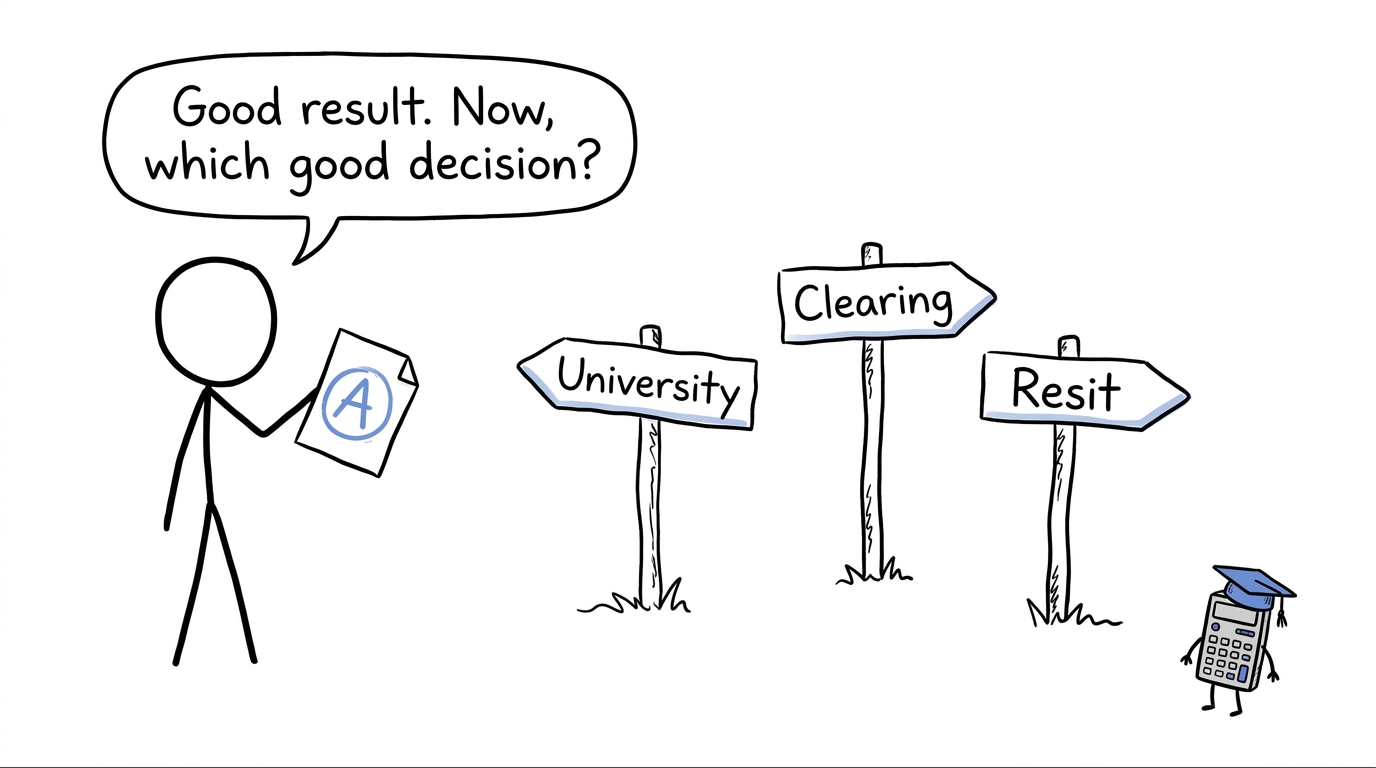 A student choosing between university, Clearing and a retake after receiving an A
What does an A-level maths grade A mean?
A-levels are awarded from A* to E, with U meaning unclassified. An A is therefore the second-highest grade available. It confirms that you met the grade A standard set for your specification and examination series.
It does not mean that you obtained a fixed percentage. Grade boundaries are established after the papers have been marked and may differ between years and exam boards, including Edexcel, AQA, OCR and Eduqas. Use the boundary document matching your qualification code rather than an unofficial percentage chart.
Your final grade normally reflects your total performance across the qualification, not a separate grade on every paper. A difficult pure maths paper can be balanced by stronger performances elsewhere, provided your combined mark reaches the overall boundary.
An A also has practical value. It is worth 484848 UCAS Tariff points, although many universities state offers as grades rather than Tariff totals. Always check the exact conditions of your course.
What next after grade A maths?
Your university place is confirmed
If UCAS shows that your firm choice is confirmed, the essential academic decision has already been made. Read the university's enrolment and accommodation messages, check that Student Finance details are correct and note any preparation recommended by your department.
A short break is sensible. If your course is mathematical, however, keeping algebra, functions and calculus familiar will make the transition gentler. The free A-level Maths revision hub lets you revisit material by exam board through revision guides, questions, videos and papers.
Your application is still pending
Do not assume that a pending status means rejection. A university may still be considering your application or waiting for information. Check its messages and contact admissions if UCAS does not explain what is happening.
Have your UCAS ID, results and course details ready. Calm questions produce more useful answers than hurried assumptions.
You missed an offer despite getting an A
Some courses require an A* in Mathematics or specify grades in other subjects. An A can be excellent and still fall short of one particular condition.
First, check UCAS because the university may have accepted you anyway. If it has not, contact admissions and ask whether your application remains under consideration. Your insurance choice may also have confirmed your place.
If you hold no confirmed offer, Clearing allows you to contact universities with vacancies. Research the course content, entry requirements, location and costs rather than choosing solely because a place is available. Only add a Clearing choice in UCAS after the provider has given you permission.
You are considering a review of marking
Ask your exams officer for your component marks and compare the total with the relevant boundary. Being close to A* is a reason to investigate, not proof that marking was wrong.
A review can cause a mark to rise, remain unchanged or fall. Requests are submitted through your school or college, and urgent priority services have short deadlines when a university place depends on the outcome. Discuss the risk, fee and likely benefit before proceeding.
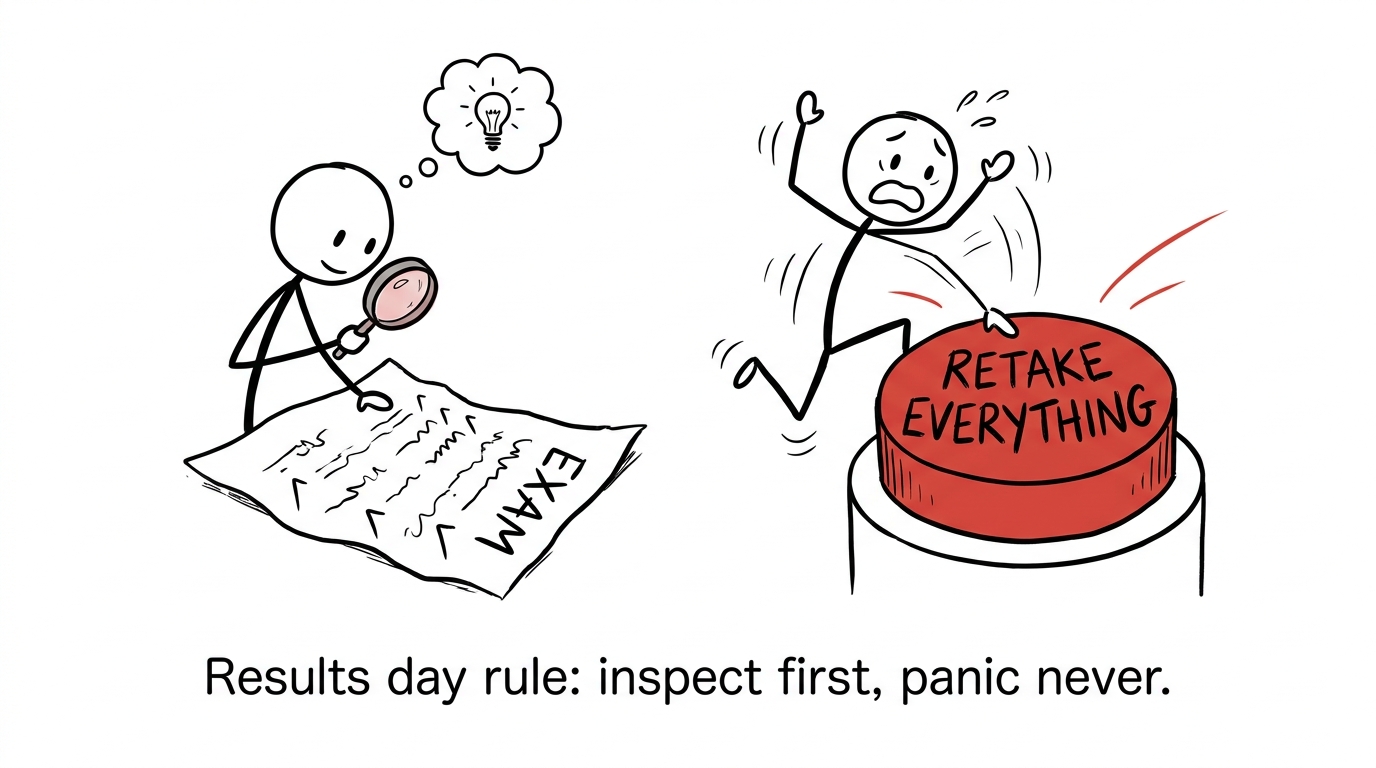 A calm student inspects an exam paper before another student presses the retake button
You are thinking about retaking A-level Maths
Retaking an A after already earning a strong grade usually makes sense only when a specific course requires A*, or when an improved result would materially change your options.
Current linear A-level retakes in England are generally taken in the next summer examination series, and Mathematics candidates normally sit the full set of papers again. Confirm entry arrangements, fees and university resit policies with your centre and prospective institutions before committing.
Build any retake around evidence. Use Edexcel A-level Maths resources or select your board through the main hub, diagnose weaknesses with past papers, then target them through question banks and video solutions. The A-level revision planner can turn a distant exam date into manageable weekly work.
Closer to the examination, Edexcel predicted papers provide timed practice alongside mark schemes and solutions. Predicted papers are practice resources, not forecasts of exact questions, so use them after covering the full specification.
What an A means for GCSE students
If you are currently preparing for GCSE rather than opening A-level results, an A shows where sustained higher-tier skills can lead. A-level Maths builds heavily on confident algebra, graphs, trigonometry and proportional reasoning.
The useful lesson is not that every GCSE student must eventually earn an A. It is that secure foundations create options. Start with the GCSE Maths revision hub, choose the correct exam board and tier, and practise weaknesses before they become habits.
Common mistakes after receiving an A
Treating an A as a fixed percentage
Boundaries change by series and specification. Check the official total rather than guessing from a percentage.
Declining a confirmed place too quickly
Releasing yourself into Clearing can mean losing your existing place. Speak to your school, the university and UCAS before making an irreversible choice.
Requesting a review only because A* feels close
A review checks marking accuracy; it is not a request for extra marks. Consider the distance from the boundary and the possibility of marks decreasing.
Retaking without a specific purpose
An A is already a high grade. A retake demands another examination cycle, so identify the course or opportunity that genuinely requires improvement.
Turn the result into a considered next step
An A-level maths grade A is evidence of substantial achievement, but its meaning becomes personal only when placed beside your offer and ambitions. Confirm your university status first. Then investigate Clearing, a marking review or a retake only if necessary.
Whatever you choose, MathsGenie remains a free place to maintain or rebuild your skills. Open the A-level Maths revision resources, select your exam board and use revision lessons, past papers, predicted papers, practice questions, mark schemes, video solutions and mini tests to make your next decision from evidence rather than results-day emotion.











