A-Level Law Resit: Explain It on Your UCAS Application
A-level Law resit UCAS application guidance: declare your retake correctly, explain it constructively and show universities evidence of progress.
Results day can compress months of work into one uncomfortable moment. If your A-Level Law grade was below the result you needed, the immediate fear is often not the resit itself but how universities will interpret it.
The short answer is that an A-Level Law resit UCAS application should be honest, concise and forward-looking. Declare both the original result and pending retake correctly, check every chosen university's resit policy, and use your application to demonstrate reflection, purposeful action and stronger preparation. Do not try to hide the first result or turn the personal statement into a long defence.
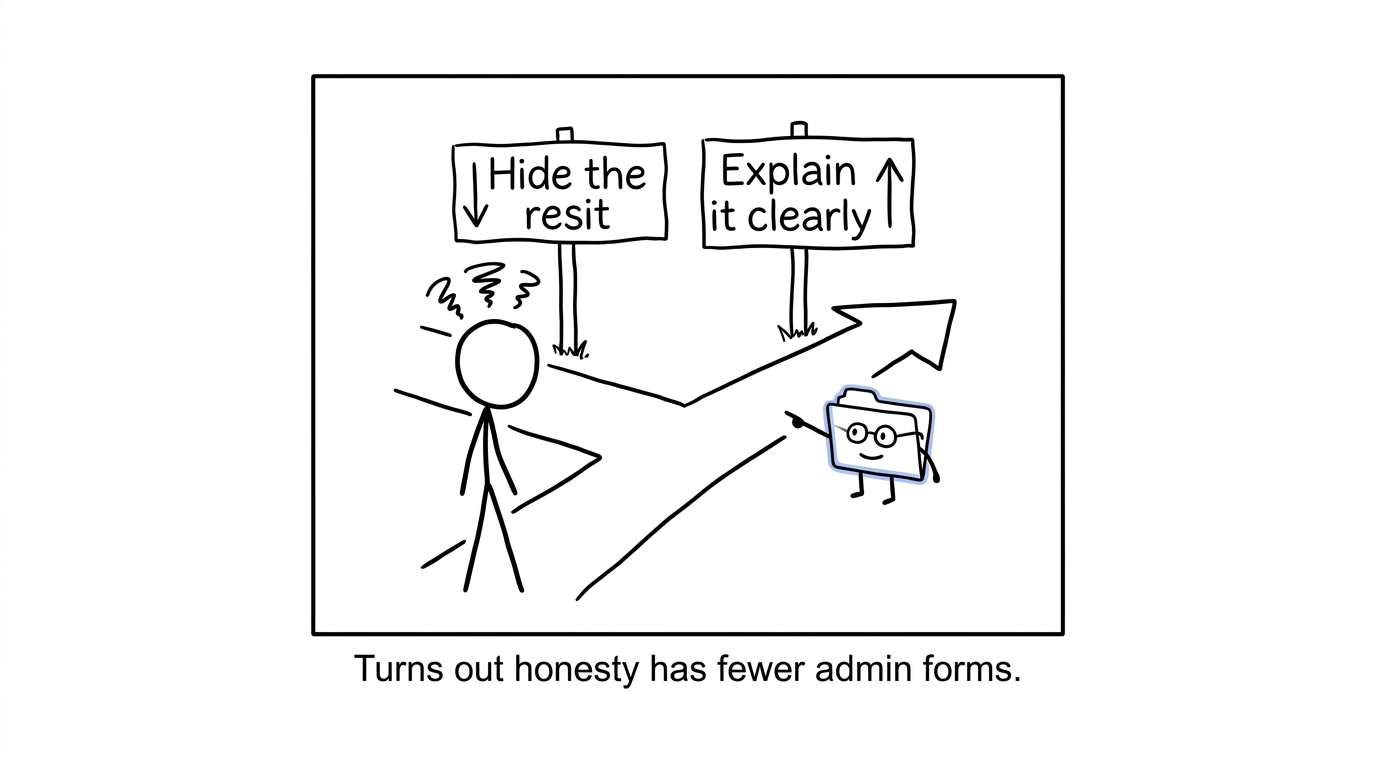 A student discovers that honesty creates fewer application problems
Your resit application checklist
Before submitting your application:
- enter every completed qualification and result, including unsuccessful grades
- add the Law retake separately as a pending qualification
- confirm the awarding body, qualification date and examination centre
- investigate the resit policy for every course and university
- arrange an academic reference and an appropriate predicted grade
- explain genuine mitigating circumstances through your referee where possible
- show what has changed since your first attempt
- keep most of your personal statement focused on your suitability for the course
Admissions policies are not identical. Some Law courses accept retakes routinely, while others impose conditions or consider them only when documented extenuating circumstances affected the first sitting. Check the current course page and ask the admissions team directly if its wording is unclear.
Declare your A-Level Law retake correctly
UCAS requires applicants to enter all previous and current qualifications from secondary education onwards. That includes original grades, unsuccessful results, multiple sittings and qualifications awaiting results.
Enter the achieved A-Level Law result under the school or college where you completed it. Then add the retake with its expected qualification date and a pending result. If you are sitting the examination through another centre, include that centre accurately.
This is administration rather than storytelling. Your education section should present a complete record; your reference and personal statement provide context. Before sending the form, ask a teacher, adviser or examinations officer to check that the subject, awarding body and dates match your documents.
How to explain a resit positively
A constructive explanation has three parts: reflection, action and evidence.
Reflection without excuses
Briefly acknowledge that the result did not represent the standard required for your next step. Avoid blaming an examiner, teacher or difficult paper. If illness, bereavement or another serious circumstance affected your performance, describe it accurately and let your referee confirm what can be supported.
Action that is specific
Explain what you changed. Strong details might include rebuilding case-law recall, producing timed essays, using mark schemes to improve evaluation, or obtaining regular feedback on legal argument. “I am working harder” is difficult to assess; a changed revision process is more convincing.
Evidence of readiness
Show the effect of those changes through recent assessments, improved predicted grades, stronger timed work or feedback from your tutor. The aim is not to prove that one grade was meaningless. It is to show that you responded intelligently.
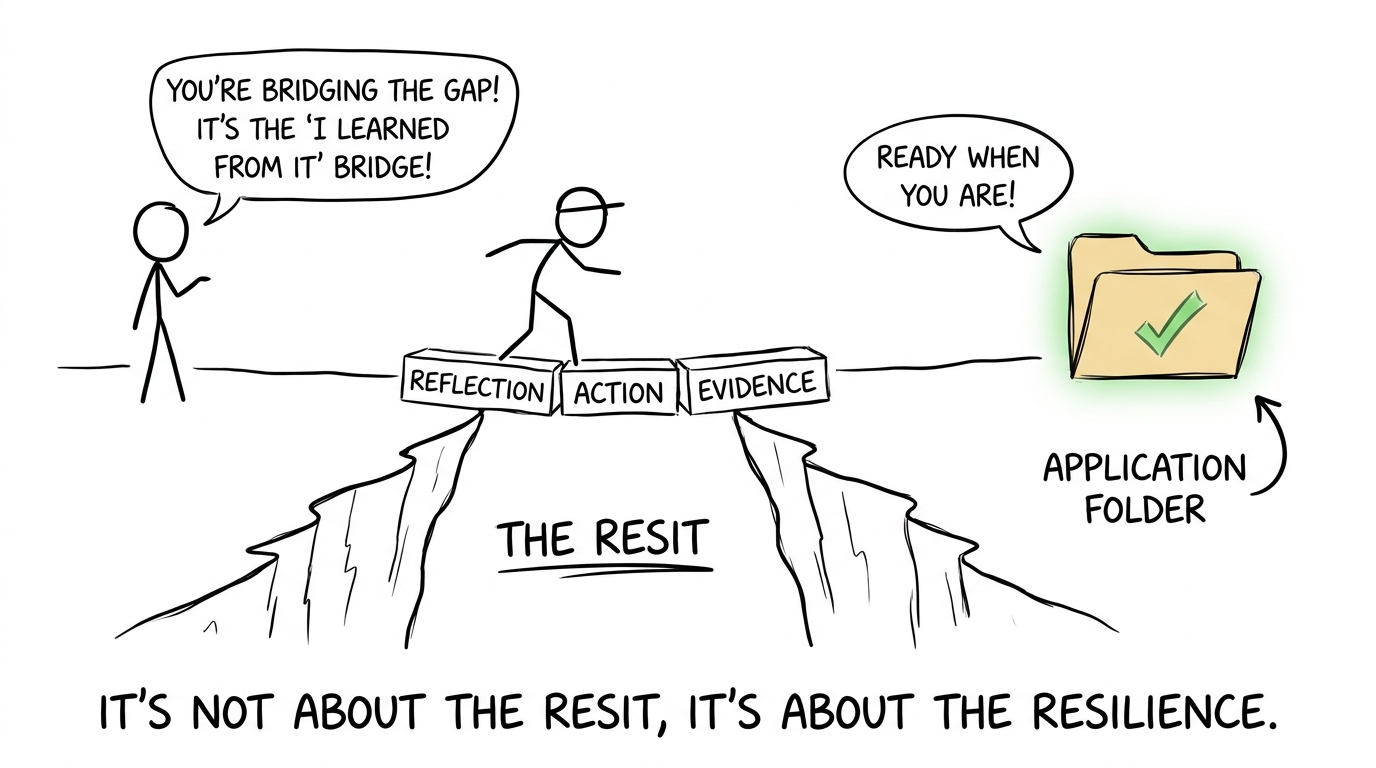 A student builds a bridge from reflection, action and evidence
Example wording for explaining a Law resit
For applications from the 2026 entry cycle onwards, the UCAS personal statement uses three questions covering your motivation, academic preparation and preparation outside formal education. The overall limit remains unchanged, so space still matters.
A short explanation will usually fit most naturally within the question about how your qualifications have prepared you. Adapt the following wording to make it truthful and personal:
My original A-Level Law result was below the standard I expected and prompted me to review how I prepared for extended legal analysis. During my retake, I have introduced regular timed essays, systematic case-law retrieval and detailed review against assessment objectives and mark schemes. This process has strengthened my ability to construct balanced arguments, evaluate authority and respond precisely to a question; skills I am ready to apply in undergraduate study.
If your referee can verify disruption or improvement, you might ask them to provide context such as:
Following circumstances that affected the original examination period, the student has approached the Law retake with consistency and maturity. Their recent assessed work provides stronger evidence of their current academic capability.
Use this only as a structural model. Never claim circumstances, progress or support that your referee cannot substantiate.
Keep the application focused on Law
Explaining a resit on UCAS does not mean making it the centre of your application. Admissions tutors still need to understand why you want to study the course and what you have done to explore it.
Connect your academic experience to relevant abilities: interpreting authority, distinguishing facts from opinion, evaluating competing arguments and writing precise conclusions. Discuss reading, lectures, court visits or other preparation only when you can explain what you learnt. A list of activities is weaker than thoughtful reflection on one relevant idea.
If you are also retaking Maths or maintaining another numerical subject, use the free A Level Maths revision hub, Edexcel A Level Maths lessons and questions or AQA A Level Maths revision resources. Keeping your wider academic profile moving matters during a reapplication year.
Common mistakes when explaining a resit
Hiding or omitting the original result
Universities need a complete qualifications record. Enter the achieved grade and the pending retake rather than hoping the earlier sitting will be overlooked.
Writing a defensive personal statement
A lengthy explanation consumes space needed for your motivation, knowledge and suitability. State the context briefly, then concentrate on what changed.
Assuming every university has the same policy
Law admissions can be competitive, and resit rules vary by institution and course. Verify each policy before using a choice.
Making unsupported claims
Do not describe a predicted grade as guaranteed or present ordinary examination pressure as a documented mitigating circumstance. Accuracy builds credibility.
Repeating the same revision method
A retake needs a diagnostic plan. MathsGenie's approach is useful even when organising another subject: identify the weakness, practise it, review feedback and test it again. Students retaking Maths can structure this through the revision planner, Edexcel A Level past papers and accompanying mark schemes.
Turn the resit into evidence of judgement
A resit is not automatically a persuasive story. The response to it can be. A careful application shows that you understand the result, have changed your preparation and can provide credible evidence of progress.
Complete the UCAS education section accurately, check course-specific rules and give your referee enough time to add context and predicted grades. Then return your attention to the work that changes outcomes.
If Maths is part of your retake or wider qualification profile, start with MathsGenie's free GCSE Maths resources or the A Level Maths revision resources. Use revision lessons and practice questions to repair gaps, then test your progress with mini tests, past papers, predicted papers, mark schemes and video solutions. A stronger application begins with a clear explanation; a stronger result begins with the next focused session.