

A-Level Law Remark: When to Request a Review
A-level law remark guidance: understand reviews of marking, possible grade changes, deadlines, costs and the steps to take after results day.
Results day can turn a single mark into the loudest number in the room. If your result is lower than expected, an A-level law remark may be worth considering, especially when you are close to a grade boundary or a university place depends on the outcome. The short answer is to speak to your school or college immediately, obtain your marks by paper and ask a Law teacher to review the available script. Do not request a review simply because the grade feels disappointing. Look for evidence that the marking may contain an error.
A-level law remark decision checklist
Before asking your exams officer to begin the process, check the following:
- How many marks are you below the next grade boundary?
- Is the unexpected result limited to one paper?
- Has a Law teacher examined your script or breakdown of marks?
- Can the teacher identify a response that may not have been credited correctly?
- Does the grade affect a university offer or another important progression decision?
- Are you prepared for the mark and grade to stay the same or go down?
- Have you checked your centre's deadline and fee?
Grade boundaries should provide context rather than a prediction. Being 111 mark below a boundary does not automatically mean that an extra mark will be found. MathsGenie's grade boundaries guide explains why boundaries can change between exam series.
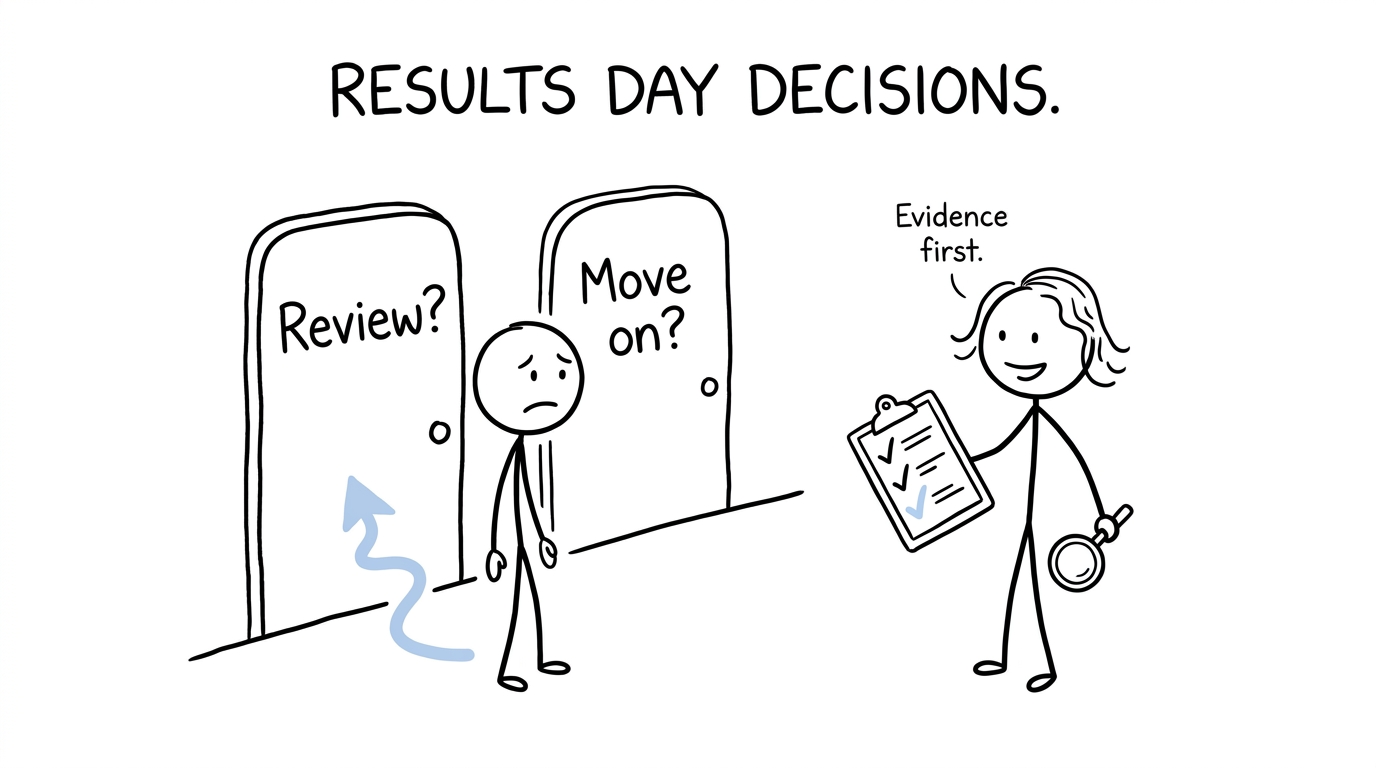 A student choosing whether to request a review with a teacher holding an evidence checklist
How the A-level law re-mark process works
Although students often say “remark” or “re-mark”, the formal service is usually called a review of marking. It is not a completely fresh mark by a new examiner. The reviewer checks whether the original marking was applied correctly according to the mark scheme and exam board procedures. A reasonable academic judgement is not replaced merely because another examiner might have awarded a slightly different mark.
This distinction matters in Law. Extended answers involve legal knowledge, application, analysis and evaluation. A response may feel persuasive while still missing a required legal principle, authority or developed line of reasoning. Equally, a well-supported point could have been overlooked. Your teacher is best placed to distinguish disappointment from credible evidence of a marking error.
Ask for your component marks
Start by finding out how you performed on each paper. One component may be substantially weaker than your others, giving your teacher a clear place to investigate. Compare the marks with the exam board's official boundaries for that specific series, not boundaries from a previous year.
Request access to the script where available
Your school or college can explain the exam board's access-to-scripts arrangements. Depending on the board and service, a script may be available electronically. Ask an experienced Law teacher to compare your answers with the mark scheme before deciding.
This is similar to reviewing a difficult maths paper: the useful question is not “Did I deserve more?” but “Where does the response meet a marking requirement that may have been missed?” You can develop that evidence-led habit using MathsGenie's A Level revision resources and A Level exam papers.
Give written consent
A review can cause a component mark to rise, remain unchanged or fall. Because a lower mark can reduce the qualification grade, centres normally need the candidate's written consent before submitting the request. Read the form carefully and discuss the risk with your teacher.
Let your centre submit the request
Students generally arrange post-results services through their school or college rather than contacting the exam board directly. Your exams officer will confirm the available service, fee and deadline. Centres may set an internal deadline earlier than the exam board's deadline, so act promptly.
Consider a priority review when progression is at stake
A priority review may be available for eligible A Level results when a higher education place depends on the outcome. Tell your school and university immediately if this applies. Availability, eligibility and deadlines are set for each exam series, so use the current information supplied by your centre rather than dates found in an old article.
When requesting a review makes sense
A review is most defensible when several pieces of evidence point in the same direction:
- You are close enough to a boundary for a plausible mark change to affect the grade.
- One paper is unexpectedly inconsistent with your performance elsewhere.
- A teacher has found a specific part of the script that appears to satisfy the mark scheme.
- The potential grade change has a meaningful consequence.
The distance from a boundary affects the practical decision, but there is no guaranteed “safe” distance. Reviews correct marking errors; they are not designed to search for sympathy marks.
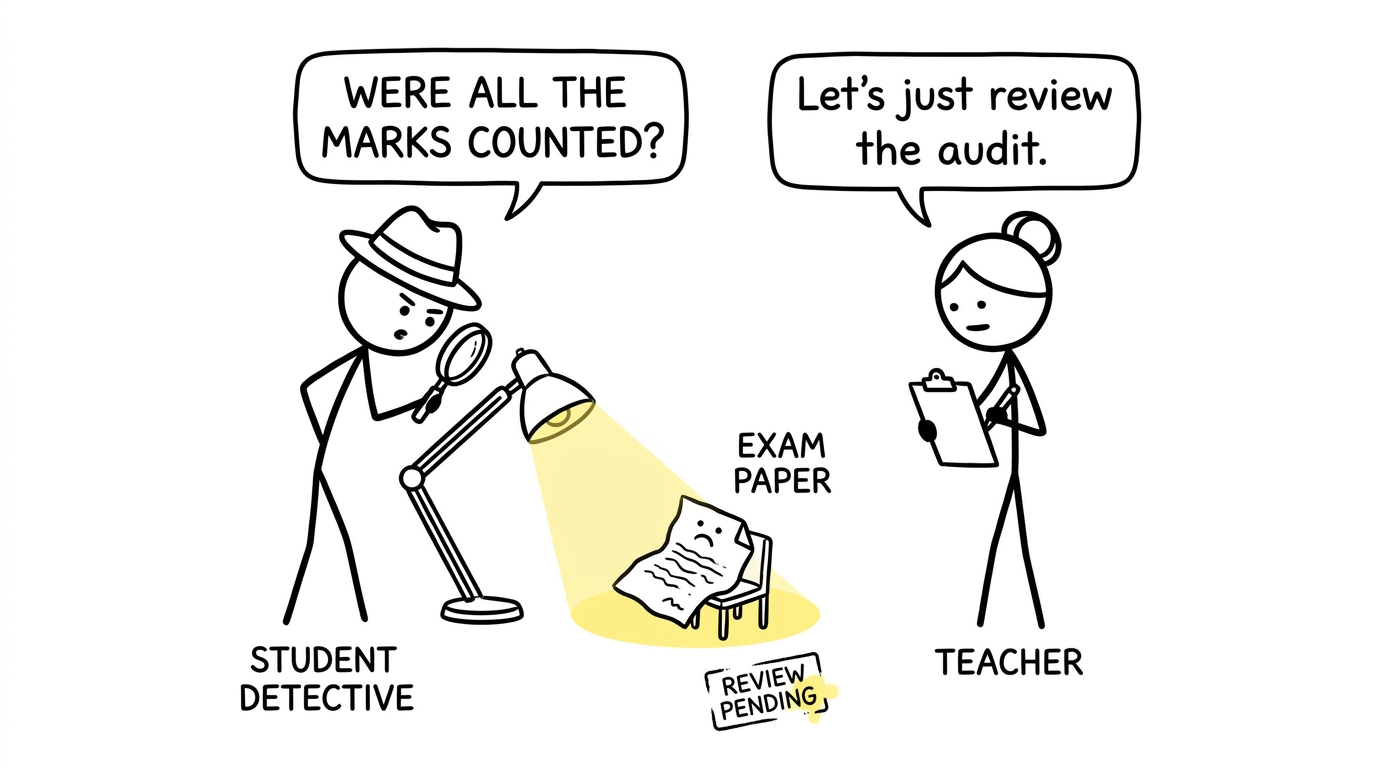 An exam paper being questioned by a student detective about whether every mark was counted
Review of marking or appeal?
Appealing an A-level law grade is not normally the first step. A review of marking checks the marking itself. An appeal usually follows the relevant review and challenges how the exam board carried out its procedures or whether the outcome was reasonable under the applicable rules.
Appeals are normally submitted by the centre. If you remain concerned after the review, ask the head of centre or exams officer for the written outcome and the current appeal procedure. A belief that an essay “should have scored more” is not, by itself, a strong appeal ground.
Common mistakes to avoid
Looking only at the overall grade
Always obtain the component breakdown. It is more useful than an overall grade when deciding which paper, if any, should be reviewed.
Assuming a review cannot lower the grade
Marks can decrease as well as increase. Consent is required for a reason.
Missing the centre's deadline
Do not wait for the exam board's published deadline. Your school may need forms and payment earlier, particularly for a priority service.
Treating an appeal as a second remark
An appeal has defined grounds. It is not an unlimited opportunity to have the same answer reconsidered until the desired grade appears.
Using old boundaries or deadlines
Rules, fees and dates can differ by series and exam board, including AQA, OCR and Eduqas. Confirm every practical detail with your exams officer.
Make the decision, then look forward
A strong post-results decision is calm, quick and evidence-led. Collect your component marks, check the current boundary, ask a Law teacher to inspect the script and let your exams officer explain the risk and deadline. If the evidence supports a review, act promptly. If it does not, accepting the result is not the same as giving up; it is choosing not to gamble on a process designed to correct errors rather than reassess potential.
For your next exams, build the habits that make results day less uncertain. Use MathsGenie's free GCSE revision lessons, GCSE past papers, predicted papers, practice questions, mark schemes and video solutions. Start with the grade boundaries page, then turn each uncertain topic into a clear revision task.











