A-Level Law Grade Boundaries History and Trends
A-level law grade boundaries history, explained year by year. Compare OCR trends from 2022 to 2025 and learn why boundaries move before planning revision.

A grade boundary can look like a target carved into stone. It is not. It is a line drawn after an exam has been taken and marked, then adjusted to reflect the demand of that particular paper.
That is the central lesson from A-level law grade boundaries history: boundaries move, sometimes noticeably, but the standard represented by each grade is intended to remain comparable. For students and teachers analysing past results, the numbers are useful evidence. They are not a forecast of the next exam.
This guide tracks recent OCR A Level Law boundaries because OCR provides a consistent series from 2022 to 2025. AQA and Eduqas use different specifications, totals and assessment structures, so their raw marks should not be mixed into the same trend line.
A quick checklist before comparing boundaries
- Check the exam board and specification code.
- Compare overall qualification boundaries, not notional paper boundaries.
- Confirm the maximum available mark.
- Convert raw boundaries into percentages when totals differ.
- Treat option routes separately where the board publishes separate boundaries.
- Remember that 2020 and 2021 were exceptional assessment years.
- Use boundaries to understand the past, not predict an exact future target.
You can begin by checking the MathsGenie A Level Law revision hub, which organises free resources by exam board.
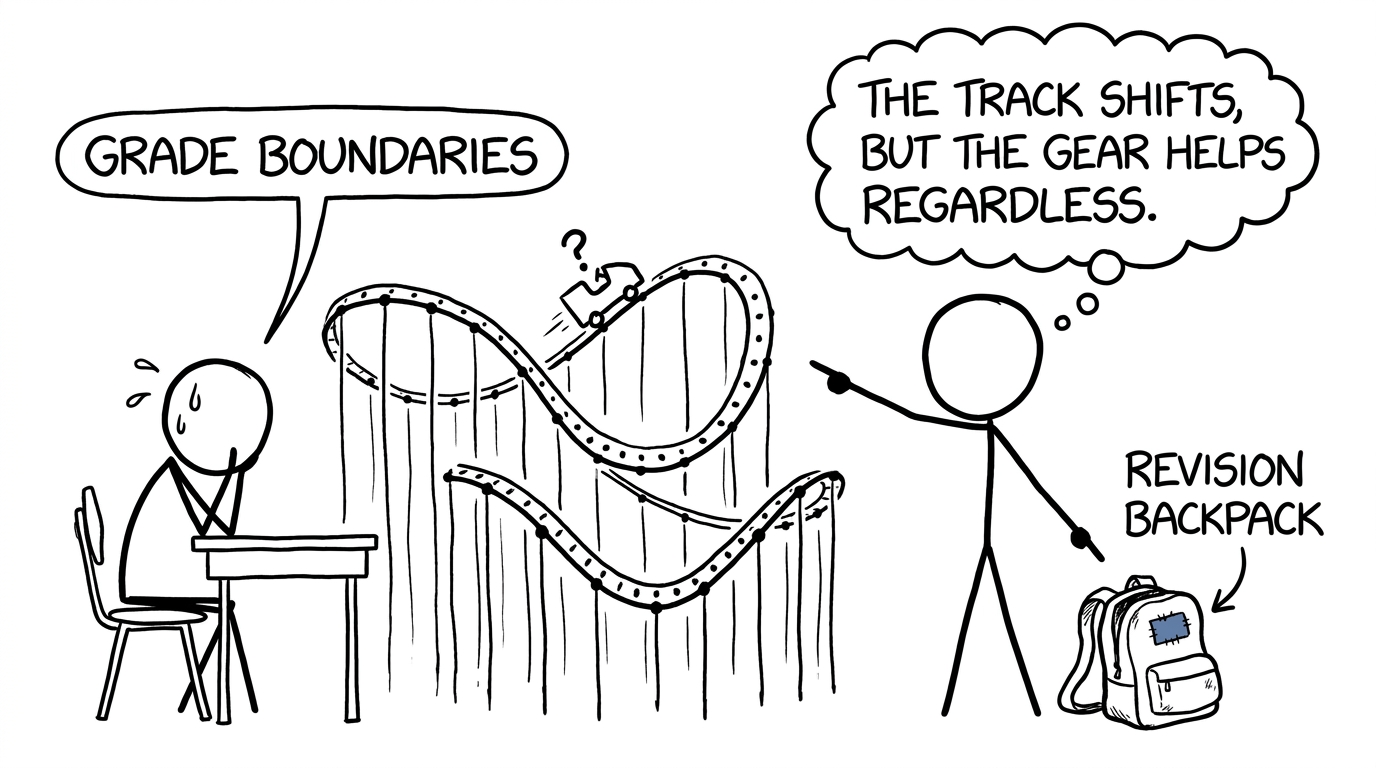 A student watches the grade-boundary rollercoaster while carrying a dependable revision backpack
Past A-Level Law grade boundaries by year
The table below shows OCR A Level Law overall raw-mark boundaries. The qualification total is 240240240 marks throughout this period, making direct year-to-year comparisons more meaningful.
| Exam series | Route | Maximum mark | A∗A^*A∗ | AAA | BBB | CCC | DDD | EEE |
|---|---|---|---|---|---|---|---|---|
| June 2022 | All options | 240240240 | 178178178 | 147147147 | 116116116 | 868686 | 565656 | 262626 |
| June 2023 | Papers 01+02+0301+02+0301+02+03 | 240240240 | 183183183 | 158158158 | 127127127 | 969696 | 656565 | 353535 |
| June 2023 | Papers 01+02+0401+02+0401+02+04 | 240240240 | 183183183 | 159159159 | 128128128 | 979797 | 666666 | 353535 |
| June 2024 | Papers 01+02+0301+02+0301+02+03 | 240240240 | 184184184 | 158158158 | 128128128 | 989898 | 696969 | 404040 |
| June 2024 | Papers 01+02+0401+02+0401+02+04 | 240240240 | 187187187 | 161161161 | 130130130 | 999999 | 696969 | 393939 |
| June 2025 | All options | 240240240 | 175175175 | 147147147 | 118118118 | 898989 | 606060 | 323232 |
These figures are available on MathsGenie's dedicated OCR A Level Law grade boundaries page, with the wider subject list on the OCR A Level grade boundaries hub.
At the time of writing, 2025 is the latest completed series with confirmed boundaries. Exam boards publish new boundaries on results day, after marking and awarding have taken place.
What the year-by-year changes tell us
2022: a lower starting point
In 2022, an A∗A^*A∗ required 178178178 marks from 240240240, or approximately 74.2%74.2\%74.2%. An AAA required 147147147 marks, equivalent to about 61.3%61.3\%61.3%.
This series formed part of the wider transition away from pandemic-era grading arrangements. It should therefore be read with particular care rather than treated as a permanent benchmark.
2023: boundaries rose across the grade range
The 2023 A∗A^*A∗ boundary reached 183183183 marks for both routes, equivalent to approximately 76.3%76.3\%76.3%. The AAA boundary increased to either 158158158 or 159159159, depending on the optional paper.
The rise was not confined to the highest grades. The boundary for an EEE moved from 262626 to 353535 marks. That broad movement shows why students should not assume that only top-grade thresholds fluctuate.
2024: the recent high point
Boundaries generally rose again in 2024. Depending on the route, an A∗A^*A∗ required either 184184184 or 187187187 marks. The higher figure represents approximately 77.9%77.9\%77.9% of the available marks.
The small difference between routes is important. OCR candidates complete either the human rights or contract option, and the awarding process can produce slightly different overall thresholds. Comparing one route with another without checking the paper combination may create a misleading conclusion.
2025: a clear downward movement
In 2025, the A∗A^*A∗ boundary fell to 175175175 marks, while the AAA boundary returned to 147147147. Lower grades also moved down: a CCC required 898989 marks compared with 989898 or 999999 in 2024.
This does not prove that standards became easier. Boundaries are set to account for differences in paper demand and candidate performance. A lower threshold can indicate that students found the assessment more demanding, but the raw boundary alone cannot explain every cause.
The larger A-Level Law grade boundary trend
The sequence is not a staircase. It rises from 2022 through 2024, then falls in 2025. For the OCR A∗A^*A∗ boundary, the pattern is:
178→183→184–187→175178 \rightarrow 183 \rightarrow 184\text{--}187 \rightarrow 175178→183→184–187→175That is why A-level law grade boundary trends are better understood as a range than as a prediction. Across these four series, the OCR A∗A^*A∗ boundary sat between 175175175 and 187187187 marks from 240240240. The AAA boundary ranged from 147147147 to 161161161.
The practical response is to build a margin of safety. Preparing only to match last year's minimum leaves no allowance for a stronger paper, an unusually demanding question or ordinary exam-day mistakes.
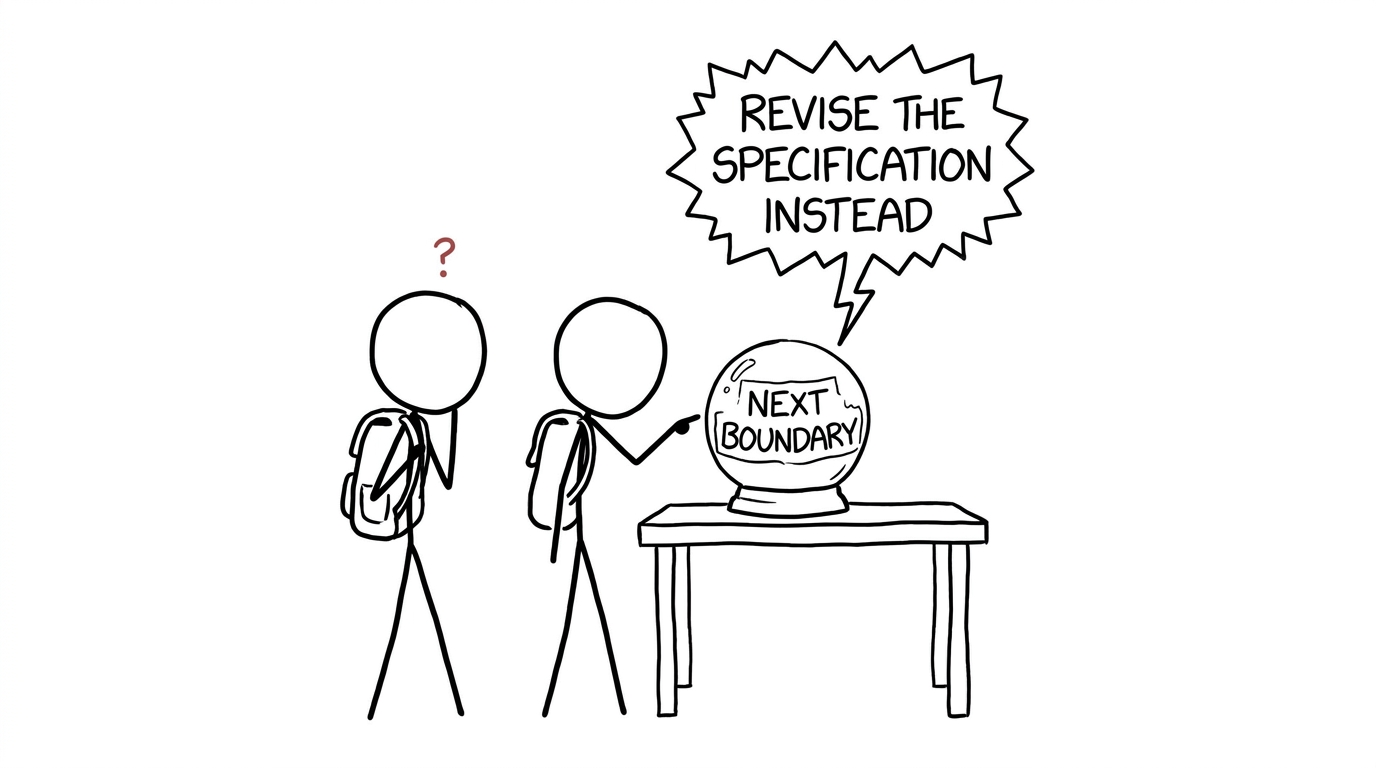 Students ask a crystal ball for the next boundary and are told to revise the specification instead
Why AQA, OCR and Eduqas figures cannot be combined
There is no universal A Level Law boundary. AQA, OCR and Eduqas have their own specifications, paper structures and maximum marks. Some boards also publish different overall boundaries for optional routes.
For example, AQA Law is assessed from a different total than OCR Law. Comparing an AQA raw mark directly with an OCR raw mark would therefore say little. Percentages help, but even percentage comparisons cannot remove differences in assessment design.
Use the AQA A Level grade boundaries page when analysing AQA, and keep OCR comparisons within the OCR series. Students can also use MathsGenie's AQA A Level past-paper collection to identify the correct paper and mark scheme.
What students and teachers should do with this data
Grade-boundary history is most useful after completing a full paper. Attempt the correct specification under timed conditions, mark it carefully, then compare the total with several years rather than one convenient year.
Look beyond the headline grade. Record where marks were lost: legal knowledge, application to a scenario, analysis, evaluation, timing or incomplete conclusions. A boundary tells you the result of a performance. The mark scheme helps explain the performance itself.
For OCR candidates, the OCR A Level Law past papers provide the right next step, with papers organised by series and official mark schemes available for checking responses.
Common mistakes when reading grade boundaries
Predicting the next boundary from one year: A fall in 2025 does not guarantee another fall. Each series is awarded independently.
Mixing boards or specifications: Raw marks are meaningful only when the maximum mark and assessment structure match.
Treating paper boundaries as final grades: Component boundaries may be notional. The overall qualification boundary determines the awarded grade.
Ignoring optional routes: A difference of a few marks may reflect different paper combinations rather than an error.
Using boundaries as revision targets: The minimum mark from a past series is not a safe target. Aim above the highest recent boundary relevant to your board while improving the quality of individual answers.
Turn the trend into a revision plan
Past boundaries offer perspective, not certainty. The calmer strategy is to prepare for the full specification, practise under timed conditions and learn how the mark scheme rewards precise legal reasoning.
Visit the MathsGenie A Level Law revision hub to choose your board, then move into revision lessons, practice questions and past papers. OCR students can start immediately with the free OCR A Level Law papers and mark schemes. Use each paper diagnostically: mark it, identify the weakness, revise it and try again.
Boundaries will keep moving. Strong preparation is what gives that movement less power over your result.