A-Level Law Grade Boundaries 2026 Explained
A-level law grade boundaries explained for 2026 results day, including how marks become grades, when boundaries appear and what to do next.
The hardest part of results day is often the minute before you understand what the numbers mean. You see a grade, perhaps a mark, and immediately wonder whether one more paragraph or remembered case could have changed everything. For students checking A-level law grade boundaries, the essential answer is simple: your exam board adds your component marks and compares the total with boundaries set after marking. The official 2026 boundaries will be released on A-level results day, Thursday 13 August 2026.
They cannot be known reliably beforehand. Predictions may offer context, but only the published table from your exam board determines your grade.
Your A-level law results day checklist
Before analysing your result, establish the facts:
- Confirm whether you took AQA, OCR, Eduqas or WJEC Law.
- Find your overall qualification mark, not only individual paper marks.
- Use the boundary table for the correct specification and option.
- Calculate how far your total is from the next grade.
- Speak to your school or college before requesting a review of marking.
MathsGenie brings together A-level Law revision resources, including exam-board pages, past papers, mark schemes and revision guides. That remains useful after results day if you are considering a review, a resit or simply want to understand where marks were gained.
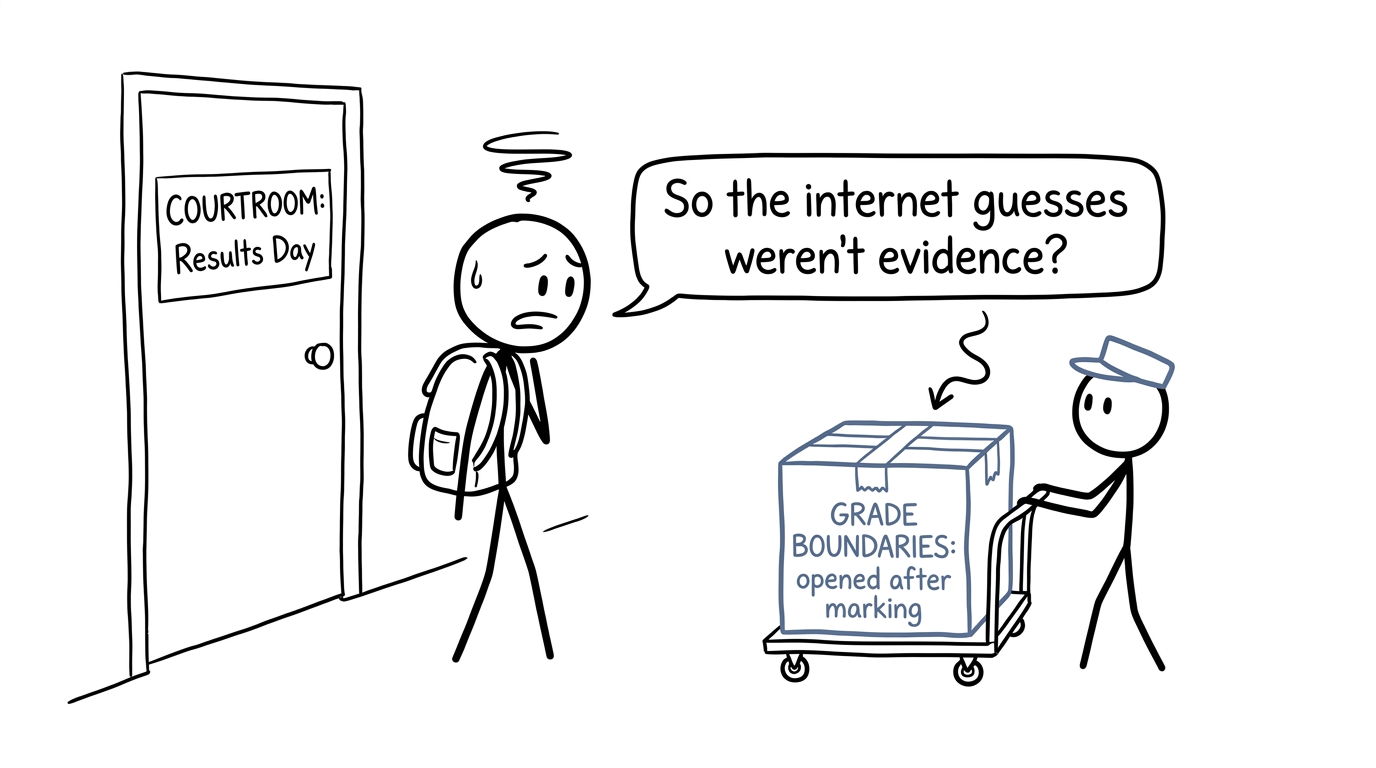 A student discovers that predicted boundaries are not evidence
How A-level law grade boundaries work
A grade boundary is the minimum overall mark required for a grade. If the boundary for an A were 184184184, a total of 184184184 would receive an A; 183183183 would fall into the grade below.
Exam boards do not set boundaries before students sit the papers. Once marking is nearly complete, they consider statistical evidence and review students' work around potential boundaries. Senior examiners use this evidence to maintain a comparable standard between years.
This explains why boundaries move. A more demanding paper may produce a lower boundary, while a more accessible paper may produce a higher one. The aim is not to reward or punish a particular year group. It is to preserve the standard represented by each grade.
There is also no fixed quota limiting how many students may receive an A or A*. Your result depends on the quality of your assessed work against the established standard.
Why exam-board totals differ
Do not compare raw totals across specifications. Current assessment structures are different:
| Exam board | Overall maximum mark | Assessment structure |
|---|---|---|
| AQA | 300300300 | Three written papers worth 100100100 marks each |
| OCR | 240240240 | Three written papers worth 808080 marks each |
| Eduqas | 200200200 | Components worth 505050, 757575 and 757575 marks |
A mark of 180180180 therefore represents different proportions on different courses. Even percentages cannot tell you the grade until the relevant year's official boundary is applied.
Students following AQA can review the complete AQA A-level Law revision hub, while OCR students should use the OCR A-level Law revision hub. Both organise resources around the correct specification.
Law A-level grade boundaries 2026
As of 31 July 2026, the official Law A-level grade boundaries 2026 are not publicly available. They are due to be released with results on Thursday 13 August 2026. Results may be issued to candidates from 08:0008{:}0008:00, although your school or college will confirm its collection arrangements.
Ofqual's 2026 guidance says the standard of work needed for a grade should be comparable with 2025. That does not mean the numerical boundaries will be identical. Paper difficulty changes, so using a previous boundary as a guaranteed target is unsafe.
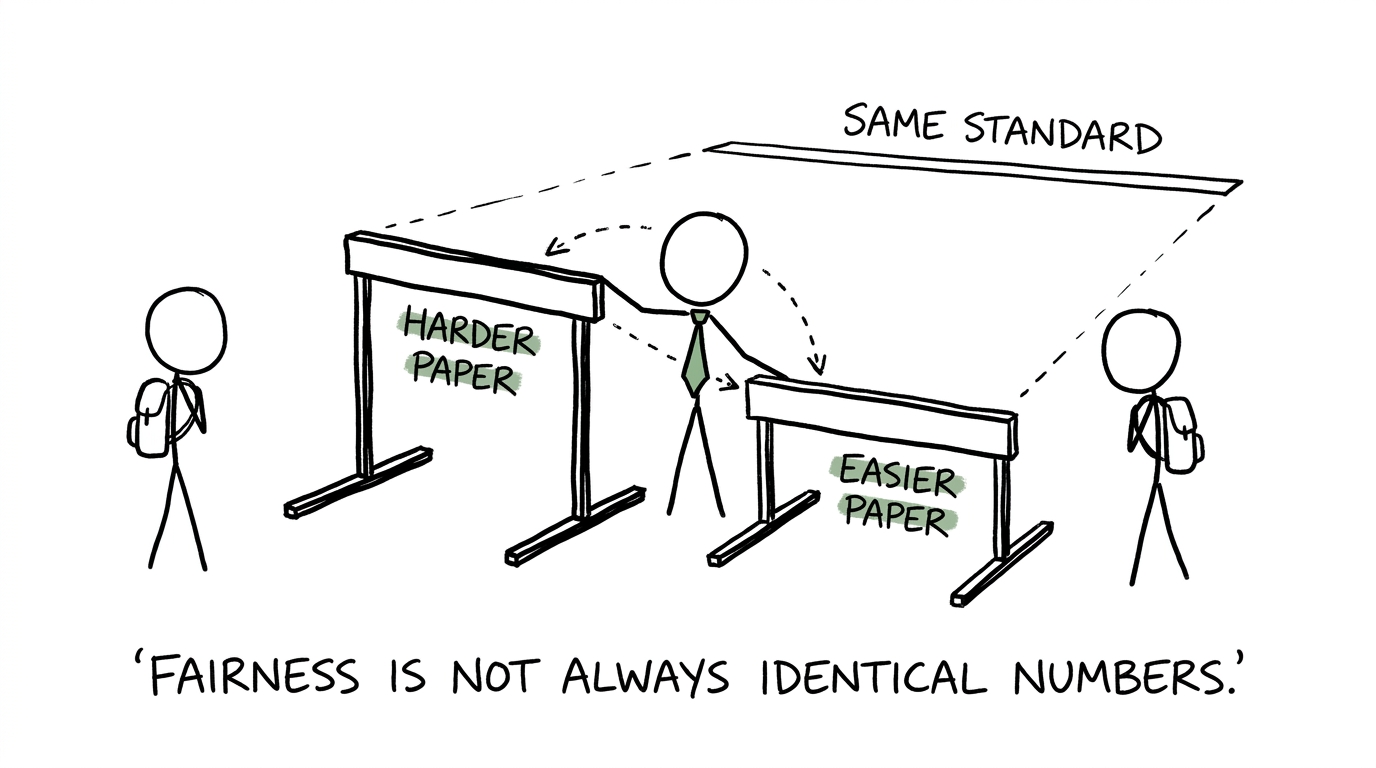 An examiner adjusts hurdles to maintain the same grading standard
Worked boundary example
Consider a hypothetical AQA student. These figures are invented solely to explain the calculation and are not predicted 2026 boundaries.
Suppose the student receives:
- Paper 1: 727272 marks
- Paper 2: 616161 marks
- Paper 3: 666666 marks
Their overall mark is:
72+61+66=19972+61+66=19972+61+66=199Now suppose the illustrative overall boundaries were:
| Grade | Hypothetical minimum mark |
|---|---|
| A* | 210210210 |
| A | 184184184 |
| B | 154154154 |
Because
184≤199<210,184\leq199<210,184≤199<210,the student would receive an A. Their distance from the A* boundary would be:
210−199=11 marks.210-199=11\text{ marks}.210−199=11 marks.The important comparison is between the combined qualification mark and the overall subject boundary. Published paper-level boundaries may be described as notional or illustrative; they do not normally award separate grades for each paper.
What to do when you receive your result
First, record your overall mark and the next boundary. Being close does not automatically mean the marking is wrong, but it gives your teacher useful context.
If the result is unexpected, ask your school or college about accessing your script. A teacher can compare your responses with the mark scheme and decide whether there may be a marking error. A review of marking is not a fresh attempt to award extra marks because an answer was nearly correct. It checks whether the original marking was applied properly.
A reviewed paper can move up or down. If its mark changes, your overall grade may rise, remain unchanged or fall. Discuss the evidence, cost and relevant deadline with your exams officer, particularly if a university place depends on the outcome.
To understand how legal knowledge is converted into credit, revisit specification-focused material such as criminal law rules and application, judicial precedent revision and the nature of law revision guide.
Common mistakes on A-level law results day
Trusting unofficial predictions
No website or social-media post can know the final boundary in advance. Use only the table matching your board, year, qualification and option.
Comparing marks with another exam board
AQA, OCR and Eduqas use different totals and papers. Your friend's raw mark is not a meaningful benchmark for yours.
Treating a component boundary as a paper grade
Your certificate reports one overall Law grade. Check the overall qualification boundary rather than assigning yourself separate grades from illustrative component figures.
Requesting a review without examining the script
A small gap can justify a careful conversation, not an automatic challenge. Ask a teacher to identify a plausible marking error first.
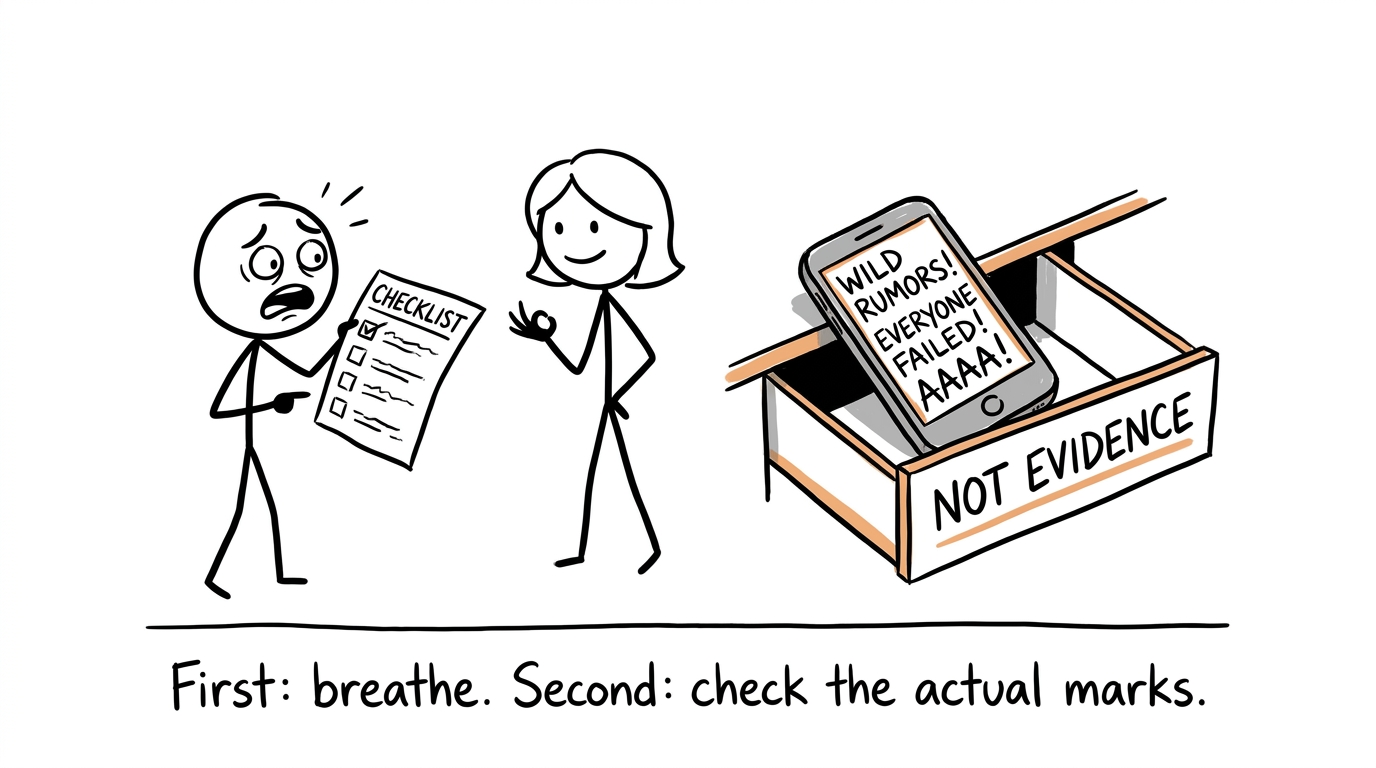 A results-day student checks real marks while ignoring online rumours
Turn the result into a clear next step
A boundary is a line on a table, not a judgement on your potential. Once you know your board, total mark and distance from the next grade, uncertainty becomes a practical decision.
Use MathsGenie's A-level Law revision guides to revisit the specification, then strengthen individual areas through guides such as Human Rights and English law and occupiers' liability. With revision lessons, practice questions, past papers and mark schemes in one place, MathsGenie gives you a calm route from today's result to your next informed choice.