

A-Level History Resit: Explain It on UCAS
A-level history resit UCAS application advice: declare grades correctly, explain your retake positively, and show universities clear evidence of progress.

Results day can compress two years of work into one letter on a screen. If that letter is not what you expected, it is easy to assume universities will see only the disappointment. They will not. For an A-level history resit UCAS application, the strongest approach is to declare both attempts honestly, check each university’s policy and frame the retake as a purposeful academic decision supported by evidence.
A resit does not need a dramatic defence. Admissions teams need clarity: what happened, what you are doing differently and why you are now better prepared for the course.
Your resit application checklist
Before writing anything, make sure you can tick these off:
- Declare your original History result and the forthcoming retake.
- Enter the completed qualification with its achieved grade and the new sitting as pending.
- Check the resit policy for every course and university individually.
- Ask your referee to provide a predicted grade for the pending qualification where appropriate.
- Put verified extenuating circumstances in the reference, with your permission.
- Use your UCAS answers mainly to demonstrate subject interest and preparation.
- Build a revision plan that can produce measurable evidence of progress.
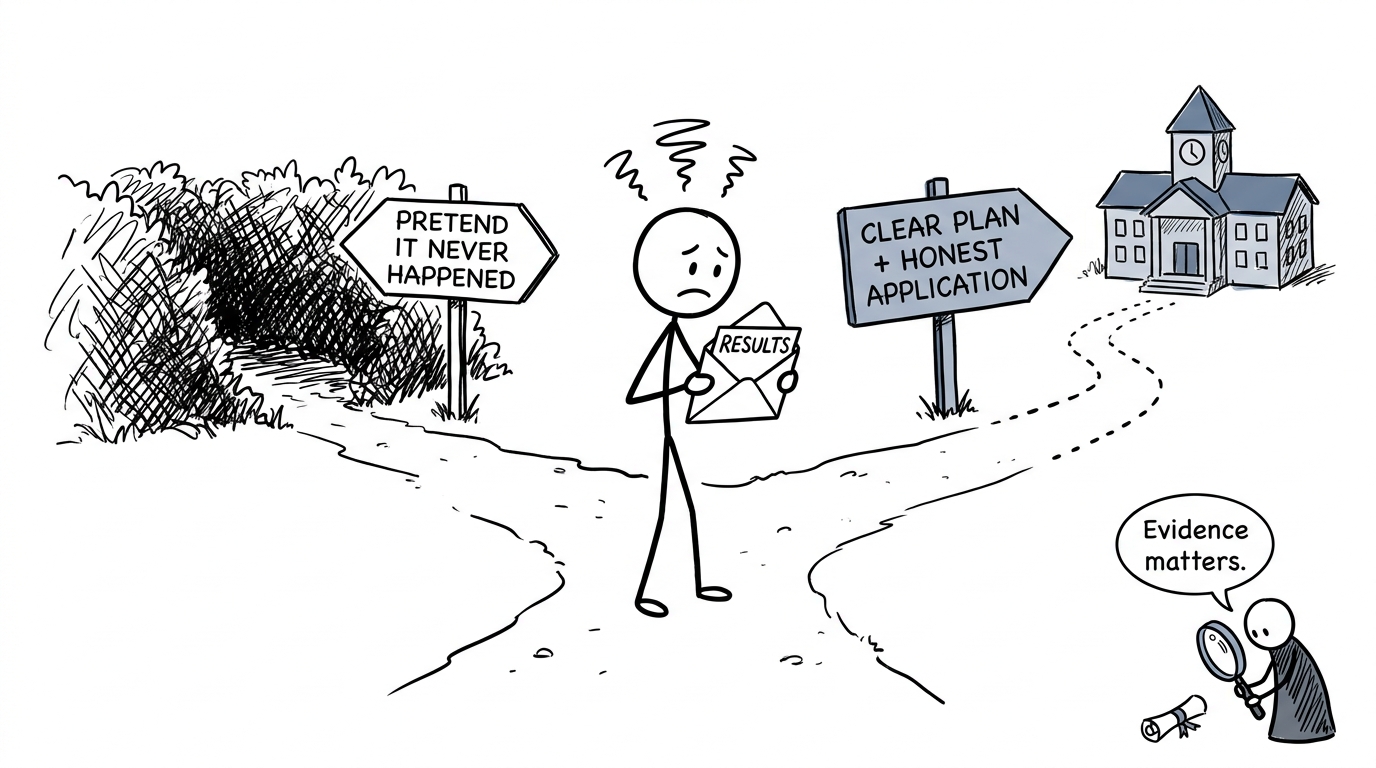 A student choosing between hiding a result and making an honest plan
Declare the History retake accurately
UCAS requires applicants to include previous and current qualifications from secondary education onwards. That includes completed A levels, unsuccessful grades, pending results and qualifications taken more than once.
If you are resitting A-level History, you may therefore need to enter the qualification twice: once with the grade already awarded and again with the future result shown as pending. Use the qualification title, awarding organisation and dates that match your official records. Ask your former school, college or exam centre if you are uncertain.
Do not omit the first grade because you expect the second to be higher. An accurate application creates trust; missing information can delay decisions or place an offer at risk.
For domestic A levels in England, retakes normally take place in the summer examination series. A private candidate must also arrange entry through an approved school, college or examination centre, so confirm this early rather than treating registration as an administrative detail for later.
Check whether each university accepts resits
There is no single admissions rule covering every university and course. Many courses consider resit applicants, while particularly competitive programmes may impose additional conditions, examine first-sitting results or accept retakes only in specified circumstances.
Check the current entry page and admissions policy for each exact course. Then contact admissions if the wording is unclear. Ask concise questions:
- Is an A-level History retake accepted for this course?
- Is there a minimum first-sitting grade?
- Will the standard offer apply, or is a higher resit grade required?
- Should relevant circumstances be supplied through the reference or directly?
Keep the written response. Policies can differ between departments at the same university, so advice about one course should not be assumed to apply to another.
Explaining a resit on UCAS without sounding defensive
For applications from 2026 entry onwards, the UCAS personal statement is divided into three questions covering course motivation, preparation through qualifications and preparation outside formal education. The total allowance remains limited, so a long account of results day is rarely the best use of the space.
Use a simple structure when explaining resit UCAS circumstances:
State the decision
Say that you are retaking A-level History and identify the academic purpose. Avoid blaming an examiner, school or paper.
Show what has changed
Name specific action: timed essays, source evaluation, interpretation questions, content retrieval or systematic use of mark schemes.
Connect the improvement to university study
Explain how the process is strengthening independence, critical judgement, organisation or written argument. These qualities matter because they relate directly to degree-level work.
A concise wording model could be:
I am retaking A-level History to strengthen my performance and demonstrate the standard of analytical writing I am capable of achieving. Since results day, I have reviewed feedback, rebuilt my revision plan around timed essays and mark schemes, and developed a more systematic approach to evaluating evidence and interpretations.
If the retake is not directly relevant to the course or your explanation would consume valuable space, let the education section and reference provide the necessary context. Your own answers should remain focused on why you are prepared for the degree.
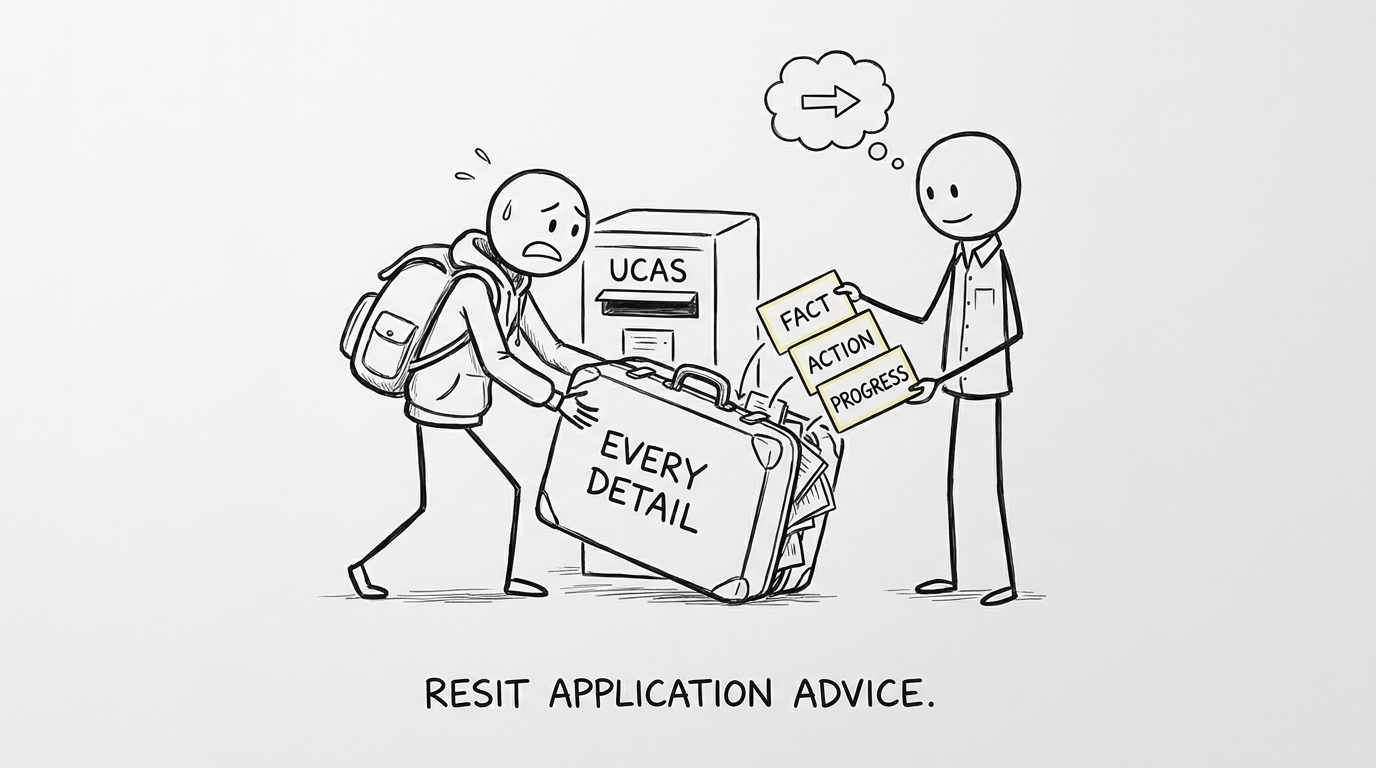 A student trying to fit every detail into UCAS while an adviser selects fact, action and progress
Use your reference to add factual context
A referee can do something your own statement cannot: independently confirm your current work, predicted performance and relevant circumstances.
Choose someone who understands your academic development, ideally a former History teacher or current tutor. Give them enough time and provide a short factual summary containing your original result, retake arrangements, current preparation and any evidence of improvement.
Where illness, bereavement or another serious disruption affected the first sitting, discuss whether it should appear in the extenuating-circumstances section of the reference. Keep the account accurate and proportionate. Circumstances explain context; they should not replace evidence that you are now ready.
Make the retake plan credible
A positive explanation carries more weight when your revision behaviour supports it. Start with the A Level History revision hub, then select the resources matching your board rather than mixing specifications.
MathsGenie provides dedicated revision areas for AQA A-level History, Edexcel A-level History and OCR A-level History. Use lessons and revision guides to repair knowledge gaps, followed by timed questions and strict marking.
If you take Edexcel, work through the Edexcel History revision guides before attempting Edexcel History past papers. OCR students can follow the same cycle with OCR History past papers. The aim is not simply to complete more papers. It is to identify why marks were lost, practise the weak skill and test it again under time pressure.
Common mistakes when explaining a History resit
Hiding the original result: UCAS requires completed and pending qualifications to be declared accurately.
Writing an apology: A university needs evidence and context, not repeated expressions of regret.
Making unsupported claims: Replace “I will work harder” with concrete changes such as timed essays, feedback logs and source-analysis practice.
Using the whole statement to discuss the grade: Keep the application centred on your course motivation and academic preparation.
Assuming every university has the same policy: Check each course before using one of your five choices.
Reusing an old statement unchanged: Reapplicants can draw on earlier material, but the three-question format and your academic position have changed.
Turn the second attempt into evidence
A resit is a fact, not your entire application. Declare it, explain it briefly and show what has changed. The persuasive part is not the promise of a better grade; it is the disciplined work already under way.
Begin with MathsGenie’s free A Level History revision resources. Combine specification-matched revision lessons and guides with past papers, mark schemes, practice questions, mini tests and predicted papers. Build evidence one essay at a time, then let your UCAS application describe that progress with calm honesty.










