

A-Level History Remark: Results Day Guide
A-Level History remark guidance for results day: understand reviews of marking, deadlines, risks, scripts and when challenging your grade makes sense.

Results day can compress two years of work into one uncomfortable number. If your History result is below the grade you expected, an A-Level History remark may be worth considering, but only when there is evidence of a marking error.
The official service is a review of marking, not a complete fresh re-mark. Your school or college asks the exam board to check whether the original mark scheme was applied correctly. Your mark can rise, remain unchanged or fall, so the decision should be made quickly but carefully.
Your results-day decision checklist
Before requesting a review, check each of these points:
- Confirm your overall mark and the grade boundary for your exact exam board and option.
- Calculate how many additional marks you need for the next grade.
- Identify the component on which a review could realistically change the result.
- Ask for access to your marked script where time permits.
- Have a History teacher compare the marking with the correct mark scheme and level descriptors.
- Tell your exams office immediately if a university place depends on the outcome.
- Check the fee, deadline and consent form before proceeding.
- Accept that the mark and final grade can go down as well as up.
Start with the MathsGenie A-Level History revision hub, then check the relevant tables on the A-Level grade boundaries page. The boundary must match your board, examination series and combination of History options.
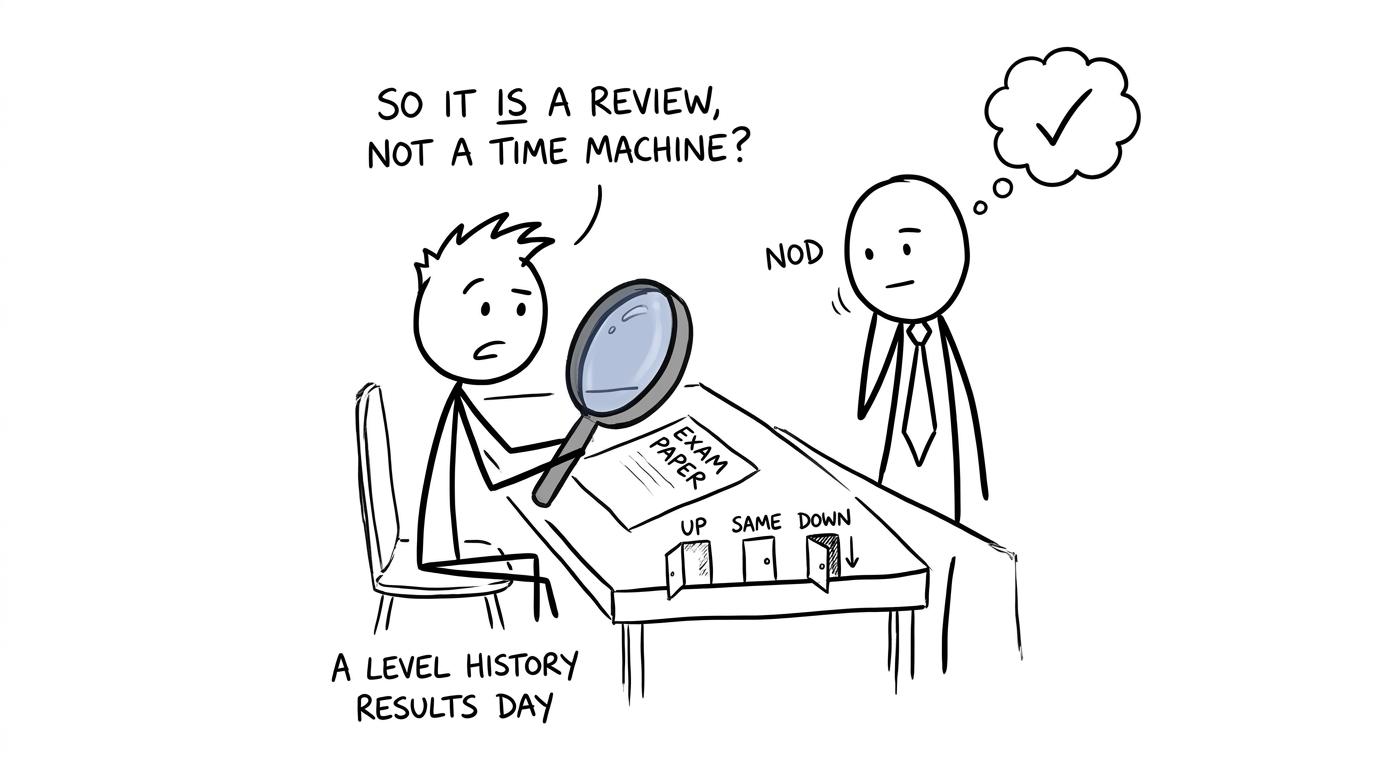 A student asks whether a review of marking is a time machine
How the A-Level History re-mark process works
Although students often say “remark”, exam boards including AQA, Pearson Edexcel, OCR and Eduqas formally call the service a review of marking.
Speak to your school or college
Contact the exams officer and your History teacher on results day. For most candidates, the school or college submits the request. Private candidates may be able to approach the awarding organisation directly or use the centre that entered them.
Your centre may set an internal deadline earlier than the exam board deadline, allowing time to collect consent, payment and supporting information.
Check your marks against the boundary
Let RRR be your awarded mark and BBB the next grade boundary. The additional marks required are
M=B−R.M = B-R.M=B−R.A small value of MMM does not prove that the marking is wrong. It simply tells you how much movement would be needed. Use the appropriate board page, such as the AQA A-Level grade boundaries, Edexcel A-Level grade boundaries or OCR A-Level grade boundaries.
Request the script where possible
Access to scripts allows your teacher to inspect the marked paper. This is particularly useful in History because essays, sources and interpretations are assessed through level descriptors and professional judgement.
A disappointing mark is not automatically an error. Stronger evidence might include an unmarked section, a response apparently placed in an unsuitable level, or credit that seems inconsistent with the published criteria. The question is not whether another teacher might prefer your argument. It is whether the original marking contains an error under the exam board's rules.
Choose the appropriate service
An administrative or clerical check looks for issues such as unmarked questions and incorrect recording or totalling of marks. A review of marking includes an administrative check and asks an independent reviewer to identify marking errors.
For A Levels, priority reviews are available when a higher education place or another urgent progression decision depends on the outcome. Current government guidance says priority reviews are normally completed within 151515 calendar days, while non-priority reviews are normally completed within 202020 calendar days.
For the June 2026 series, JCQ lists 202020 August 2026 as the awarding-body deadline for a priority review and 242424 September 2026 for standard reviews. Your centre may require requests earlier, so never treat those dates as personal submission deadlines.
Give written consent
Your centre must obtain your written consent after results have been published. This is necessary because the reviewed mark replaces the original outcome and may be lower, unchanged or higher. Once an outcome has been released, you cannot simply choose whichever mark you prefer.
Fees vary by exam board and centre. Ask whether the fee is waived or refunded when the subject grade changes, as arrangements can differ.
When requesting a History review makes sense
Appealing an A-Level History grade is most reasonable when several signals align:
- You are close enough to the next boundary for a plausible correction to affect the grade.
- A teacher has reviewed the script and identified a specific possible marking error.
- One component is notably inconsistent with your other assessed work and there is evidence explaining why.
- A question or page may have been missed.
- The grade affects a confirmed university, apprenticeship or employment condition.
Being one mark below a boundary is a reason to investigate, not an automatic reason to request a review. Equally, being several marks away does not make a review impossible if the script contains a clear and substantial concern.
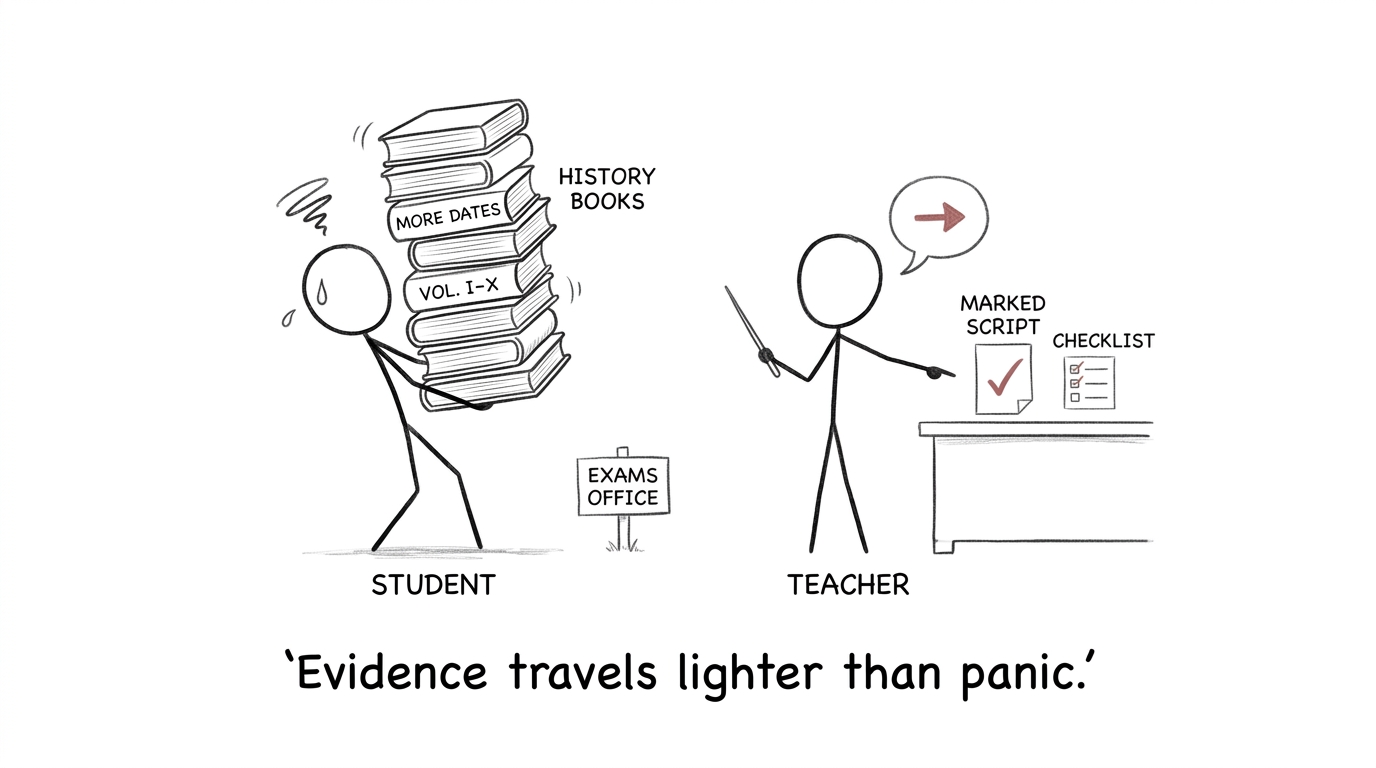 A teacher points from a mountain of panic towards one marked script and a checklist
Review of marking or formal appeal?
A review of marking comes first. A formal appeal is a later stage used when your centre believes an error remains after the review or that the correct procedure was not followed.
An appeal is not simply a second attempt because the review did not produce the desired grade. For 2026, JCQ states that appeals must generally be made within 303030 calendar days of the review outcome. Your school or college should explain its internal appeals procedure if it declines to request a review or appeal on your behalf.
Common mistakes to avoid
Looking at the wrong boundary
History boundaries may vary by board, series and option combination. Do not rely on a screenshot or a previous year's figures. MathsGenie's A-Level grade boundary directory helps you navigate the relevant board tables.
Assuming a review means generous marking
A reviewer does not award extra marks because you are close to a boundary or need the grade for university. The task is to correct marking errors while respecting legitimate professional judgement.
Waiting for the published deadline
Schools frequently set earlier internal cut-offs. Contact the exams office on results day, especially if you need a priority service.
Reviewing every component without evidence
Reviews apply to individual components. Ask which paper presents the strongest evidence rather than paying to challenge everything automatically.
Ignoring the risk of a lower mark
Written consent is not a formality. Read it carefully and discuss the downside with your teacher before signing.
Make the decision from evidence, not panic
An A-Level History remark is worthwhile when the boundary, script and teacher assessment point towards a genuine marking concern. The strongest results-day approach is calm and sequential: verify the figures, obtain the script, seek subject-specialist advice and speak to the exams office before its deadline.
Begin with the MathsGenie A-Level History grade information and compare your result with the correct official boundary. If you are also preparing for GCSE or A-Level Maths, MathsGenie remains your free revision base for Edexcel GCSE Maths lessons and practice questions, GCSE predicted papers, mini tests, past papers, mark schemes and video solutions. Results day rewards evidence. Good revision does too.











