

A-Level History Marks per Grade: 2025 Guide
A-level History marks per grade explained using 2025 raw grade thresholds for AQA, Edexcel and OCR, plus essential results-day checks.
The envelope opens in seconds. Understanding the number inside can take longer. If you are searching for A-level History marks per grade, the short answer is that there is no single universal mark for each grade. Your threshold depends on the exam board, examination year and, for some boards, the combination of History options you took.
The latest available boundaries are from June 2025. Most routes shown below have a maximum qualification mark of 200200200, but you must match your result to the exact route listed by your exam board.
Results-day checklist
Before comparing your mark with a boundary:
- confirm whether you studied AQA, Pearson Edexcel, OCR or Eduqas;
- find your exact option or component combination;
- use the boundary for the correct examination series;
- compare your total with the overall qualification boundary, not a notional paper boundary;
- remember that the published figure is the minimum mark for that grade.
You can begin with the MathsGenie A-Level grade boundaries hub, which brings the exam boards and available years together.
A-Level History raw marks and grade thresholds
A raw mark is the mark awarded for your assessed work before any scaling required by the exam board. An overall grade boundary is the lowest total needed to receive a particular qualification grade.
For example, a boundary of 160160160 for grade AAA means that 160160160 is an AAA, while 159159159 falls into the grade below unless a review changes the mark.
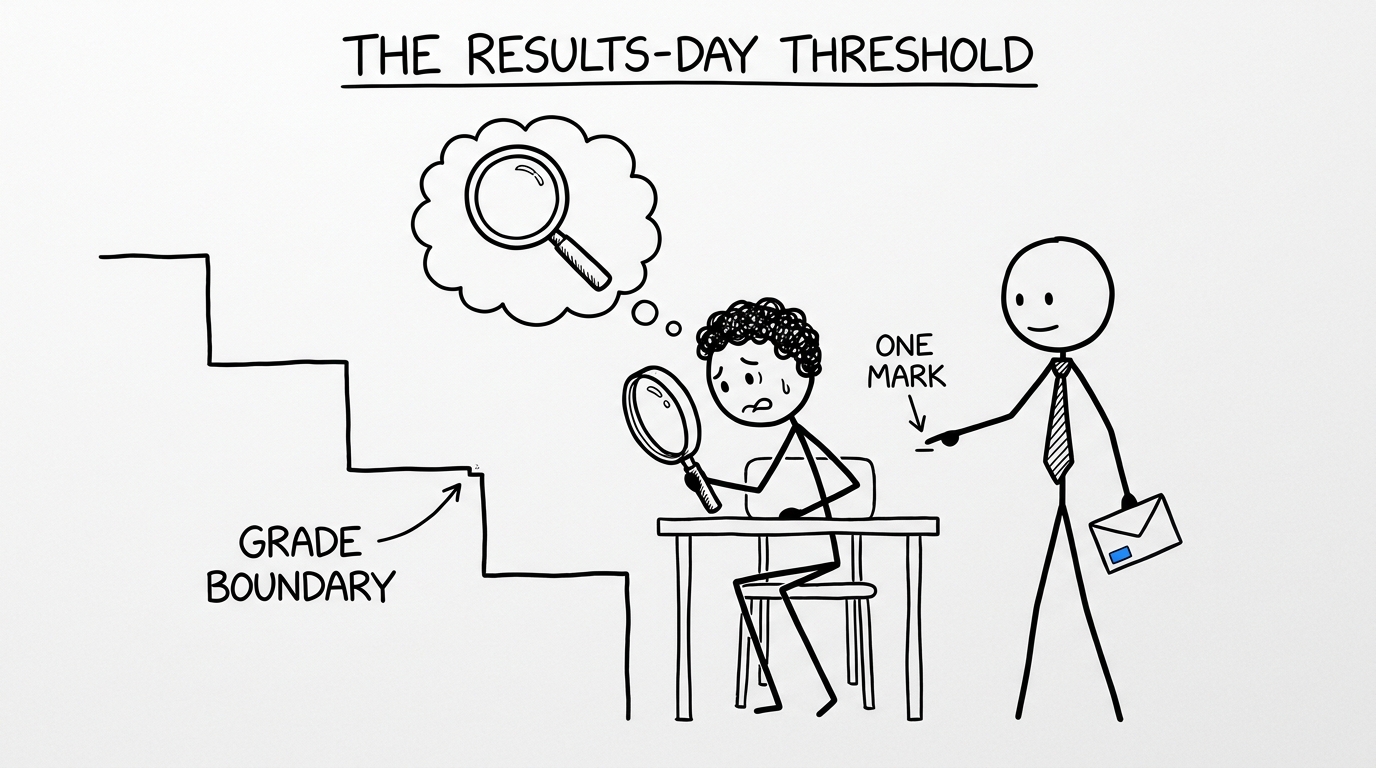 A nervous student inspecting the one-mark gap between grade steps
The table gives verified June 2025 examples. It is a quick reference, not a replacement for checking your precise route.
| Exam board and route | Maximum mark | A∗A^*A∗ | AAA | BBB | CCC | DDD | EEE |
|---|---|---|---|---|---|---|---|
| AQA option AA | 200200200 | 157157157 | 135135135 | 111111111 | 888888 | 656565 | 424242 |
| Edexcel route 040404, 1A1A1A, 2A2A2A, 303030 | 200200200 | 174174174 | 160160160 | 137137137 | 114114114 | 929292 | 707070 |
| OCR H505 standard route shown | 200200200 | 153153153 | 137137137 | 116116116 | 959595 | 757575 | 555555 |
AQA publishes different boundaries for its option combinations. Use the AQA A-Level History grade calculator or browse the wider AQA A-Level boundaries rather than assuming option AA applies to you.
Edexcel also sets overall boundaries by route. The Edexcel A-Level History grade calculator lets you select the relevant papers and compare totals across several years.
OCR H505 boundaries vary slightly for certain unit combinations. Check the complete OCR A-Level History grade boundaries or enter marks in the OCR History grade calculator.
For Eduqas, use the board-specific entry in the MathsGenie boundaries hub and match it against your qualification code. Do not confuse A-Level History grades A∗A^*A∗ to EEE with Eduqas GCSE History grades 999 to 111.
Why History grade boundaries change
Grade thresholds are set after papers have been marked. Exam boards use evidence about the demand of the assessments so that a slightly harder paper does not automatically disadvantage an entire cohort. This is why last year's boundary is useful context, but not a promise.
The percentage represented by a raw mark can be calculated as:
percentage=raw markmaximum mark×100\text{percentage}=\frac{\text{raw mark}}{\text{maximum mark}}\times 100percentage=maximum markraw mark×100Yet percentages do not transfer safely between boards. In the examples above, the June 2025 A∗A^*A∗ threshold ranges from 153153153 to 174174174 out of 200200200. That difference reflects distinct specifications and routes, not proof that one board is inherently easier.
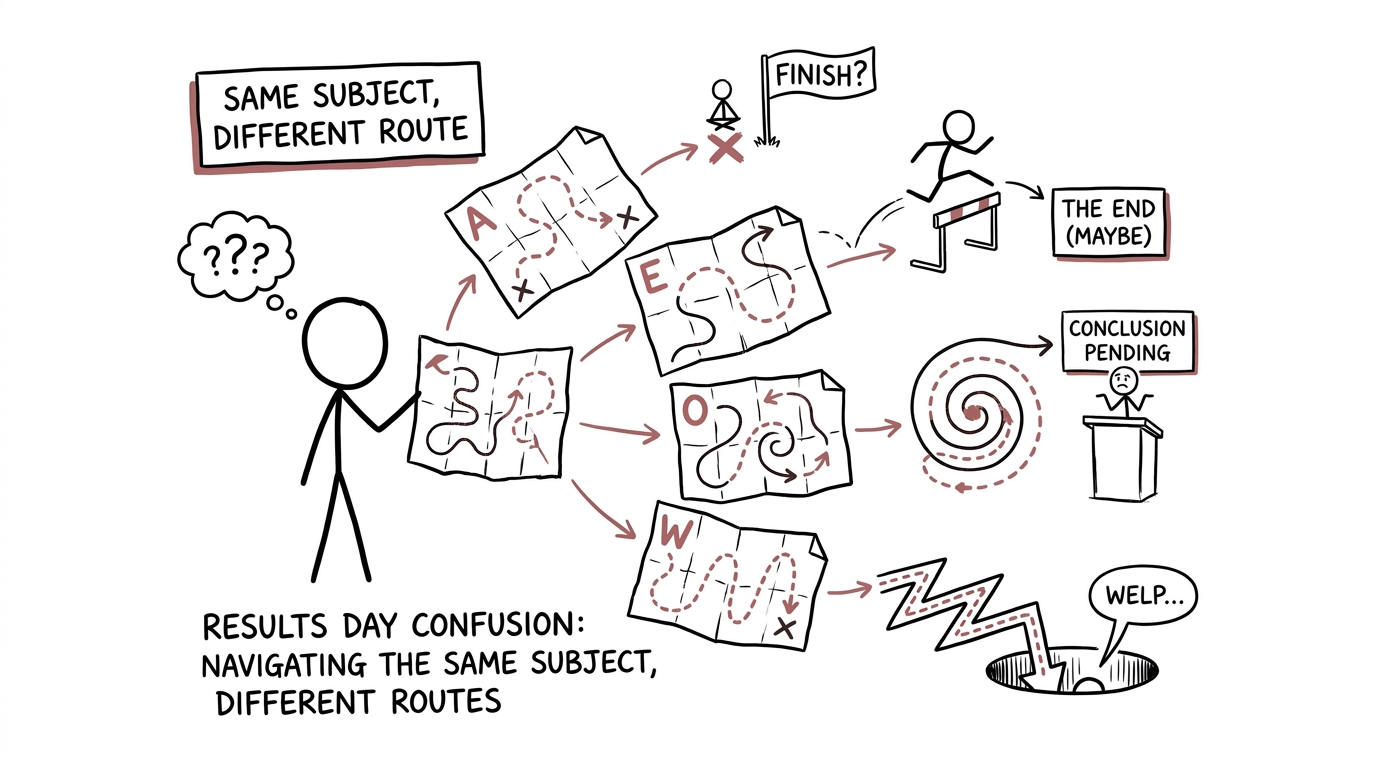 A student comparing different route maps leading to nearby finish lines
What to do if you are close to a boundary
First, check the total carefully. Then ask your school or college for your component marks and, where available, access to scripts. A review of marking is not a free extra chance: marks can rise, remain unchanged or fall. Discuss the evidence, deadline, fee and effect on any university place with your exams officer before proceeding.
One mark can feel enormous on results day because it sometimes changes the printed grade. But the sensible decision still comes from evidence rather than the size of the disappointment.
Common mistakes when checking History marks
Using the wrong year: June 2024 thresholds do not determine a June 2025 result.
Ignoring the option route: AQA and Edexcel History can have different overall boundaries for different combinations of topics or papers.
Adding incompatible figures: Do not add notional component boundaries and treat the result as an official qualification boundary.
Treating an estimate as confirmed: Predicted boundaries published before results day cannot tell you the final grade threshold.
Reading the GCSE scale: A-Level History uses grades A∗A^*A∗ to EEE, not grades 999 to 111.
Make the next mark easier to earn
Grade boundaries explain a result; good revision changes the next one. MathsGenie is built around that distinction. If History is one part of a wider results-day plan, use the free GCSE Maths revision hub or A-Level Maths revision resources to combine revision lessons, practice questions, past papers, predicted papers, mini tests, mark schemes and video solutions.
For the exact History threshold, open the MathsGenie A-Level grade boundaries guide, choose your board and match the route carefully. The right comparison is rarely the first number you find. It is the number belonging to your paper, your series and your qualification.










