

A-Level History Lower Grade Than Expected: Next Steps
A-level history lower grade than expected? Explore reviews of marking, Clearing and resits, then build a focused plan for improving your result.

Opening an results envelope can shrink two years of work into a single letter. If you received an A-level history lower grade than expected, pause before making any irreversible decision. Check your university status, speak to your school or college, review your component marks and then choose between a review of marking, Clearing or a resit.
A disappointing result matters, but it does not decide the whole story. Results day is a decision point, not a verdict on your ability.
Your immediate A-level History results checklist
Before analysing every essay you remember writing, take these practical steps:
- Check UCAS Hub because your firm or insurance university may still have accepted you.
- Collect your component marks and compare them with the published grade boundaries.
- Speak to your History teacher and exams officer.
- Ask whether your marked scripts can be accessed.
- Contact your university if your application is still pending.
- Explore Clearing without rushing to accept an unsuitable course.
- Consider a resit only after understanding what caused the result.
You can also use the A-level History revision hub to find resources for AQA, Edexcel, OCR and WJEC, including past papers, revision guides and grade information.
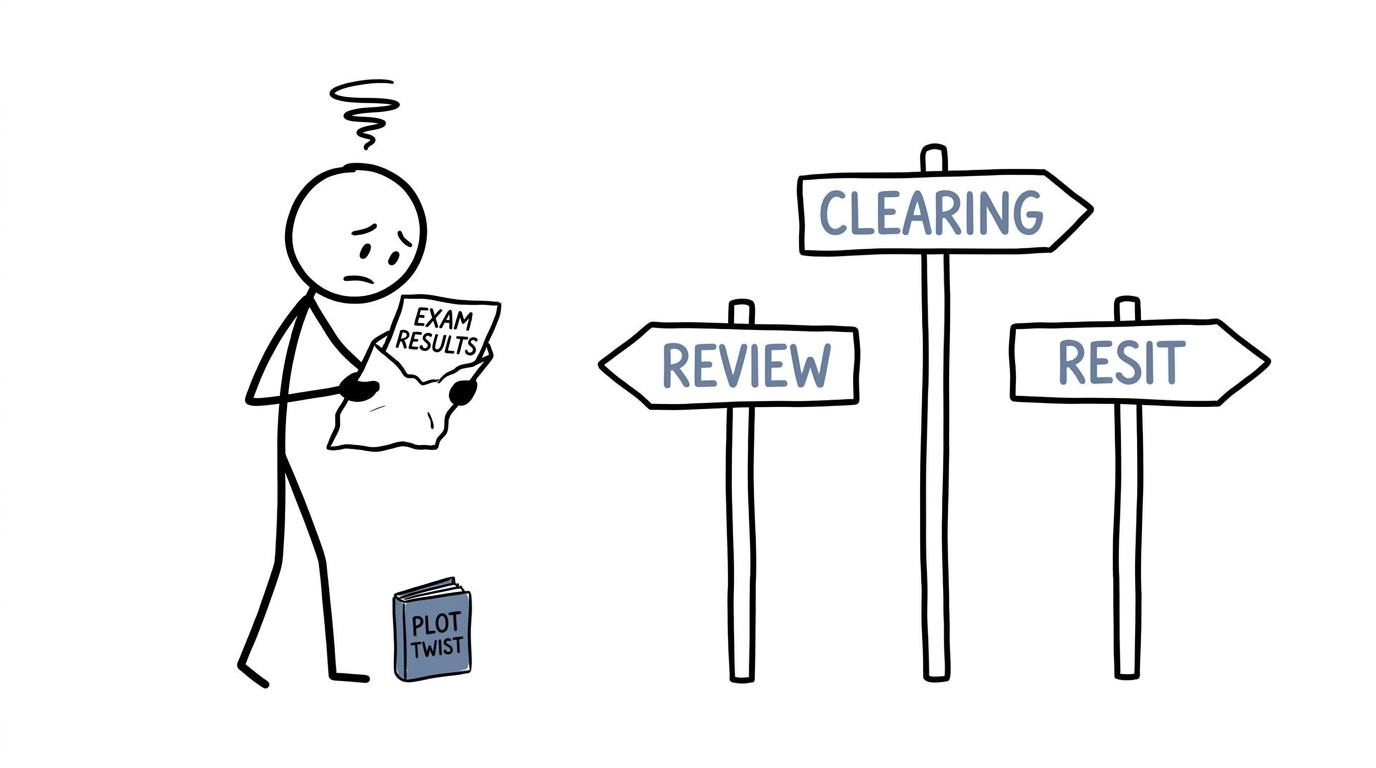 A student facing three calm signposts after an unexpected History result
Check what your result actually means
Disappointment often arrives before the evidence. A grade may be lower than your prediction but still secure your university place. Check UCAS Hub first rather than assuming that one missed condition has ended your application.
If your status is unclear, contact the university directly. Admissions teams may still be considering you, particularly when you have narrowly missed an offer. They might accept you, suggest a related course or discuss a foundation year. Ask specific questions and record any instructions or deadlines.
Next, inspect your component marks. History qualifications combine different forms of assessment, which may include breadth and depth papers, source evaluation, interpretations and non-exam assessment. One weak component can explain an otherwise surprising overall grade.
Grade boundaries change between exam series, so do not compare your raw mark with an old boundary and assume an error. MathsGenie's AQA A-level History grade calculator and OCR A-level History grade calculator can help you examine recent boundaries in context.
Ask whether a review of marking is appropriate
A review of marking is sometimes informally called a remark, but it is not a completely fresh assessment based on whether another examiner prefers your argument. The reviewer checks whether the original mark scheme was applied correctly and whether administrative or marking errors occurred.
Your school or college can usually request access to your marked script. A History teacher can then compare your answers with the mark scheme and decide whether there is evidence of an error. This is especially useful in History because an answer can feel convincing while still missing the precise evaluation, supporting knowledge or judgement required by the assessment objectives.
Most students request a review through their school or college, and written consent is required. Fees may apply. Crucially, a mark and grade can remain unchanged, rise or fall.
For summer 2026, A-level results are released on Thursday 13 August. The deadline for a priority review of marking is 20 August 2026, while the standard review deadline is 24 September 2026. Your centre may impose an earlier internal deadline, so speak to its exams officer immediately. A priority review is intended for cases where progression to further or higher education depends on the outcome.
If a university place is at stake, tell the admissions team that a priority review has been requested and ask how long it can keep the place open. Do not assume that the exam board or UCAS will handle this conversation for you.
Use Clearing without treating it as second best
An A-level History disappointing result may make Clearing feel like an emergency exit. In reality, it is a structured UCAS route connecting applicants with courses that still have vacancies.
For 2026 entry, Clearing runs from 2 July to 19 October. Students who miss their offer conditions can use it from results day. Search carefully, contact universities directly and obtain permission from a provider before adding it as your Clearing choice in UCAS Hub.
Prepare the following before calling:
- your UCAS ID and Clearing number, if shown;
- your complete results, not only History;
- the exact course title and code;
- concise reasons for wanting the course;
- questions about modules, accommodation and entry requirements.
Do not choose a course merely because it is available. Read its content and consider whether you would genuinely want to spend several years studying it. A slightly different university or course can be a sensible destination; an impulsive choice made to escape disappointment can create a larger problem.
Decide whether an A-level History resit is worthwhile
A resit can be the right choice when a higher grade is essential for your next step and you can identify a realistic route to improvement. It is less useful when the plan is simply to reread the same notes and hope for a different outcome.
UK A levels are linear qualifications. A student resitting A-level History will normally take the required examined components again in a future summer series rather than retaking one selected paper. If you received your result in August 2026, the next standard opportunity will generally be the summer 2027 series.
History often includes non-exam assessment. Whether an existing NEA mark can be carried forward depends on the specification, exam board and entry arrangements. Confirm this with your original centre or a private candidate centre before paying fees or committing to a revision course. Universities can also have different policies on resits, particularly for competitive courses, so ask before reapplying.
Start by returning to the correct specification. Students following AQA can use the AQA A-level History revision page, while Edexcel students can rebuild topic knowledge through Edexcel A-level History lessons. OCR students can use specification-focused guides such as Russia and its Rulers, 1855-1964.
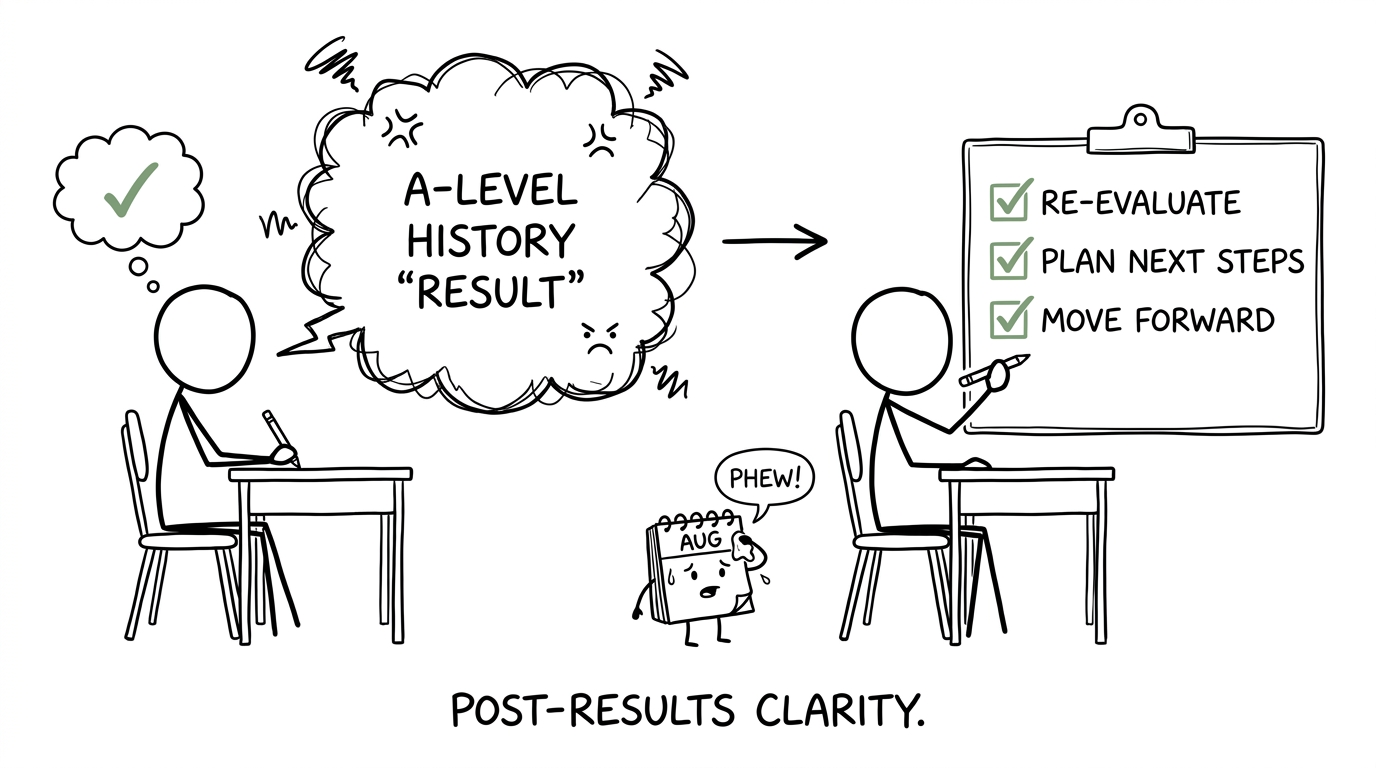 A student turning a frightening result cloud into a manageable checklist
Build a stronger History resit plan
The most useful question is not, "How many hours did I revise?" It is, "Which part of my performance needs to change?"
Separate the problem into knowledge, argument, evidence, source analysis, interpretations and timing. Ask your teacher to identify patterns across your papers or marked script. Then build revision around the weakest areas rather than repeatedly revising your favourite topic.
A strong weekly routine should include:
- retrieval of precise dates, events and evidence;
- timed essay plans with a defensible overall judgement;
- complete essays under exam conditions;
- source and interpretation questions matched to your specification;
- marking against official level descriptors;
- an error log showing what to change next time.
Use Edexcel A-level History past papers to practise under realistic conditions, then study the mark schemes. Past papers reveal whether your problem is missing knowledge or failing to turn knowledge into analysis.
Common mistakes after a disappointing result
Requesting a review because the grade feels unfair
A prediction is not evidence of a marking error. Ask a teacher to inspect the component marks and script before recommending a review.
Forgetting that a reviewed mark can fall
Consent matters because the outcome is not guaranteed. Understand the risk, cost and likely effect on your overall grade.
Waiting too long when a university place depends on the result
Priority review deadlines arrive quickly. Contact your exams officer and university on results day if possible.
Accepting the first Clearing option
Availability does not make a course suitable. Compare content, location, costs and progression before adding a choice.
Planning a resit without diagnosing the original result
More revision is not automatically better revision. Use scripts, mark schemes and teacher feedback to identify the precise change required.
Turn the result into a clear next step
Your A-level History next steps depend on evidence. If marking appears incorrect, discuss a review. If you want to begin university this year, investigate your existing offer and Clearing. If the grade blocks an important goal and improvement is realistic, consider a carefully planned resit.
When you are ready to rebuild, start with MathsGenie's free A-level History revision resources. Use revision lessons to repair knowledge, practice questions to sharpen arguments, and past papers, predicted papers, mini tests and mark schemes to make progress visible. A lower grade can close one version of the plan. It does not prevent you from writing a better one.











