

A-Level History Grade Boundaries 2026 Explained
A-level history grade boundaries explained for 2026 results day, including total marks, notional boundaries and what to do if your grade is unexpected.
The envelope, email or results portal can make two years of work feel as though it has been compressed into one letter. Yet that letter is not decided by a fixed percentage. A-level history grade boundaries are set after the exams have been taken and marking is nearly complete, using statistical evidence and senior examiners’ judgement.
For students awaiting A-level history results day, the essential facts are simple: results are released on Thursday 13 August 2026, the precise 2026 boundaries cannot be known in advance, and your final grade depends on your total qualification mark rather than whether one paper felt unusually difficult.
A-level history results day checklist
Before interpreting your result, check:
- your exam board: AQA, Edexcel, OCR or WJEC/Eduqas
- your exact specification and combination of options
- your total qualification mark
- the official subject-level boundary for summer 2026
- whether any paper-level figures are described as notional
- the deadline and cost for any post-results service, confirmed by your school or college
MathsGenie’s A Level History revision hub brings together board-specific resources and grade tools in one place.
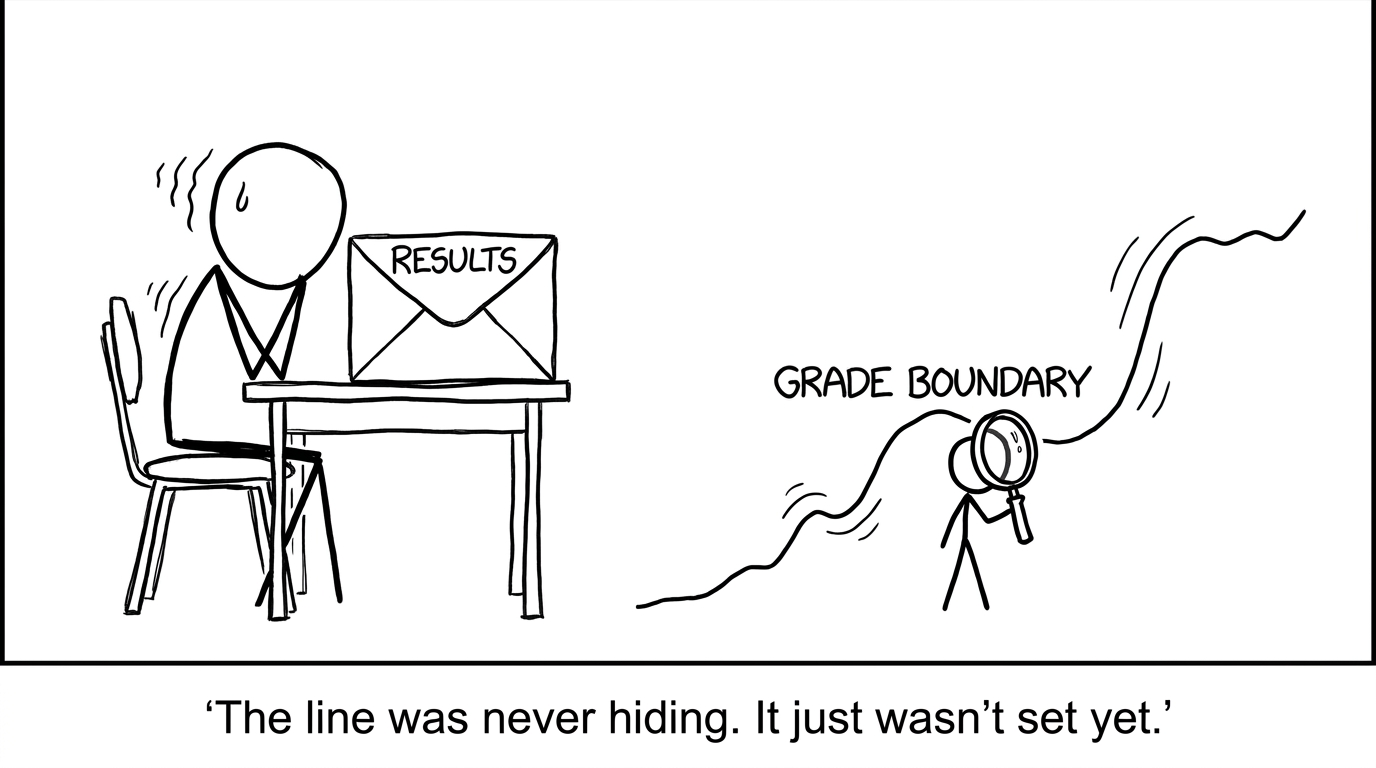 A nervous student waits while a historian examines a moving grade boundary
How A-level history grade boundaries work
A grade boundary is the minimum mark required for a grade. If an A boundary were 135135135, a total of 135135135 would receive an A, while 134134134 would fall into the grade below. This does not mean that 135135135 will be the real boundary in 2026; it is simply how a published boundary should be read.
Exam boards cannot set reliable boundaries before students sit the papers because papers vary slightly in difficulty. When marking is almost complete, senior examiners examine evidence including:
- how demanding the assessments proved to be
- statistical information about the cohort
- the quality of work around possible boundary marks
- standards established in previous years
A harder paper can lead to a lower boundary, while an easier paper can lead to a higher one. The aim is to maintain a comparable standard, not to reward or punish a cohort for receiving a particular paper. There is also no fixed quota limiting how many students may achieve each grade.
This is why last year’s thresholds provide context but cannot reveal the history A-level grade boundaries 2026.
Why History boundaries can look complicated
History qualifications contain different topics, components and option combinations. The relevant row in a boundary document may therefore carry a long option code rather than simply saying “History”. Check that code against your results information before drawing conclusions.
The overall grade is normally based on the combined qualification mark. For example, AQA History has two written components worth 808080 marks each and a historical investigation worth 404040 marks, producing a total of:
80+80+40=200 80+80+40=200 80+80+40=200The components are weighted at 40%40\%40%, 40%40\%40% and 20%20\%20%. OCR History A also totals 200200200 marks across three examinations and a non-exam assessment, although its component structure differs. Edexcel uses its own paper and option combinations. Never transfer a boundary from one board or option route to another.
Students following AQA can compare their information with the AQA A Level History grade calculator. OCR students can use the OCR A Level History grade calculator and review the OCR History boundary archive.
Worked boundary example
Suppose a hypothetical AQA student receives these component marks:
| Component | Mark |
|---|---|
| Breadth study | 575757 out of 808080 |
| Depth study | 616161 out of 808080 |
| Historical investigation | 323232 out of 404040 |
Their qualification total is:
57+61+32=150 57+61+32=150 57+61+32=150Now suppose the illustrative subject boundaries were:
| Grade | Minimum total mark |
|---|---|
| A* | 158158158 |
| A | 136136136 |
| B | 113113113 |
Because:
136≤150<158 136\leq150<158 136≤150<158the student would receive an A. They would not average separate “grades” from the three components. Their combined mark determines the qualification grade.
These figures are deliberately hypothetical and are not the 2026 boundaries. Official summer 2026 boundaries are published on results day.
Overall and notional component boundaries
This distinction matters. A subject-level boundary determines the qualification grade. A notional component boundary shows approximately how performance on an individual paper relates to a grade standard, but it does not award a separate grade for that paper.
Imagine that one essay paper appears to be at a B standard while another appears to be at an A standard. That does not automatically produce a particular overall result. Marks from the required components are combined according to the specification, and the resulting total is compared with the qualification boundary.
Notional boundaries are useful for mocks and diagnosis. On results day, however, focus first on your total mark and official overall boundary.
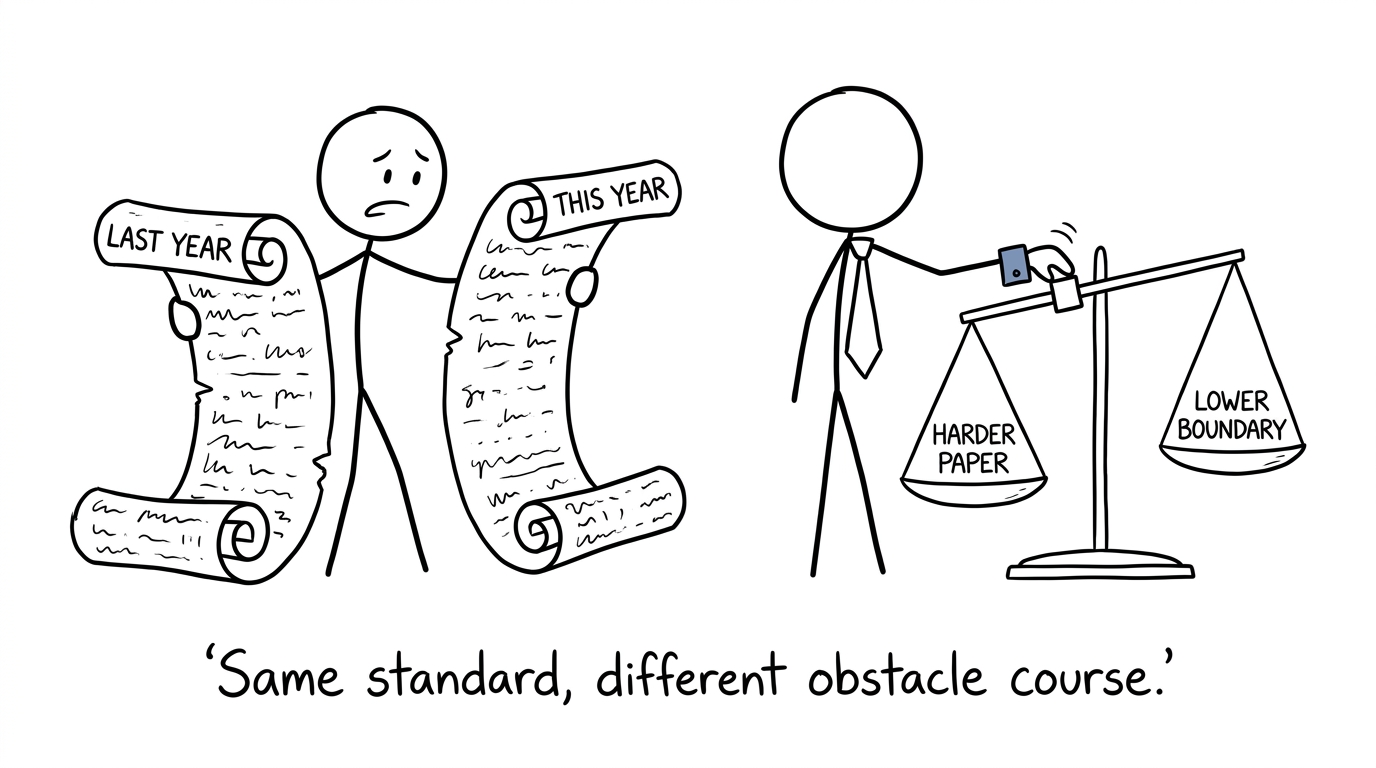 An examiner balances a harder paper against a lower boundary
What to do when you receive your result
Read the entire results information before reacting to the headline grade. Confirm your component marks and ask your school or college how far your total sits from the next boundary.
If the grade affects a university place, speak promptly to your school and check your UCAS status. If a mark appears inconsistent with your usual performance, your centre can explain available post-results services. A review of marking checks whether the mark scheme was applied correctly; it is not a fresh attempt to make the response more generous. Marks and grades can stay the same, rise or fall.
If you are preparing for a resit or beginning the course, turn the result into specific action. Use AQA A Level History revision for lessons, flashcards, practice and papers, or work through the AQA History revision guides. Edexcel students can build exam technique through Edexcel A Level History lessons.
Common mistakes when reading grade boundaries
Treating old boundaries as a prediction
Past boundaries show what happened under previous assessments. They are not advance notice of the 2026 thresholds.
Looking at the wrong option code
History boundaries may vary between option combinations. Match the board, specification, series and route exactly.
Converting everything into a percentage
A percentage can describe your performance, but grades are awarded using the official raw or scaled total specified by the board. There is no universal rule that an A is always a particular percentage.
Using paper boundaries as final grades
Notional component boundaries are diagnostic. The overall qualification boundary is what determines your certificate grade.
Assuming a review can only improve a mark
A review can leave a mark unchanged, raise it or lower it. Discuss the evidence, deadline and possible consequences with your school before requesting one.
A result is information, not a verdict
A boundary turns marks into a grade, but it cannot summarise every skill developed while researching interpretations, evaluating sources and constructing arguments. On 13 August 2026, use the official table, check the correct option code and seek advice before making a decision.
For the next step, visit MathsGenie’s free A Level History resources. Revision guides, lessons, past papers, predicted papers, practice questions, mark schemes and mini tests can turn one results-day number into a clear plan for what comes next.











