

A-Level Grades for Russell Group Offers: What Is Good?
A-level grades Russell Group applicants need vary by course. Learn what a good results day means, with example offers and a calm plan if grades fall short.

A results envelope can contain three letters and somehow feel as if it contains your whole future. But the truth about A-level grades for Russell Group offers is calmer: a good results day means meeting the precise conditions of your chosen course, not achieving a mythical universal set of grades.
Russell Group entry requirements vary by university, degree and applicant. For one course, ABB may secure the place. For another, A*A*A with particular subject grades may be essential. Your actual UCAS offer is therefore more important than any general league-table comparison.
The short results day checklist
A good outcome usually means one of the following:
- You meet your firm offer and your place is confirmed.
- You miss the firm offer but meet your insurance offer.
- You narrowly miss an offer but the university still accepts you.
- You find a suitable alternative through Clearing.
- You choose to reapply because a different route better serves your long-term goal.
For 2026 entry, A-level results day in England, Wales and Northern Ireland is Thursday 13 August. Before then, keep your UCAS details, offer conditions and university contact information together.
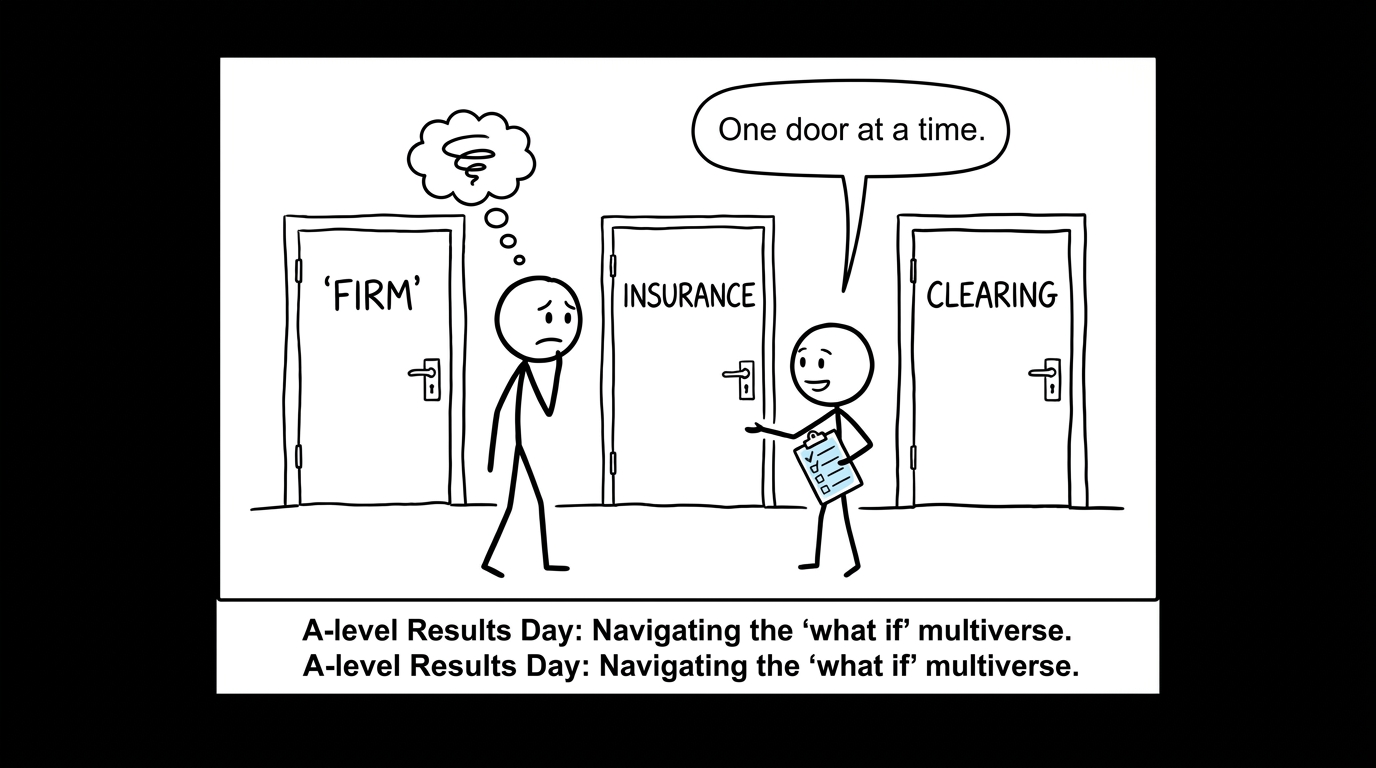 A student facing the firm, insurance and Clearing doors on results day
There is no single Russell Group grade requirement
“Russell Group” describes a group of research-intensive universities. It does not create one admissions policy shared by every member.
Each university sets requirements course by course. These may include:
- three specified A-level grades;
- a required grade in a particular subject;
- GCSE English Language or Maths requirements;
- an admissions test or interview;
- a pass in a science practical component;
- additional conditions stated in the offer.
Published requirements also differ from contextual offers. Eligible applicants may receive reduced grade conditions based on criteria set by the university. The only dependable target on results day is the wording in your personal offer.
Example Russell Group entry requirements
The following published 2026 requirements show how much offers can vary. They are examples, not promises about future admissions cycles or individual applicants.
| University and course | Published standard A-level requirement | Important detail |
|---|---|---|
| Oxford Mathematics | A*A*A | The two A* grades are required in Mathematics and Further Mathematics when Further Mathematics is available. |
| Bristol Mathematics | A*A*A | Includes an A* in Mathematics and an A in another mathematics-related subject, with an alternative condition involving Mathematics and Further Mathematics. |
| Manchester Chemical Engineering | AAA | Includes Mathematics and either Chemistry or Physics; the published contextual offer is AAB with specified subject grades. |
The lesson is not that one offer is “better” than another. It is that the course decides the grades. Mathematics, medicine, engineering and other competitive degrees may also specify subjects, so an overall result can look impressive while still missing one crucial condition.
Always check the current course page and then read the exact offer shown in your UCAS application.
What counts as a genuinely good results day?
Meeting your firm offer
This is the clearest success. If every academic and non-academic condition has been satisfied, the university can confirm your place. UCAS receives many UK qualification results directly and displays the university’s decision in your application.
Notice the important distinction: AAA is excellent, but it does not meet an A*AA offer. Meanwhile, ABB is a successful outcome when ABB was the condition. Results day is about fit, not comparison.
 A small Offer Met key opening a university gate while a Perfect Grades trophy proves unnecessary
Reaching your insurance choice
An insurance choice is not a consolation prize. It is a university and course you selected in advance because you would genuinely be willing to attend. If your firm does not confirm you but your insurance does, that is still a successful results day.
Missing narrowly but being accepted
Falling below the stated conditions does not guarantee rejection. A university may still be considering the application, depending on available places and the complete offer conditions. It might also propose a related course or foundation year.
Do not assume, however, that being one grade short is automatically acceptable. Check UCAS first and follow any instructions from the university.
Using Clearing thoughtfully
If neither offer is confirmed, Clearing can reveal courses with vacancies. The best choice is not necessarily the first available Russell Group course. Compare content, location, costs, professional accreditation and whether you would actually want to spend several years there.
Why this matters while you are still doing GCSEs
For a GCSE student, results day may feel distant. Yet the useful decisions begin now.
Some university courses require particular A-level subjects, while sixth forms often set their own GCSE entry standards for those subjects. A prospective mathematics applicant, for example, should investigate whether Further Mathematics is recommended or required and whether their sixth form offers it.
Your immediate task is not to predict an offer several years early. It is to keep sensible options open. Build secure algebra, graphs and problem-solving skills through the GCSE Maths revision hub. Edexcel students can use the Edexcel GCSE Maths revision resources and topic-by-topic GCSE lessons.
After practice papers, the GCSE predicted grade calculator can help you interpret your marks using historical boundaries. It is a guide, not a guarantee of the boundary in a future exam series.
Turning a university target into a revision target
Once you begin A-level Maths, focus on marks rather than repeatedly asking whether you are “an A student”. Grades are awarded from total performance across the relevant assessments, and boundaries can change between exam series.
Use your correct specification: the Edexcel A-level Maths hub and OCR A-level Maths resources organise lessons, practice questions, past papers, predicted papers, mini tests and mark schemes by exam board.
A productive routine is simple:
- learn or revisit one weak topic;
- answer exam-style questions without notes;
- mark them carefully;
- record why each mark was lost;
- retest the same skill later;
- add timed papers when your topic knowledge is secure.
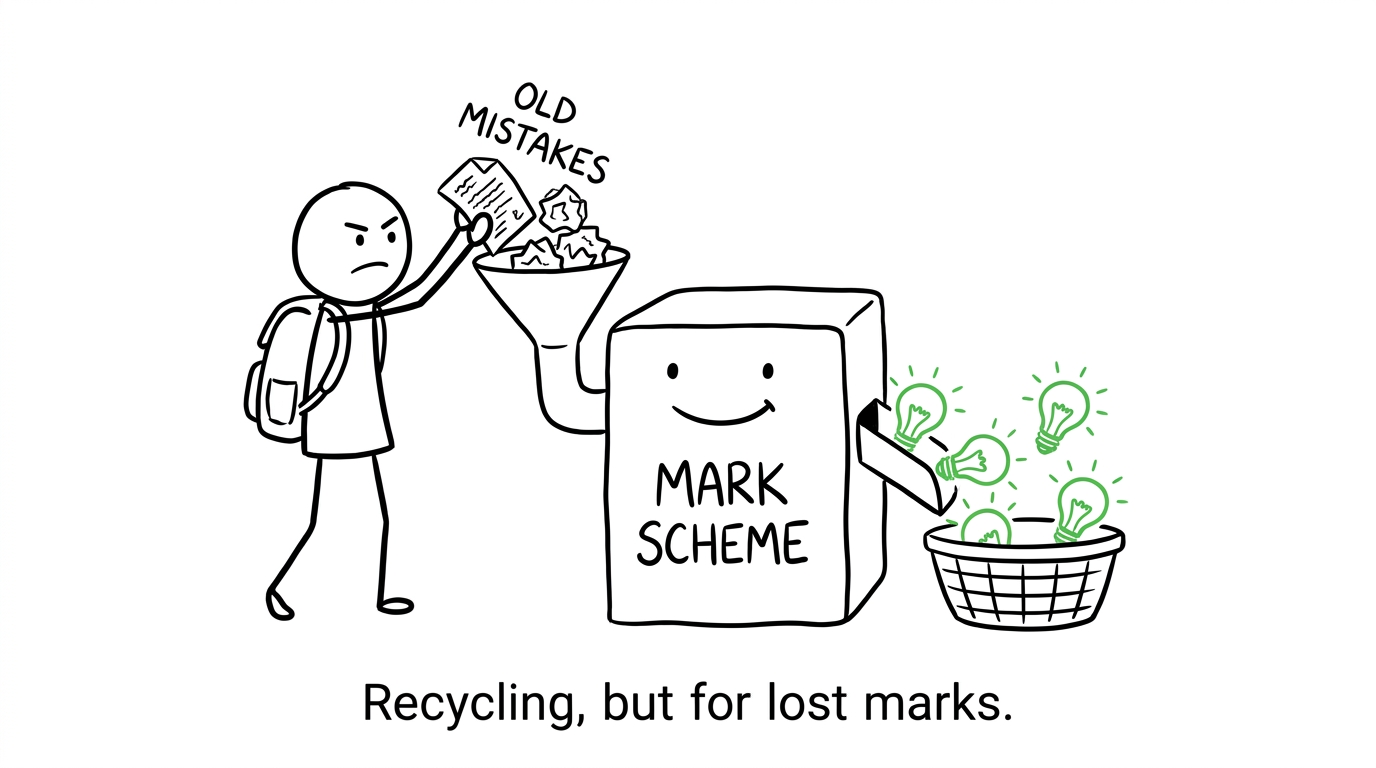 A student recycling old mistakes through a friendly mark-scheme machine
Common mistakes when judging Russell Group offers
Treating AAA as a universal benchmark
Requirements can sit above or below AAA, and subject conditions matter. Search for the exact degree rather than the university name alone.
Confusing entry requirements with your offer
A course page helps before applying. After receiving an offer, the conditions in UCAS are decisive.
Assuming four A-levels always improve your position
Some universities make offers based on three A-levels and do not prefer applicants simply because they take four. More subjects can also reduce the revision time available for each one.
Comparing raw marks across years
Grade boundaries vary by exam board and series. Use MathsGenie’s A-level grade boundary collection to interpret historical results correctly. For a subject-specific view, see the Edexcel A-level Maths grade boundaries.
Your offer is the target that matters
A good results day is not defined by having the most impressive envelope in the room. It is reaching a destination you chose, whether through your firm offer, insurance choice or a thoughtful alternative.
Start building that freedom now. Use MathsGenie’s free revision lessons and practice questions to strengthen weak topics, then test your progress with mini tests, past papers, predicted papers, mark schemes and video solutions. Check the subject grade boundaries, make your next marks measurable, and let each revision session keep one more university option open.











