

A-Level Grade Boundary Table Explained
A-level grade boundary table explained clearly: compare raw marks, overall totals and notional paper boundaries confidently on results day with MathsGenie.
Results day can turn a simple table into something that feels strangely difficult. You have a mark, a grade and several rows labelled with paper codes. Which figure actually decides the result?
Here is the A-level grade boundary table explained in one sentence: find the correct exam board, subject, specification and exam series, then compare your overall subject mark with the qualification-level boundaries. Your raw paper marks help build that total, but notional component boundaries usually do not award separate paper grades.
That distinction matters whether you are checking an A Level result now or preparing for GCSE grades 999 and 111 and wondering how results tables work.
Your results-day checklist
Before comparing any figures, check:
- the exam board: AQA, Edexcel, OCR or Eduqas;
- the exact subject and specification code;
- the correct exam series and year;
- whether the row says overall, subject or qualification;
- the maximum available mark;
- whether component marks are added directly or weighted;
- the minimum boundary for each grade.
MathsGenie brings the main tables together in its GCSE, AS and A Level grade boundaries hub.
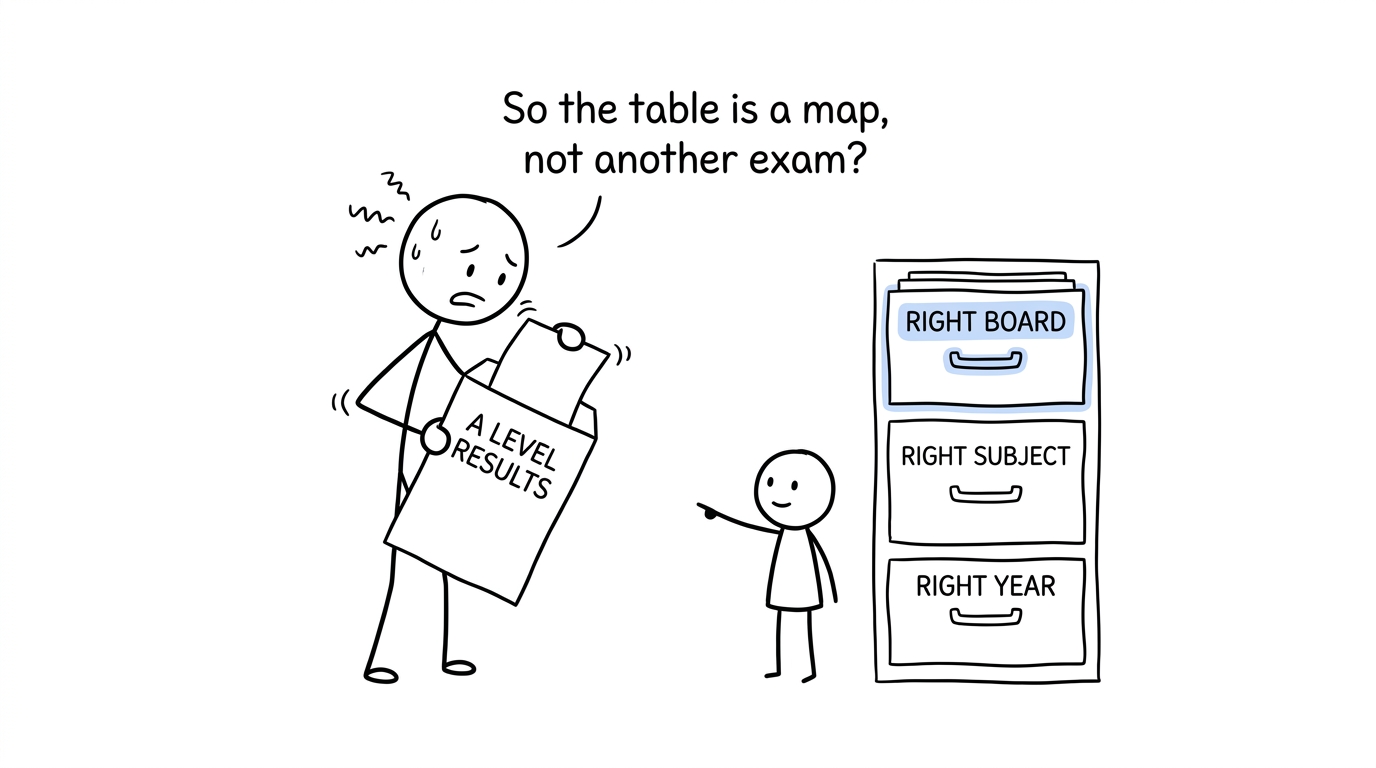 A student discovers that a grade boundary table is a map rather than another exam
Raw marks and grade boundaries mean different things
A raw mark is the mark awarded for your answers on an assessment. If a paper is marked out of 100100100 and the examiner awards 727272 marks, its raw mark is 727272.
A grade boundary is the minimum mark required for a grade. Suppose an overall table shows:
| Grade | Minimum overall mark |
|---|---|
| A* | 258258258 |
| A | 214214214 |
| B | 178178178 |
| C | 142142142 |
| D | 106106106 |
| E | 717171 |
A total of 258258258 reaches the A* boundary exactly. A total of 257257257 does not reach it, so it falls into the next available grade range, in this table, grade A.
Boundaries are not fixed percentages. Awarding organisations set them after marking, using evidence about how the assessments performed and expert judgement. This allows the required raw mark to reflect differences in paper difficulty between exam series. Consequently, a previous year's boundary is useful context, not a prediction of the next one.
Reading A-Level exam board grade boundaries
Start with the qualification-level row. A linear A Level normally produces one overall subject grade from A* to E; AS Levels use A to E and do not have A*.
Find the exact qualification
Subject names alone may not be enough. Mathematics, Further Mathematics and subjects with optional routes can have different specification codes or combinations. Check these against your statement of results or ask your school's examinations officer.
Use the appropriate MathsGenie subject collection:
- AQA A Level grade boundaries
- Edexcel A Level grade boundaries
- OCR A Level grade boundaries
- Eduqas A Level grade boundaries
Check whether marks are weighted
Where papers contribute equally and have matching maximum marks, their raw marks may simply be added. In other qualifications, a component can be scaled so that it contributes the correct proportion of the subject total.
In general, a weighted contribution can be represented as:
weighted mark=raw mark×weighting factor\text{weighted mark}=\text{raw mark}\times\text{weighting factor}weighted mark=raw mark×weighting factorThe weighted component marks are then combined:
overall subject mark=∑weighted component marks\text{overall subject mark}=\sum \text{weighted component marks}overall subject mark=∑weighted component marksDo not invent a weighting from percentages shown in a specification. Use the exam board's published information or ask your examinations officer for the recorded component and subject marks.
Worked example: reading the overall table
Consider an illustrative student checking the published June 2025 Edexcel A Level Mathematics table. The qualification has three papers, each marked out of 100100100, giving a maximum overall mark of 300300300. The published A* boundary was 258258258.
Suppose the recorded raw marks were:
| Component | Raw mark |
|---|---|
| Paper 1 | 868686 |
| Paper 2 | 828282 |
| Paper 3 | 909090 |
Because these papers contribute equally, the overall mark is:
86+82+90=25886+82+90=25886+82+90=258The student compares 258258258 with the overall subject row, not three separate paper grades. Since the A* boundary is the minimum qualifying mark,
258≥258258\geq258258≥258so the overall result is A*. You can inspect the current and historical figures on the Edexcel A Level Maths grade boundaries page.
The important lesson is not the particular boundary. It is the process: identify the correct table, calculate or confirm the official overall total, then compare it with the minimum mark for each grade.
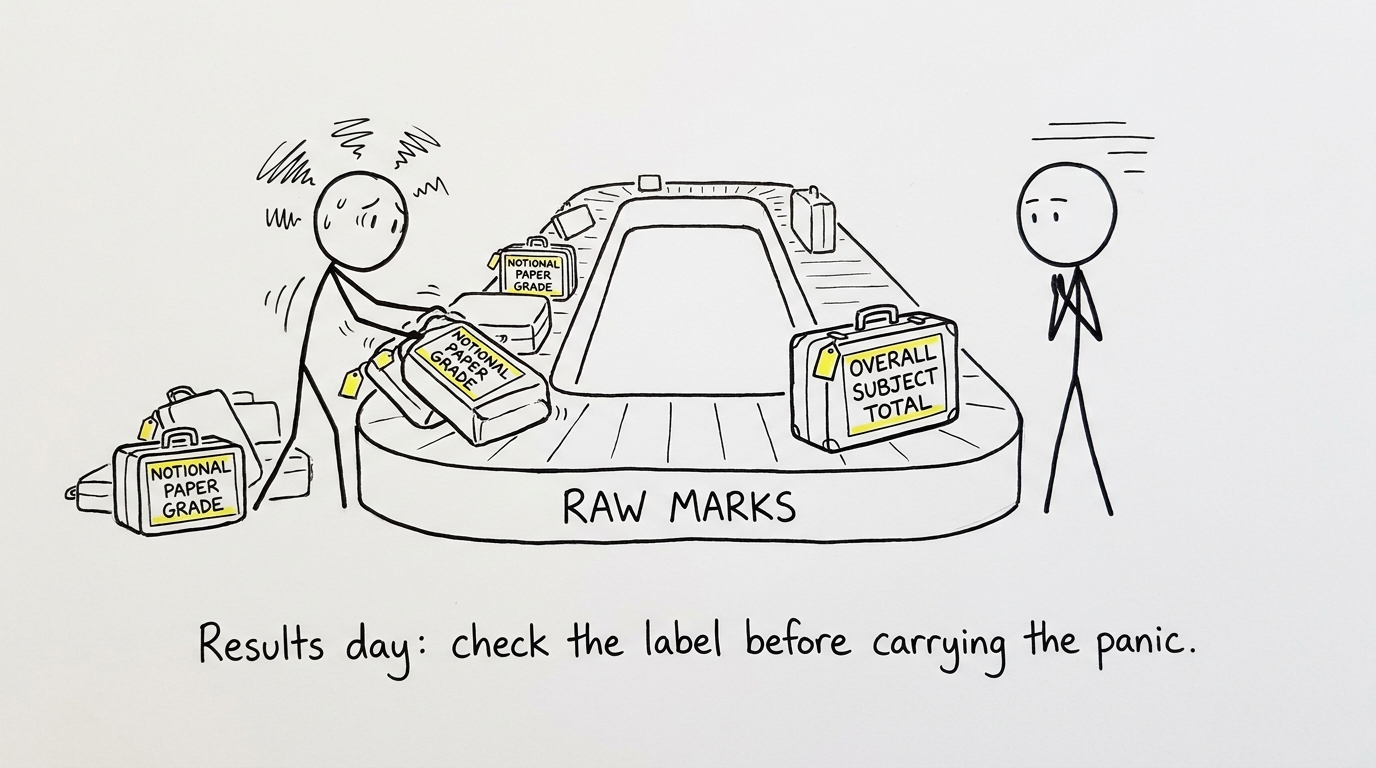 Students wait for the overall subject total instead of collecting misleading paper-grade luggage
Why notional paper boundaries can mislead
Exam boards may publish notional component boundaries to show roughly what performance on an individual paper resembles. They are diagnostic, not separate grades that combine to determine the certificate result.
A student might appear below an A boundary on one paper and above it on another. That does not mean the final grade is found by averaging letters. The binding comparison is normally between the combined subject mark and the overall qualification boundary.
Think of component rows as explanations of performance. Think of the overall row as the decision.
What to do when you are close to a boundary
First, confirm that you are comparing like with like: the right series, maximum mark, route and overall row. Then ask your school or college for your component marks and speak to a teacher or examinations officer about the available post-results options.
A review of marking is not simply a request for extra marks. The mark can remain unchanged, rise or fall, so discuss the evidence and any deadlines with your centre rather than making the decision from the boundary gap alone.
Common mistakes when checking marks
- Using last year's table: boundaries can change between exam series.
- Reading a component row as a final grade: notional paper boundaries are usually illustrative.
- Adding grade letters: final results come from marks, not an average of paper grades.
- Ignoring weighting: unequal components may need scaling before marks are combined.
- Choosing the wrong route: optional papers and specification codes can produce different rows.
- Treating a boundary as a target percentage: it is the minimum published mark for that particular qualification and series.
- Confusing GCSE and A Level scales: GCSEs generally report grades 999 to 111, while A Levels report A* to E.
Turn the table into a better revision plan
Grade boundaries explain a completed result; they should not become a ceiling for future revision. A safer goal is to collect every mark you can and build enough margin that a difficult paper does not decide everything.
Start with the free A Level Maths revision hub. Use revision lessons and practice questions to repair individual topics, then complete Edexcel A Level Maths past papers under timed conditions. Mark schemes and video solutions show where method marks are earned, while mini tests make it easier to revisit weak areas without sitting a full paper.
As the next exam series approaches, add A Level predicted papers for fresh practice. Then return to the relevant MathsGenie subject grade boundary page when official results are available. A table that first looked intimidating becomes what it always was: a careful translation from marks into a grade.











