

A-Level Grade Boundaries Explained: How They Work
A-Level grade boundaries explained clearly: learn how comparable outcomes, exam difficulty and examiner judgement turn raw marks into fair final grades.
A difficult exam can create a strange kind of panic. Students leave the hall, compare answers and begin searching for last year's boundaries as though those numbers can predict the future. Usually, they cannot.
Here are A-Level grade boundaries explained simply: exam boards set them after the papers have been sat and marking is nearly complete. They use statistical evidence, the difficulty of the assessment and expert reviews of students' work to keep the standard required for each grade comparable over time. A harder paper will generally have lower boundaries; an easier paper will generally have higher ones.
That principle matters to A-Level students, parents and GCSE students looking ahead. Your grade is not decided by how frightening a paper felt. It is decided by your final mark compared with boundaries established from evidence.
Grade boundaries at a glance
- A grade boundary is the minimum mark required for a grade.
- Boundaries are not normally fixed before students sit the examination.
- Exam boards consider both statistical data and students' actual scripts.
- Comparable outcomes help maintain standards between years and exam boards.
- There is no fixed quota saying only a certain number of students may receive each grade.
- Boundaries from previous years are useful revision guides, not guaranteed targets.
- Your final grade depends on your marks, not your personal GCSE results or predicted grade.
Students can compare published figures on the Edexcel A-Level Maths grade boundaries page.
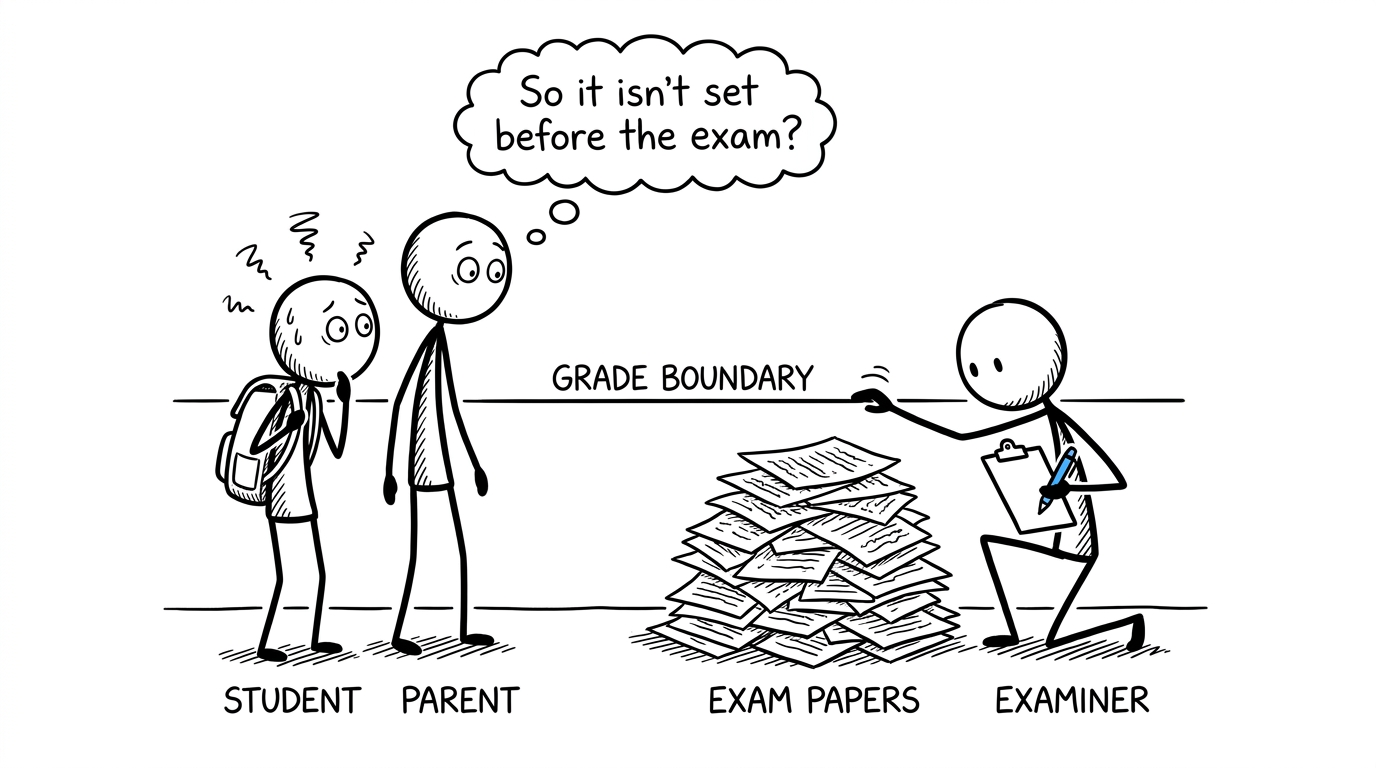 A student and parent discover that grade boundaries are not set before the exam
How A-Level grade boundaries work
Once an examination has been taken, examiners mark students' responses using the agreed mark scheme. When enough marking has been completed to provide reliable evidence, the awarding process begins.
Exam boards such as AQA, Pearson Edexcel, OCR and Eduqas examine several kinds of evidence:
- the distribution of marks across the qualification;
- the prior attainment profile of the national cohort;
- the question papers and final mark schemes;
- reports about how individual questions performed;
- samples of scripts around possible grade boundaries;
- comparable work from previous examination series; and
- senior examiners' professional judgement.
A provisional boundary may be suggested by the statistical evidence. Senior examiners then inspect work at and around that mark. They consider whether it represents the same standard as work receiving that grade in an earlier year. The boundary is confirmed only after this evidence has been considered together.
If MMM is a student's total mark and bGb_GbG is the boundary for grade GGG, the student reaches that grade when
M≥bG.M \geq b_G.M≥bG.The prior attainment data does not alter an individual's mark. It helps predict results for the cohort as a whole; it does not decide what a particular student deserves.
What comparable outcomes means
Comparable outcomes is the central idea behind the process. If the group taking a subject this year has a broadly similar prior-attainment profile to the previous cohort, overall results would normally be expected to be broadly similar too.
For A Levels, exam boards can compare the current cohort's earlier GCSE attainment with the relationship between GCSE and A-Level performance seen in previous cohorts. This provides a statistical guide, not an automatic answer.
That distinction is important. Comparable outcomes does not mean forcing every year's results into an identical pattern. Genuine changes in performance can still be recognised when the evidence supports them. Nor does it mean ranking students and awarding only the top fixed percentage an A.
Instead, the method asks a more useful question: does the work at this proposed boundary represent a comparable standard to the work awarded that grade previously?
Ofqual regulates qualifications in England and oversees how awarding organisations maintain these standards. Exam boards perform the marking and awarding, while Ofqual can question outcomes that differ substantially from statistical predictions without convincing evidence.
Why boundaries move every year
No two examination papers have precisely the same difficulty. Writers may aim for consistency, but a particular combination of topics, wording and problem-solving demands can make one series more accessible than another.
Grade boundaries absorb some of that variation. If a paper proves harder, a lower raw mark may demonstrate the required standard. If it proves easier, students may need a higher raw mark.
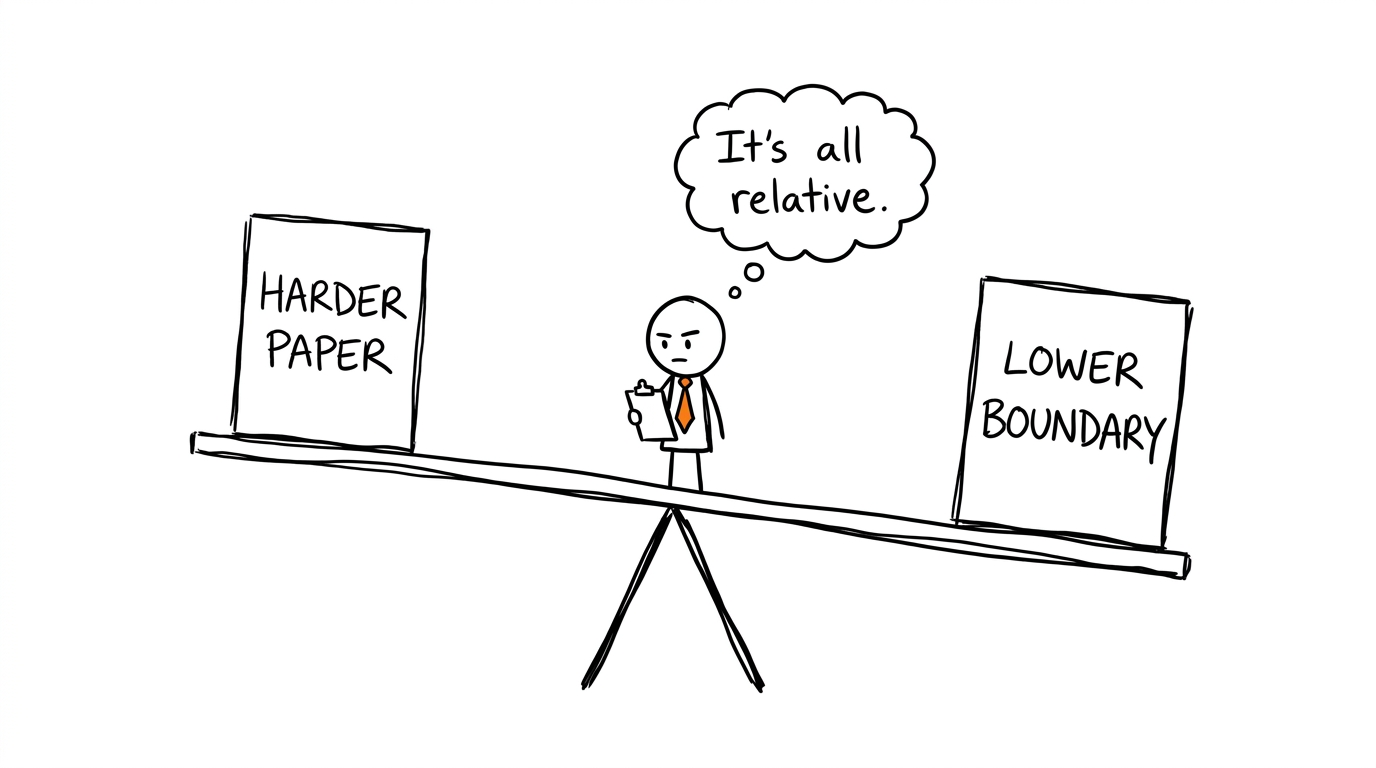 An examiner balances a harder paper against a lower grade boundary
The published Edexcel A-Level Maths figures illustrate how boundaries can change:
| Exam series | Maximum mark | A* boundary | A boundary | B boundary |
|---|---|---|---|---|
| June 202520252025 | 300300300 | 258258258 | 214214214 | 178178178 |
| June 202420242024 | 300300300 | 251251251 | 205205205 | 167167167 |
These are real published boundaries, not targets for a future series. The higher figures in 202520252025 do not mean that the standard of an A or B was deliberately raised. They show why marks from different papers should not be compared without considering their boundaries.
Different boards can also publish different raw boundaries because their papers, mark totals and specifications are different. The aim is comparable standards, not identical numbers. MathsGenie also provides OCR A-Level Maths grade boundaries for board-specific comparison.
How students and parents should use old boundaries
Past boundaries are best treated as reference points. They show the historical range associated with each grade, but they cannot reveal the exact boundary for an examination that has not yet been marked.
A sensible revision target is therefore a range with a safety margin, rather than last year's minimum mark. If your practice-paper result sits exactly on an old boundary, a small change in paper difficulty or a few avoidable errors could move the outcome.
Start with the correct board and specification. The A-Level Maths revision hub organises resources by exam board, while the Edexcel A-Level Maths revision page brings together lessons, topic questions, worksheets and assessment tools.
Then use this revision loop:
- Complete a paper under realistic timed conditions.
- Mark it carefully using the correct mark scheme.
- Record lost marks by topic and reason.
- Revisit the relevant revision lesson and practice questions.
- Retake similar questions before attempting another full paper.
The Edexcel A-Level Maths past papers support this process with mark schemes and solutions. Students following another specification can use resources such as the AQA A-Level papers collection.
For GCSE students, the same principle already applies to grades 999 to 111. Foundation and higher-tier boundaries vary between series, so use the GCSE Maths revision hub and GCSE past papers by exam board rather than relying on a single remembered figure.
Common mistakes when interpreting grade boundaries
Assuming this year's boundary will match last year's
Previous figures are evidence of what happened on previous assessments. They are not advance promises.
Believing grades are limited by a quota
There is no fixed allocation under which only a predetermined number of students can receive each grade. Comparable outcomes guide standards at cohort level, but grades are awarded from marks against confirmed boundaries.
Comparing raw marks across exam boards
A mark from an OCR paper cannot be compared directly with the same mark from an Edexcel or AQA paper. Maximum marks, questions and assessment structures may differ.
Thinking prior GCSE attainment determines an individual's grade
Prior attainment supports statistical predictions for the whole cohort. Your individual A-Level grade comes from the marks awarded for your work.
Chasing boundaries instead of improving marks
Students cannot control the final boundary. They can control method, accuracy, timing and how honestly they review mistakes. That is where revision becomes useful.
Build marks instead of predicting the boundary
The calmest response to uncertainty is preparation. Grade boundaries exist to protect fairness when papers vary, not to make revision a guessing game.
Use the MathsGenie A-Level grade boundaries page to understand historical results, then return your attention to what can still change: your performance. Work through free revision lessons, practise targeted questions, complete past and predicted papers, and learn from mark schemes, mini tests and video solutions.
A boundary is only a line on results day. The marks that carry you across it are built much earlier, one corrected mistake at a time.











