

A-Level Economics Resit: Explain It on Your UCAS Form
A-level economics resit UCAS application advice: declare your retake, explain it positively and show universities a focused, credible improvement plan.
Results day can reduce two years of work to one line on a screen. If that line is not what you hoped for, it is natural to imagine that universities will see only the grade. They will not. An A-level economics resit UCAS application should declare the original result and pending retake honestly, while briefly showing what changed and how you are preparing differently.
Your task is not to disguise the resit. It is to make the application around it convincing: check each university's policy, provide accurate qualification details, secure a realistic predicted grade and demonstrate purposeful progress.
Your resit application checklist
Before submitting, make sure you have:
- entered your original A-level Economics result;
- entered the resit separately with the result shown as pending;
- checked the resit policy for every course and university;
- arranged an academic referee and discussed your predicted grade;
- explained relevant circumstances briefly and factually;
- shown what you have changed since the original sitting;
- connected your preparation to the course you want to study;
- built an evidence-based revision plan.
Policies differ between universities and sometimes between courses at the same institution. Never assume that a general admissions statement applies to your particular degree. Contact the admissions team if the published requirements are unclear.
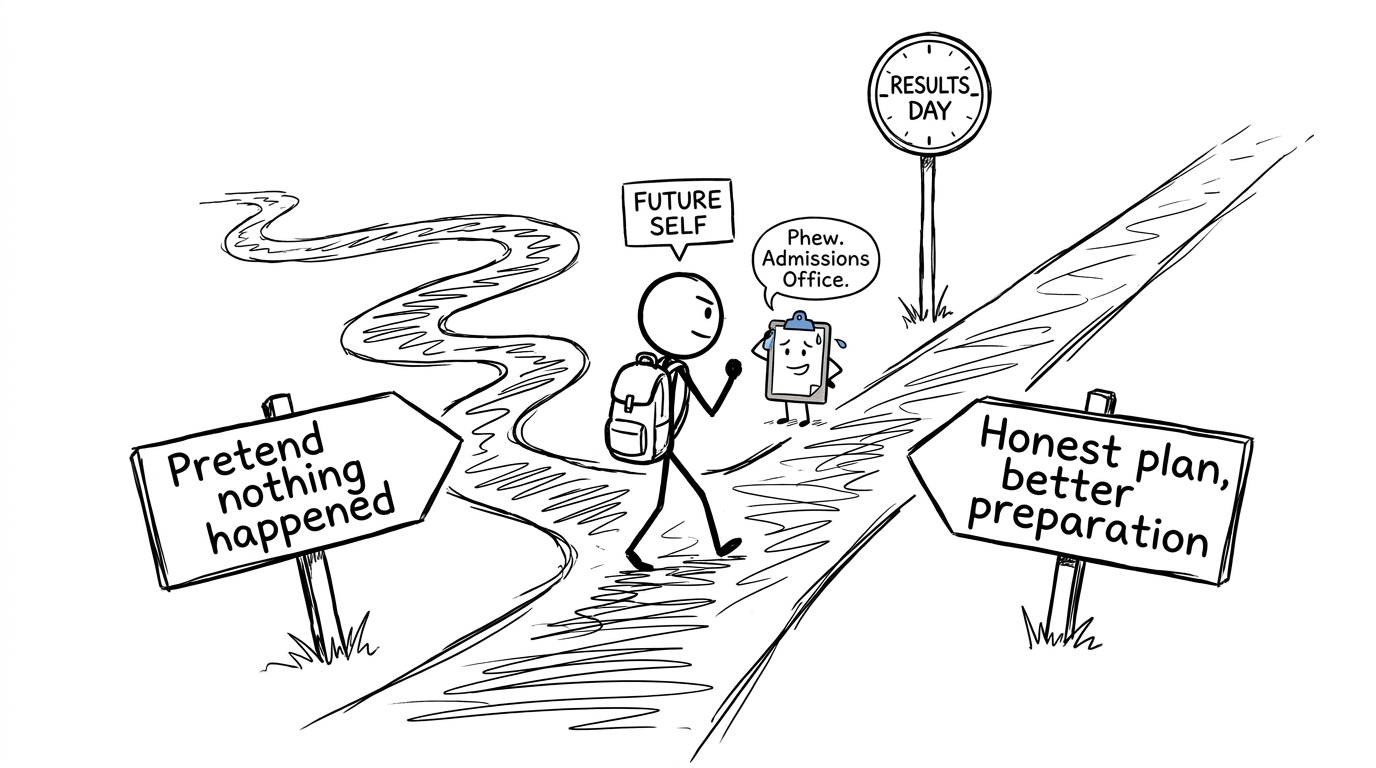 A student choosing an honest, well-planned route after results day
How to declare an A-level Economics resit on UCAS
UCAS requires applicants to include all completed and pending qualifications from secondary education onwards. That includes unsuccessful grades and results from earlier sittings.
For an Economics retake, you should normally enter the qualification twice:
- once with the grade already achieved and its original qualification date;
- once with the new expected qualification date and the result marked as pending.
Do not replace the original grade with the result you hope to achieve. Admissions teams need a complete academic record, and accurate disclosure protects your application from avoidable problems later.
Your referee should also provide a predicted grade for the pending qualification where applicable. Speak to your school, college or exam centre early so that everyone understands how your resit is being entered and supported.
Explaining a resit on your UCAS application
For applications beginning in 2026, the UCAS personal statement is organised around three questions: why you want to study the course, how your qualifications have prepared you, and what you have done outside formal education to prepare.
You do not need to force a long defence of your grade into these answers. Space is limited, and universities primarily want evidence that you are prepared for your chosen subject. If the resit is relevant, use a short structure:
State what happened without dramatising it
Keep the explanation proportionate. If illness, bereavement, disrupted education or another serious circumstance affected the original examination, describe it accurately. Do not share more personal detail than is necessary, and ask your referee to confirm circumstances they can verify.
Example wording:
My original A-level Economics result did not reflect the standard I had reached during the course. After reviewing my performance, I decided to retake the qualification with a more structured approach to essay planning, quantitative skills and timed practice.
Explain what changed
Resilience is easy to claim. A new process is evidence.
Mention specific changes such as completing timed essays, using assessment objectives when planning answers, analysing mark schemes, revisiting weak specification areas or keeping an error log. Students following AQA can use the AQA A-level Economics revision hub, while Edexcel students can work through the Edexcel A Economics revision guides.
Example wording:
Preparing for the retake has made my revision more analytical. I now compare timed responses with mark schemes, record recurring weaknesses and revisit them through focused practice rather than repeatedly rereading notes.
Connect the experience to university study
The strongest explanation looks forward. Show how the retake has improved your independence, judgement or ability to respond to feedback.
Example wording:
This process has strengthened my ability to diagnose weaknesses and act on feedback, habits I will bring to independent study at university.
Avoid suggesting that resitting alone proves commitment. The persuasive evidence is what you have done with the extra opportunity.
Keep the personal statement focused on Economics
An A-level Economics retake application is still an application for a university course, not an appeal against results day. Most of your answers should explain your academic interest and preparation.
You might discuss how studying market failure changed the way you evaluate policy, how macroeconomic data led you to question simple explanations, or how reading beyond the specification developed your interest. Be precise about what you learnt rather than listing books, podcasts or activities without reflection.
A useful balance is:
- acknowledge the retake where it adds context;
- explain the corrective action;
- return quickly to your subject knowledge and readiness.
Remember that the same UCAS personal statement is sent to all your choices. Keep university-specific explanations out of it unless every choice is closely aligned.
Build evidence for the grade you are predicting
A predicted grade becomes more credible when it is supported by recent work. Ask your teacher or referee what evidence they need. This could include timed assessments, marked essays or complete papers.
Use the MathsGenie A-level subjects hub to organise your preparation, then combine topic revision with A-level past papers. Marking matters as much as attempting: identify whether lost marks came from knowledge, application, analysis, evaluation, timing or quantitative accuracy.
Economics includes numerical and graphical reasoning. If percentages, index numbers, ratios or interpreting data remain weak, revisit the GCSE maths revision hub before practising them in an Economics context. Students taking A-level Maths alongside Economics can also use the Edexcel A-level Maths revision hub and its A-level Maths past papers.
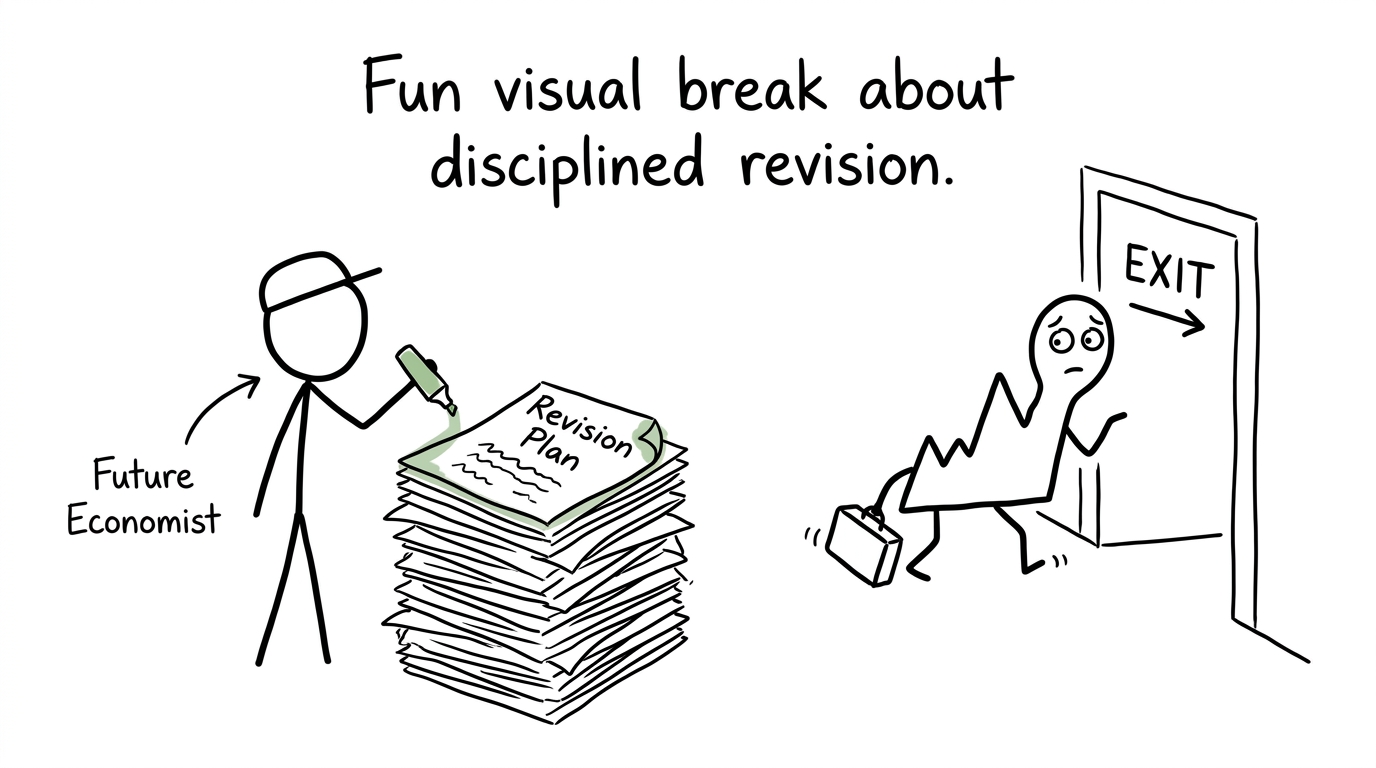 A future economist using a highly organised revision plan
Common mistakes when explaining a resit
Hiding the original result
Declare both the achieved grade and pending resit. Omitting an earlier result is not positive framing; it is incomplete information.
Writing an extended apology
A university application should show academic suitability. Explain the setback briefly, then devote more space to action and preparation.
Blaming the exam or exam board
Claims that the paper was unfair rarely help. Focus on the factors you could control and the changes you have made.
Making unsupported promises
Saying that you are “certain” to achieve a higher grade is weaker than describing timed practice, improved assessments and feedback from your teacher.
Assuming every university accepts resits
Admissions policies vary. Check the current course page and ask the university directly before using one of your UCAS choices.
Turn a disappointing result into a credible next step
A resit does not need clever spin. It needs accuracy, proportion and evidence. Declare both sittings, explain relevant circumstances calmly, show what has changed and keep the wider application centred on your readiness for university-level study.
Then make the improvement plan real. Start with MathsGenie's AQA A-level Economics resources or Edexcel A Economics revision guides. Use revision lessons and practice questions to repair gaps, then test yourself with past papers, predicted papers, mini tests and mark schemes. The best explanation of a retake is ultimately the work that follows it.










