

A-Level Economics Resit: Your Results Day Plan
A-level economics resit plan for after results day: diagnose lost marks, set milestones, practise essays and use past papers with purpose and confidence.
Results day can make two years of work feel as though they have been reduced to one letter. Yet a disappointing grade is information, not a verdict. If you are considering an A-level economics resit, first confirm the administrative details with your school or exam centre. Then build your preparation around three things: an honest diagnosis, targeted question practice and timed papers.
Most A Levels in England are linear. That generally means resitting the complete assessment in the next available summer series rather than repeating one paper. Your exact arrangements depend on your specification and centre, so check them before planning around an assumed date.
Your resit preparation checklist
Before opening a textbook, complete these practical steps:
- Speak to your school about your component marks and whether a review of marking is appropriate.
- Confirm your exam board and specification: AQA, Edexcel, OCR or Eduqas.
- Find a school or approved exam centre willing to enter you.
- Ask about entry deadlines, fees and access arrangements.
- Check requirements with universities, apprenticeships or employers affected by your result.
- Complete a diagnostic paper and create a topic-by-topic weakness list.
- Set weekly milestones that include essays, data response and quantitative skills.
Do not delay the administrative work. A brilliant revision plan cannot help if your exam entry has not been arranged.
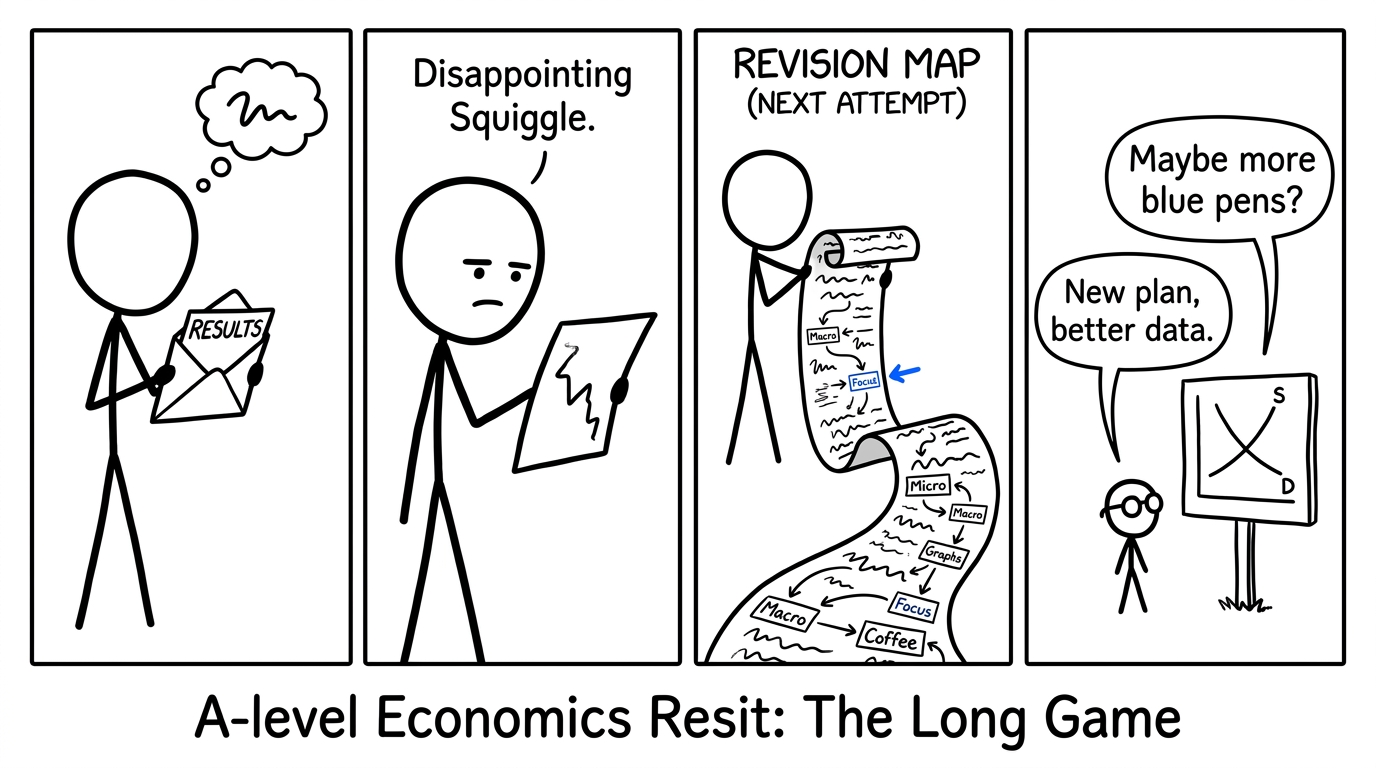 A student turns a disappointing result into a calm plan for the next attempt
Start with evidence, not emotion
A low result may come from missing knowledge, weak application, incomplete evaluation, poor timing or several smaller issues acting together. These problems require different responses.
Obtain your component marks if they are available. Compare performance across papers and question types, then complete a fresh paper under timed conditions. Edexcel students can use the Edexcel A A Level Economics past papers, while the wider Edexcel Economics revision hub brings lessons, questions and revision tools together.
Mark your work strictly. For every lost mark, record one main cause:
- Knowledge: the concept or definition was missing.
- Application: the response did not use the extract or context.
- Analysis: the chain of reasoning stopped too early.
- Evaluation: the judgement was unsupported or generic.
- Quantitative skill: a calculation, unit or interpretation was wrong.
- Exam control: timing, question choice or structure caused the loss.
This error log becomes the centre of your A-level Economics retake revision. Revise what the evidence reveals, not simply what feels comfortable.
A practical resit plan with milestones
A resit year is long enough to improve, but only if each phase has a purpose. Adjust the months to match your own results day and exam series.
| Phase | Main focus | Milestone |
|---|---|---|
| Results day to early autumn | Confirm entry and diagnose weaknesses | Complete one timed paper and produce a ranked topic list |
| Autumn term | Rebuild microeconomics and macroeconomics | Answer targeted questions without relying on notes |
| January to February | Develop application, analysis and evaluation | Complete timed data responses and essays every week |
| March to April | Combine topics and strengthen synoptic thinking | Finish full papers within the official time limit |
| Final weeks | Rehearse the complete exam process | Alternate papers, corrections and short targeted sessions |
Autumn: repair the foundations
Work through your specification systematically. Secure definitions, diagrams, assumptions and causal chains before attempting a large volume of essays. For each topic, retrieve what you know from memory, check a revision lesson, answer questions and revisit errors several days later.
Use the Edexcel Economics question bank for targeted sets. AQA students can begin with the AQA A Level Economics revision hub and its AQA Economics question bank. WJEC students can find board-specific material in the WJEC A Level Economics revision area.
Quantitative revision should include percentage changes, index numbers, elasticity, interpreting data and recognising when a calculation supports an economic argument. Do not separate these skills from the surrounding theory.
Winter: turn knowledge into marks
Knowing monetary policy is not the same as answering a contextual question about it. Practise selecting relevant evidence, building linked reasoning and explaining why an outcome depends on assumptions, timescales or stakeholder responses.
A useful paragraph process is:
- make a precise economic point;
- apply it to the supplied context;
- explain the causal chain;
- evaluate the conditions affecting the outcome;
- connect the reasoning to a justified judgement.
Targeted resources such as macroeconomic policies in a global context and oligopoly exam questions help you practise depth without completing an entire paper every evening.
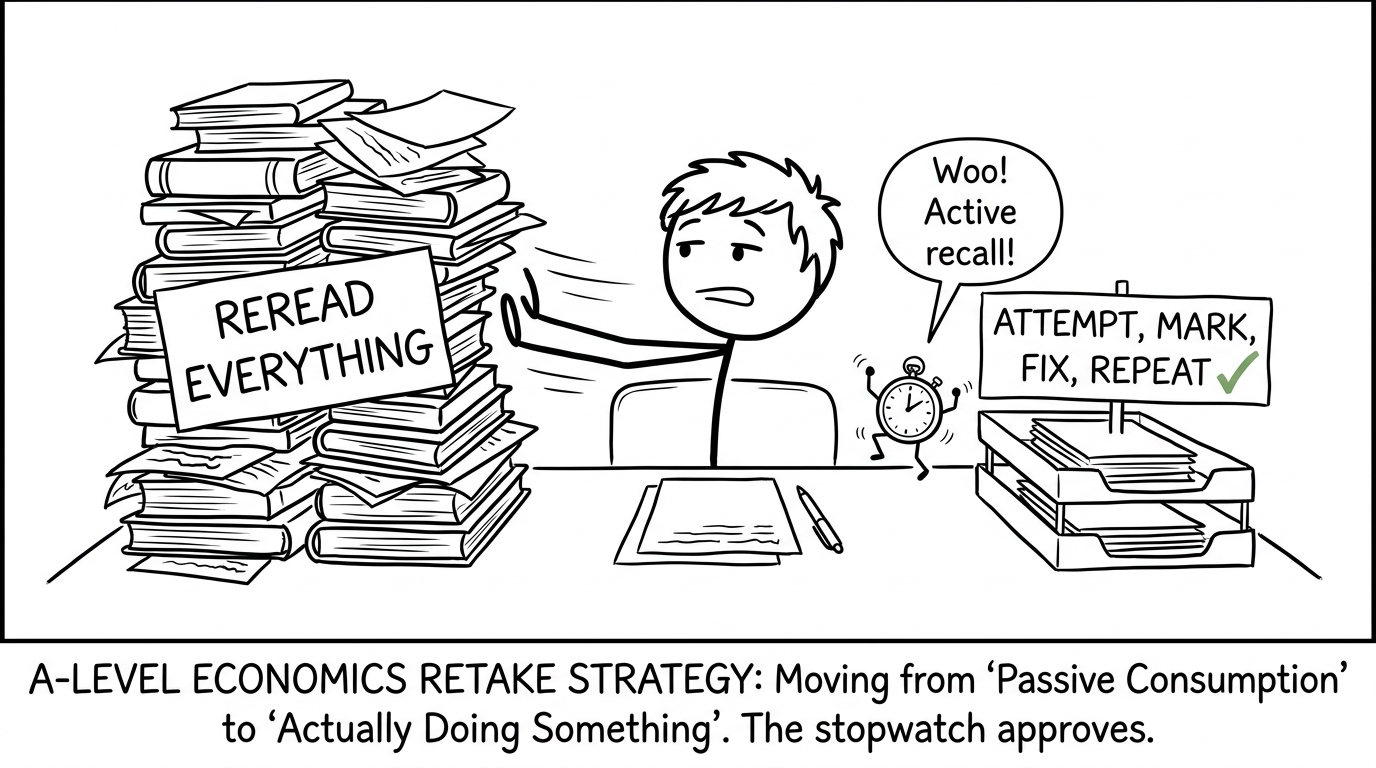 A student chooses an attempt, mark, fix and repeat routine over endless rereading
Spring: rehearse full papers
AQA, Edexcel and OCR A Level Economics qualifications each use three compulsory written papers, although their structures and weightings differ. Check your current specification rather than borrowing timings or essay structures from another board.
Complete papers under genuine conditions: correct duration, no notes and no interruptions. Use the mark scheme to identify what was rewarded, but avoid treating it as a model answer containing the only acceptable wording. Then correct the weakest responses and schedule related questions for later in the week.
Track progress by skill and paper rather than predicting a grade after every attempt. Grade boundaries can vary between exam series; your more dependable target is consistently stronger evidence, analysis, evaluation and time management.
Build a weekly routine you can sustain
A balanced week might contain two topic sessions, one quantitative or data session, one essay session and one timed paper section. Finish every session by marking the work and recording the next action.
Resitting A-level Economics can sit alongside employment or another course. In that situation, shorter regular sessions are more realistic than ambitious plans that collapse after a fortnight. Protect a small number of fixed revision appointments and decide the task before each one begins.
Common mistakes when resitting A-level Economics
Repeating last year's revision method
More hours will not solve a method that relied on rereading and highlighting. Increase retrieval, written answers and marked practice.
Ignoring the specification
Topics and paper structures differ across Edexcel, AQA, OCR and Eduqas. Use the current specification for the exact qualification entered by your centre.
Writing generic evaluation
Phrases such as “it depends” earn little without explaining what it depends on and why that condition changes the conclusion.
Saving timed practice until May
Timing is a skill. Introduce short timed sections during autumn, essays during winter and complete papers during spring.
Practising without correcting
A finished paper is only the diagnosis. Improvement happens when you classify lost marks, repair the relevant skill and attempt another related question.
Make the next attempt different
The goal of an A-level economics resit is not to recreate the previous course more carefully. It is to build a better feedback system: attempt, mark, diagnose, repair and return.
Start today with the Edexcel A Level Economics past papers or the appropriate MathsGenie board hub. Combine past papers with the question bank, revision lessons, practice questions, mark schemes, predicted papers and mini tests. One disappointing result may explain where you are. A disciplined revision plan decides where you go next.











