

A-Level Economics Remark: Results Day Guide
A-level economics remark guide for 2026: understand reviews of marking, deadlines, grade risks and when appealing your Economics grade makes sense.
Results Day can turn a single mark into the most important number in the room. If your Economics grade is lower than expected, an A-level Economics remark may be worth considering, particularly when you are close to a grade boundary or a university place depends on the outcome.
The short answer is this: ask your school or college to obtain your marked scripts, have an Economics teacher compare them with the mark scheme, and request a review only where there is credible evidence of a marking error. A review is not a second attempt at the paper, and your mark can rise, stay the same or fall.
For the June 2026 series, A-level results are released on Thursday 13 August 2026. The priority review deadline is 20 August 2026, while standard reviews must reach the awarding body by 24 September 2026. Your centre may set earlier internal deadlines.
Your results-day decision checklist
Before requesting an A-level Economics review, check the following:
- Find your overall mark and marks for each paper.
- Compare your total with the correct board and specification boundary.
- Calculate how many additional marks would change your grade.
- Ask for access to the relevant marked script.
- Have an Economics teacher inspect longer responses against the mark scheme.
- Identify a specific possible error rather than relying on disappointment alone.
- Decide whether a university offer requires urgent action.
- Confirm the fee, centre deadline and risk of losing marks.
- Give written consent before your centre submits the request.
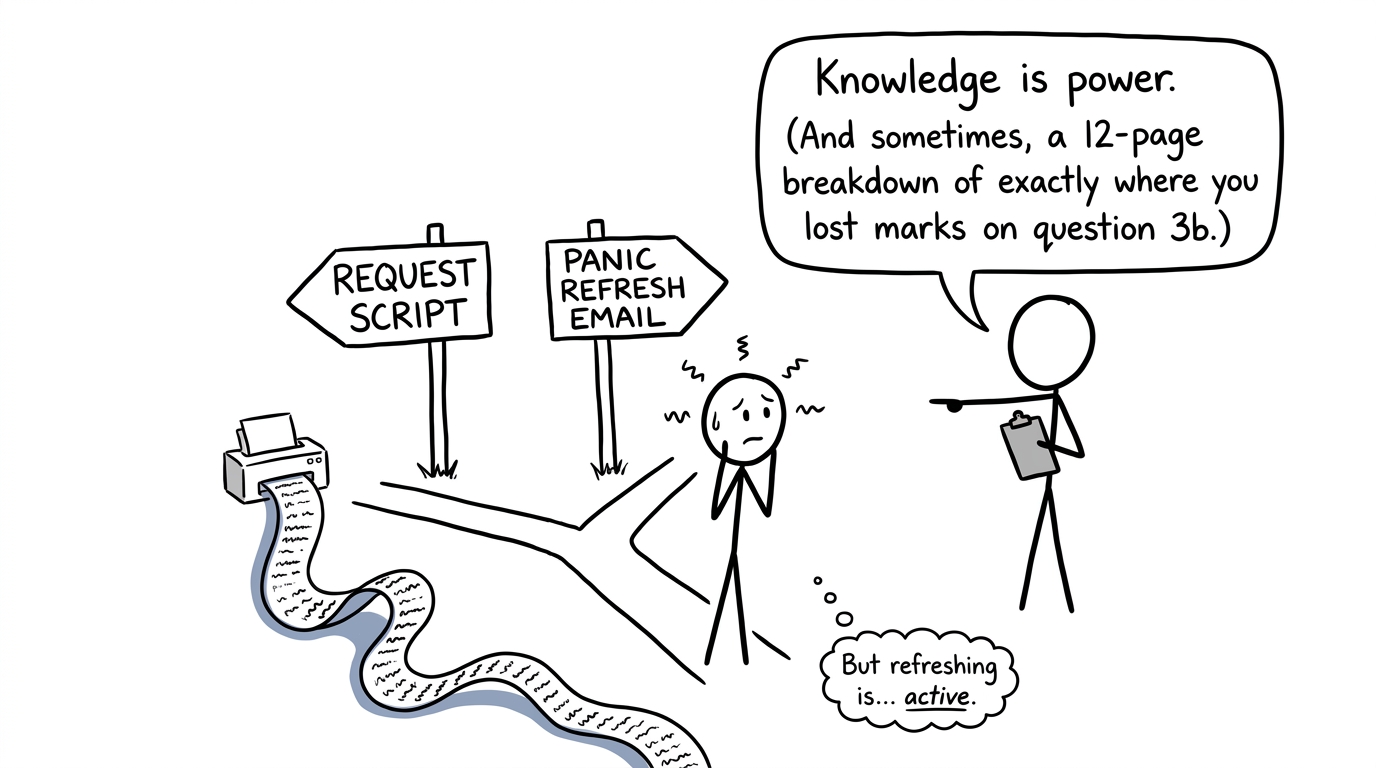 A student choosing between requesting a script and repeatedly refreshing an inbox
How the A-level Economics re-mark process works
Students often say “remark”, but the official service is normally called a review of marking. A reviewer checks whether the original examiner applied the agreed mark scheme correctly. The paper is not simply marked again from scratch because another examiner might prefer a different judgement.
The process usually follows these steps.
Check the correct grade boundary
Use the boundary for your exam board, specification and examination series. Economics specifications are not interchangeable: Edexcel Economics A and Economics B, for example, have different assessment structures.
Start with MathsGenie’s A Level grade boundaries, then open the relevant subject information. You can inspect AQA A Level grade boundaries, Edexcel A Level grade boundaries, OCR A Level Economics grade boundaries or Eduqas A Level Economics grade boundaries.
The useful calculation is:
marks needed=next grade boundary−current total mark\text{marks needed} = \text{next grade boundary} - \text{current total mark}marks needed=next grade boundary−current total markBeing close to a boundary does not prove that an error occurred. It tells you how large a change would need to be useful.
Request the marked script
Your exams officer can normally access a copy of an externally assessed paper with your permission. Ask quickly, especially if a university decision is waiting.
For Economics, script access matters because many marks come from constructed responses involving knowledge, application, analysis and evaluation. A teacher can examine whether an answer was credited consistently with the published mark scheme and level descriptors.
They might look for:
- an unmarked page or response;
- marks that were added incorrectly;
- relevant analysis that appears to have been overlooked;
- a level of response that seems inconsistent with the examiner’s annotations;
- an apparent failure to apply the mark scheme correctly.
A teacher saying that an answer was “good” is not enough by itself. The strongest advice connects particular passages to the assessment criteria.
Choose the appropriate service
A clerical re-check checks procedures such as whether every page was marked and whether marks were totalled correctly. It does not reconsider the academic judgement applied to an essay.
A review of marking, also called Service 2, includes clerical checks and examines whether the mark scheme was applied correctly. Requests are normally made for individual components, so you should target the paper where the evidence is strongest rather than automatically reviewing every paper.
A priority review of marking is the faster A-level service intended for cases where a higher-education place depends on the result. For June 2026, it must reach the board by 20 August and should be completed within 15 calendar days. A standard review should be completed within 20 calendar days.
Submit the request through your centre
For most students, the school or college submits the request to AQA, Pearson Edexcel, OCR or Eduqas. You must give written consent after results are published because the outcome may lower, confirm or raise your mark and grade.
Fees vary by board, component and service. Your centre may pay, charge you or apply its own policy, so ask the exams officer for the current amount. Private candidates should contact their entering centre first; awarding bodies may provide a direct route in particular circumstances.
When requesting a review makes sense
A review is most defensible when several factors point in the same direction:
- you are close enough to a boundary for a realistic correction to change the grade;
- a teacher has reviewed the script and identified credible marking concerns;
- one paper is unexpectedly weak compared with your other components;
- your result affects a university offer or another important progression decision;
- you understand and accept that the mark could decrease.
Economics marking involves professional judgement, especially in extended evaluation. That does not make every disappointing essay incorrectly marked. The question is whether the original mark was a reasonable application of the mark scheme.
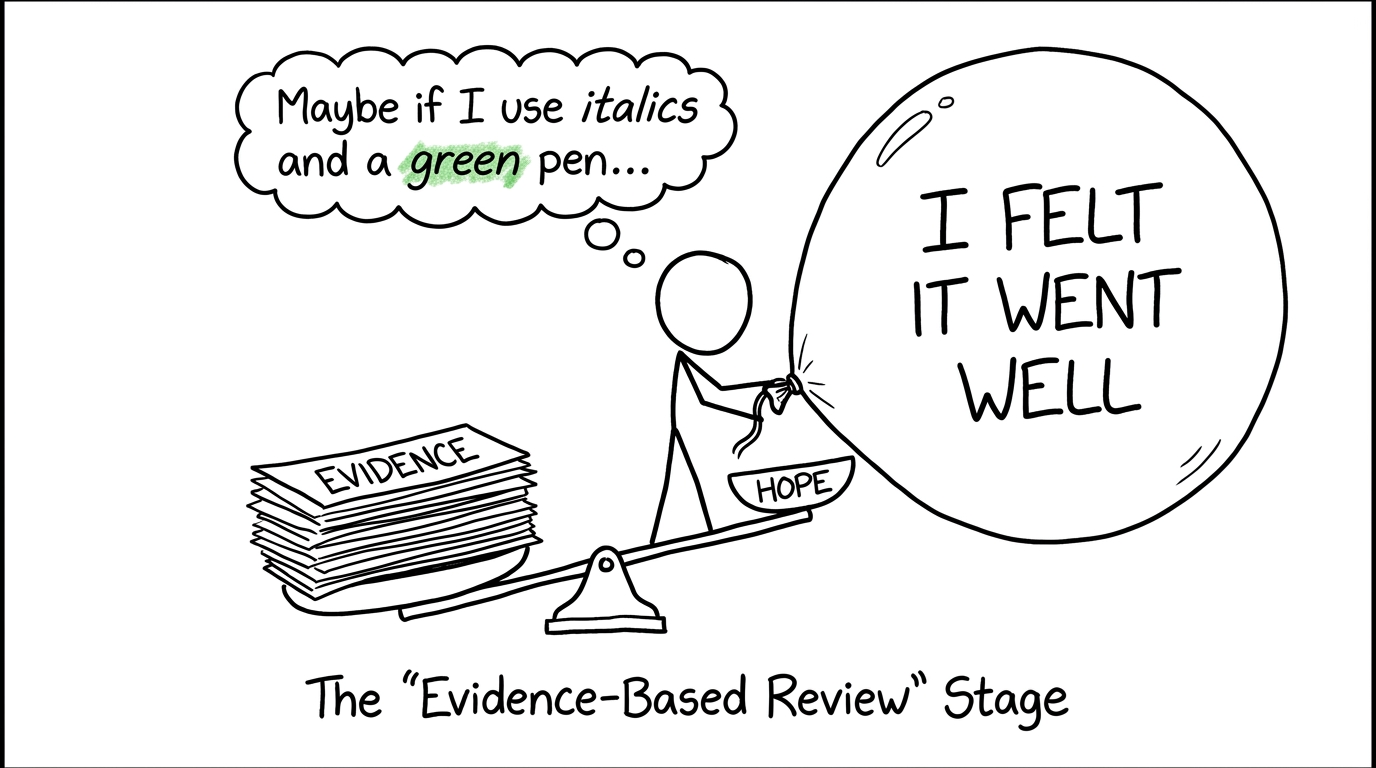 An evidence scale outweighing a hopeful feeling about an Economics exam
When to think carefully before requesting one
Pause if you are many marks below the next boundary, no teacher has found a plausible error, or you want a review solely because your predicted grade was higher. Predicted grades, mock results and past performance do not override the evidence in the completed examination script.
Also consider the downside. A reduced component mark may leave the overall grade unchanged, but it becomes the corrected result. There is no automatic protection for the original mark.
If you are planning future quantitative revision, MathsGenie’s A Level Maths revision hub brings together lessons, practice questions, past papers and mark schemes. GCSE students considering Economics later can strengthen their foundations through the GCSE Maths revision hub.
Appealing an A-level Economics grade
An appeal is not the first stage of the process. Normally, your centre requests a review of marking first. If it still believes a marking or procedural error remains, it can consider an appeal under the awarding body’s rules.
This distinction matters. Appealing an A-level Economics grade is not an opportunity to argue that you deserved a higher result in general. The appeal needs recognised grounds, such as a remaining marking error or a problem with the procedure used. Discuss the evidence, deadline and possible cost with your head of centre or exams officer.
Common mistakes to avoid
Requesting every paper immediately
More reviewed papers mean more cost and more opportunities for marks to move in either direction. Inspect the component results and scripts first where time allows.
Confusing closeness with evidence
Being 111 mark below a boundary makes a change more consequential, not more certain. A review corrects errors; it does not award a sympathy mark.
Missing the centre’s deadline
The official board deadline is not necessarily your deadline. Schools need time to collect consent, payment and component details, so contact the exams officer on Results Day.
Waiting silently when a university place is involved
Contact the university promptly, explain that a priority review is being considered or submitted, and follow its instructions. Do not assume it will automatically hold the place.
Make the decision with evidence, not panic
A disappointing grade can make speed feel more important than judgement. The better approach is calm and specific: check the boundary, obtain the script, ask an Economics teacher for an evidence-based view, and use the appropriate post-results service before the deadline.
Begin with MathsGenie’s A-level Economics grade boundaries so you know exactly where your result sits. Then speak to your exams officer. For the next stage of your education, keep MathsGenie close for free revision lessons, practice questions, past papers, predicted papers, mini tests, mark schemes and video solutions, the tools that turn uncertainty into a clear plan.











