A-Level Economics Grade: University Entry Guide
A-level economics grade university guide: compare current Economics degree entry requirements and learn why A-level Maths is often the decisive subject.
A university offer can look like a short code, AAA, AAB or ABB, yet those three letters hide several decisions. If you are searching for a-level economics grade university guidance, the central answer is simple: your Economics grade matters, but universities usually assess it alongside your overall A-level results, Mathematics grade, GCSE profile and contextual information.
For many Economics degrees, A-level Mathematics is required or preferred while A-level Economics is not compulsory. That is particularly important for GCSE students choosing sixth-form subjects now. Strong maths foundations may keep more Economics courses open later.
Your university entry checklist
Before comparing courses, check:
- the overall A-level offer;
- whether Mathematics is required and at what grade;
- whether Economics has a minimum grade when taken;
- GCSE Mathematics and English Language requirements;
- contextual or foundation-year offers;
- admissions tests and application deadlines;
- the requirements for your exact course and entry year.
Entry requirements change. The examples below reflect official course information published for 2026 entry where available, but the university course page must always be your final reference.
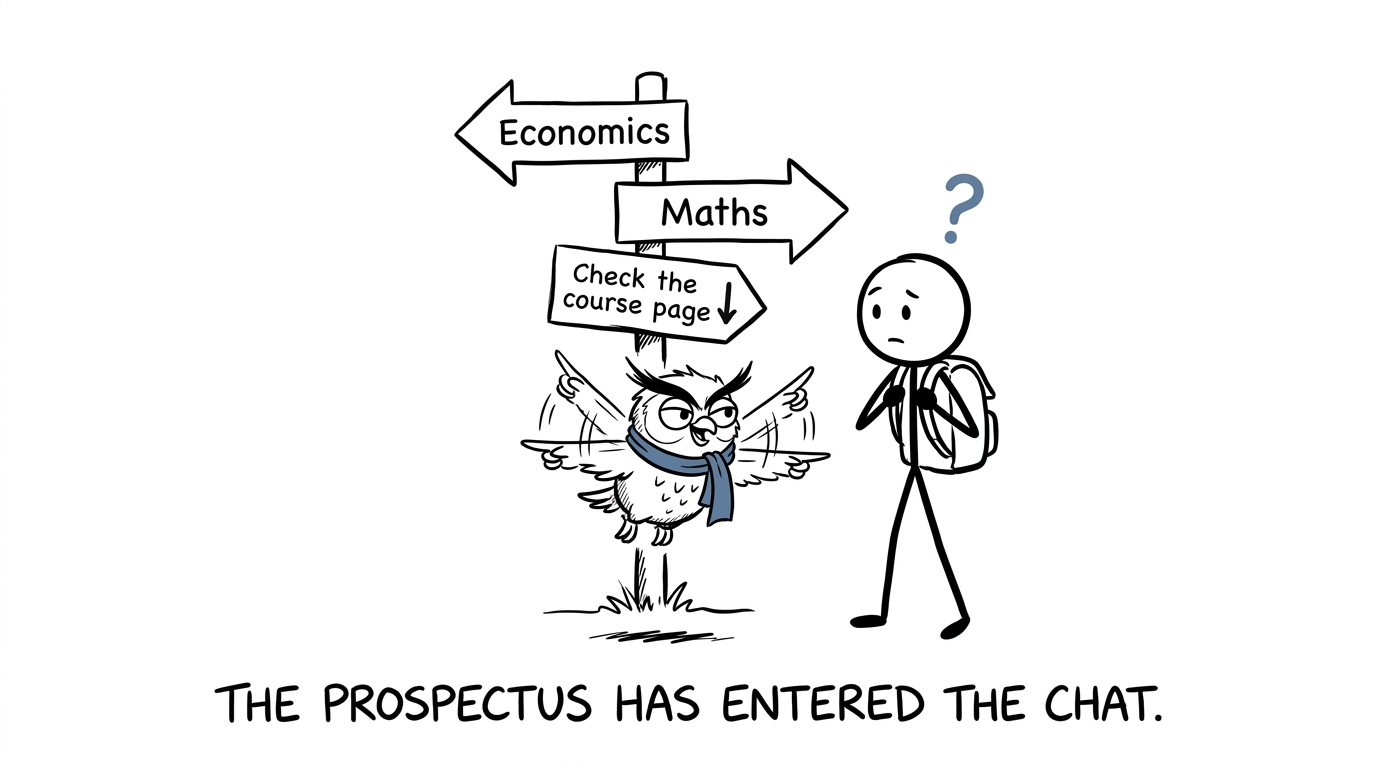 A student meets a university signpost and a confidently unhelpful owl
A-level Economics grade meaning by grade
An Economics grade does not produce one automatic university outcome. Instead, it influences how well you satisfy the complete offer.
| Economics grade | What it may mean for university applications |
|---|---|
| A* | Excellent subject performance, suitable for highly competitive applications when the other required grades are also achieved. |
| A | Strong performance and compatible with many Economics offers, provided you meet Mathematics and overall-grade conditions. |
| B | A solid result accepted within many offers, although the most selective courses may expect a higher overall profile. |
| C | May fit courses with lower offers or foundation years, but direct entry choices are likely to be narrower. |
| D or E | A passing A-level grade, though many standard Economics degrees will require stronger results. Alternative routes may be more realistic. |
Grade A*
An A* demonstrates exceptional performance in A-level Economics, but it cannot replace a missing compulsory subject.
For example, UCL’s published Economics BSc offer for 2026 entry was AAA, including A in Mathematics. If Economics was offered, UCL required grade A in it. Cambridge listed a minimum Economics offer of AAA and required Mathematics, while explaining that applicants do not necessarily need A-level Economics.
The lesson is subtle: an A* in Economics strengthens an application, but an A* in Mathematics may be the formal condition that makes an application eligible.
Grade A
An A is a strong Economics result and sits comfortably within many competitive grade profiles. Manchester’s published BSc Economics offer was AAA including Mathematics, with a contextual offer of ABB including A in Mathematics. Economics appeared among its preferred subjects rather than as an absolute requirement.
An A therefore has considerable value, especially when paired with strong Mathematics. Students taking Edexcel can use the Edexcel A Economics revision resources to combine specification-focused lessons with question practice and papers.
Grade B
A B can support applications to a wide range of universities, but you must read the subject conditions carefully. Exeter’s published 2026 Economics BSc range was A*AA to AAA, with grade B in A-level Mathematics required. Here, a B in Economics could be part of a successful overall combination, but Mathematics remained the named subject requirement.
Surrey published a standard AAB offer for Economics and indicated a reduced ABB offer for students taking A-level Mathematics or Economics. This shows why subject choice can affect an offer even when a particular Economics grade is not specified.
Grade C
A C does not end the possibility of an Economics-related degree, but it often changes the route. Some foundation-year courses publish offers around CCC, while direct-entry courses commonly ask for combinations from ABB upwards.
A foundation year adds preparation before the main degree. It is not an easier version of the same application, and eligibility rules differ. Check the course structure, progression conditions and Mathematics requirements rather than looking only at the headline grades.
Grades D and E
D and E are passing A-level grades, but they fall below the typical offers in the examples above. Sensible next steps may include a foundation year, resitting, a different related course or another recognised route into higher education.
This is a planning decision, not a verdict on your ability. The useful question is not, “Is this grade good or bad?” It is, “Which verified routes remain open, and what requirement should I improve next?”
Economics degree entry requirements and Mathematics
Economics at university is quantitative. Degree courses commonly include statistics, mathematical methods, econometrics and data analysis. That helps explain why Mathematics requirements can be more restrictive than Economics requirements.
York, for example, published an AAB offer and described A-level Mathematics as preferred rather than essential. However, applicants without it needed grade 7 in GCSE Mathematics. Birmingham required AAA including Mathematics, while Bath required Mathematics within its published offer.
If you are still preparing for GCSEs, strengthen the skills that preserve future choices. Start with the GCSE Maths revision hub, or use the Edexcel GCSE Maths resources if that is your exam board. Students considering quantitative subjects can also explore GCSE Statistics revision.
At sixth form, the A-level Maths revision hub supports the algebra, calculus, probability and statistical reasoning used in Economics degrees. Topics such as regression, correlation and hypothesis testing reveal how mathematical evidence is interpreted rather than merely calculated.
 A checklist finds a sensible route through university entry requirements
How to build a balanced university shortlist
Create three groups: ambitious choices, choices close to your predicted grades, and safer options. For every course, record the overall offer and each subject-specific condition separately.
Do not assume that two degrees called “Economics BSc” have comparable requirements. One may demand A-level Mathematics, another may accept GCSE Mathematics at grade 7, and another may offer a foundation route. Contextual offers can also reduce the overall combination, although required subject grades may remain unchanged.
Use predicted grades as planning information rather than certainty. Then revise against your actual specification through the A-level Economics revision hub, which covers AQA, Edexcel A, Edexcel B, Eduqas, OCR and WJEC resources.
Common mistakes when interpreting entry grades
- Looking only at Economics: A strong Economics grade cannot compensate automatically for a missing Mathematics requirement.
- Confusing typical offers with guarantees: Meeting the published grades does not always guarantee an offer.
- Ignoring GCSE conditions: Some courses specify GCSE Mathematics or English Language grades.
- Using requirements from the wrong year: Admissions tests, offers and subject rules can change between cycles.
- Treating contextual offers as universal: Eligibility depends on each university’s published criteria.
- Applying to five courses with the same risk: A balanced shortlist protects you if predicted or achieved grades change.
Turn the grade into a plan
Your A-level Economics grade meaning comes from context. An A* can strengthen an ambitious application, a B can support many credible choices, and a C may point towards a foundation route. Across the range, Mathematics often decides which doors are open.
Begin by checking current course requirements, then build the grades those courses actually request. MathsGenie’s free A-level Economics resources bring together revision lessons, practice questions, revision guides, past papers, predicted papers, mini tests and mark schemes. Pair them with Maths revision and video solutions, then use regular paper practice to turn a distant university requirement into the next manageable task.