A-Level Economics Grade Boundaries History
A-level economics grade boundaries history from 2019 to 2025, showing AQA and Edexcel trends, pandemic context and practical revision advice for students.
A grade boundary can feel like a finish line that moves while you are running towards it. One year, an AAA requires fewer marks; another year, it rises. Yet the A-level economics grade boundaries history is not evidence that exam boards arbitrarily make qualifications easier or harder. Boundaries are set after papers have been marked to account for differences in demand between exam series.
The recent pattern is clear but not universal: Edexcel Economics A boundaries have risen steadily since 2022, while AQA boundaries have moved up and down within a narrower range. That distinction matters. There is no single Economics boundary shared by AQA, Edexcel, OCR and Eduqas.
Grade boundary checklist
Before comparing years, remember:
- use the overall qualification boundary, not a notional paper boundary;
- check the correct exam board and specification code;
- compare percentages when total marks differ;
- treat 2020 and 2021 separately because normal summer exams were cancelled;
- never assume that next year's boundary will repeat the latest figure.
Students beginning the subject can explore the A Level subjects available on MathsGenie before choosing the correct specification.
Past A-Level Economics grade boundaries
The table compares AQA Economics 713671367136 with Edexcel Economics A 9EC09EC09EC0. It uses official overall qualification boundaries for A∗A^*A∗ and AAA. Percentages are included because AQA has a maximum of 240240240 marks, whereas Edexcel's weighted qualification total is 335335335.
| Year | AQA A∗A^*A∗ | AQA AAA | Edexcel A A∗A^*A∗ | Edexcel A AAA |
|---|---|---|---|---|
| 2019 | 191/240191/240191/240 (79.6%79.6\%79.6%) | 164/240164/240164/240 (68.3%68.3\%68.3%) | 268/335268/335268/335 (80.0%80.0\%80.0%) | 240/335240/335240/335 (71.6%71.6\%71.6%) |
| 2020 | No normal summer exam boundary | No normal summer exam boundary | No normal summer exam boundary | No normal summer exam boundary |
| 2021 | No normal summer exam boundary | No normal summer exam boundary | No normal summer exam boundary | No normal summer exam boundary |
| 2022 | 175/240175/240175/240 (72.9%72.9\%72.9%) | 151/240151/240151/240 (62.9%62.9\%62.9%) | 262/335262/335262/335 (78.2%78.2\%78.2%) | 235/335235/335235/335 (70.1%70.1\%70.1%) |
| 2023 | 182/240182/240182/240 (75.8%75.8\%75.8%) | 156/240156/240156/240 (65.0%65.0\%65.0%) | 273/335273/335273/335 (81.5%81.5\%81.5%) | 245/335245/335245/335 (73.1%73.1\%73.1%) |
| 2024 | 173/240173/240173/240 (72.1%72.1\%72.1%) | 149/240149/240149/240 (62.1%62.1\%62.1%) | 278/335278/335278/335 (83.0%83.0\%83.0%) | 251/335251/335251/335 (74.9%74.9\%74.9%) |
| 2025 | 177/240177/240177/240 (73.8%73.8\%73.8%) | 153/240153/240153/240 (63.8%63.8\%63.8%) | 287/335287/335287/335 (85.7%85.7\%85.7%) | 262/335262/335262/335 (78.2%78.2\%78.2%) |
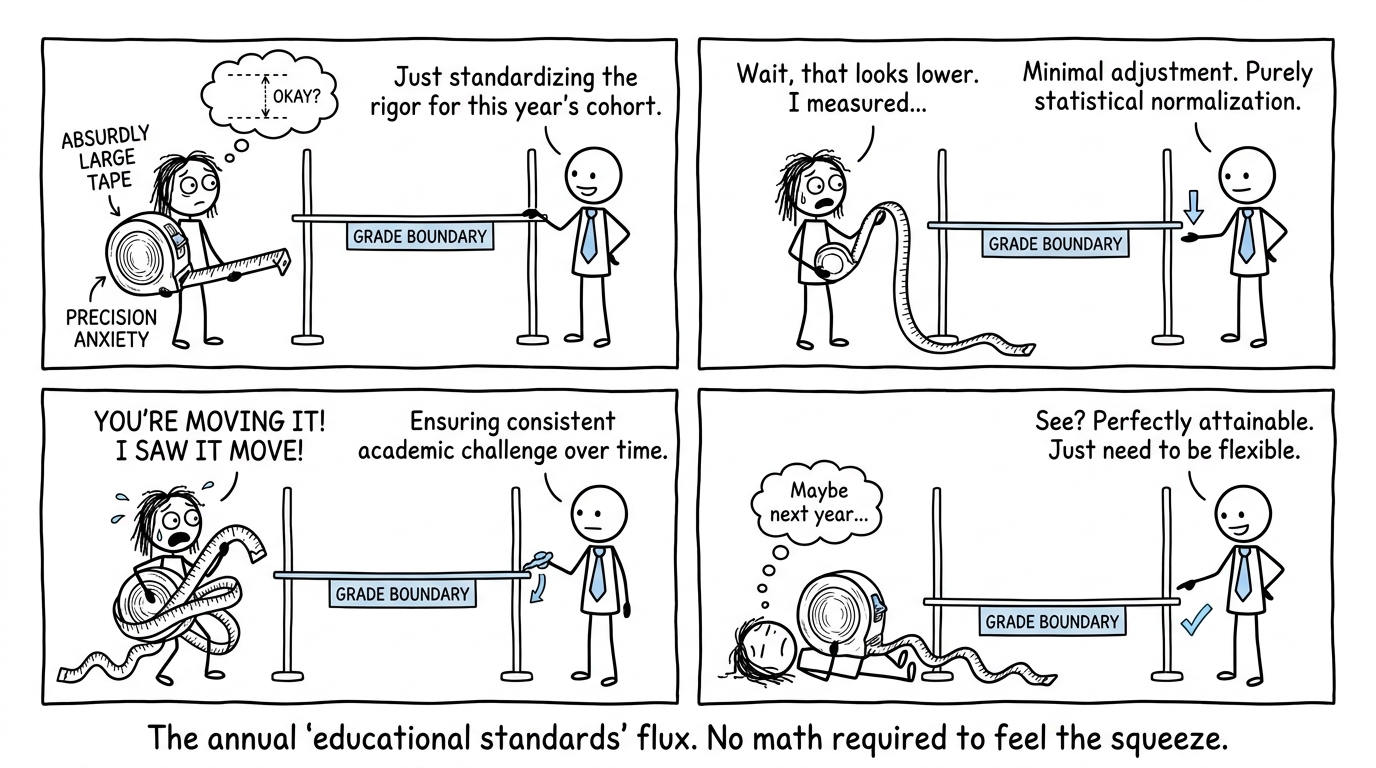 A student arrives with an oversized measuring tape as an examiner moves the grade boundary
What changed year by year?
2019: the useful pre-pandemic benchmark
The 2019 series provides the cleanest recent pre-pandemic comparison. The A∗A^*A∗ boundaries were close in percentage terms: 79.6%79.6\%79.6% for AQA and 80.0%80.0\%80.0% for Edexcel Economics A.
This does not mean the papers were identical. Each board has its own specification, assessment structure and mark scheme. It simply gives students a sensible reference point before the disruption of the following years.
2020 and 2021: a break in the sequence
Normal summer GCSE and A Level examinations were cancelled in both years because of the pandemic. In 2020, final grades were based principally on centre assessment grades after the original standardisation arrangements were withdrawn. In 2021, teachers determined grades from evidence such as assessments, mock examinations and completed work.
Consequently, there are no normal summer written-paper boundaries that can be compared fairly with 2019 or 2022. Some autumn examination boundaries exist, but mixing those smaller, unusual series into a summer trend can create a misleading picture.
2022: exams returned with transitional grading
Summer exams resumed in 2022. Ofqual's grading approach was designed as a transition between 2021 outcomes and the pre-pandemic standard of 2019.
Both boards' boundaries were below their 2019 equivalents. However, a lower boundary does not automatically mean an easier grade. It can reflect more demanding assessments, differences in candidate performance and the grading arrangements used for that series.
2023: a return towards normal grading
Ofqual returned to pre-pandemic grading standards in 2023, with protection recognising the disruption experienced by that cohort. Boundaries increased for both specifications: AQA's AAA boundary rose from 62.9%62.9\%62.9% to 65.0%65.0\%65.0%, while Edexcel's rose from 70.1%70.1\%70.1% to 73.1%73.1\%73.1%.
The change should be read in its policy context rather than treated as proof that the subject suddenly became harder.
2024 and 2025: the boards diverged
AQA boundaries fell in 2024 and then rose modestly in 2025. Its 2025 A∗A^*A∗ boundary of 73.8%73.8\%73.8% remained below the 2019 percentage.
Edexcel Economics A followed a different path. Its A∗A^*A∗ boundary increased in every summer series from 2022 to 2025, reaching 287287287 weighted marks, or 85.7%85.7\%85.7%, in 2025. This is the strongest recent A-level economics grade boundary trend in the data, but it still cannot predict the next series.
What the trends actually tell you
A boundary is an outcome, not a target announced before the examination. Senior examiners consider the quality of students' work and statistical evidence after marking is nearly complete. Boundaries can therefore rise when a paper proves more accessible and fall when it proves more demanding.
For teachers using old papers as mocks, percentages offer a useful historical guide. For students, a safer strategy is to aim comfortably above several recent boundaries rather than building a revision plan around the lowest year.
Use the AQA A Level Economics revision hub or the Edexcel Economics A revision hub to match your work to the correct specification. AQA students can diagnose topic gaps through the AQA Economics question bank.
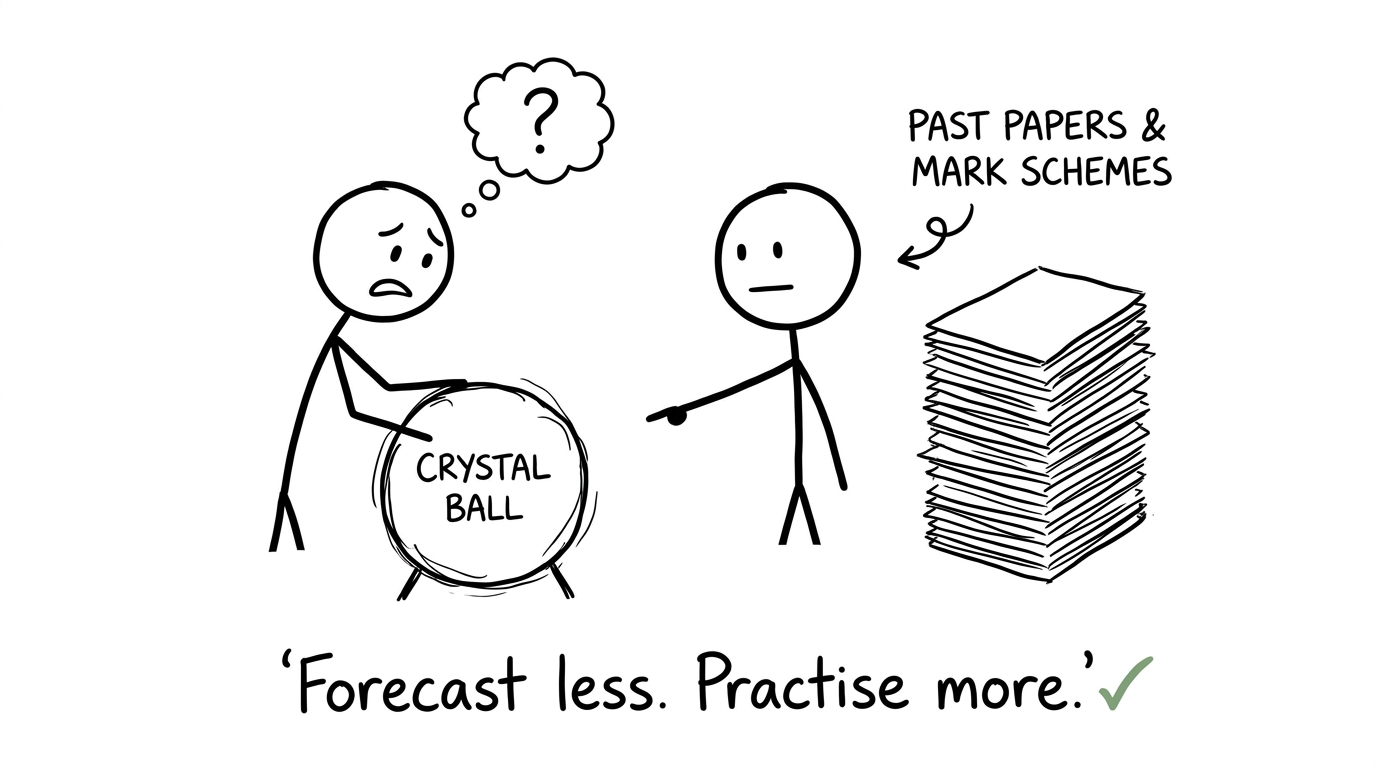 A student abandons a grade-boundary crystal ball for past papers and mark schemes
Common mistakes when interpreting boundaries
Comparing raw totals directly
177177177 on AQA and 287287287 on Edexcel describe different totals. Convert them to percentages before discussing the gap.
Treating paper boundaries as final grades
Notional component boundaries help teachers interpret individual papers, but the overall qualification result is determined from the combined weighted mark. Paper-level performance does not create a separate certificate grade.
Comparing different Edexcel specifications
Edexcel Economics A and Economics B are separate qualifications with different assessments. Their boundaries are not interchangeable.
Predicting the next boundary from one year
Past A-Level Economics grade boundaries provide context, not prophecy. A demanding unseen paper may produce a lower boundary, while an accessible paper may produce a higher one.
Turn boundary research into better revision
The calmest response to a moving boundary is to build a margin. Complete a paper under timed conditions, mark it accurately, identify where marks were lost and return to those topics. Then repeat the process using another series rather than repeatedly attempting the same familiar questions.
MathsGenie brings those steps together through revision lessons, practice questions, mark schemes, predicted papers, mini tests and video solutions. Start with the Edexcel A Level Economics past papers, or use the relevant AQA resources above. If you are still preparing for grades 999 to 111, build the same habits through the GCSE Maths revision hub.
Grade boundaries will keep moving. Strong knowledge, careful evaluation and disciplined paper practice are the part you can control.