

A-Level Computer Science Resit: A Revision Plan
A-level computer science resit revision plan for after Results Day, with milestones for theory, programming, past papers, NEA and exam technique.
Results Day can reduce two years of work to one letter on a screen. If that letter changes your plans, an A-level computer science resit gives you another route forward, but only if the second attempt is prepared differently from the first.
Start by confirming your exam board, resit centre and non-exam assessment arrangements. Then use your previous papers to identify whether marks were lost through weak knowledge, programming errors, poor explanations or timing. Your retake should be a targeted repair plan, not another tour through the same notes.
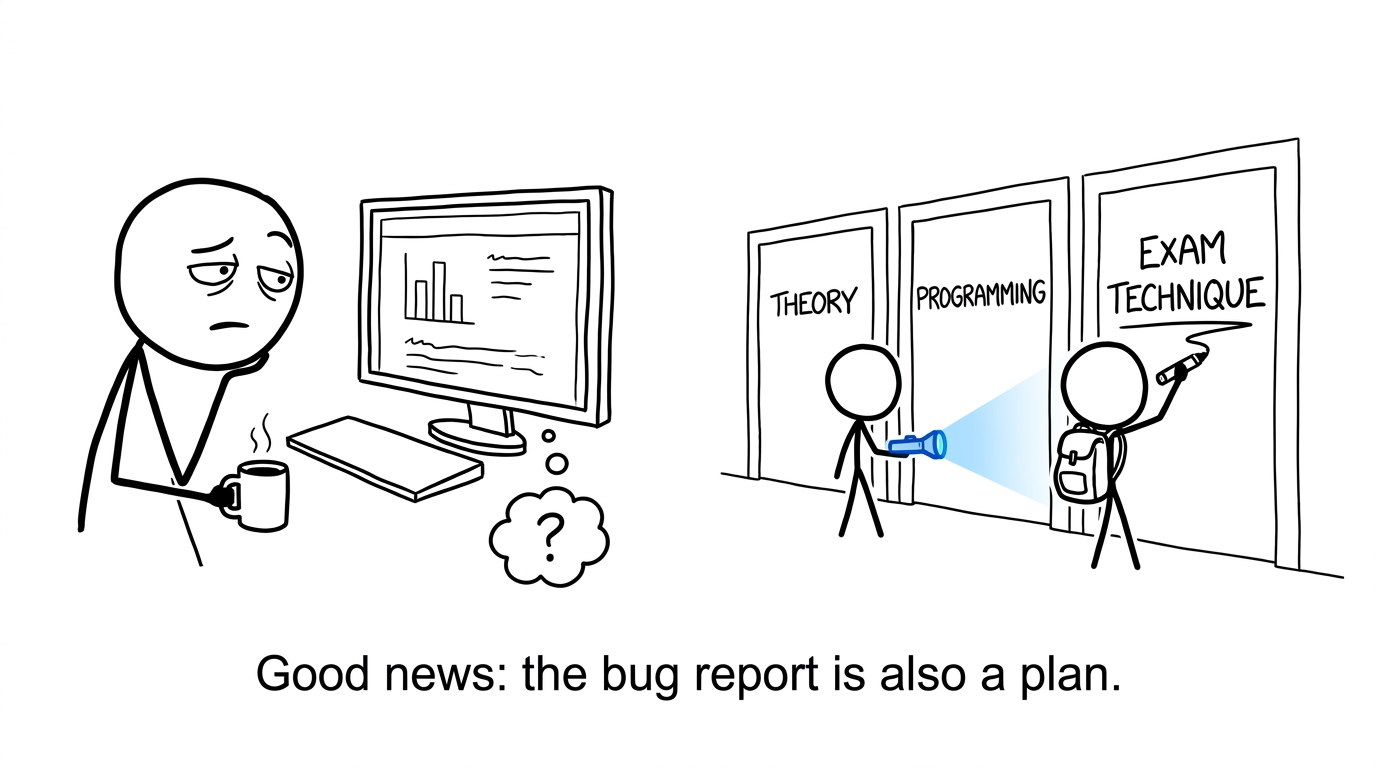 A student turning a disappointing result into a useful debugging plan
Your resit preparation checklist
Before beginning serious revision, make sure you can answer these questions:
- Which specification and exam board are you entering?
- Which examined components must you retake?
- Can your previous NEA mark be carried forward?
- Which school, college or private candidate centre will enter you?
- What are the centre's entry and NEA deadlines?
- Which topics and question types cost you the most marks?
- How many realistic revision sessions can you complete each week?
AQA and OCR A-level Computer Science are linear qualifications. Their current specifications contain two examined components worth 40%40\%40% each and an NEA worth 20%20\%20%. OCR explicitly allows eligible resit candidates to carry forward their most recent non-absent programming project result, while the precise entry and carry-forward process depends on the board and centre.
Do not assume that your old project will transfer automatically. Ask the examinations officer to confirm the rules in writing before planning your year around it.
Milestone one: diagnose the first result
The most useful question after Results Day is not simply, “What grade did I get?” It is, “Where did the marks go?”
Ask your centre about component marks and the available post-results services. If appropriate, discuss access to scripts or a review of marking with a teacher. A review is not a free second attempt: marks can remain unchanged, rise or fall, and formal deadlines apply.
Create an error log with four categories:
- Knowledge: a definition, process or concept was missing.
- Application: you knew the topic but could not apply it to the scenario.
- Programming: tracing, adapting or writing code caused difficulty.
- Exam technique: timing, command words or imprecise explanations lost marks.
This separates symptoms from causes. “Networks are weak” is vague. “I cannot justify a protocol for a given situation” is something you can practise.
Milestone two: secure the resit entry
Resitting A-level Computer Science normally means taking the required examined components in a future summer series. You may enter through your former school or college, another centre, or as a private candidate where suitable arrangements are available.
Computer Science needs particular care because a centre must be able to administer the correct assessment format and any NEA requirements. Before paying, confirm:
- the exact specification code;
- which papers and programming language options are offered;
- whether the centre accepts your NEA arrangement;
- internal entry deadlines and total fees;
- how preliminary or skeleton program material will be provided, where applicable.
Exam formats differ. For example, AQA Paper 1 includes on-screen programming work, whereas OCR assesses its two examined components through written papers. Prepare for the format you will actually sit, not the one described in another board's resources.
A practical revision plan with milestones
A useful plan moves from understanding to retrieval, then from untimed practice to full exam conditions.
| Stage | Main objective | Evidence that you are ready to move on |
|---|---|---|
| Weeks one to two | Audit the specification and previous performance | Every topic has a red, amber or green rating |
| Weeks three to eight | Rebuild weak theory and programming knowledge | You can recall key ideas and solve short questions without notes |
| Weeks nine to fourteen | Complete topic-based exam questions | Your error log shows fewer repeated mistakes |
| Weeks fifteen to twenty | Mix topics and practise longer responses | You can select relevant knowledge without being told the topic |
| Final phase | Complete timed papers and targeted repairs | Timing is controlled and mark-scheme language is precise |
Adapt the timescale to your exam date. The sequence matters more than the exact number of weeks.
Rebuild theory through active recall
Reading feels comfortable because the answer is always nearby. Exams are uncomfortable because it is not.
Use short retrieval sessions for data representation, computer architecture, networks, databases, Boolean logic, legal and ethical issues, algorithms and programming concepts. Then answer questions which force you to apply that knowledge.
The AQA A-level Computer Science revision hub brings lessons and topic-by-topic questions together. If mathematical content is a weakness, use the A-level Computer Science mathematical skills guide to revisit number bases, Boolean algebra and algorithm efficiency.
Students with gaps carried forward from GCSE can briefly repair them through the computational thinking revision guide or programming constructs guide. Return to A-level questions once the foundation is secure.
Practise programming away from your notes
Programming improves through writing, tracing, testing and debugging. Watching someone else code may clarify a method, but it does not prove that you can produce one independently.
Schedule at least two programming sessions each week. Rotate between:
- tracing existing algorithms;
- completing partially written code;
- writing short solutions from requirements;
- testing normal, boundary and invalid data;
- explaining time and space efficiency;
- debugging syntax, logic and runtime errors.
Use the language and conventions required by your specification. The algorithms revision guide can support revision of searches, sorts, data structures and complexity.
If you are retaking or completing an NEA, keep it separate from ordinary exam practice. Follow your board's current authentication rules and your centre's supervision requirements. The solution design revision guide helps clarify how requirements, algorithms, data structures and validation fit into a coherent design.
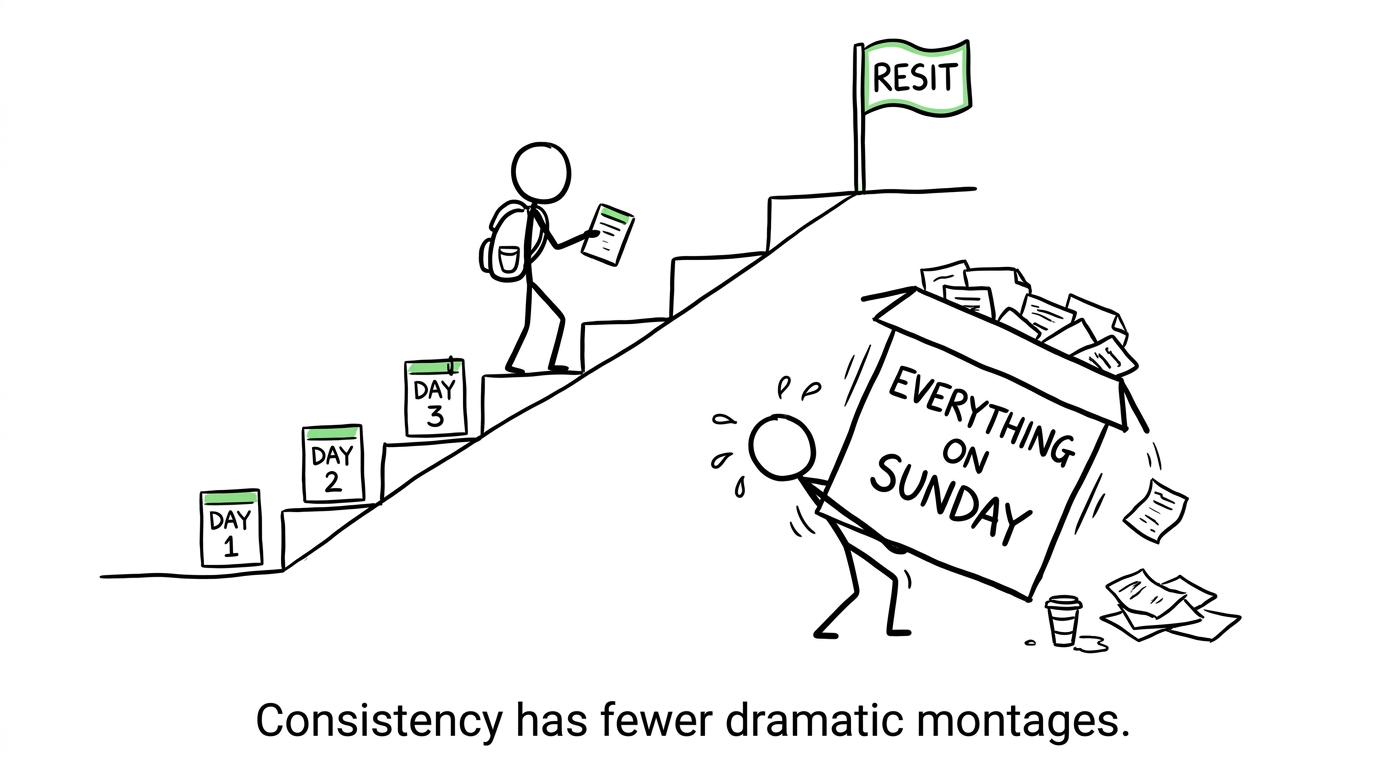 A little revision each day competing with an enormous Sunday revision box
Turn past papers into feedback
Begin with topic questions, but do not stay there. Real papers mix topics, vary command words and force you to decide which knowledge matters.
Use AQA A-level Computer Science past papers in three passes:
- complete early questions without a time limit;
- complete sections under controlled timing;
- sit full papers under exam conditions.
Mark every attempt carefully. Record the lost mark, its cause and the action needed. Reattempt incorrect questions later without looking at the solution. A paper is valuable because of what happens after marking, not because it has been completed.
Common mistakes when resitting A-level Computer Science
Repeating the original revision method
More hours do not automatically produce better preparation. If passive rereading failed to expose weak recall, replace it with retrieval, coding and marked questions.
Revising from the wrong specification
AQA, OCR and Eduqas differ in content detail, paper structure and NEA administration. Keep the current specification beside your revision plan.
Leaving centre arrangements too late
A private candidate entry is not secured until a centre confirms it. Computer Science assessment and NEA requirements can limit which centres are suitable.
Memorising mark schemes without understanding
Mark schemes reveal the precision expected, but copied phrases collapse when the context changes. Explain each answer in your own words before comparing it with the scheme.
Avoiding timed practice
Knowing the content and delivering it under pressure are different skills. Build timing gradually rather than discovering the problem in the final week.
Make the second attempt genuinely different
Resitting A-level Computer Science is not about pretending the first result never happened. It is about treating that result as diagnostic information.
Confirm the administration early. Identify the specific causes of lost marks. Rebuild weak knowledge, practise programming independently and use full papers to measure progress. MathsGenie can support each stage with free revision lessons, question banks, practice questions, mark schemes and past papers. Start with the AQA A-level Computer Science question bank and revision resources, then make your first milestone small enough to begin today.











