

A-Level Computer Science Marks per Grade 2025
A-level computer science marks per grade for 2025, covering AQA, OCR and Eduqas raw marks, grade thresholds and results-day checks.
Results-day uncertainty often comes down to one question: how many marks were needed? The latest confirmed A-level computer science marks per grade are the June 2025 boundaries. They differ by exam board: an A* required 300300300 out of 375375375 for AQA, 291291291 out of 350350350 for OCR and 393393393 out of 500500500 for Eduqas.
These are minimum whole-qualification thresholds, not targets for every paper. Boundaries for summer 2026 will not be known until results day, so use the figures below to interpret 2025 results or as historical guidance rather than a prediction.
Results-day checklist
Before comparing your mark with a threshold:
- confirm whether your board is AQA, OCR or Eduqas;
- check the exam series on your statement of results;
- use the overall qualification mark, not one paper mark;
- remember that a boundary is the minimum mark for that grade;
- do not apply a 2025 threshold to a different year.
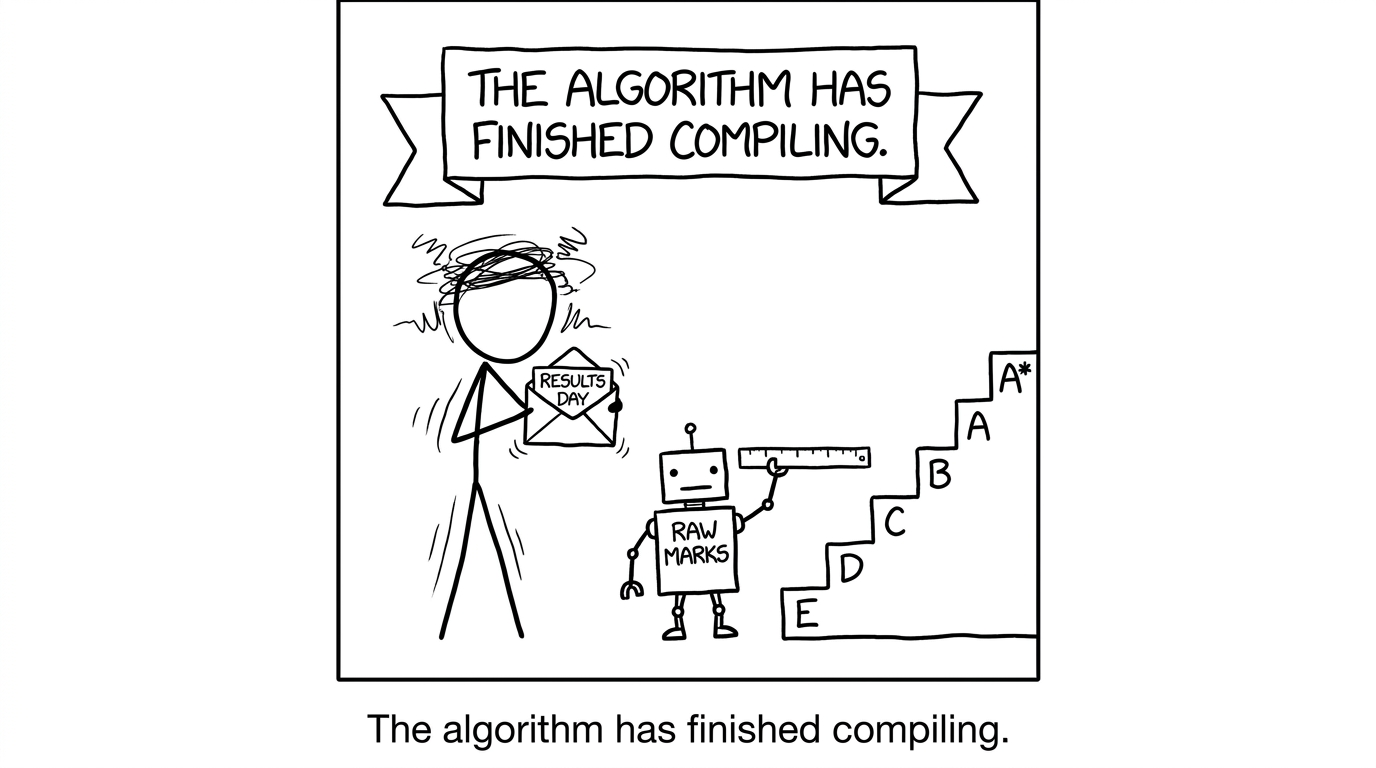 A results-day student waits while a raw-marks robot finishes compiling the grades
A-Level Computer Science grade thresholds for 2025
The table gives the confirmed June 2025 whole-subject boundaries. Pearson Edexcel does not offer the reformed UK GCE A Level Computer Science qualification covered here, although it does offer GCSE and International A Level Computer Science qualifications.
| Grade | AQA 751775177517 out of 375375375 | OCR H446H446H446 out of 350350350 | Eduqas A500QSA500QSA500QS out of 500500500 |
|---|---|---|---|
| A* | 300300300 | 291291291 | 393393393 |
| A | 245245245 | 256256256 | 347347347 |
| B | 201201201 | 218218218 | 289289289 |
| C | 157157157 | 180180180 | 231231231 |
| D | 113113113 | 142142142 | 174174174 |
| E | 696969 | 105105105 | 117117117 |
| U | Below 696969 | Below 105105105 | Below 117117117 |
You can inspect the underlying board-specific information on MathsGenie's AQA A-Level Computer Science grade boundaries, OCR A-Level grade boundaries for 2025 and Eduqas A-Level grade boundaries for 2025.
What A-Level Computer Science raw marks mean
A raw mark is the mark awarded for your assessed work before any necessary scaling or weighting. Your qualification grade is decided from your overall total across the required components.
For AQA, the qualification total is 375375375. The two examination papers make scaled contributions of 150150150 each, while the non-exam assessment contributes 757575.
OCR has a total of 350350350: Computer Systems and Algorithms and Programming are each worth 140140140, while the programming project is worth 707070.
Eduqas requires extra care. Its two written components each begin with a raw maximum of 100100100 but have a weighting factor of 222, while the programmed solution component has a maximum of 100100100 and a weighting factor of 111. The resulting qualification total is therefore 500500500. Compare the final weighted total with the overall boundary rather than simply adding three unweighted component marks.
For a quicker check, MathsGenie provides an AQA Computer Science predicted grade calculator and an Eduqas Computer Science predicted grade calculator.
Why grade boundaries change
A-level computer science grade thresholds are not fixed percentages. Exam boards set boundaries after papers have been marked, considering the demands of that particular assessment and evidence of student performance.
That is why AQA's A* boundary was 298298298 in 2024 but 300300300 in 2025. OCR moved from 292292292 to 291291291 over the same period. A small movement does not mean a subject suddenly became easier or harder to earn; it helps maintain a comparable standard when papers vary.
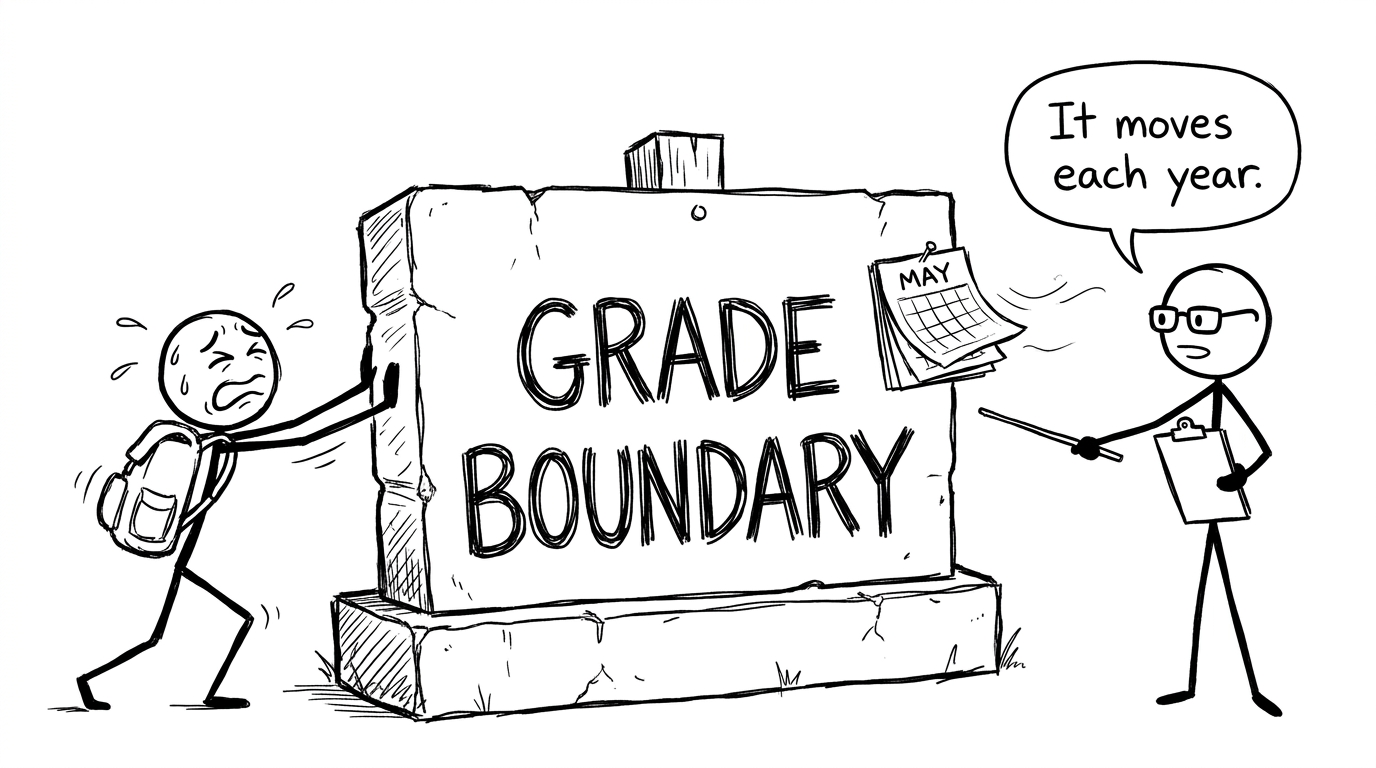 A student discovers that the grade-boundary sign moves each year
How to interpret a mark on results day
Find your board and read across the table. If your overall mark equals a threshold, you have reached that grade. A mark one below it belongs to the grade beneath.
Do not average the boundaries from different boards. AQA, OCR and Eduqas have different specifications, assessment structures and maximum marks, so their totals are not directly interchangeable. If you are still preparing for A Level, use the boundary as context while setting a safer target above it rather than aiming for the exact minimum.
Students following OCR can combine this information with the free OCR A-Level Computer Science revision hub, which includes past papers, mark schemes and revision tools. Strong algebra and logical reasoning also support programming and algorithms, so the A-Level Maths revision hub remains useful when preparing for mathematically demanding courses.
Common mistakes when checking grade boundaries
Using a component boundary as a final grade. Component boundaries are often notional. Your qualification grade comes from the overall total.
Looking at the wrong year. Boundaries can move between exam series, even when the specification is unchanged.
Ignoring scaling. This is particularly risky with Eduqas and with scaled AQA paper contributions.
Treating the boundary as a revision target. Past thresholds describe previous results; they do not guarantee the next boundary.
Comparing percentages across boards. Different maximum marks and assessment models make a raw percentage comparison misleading.
Turn the threshold into a revision decision
A grade boundary is useful because it turns a vague result into a clear benchmark. But progress comes from finding where marks are being lost: incomplete explanations, weak programming accuracy, missed theory or poor timing.
Start with the AQA A-Level Computer Science grade boundaries post, or select the matching OCR or Eduqas page above. Then use MathsGenie's free revision lessons, practice questions, past papers, predicted papers, mini tests, mark schemes and video solutions to close specific gaps. The threshold tells you where the line was. Careful practice helps you move beyond it.











