

A-Level Computer Science Lower Grade Than Expected
A-level Computer Science lower grade than expected? Follow a calm results-day plan covering reviews, university offers, Clearing and resits.

A results envelope can make two years of work feel as though it has been compressed into one letter. If you received an A-level Computer Science lower grade than expected, pause before deciding what it means. Check your UCAS status, speak to your school or college, and investigate three routes: a review of marking, Clearing, or a resit.
A disappointing result may alter the route, but it does not automatically remove the destination. The important thing is to make the next decision using evidence rather than the emotion of the first few minutes.
Your immediate results-day checklist
Work through these actions in order:
- Check your component marks and overall grade.
- Log in to UCAS Hub before assuming that you have lost your place.
- Speak to your Computer Science teacher and exams officer.
- Contact your firm or insurance university if your status is unclear.
- Ask whether access to scripts or a priority review is appropriate.
- Research Clearing while any review is being considered.
- Consider a resit only after comparing it with your other options.
For the 2026 cycle, A-level results day is Thursday 13 August. UCAS Clearing runs from 2 July to 19 October, although course availability changes throughout that period.
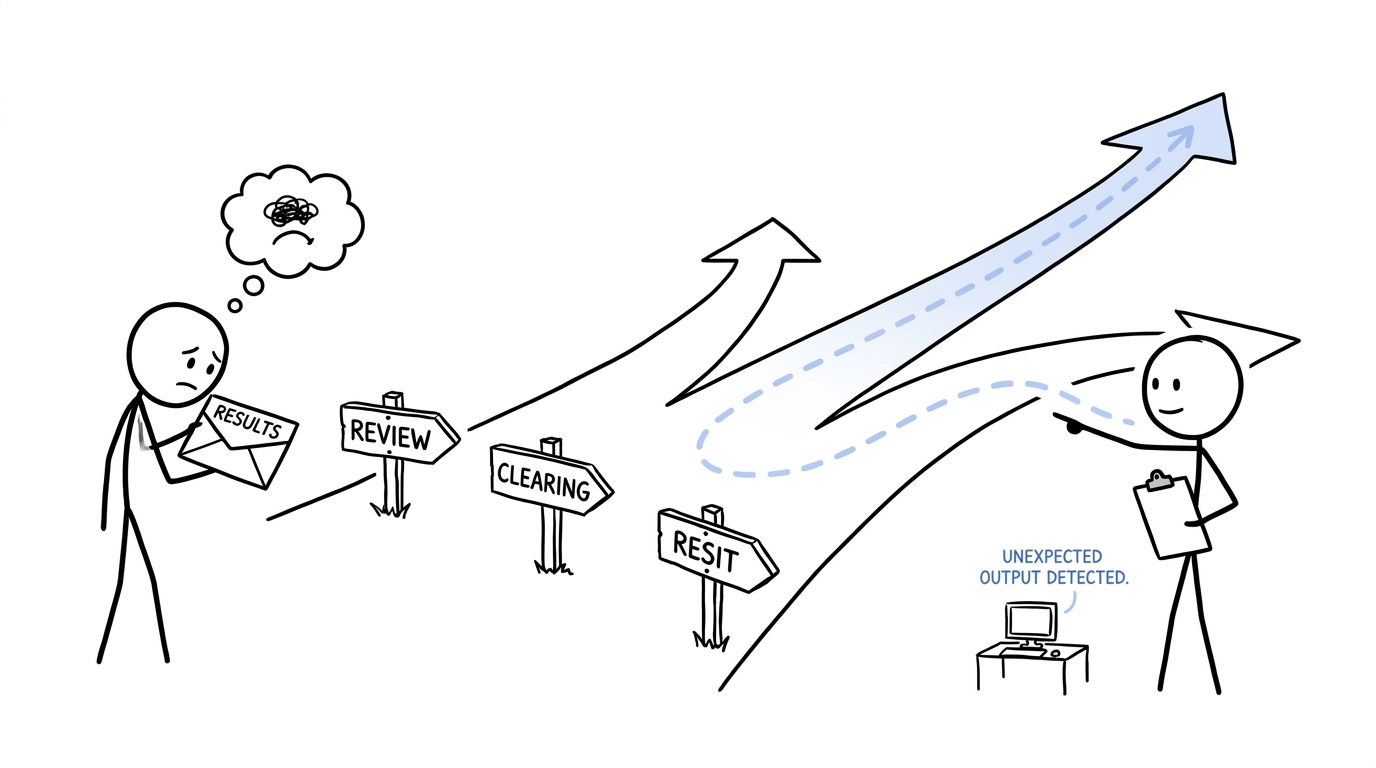 A student discovers that review, Clearing and resit routes all continue forward
Check what the result actually changes
A lower Computer Science grade and a lost university place are not the same event. Your firm choice may still accept you, particularly if the university has confirmed your place in UCAS Hub. You might instead have been accepted by your insurance choice or offered an alternative course.
Check the official status before making calls. If a decision is pending, contact the university admissions team and have your UCAS ID, grades and course details ready. Ask a direct question: is your application still being considered?
If you are a GCSE student thinking ahead, this distinction is useful. Results are important, but decisions are made using entry requirements, course availability and your complete application, not disappointment alone.
Ask whether a review of marking makes sense
Students often call this a “remark”, but the formal process is usually a review of marking. The reviewer checks whether the mark scheme was applied correctly. It is not simply a fresh attempt to award more marks.
Your school or college normally submits the request, and your written consent is required because the mark can rise, remain unchanged or fall. Private candidates may have different arrangements through their exam centre or awarding organisation.
Ask your teacher to examine:
- your mark relative to the next grade boundary;
- your performance across individual papers and non-exam assessment;
- whether a script appears inconsistent with the mark scheme;
- whether the possible gain justifies the cost and risk;
- whether a university place depends on a quick outcome.
You can compare your result with the published AQA A-level Computer Science grade boundaries, but being close to a boundary is not proof of a marking error.
For summer 2026, the JCQ deadline for an awarding body to receive an A-level priority review is 20 August. The general review deadline is 24 September. Schools often set earlier internal deadlines, so speak to your exams officer immediately. If your university place is affected, tell both the school and university that a priority review is being considered.
Use Clearing without treating it as second best
If you do not hold an offer and meet the eligibility conditions, Clearing allows you to search for courses with vacancies. It is not a judgement on your ability. It is a matching process between applicants and available places.
Start by deciding what you actually want. A course with “computing” in its title might focus on software engineering, artificial intelligence, cyber security, information systems or theoretical computer science. Read the modules rather than choosing by title alone.
When contacting a university, prepare:
- your UCAS ID and Clearing number, if shown;
- your confirmed grades;
- the course code;
- two or three reasons the course suits you;
- questions about modules, accreditation, accommodation and entry conditions.
Do not abandon a confirmed place impulsively. Declining it can be irreversible, and another offer is not guaranteed. Equally, do not stop exploring Clearing merely because a review is underway. The two processes can move at different speeds.
Decide whether an A-level Computer Science resit is right
A resit may be sensible if the grade blocks a specific, realistic goal and you believe another year of structured preparation can produce a different result. It is less useful when chosen only because the original grade feels uncomfortable.
Before committing, check:
- whether your former school will accept resit candidates;
- whether you need a private exam centre;
- the examination and administration fees;
- when your exam board offers the relevant papers;
- how non-exam assessment will be handled;
- whether your intended universities accept resit grades;
- whether you will also reapply through UCAS.
A-level Computer Science examinations are normally available in the summer series, so a resit often means waiting until the following summer. Rules concerning assessment components and the carrying forward of non-exam assessment can depend on the specification and your circumstances. Confirm them with your exam board and centre before paying any fees.
MathsGenie’s free A-level Computer Science revision hub is the strongest starting point for a new plan. Choose the correct specification through the AQA A-level Computer Science resources or OCR A-level Computer Science resources, then combine revision lessons with past papers and mark schemes.
Build a resit plan from the marks you lost
“Revise harder” is not a plan. Diagnose why the result happened.
Sort each lost mark into one of four categories:
- Knowledge: a specification point was missing or confused.
- Application: you knew the content but could not use it in context.
- Programming: algorithms, trace tables or code lacked precision.
- Exam technique: timing, command words or extended responses reduced the mark.
Then repair the weakest category first. If number systems, Boolean algebra or algorithm efficiency caused problems, revisit the OCR mathematical skills revision guide. For programming-project weaknesses, the OCR guide to describing a solution helps clarify inputs, processing, outputs and design decisions.
Use a repeating cycle: learn one topic, answer practice questions, mark them strictly, record the cause of each error, and retest the topic later. Past papers should become diagnostic tools, not piles of completed pages.
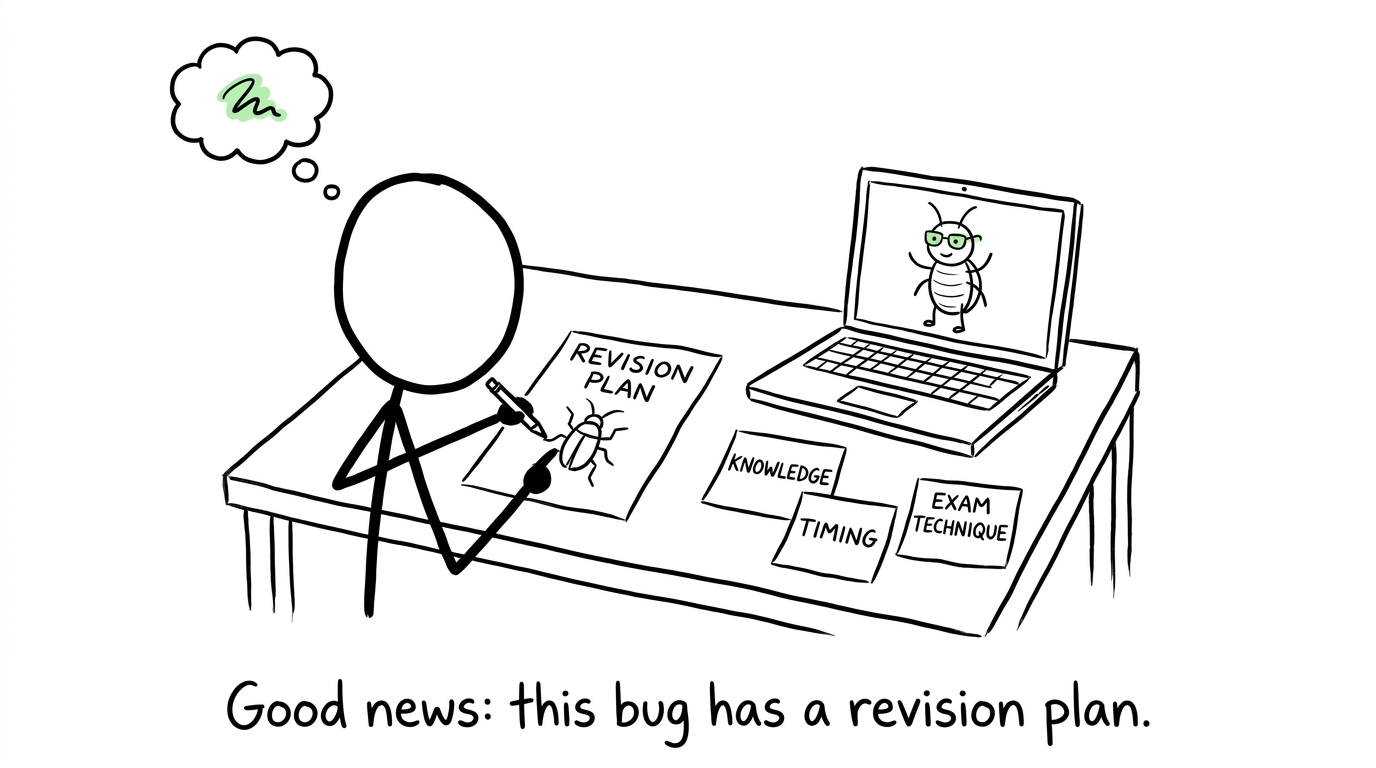 A student calmly debugs a revision plan with knowledge, timing and exam-technique labels
Common mistakes after a disappointing result
Assuming the university has rejected you
UCAS Hub may show that your firm or insurance place is already confirmed. Check before reacting to the grade alone.
Requesting a review without checking the risk
A review can leave the mark unchanged or move it down as well as up. Discuss the script, boundary and likely evidence with your teacher.
Waiting for a review before exploring Clearing
Vacancies can change. Research alternatives while the review proceeds and keep universities informed.
Choosing any course with a similar title
Compare modules, teaching style, placement opportunities and entry conditions. A quick offer is only valuable if the course is a good fit.
Resitting with the same revision method
A resit needs a different system. Use specification-matched lessons, active recall, timed papers, mark schemes and a written mistake log. Topic resources such as AQA Internet revision and OCR thinking-ahead revision can make weaknesses precise enough to fix.
Your result is information, not identity
An A-level Computer Science disappointing result deserves an honest response, but not a hopeless one. First establish your university status. Then investigate a review, Clearing and resitting in parallel until you know which route offers the best outcome.
If resitting becomes your choice, begin with the MathsGenie A-level Computer Science revision hub. Use the revision lessons to rebuild knowledge, practise with specification-matched questions, and test progress through past papers, mini tests, predicted papers and mark schemes. The result cannot be rewritten today. Your next process can.











