A-Level Computer Science Grade Boundaries 2026
A-level computer science grade boundaries explained for results day 2026, including weighting, a clear mark example and what to do after opening results.
The strange thing about results day is that the exams are over, yet one important number remains unknown. A-level computer science grade boundaries decide how your total mark becomes a grade, but the official 2026 boundaries cannot be known in advance. Exam boards set them after the papers have been marked, using evidence about the difficulty of that year's assessments.
For students in England, A-level results day is Thursday 13 August 2026. Results and grade boundaries must not be released to candidates before 8.00 am. Until then, any website claiming to know the final Computer Science boundaries is offering an estimate, not an official answer.
Results day checklist
Before looking at individual marks, remember:
- A Level Computer Science is graded from A* to E; a result below E is recorded as U.
- Boundaries are minimum marks, not target percentages fixed before the exam.
- Your final grade is based on the overall qualification mark.
- Component boundaries may be notional and do not necessarily represent separate grades.
- Different exam boards have different papers, weightings and total marks.
- The official 2026 table is the only boundary table that determines your result.
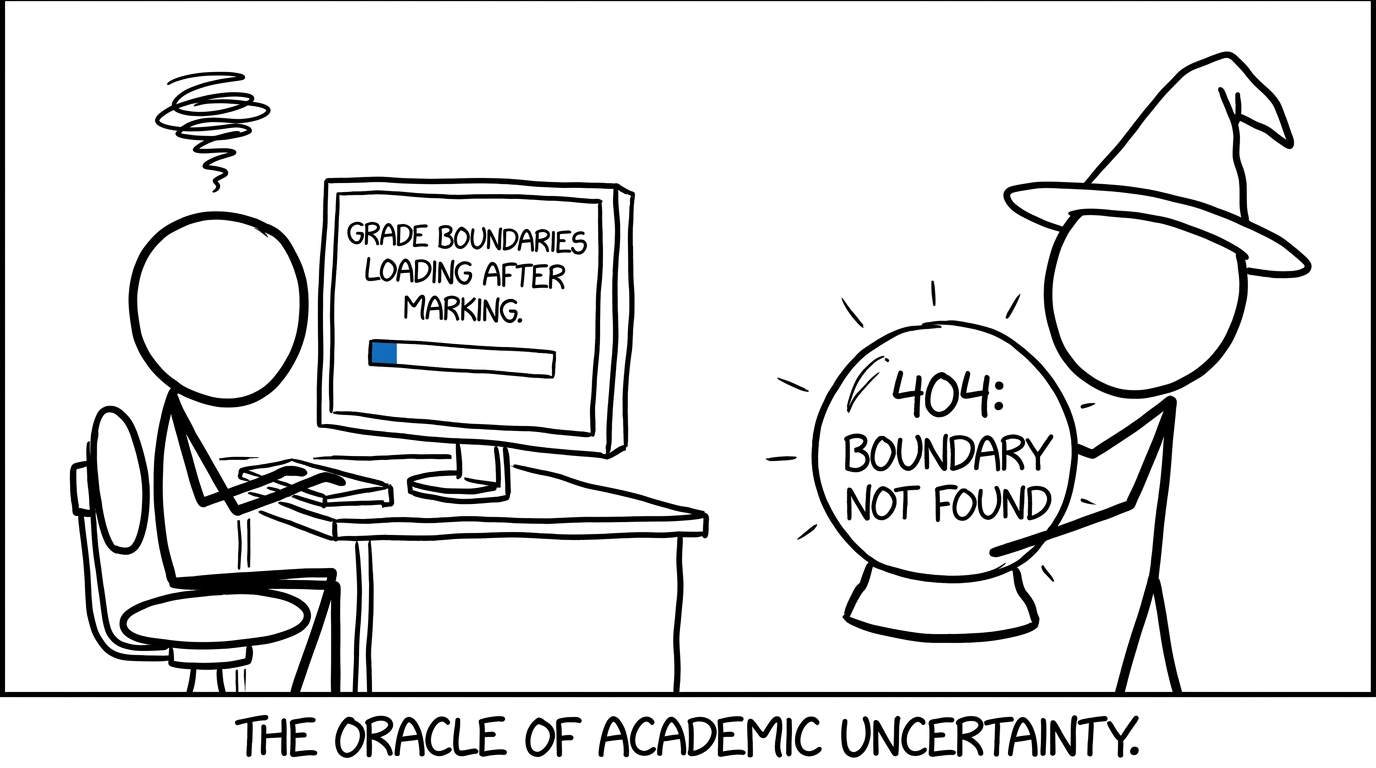 Student discovering that grade boundaries cannot be predicted before marking
How A-level Computer Science grade boundaries work
A grade boundary is the lowest overall mark needed for a particular grade. If the A boundary were 255255255, for example, a total of 255255255 would receive an A while 254254254 would receive the grade below. That does not mean the A boundary will actually be 255255255 in 2026.
Exam boards set boundaries during awarding after sufficient work has been marked. Senior examiners and assessment specialists consider quantitative and qualitative evidence, including mark distributions, the demand of the assessments, mark schemes, samples of student work and evidence from previous series.
The principle is fairness across years. If an assessment proves more demanding than an earlier paper, its boundaries may be lower. If it proves less demanding, they may be higher. Ofqual oversees the process in England so that the standard represented by a grade remains comparable over time and between exam boards.
This is why historical boundaries are useful for context but poor fortune-tellers. They show what happened after previous cohorts sat different papers. They do not reveal the computer science A-level grade boundaries 2026.
Your exam board changes the calculation
AQA, OCR and Eduqas do not use one shared mark structure. You must find the table for the correct board, specification and summer 2026 series.
For AQA specification 7517, Paper 1 and Paper 2 are each worth 40%40\%40%, while the non-exam assessment is worth 20%20\%20%. Each written paper has 100100100 raw marks and is scaled to 150150150; the 757575-mark project remains unscaled. The maximum scaled total is therefore 375375375.
OCR specification H446 also has two written components worth 40%40\%40% each and a programming project worth 20%20\%20%. The written papers each carry 140140140 marks and the project carries 707070, giving a total of 350350350 marks with the intended weightings already reflected.
Eduqas A500QS uses two 100100100-mark written components worth 40%40\%40% each and a 100100100-mark project worth 20%20\%20%. The written components are scaled by 222, producing a maximum scaled total of 500500500.
Pearson Edexcel's International A Level is a different qualification from the domestic A Levels above. Never use an International A Level boundary table unless that is the qualification named on your entry documents.
Worked boundary example for AQA
Consider a deliberately hypothetical AQA result. This demonstrates the method only; the boundaries below are not predictions for 2026.
Suppose the marks are:
| Component | Raw mark | Scaling | Scaled mark |
|---|---|---|---|
| Paper 1 | 686868 out of 100100100 | ×1.5\times 1.5×1.5 | 102102102 |
| Paper 2 | 626262 out of 100100100 | ×1.5\times 1.5×1.5 | 939393 |
| NEA | 555555 out of 757575 | ×1\times 1×1 | 555555 |
The overall scaled mark is:
(68×1.5)+(62×1.5)+55=102+93+55=250(68 \times 1.5) + (62 \times 1.5) + 55 = 102 + 93 + 55 = 250(68×1.5)+(62×1.5)+55=102+93+55=250Now imagine that the fictional overall boundaries were:
| Grade | Hypothetical minimum mark |
|---|---|
| A | 255255255 |
| B | 230230230 |
| C | 205205205 |
A total of 250250250 would be a B because it reaches 230230230 but not 255255255. You do not average the three raw percentages because the components have prescribed weightings.
What to check on A-level Computer Science results day
Start with the grade printed on your official results. Then check your component marks against the correct overall boundary table. Stay calm if one paper appears weaker than expected: the qualification grade depends on the combined weighted total, including the project.
If you are close to the next boundary, speak to your school or college before requesting a review of marking. A review is not a free search for extra marks, and a reviewed mark can remain unchanged, rise or fall. Your centre can explain the available scripts, deadlines, fees and whether a review is sensible.
Do not let a boundary distract you from your next practical decision. If a university place is involved, follow your school's results-day plan and check your official application status. A near miss may still require a conversation rather than an assumption.
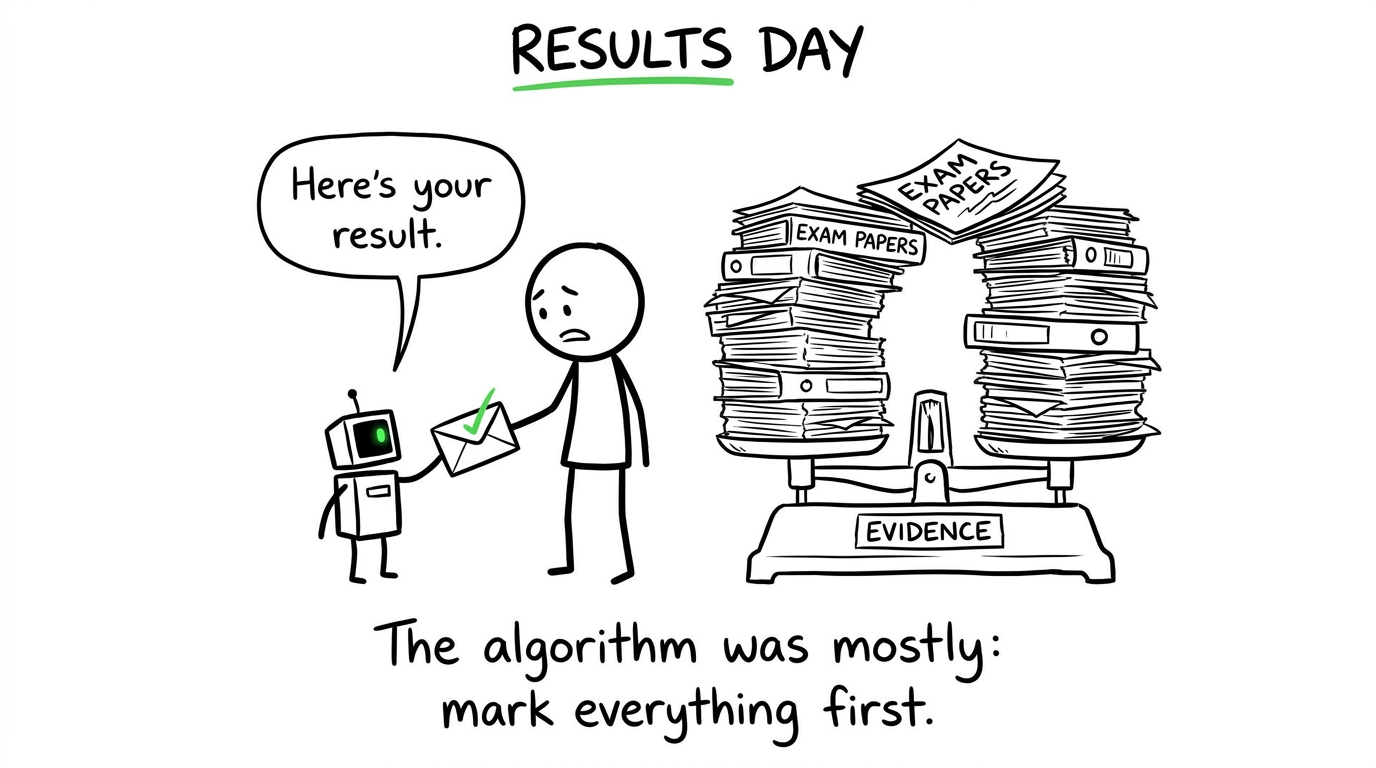 A robot explaining that exam evidence comes before the boundary
Common mistakes when reading grade boundaries
Treating last year's boundary as a promise
Previous boundaries provide a range, not a guaranteed threshold. Paper difficulty and student performance vary between series.
Comparing raw marks with scaled boundaries
On specifications such as AQA and Eduqas, some raw component marks are scaled. Compare like with like: an overall scaled mark belongs beside an overall scaled boundary.
Adding notional component grades
A linear A Level normally awards one grade for the whole subject. Notional paper boundaries are guidance and cannot simply be combined as separate qualifications.
Using the wrong board or specification
AQA, OCR and Eduqas totals are not interchangeable. Check the qualification code as well as the subject name.
Assuming a fixed percentage always earns an A
There is no universal rule that a particular percentage automatically produces a particular A-level grade. The published boundary for your series is decisive.
Turn uncertainty into useful preparation
If you are still preparing rather than waiting, boundaries should not become your revision strategy. A safer approach is to learn the specification, practise questions under timed conditions and analyse the mark scheme. MathsGenie's free AQA A Level Computer Science revision hub brings together lessons, questions and revision tools, while the AQA Computer Science past papers let you practise with mark schemes and available solutions.
Students balancing Computer Science with Maths can also use the A Level Maths revision hub, explore board-specific resources through Edexcel A Level Maths revision, and use A Level predicted papers as part of a broader practice plan. The MathsGenie home page provides quick access to free GCSE and A Level resources.
The boundary is outside your control. Your preparation, checking and next decision are not. Use MathsGenie's revision guides, past papers, predicted papers, practice questions, mark schemes, video solutions and mini tests to make the next result less mysterious, and the work behind it more deliberate.