A-Level Computer Science Career Paths After Results Day
A-level computer science career paths explained: compare university, apprenticeships and entry-level routes, then plan your next move after results day.

Results day has a strange way of making one letter feel larger than the years ahead. Yet a grade is not a career verdict. It is better understood as a key: it may open some doors immediately, while another route reaches the same destination through a different entrance.
The main A-level computer science career paths include university degrees, degree or higher apprenticeships, further education and entry-level digital work. Your grade affects which options are available now, but course requirements, your other subjects, practical projects and employer selection all matter too.
For GCSE students, this is useful knowledge before choosing A Levels. Strong maths, logical reasoning and problem-solving can keep more computing routes open later.
Your results-day route checklist
Before making a hurried decision:
- Compare your result with every condition in your university or apprenticeship offer.
- Check whether Mathematics, Further Mathematics or another subject has a specific required grade.
- Look at contextual offers, foundation years and Clearing vacancies where relevant.
- Compare course content rather than choosing by title alone.
- Keep evidence of programming projects, competitions or independent learning.
- Speak to the university, employer, college or school when a requirement is unclear.
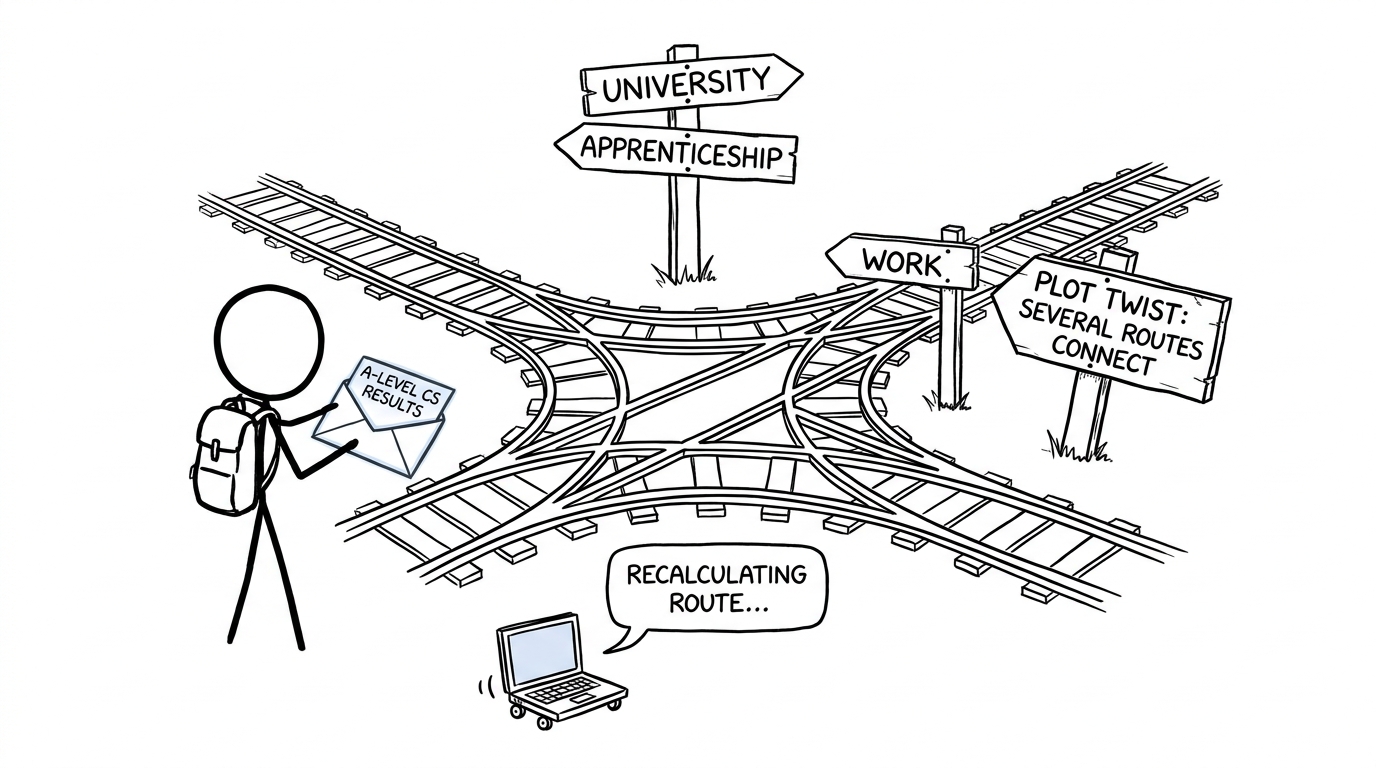 A student discovers that several computer science career routes connect
What does an A-Level Computer Science grade actually show?
The AQA and OCR specifications develop more than coding. They cover algorithms, data structures, computer systems, data representation, programming and systematic problem-solving. OCR also identifies abstraction, decomposition, logic and mathematical skills as central parts of the qualification.
That makes the subject relevant to several fields, but it does not qualify someone instantly as a software engineer or cyber security analyst. The grade is evidence of academic performance. Employers and universities may also look for mathematical preparation, communication, practical experience and the ability to explain decisions.
Students following AQA can consolidate those foundations with AQA A Level Computer Science revision, including specification-focused topics and past papers. OCR students can use OCR A Level Computer Science past papers to practise applying knowledge under timed conditions.
A-Level Computer Science careers and course pairings
There is rarely one compulsory degree for one job. These pairings show realistic connections rather than guaranteed outcomes.
Software development and engineering
Possible courses: Computer Science, Software Engineering or a Digital and Technology Solutions apprenticeship.
Software roles involve designing, testing, maintaining and improving applications or systems. Programming matters, but so do debugging, teamwork, documentation and understanding users.
A portfolio containing a modest but complete project can be more revealing than a folder of unfinished ambitious ideas. Record the problem, your design choices, tests and improvements. That turns code into evidence of how you think.
Cyber security
Possible courses: Cyber Security, Computer Science, Networks or a cyber security apprenticeship.
Possible longer-term roles include security analyst, security engineer, penetration tester and risk analyst. Entry requirements vary, and responsible cyber work requires legal and ethical awareness alongside technical knowledge.
Government apprenticeship standards confirm that digital routes can lead towards cyber security, software, networks, business analysis and data roles. Vacancies remain competitive, so applicants should check each employer's subject and grade criteria rather than assuming one universal threshold.
Data science and analytics
Possible courses: Data Science, Computer Science, Mathematics, Statistics or a data-focused degree apprenticeship.
This route suits students interested in finding patterns, evaluating evidence and communicating what data does, and does not, prove. Programming is useful, but mathematical confidence is particularly important.
Start strengthening that foundation through A Level Maths revision. The OCR Computer Science mathematical skills guide also connects computing with number bases, Boolean algebra and algorithm efficiency such as O(n)O(n)O(n).
Games and interactive technology
Possible courses: Games Computing, Computer Science, Software Engineering or Creative Computing.
Games careers extend beyond game programming. They can include tools development, artificial intelligence, testing, technical art and production. Course quality should be judged by its modules, facilities, placement opportunities and graduate work, not its title alone.
Mathematics can become especially useful in graphics, simulation and physics-based systems. Students taking A Level Maths can build fluency with Edexcel A Level Maths revision and test exam technique using Edexcel A Level Maths past papers.
Business analysis and technology consulting
Possible courses: Computer Science, Information Systems, Business Computing or a Digital and Technology Solutions apprenticeship.
These routes connect technical understanding with organisational problems. A business analyst might investigate requirements, model processes and help teams decide what a system should do. Clear writing and careful questioning can matter as much as programming speed.
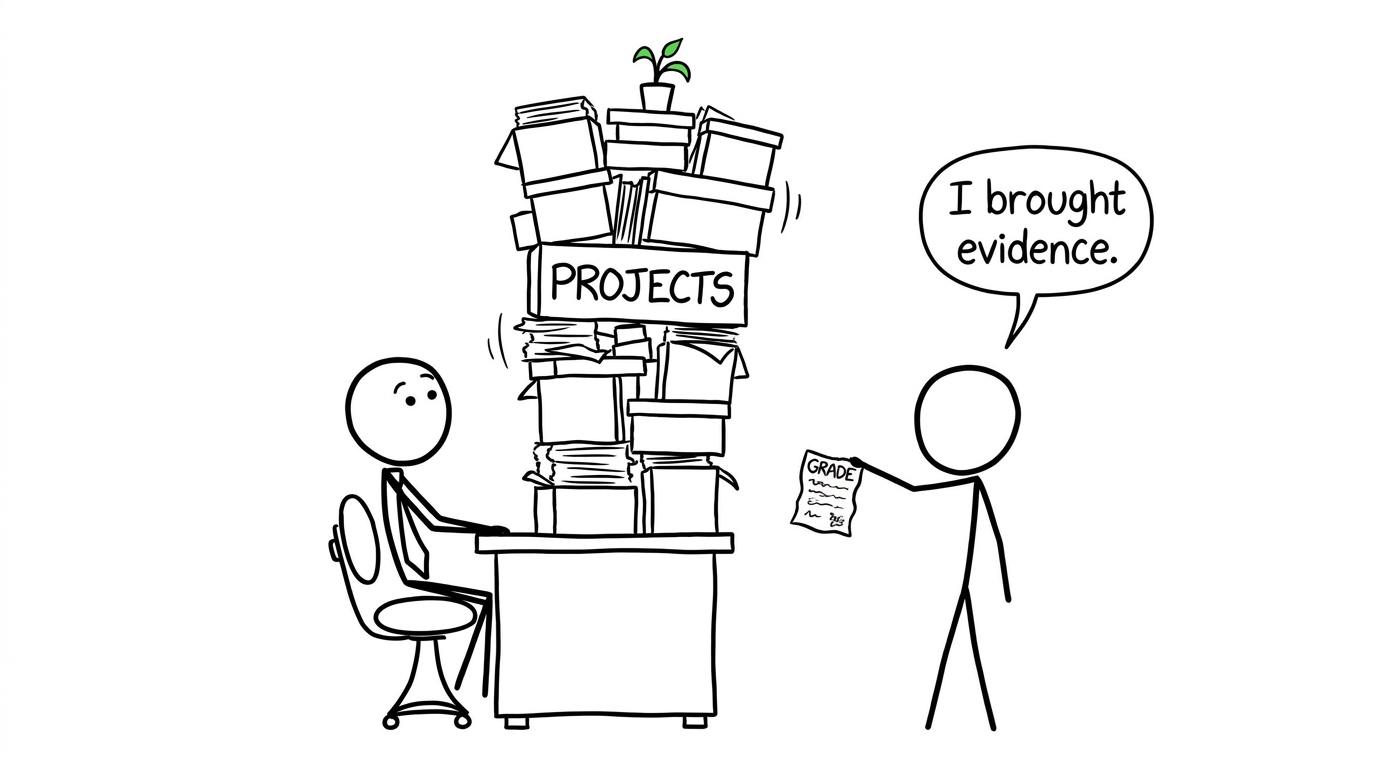 A student brings a tower of project evidence to an interview
University, apprenticeship or work?
University
UCAS guidance makes two important points: requirements vary considerably, and relatively few Computer Science courses universally demand A Level Computer Science. However, mathematically theoretical degrees may require A Level Mathematics, sometimes at a high grade.
Always check the exact course page for your year of entry. A strong Computer Science grade cannot replace a required Mathematics grade unless the university explicitly says it can.
Higher or degree apprenticeship
An apprenticeship combines paid employment with structured training. Current Level 6 digital technology routes can prepare apprentices for areas including software engineering, data analysis, cyber security, networking and consultancy.
You apply to the employer, not through the standard university application process. UCAS confirms that students may apply for university and apprenticeships at the same time, so keeping both routes open can be sensible.
Jobs after A-Level Computer Science
Possible entry-level vacancies include trainee software roles, IT support, junior testing, data support and digital operations. Availability and requirements differ widely. Specialist roles often demand further training, experience or a degree, so read the person specification carefully.
A first role need not determine an entire career. It can provide technical experience while you build qualifications and a portfolio.
Why GCSE maths matters before any of this
For a GCSE student, the most useful career preparation is not predicting one future job. It is protecting future choices.
Maths develops algebraic reasoning, precision, graphs, probability and multi-step problem-solving. These habits support algorithms, data analysis and technical courses. Begin with the GCSE Maths revision hub, then use topic questions before moving to GCSE predicted papers. Students already taking computing can also explore OCR GCSE Computer Science revision.
Common mistakes when choosing a route
- Treating one grade as a permanent ceiling. Foundation years, alternative courses, apprenticeships and later progression can provide other routes.
- Assuming every Computer Science degree has identical requirements. Some demand Mathematics; others accept a broader range of subjects.
- Choosing a course by career title alone. Read the modules, assessment methods, accreditation details and placement information.
- Ignoring practical evidence. A documented project can demonstrate persistence, testing and reflection.
- Applying only to famous job titles. Networks, quality assurance, DevOps, business analysis and technical support can offer valuable starting points.
- Failing to check current information. Entry criteria and vacancies can change between application cycles.
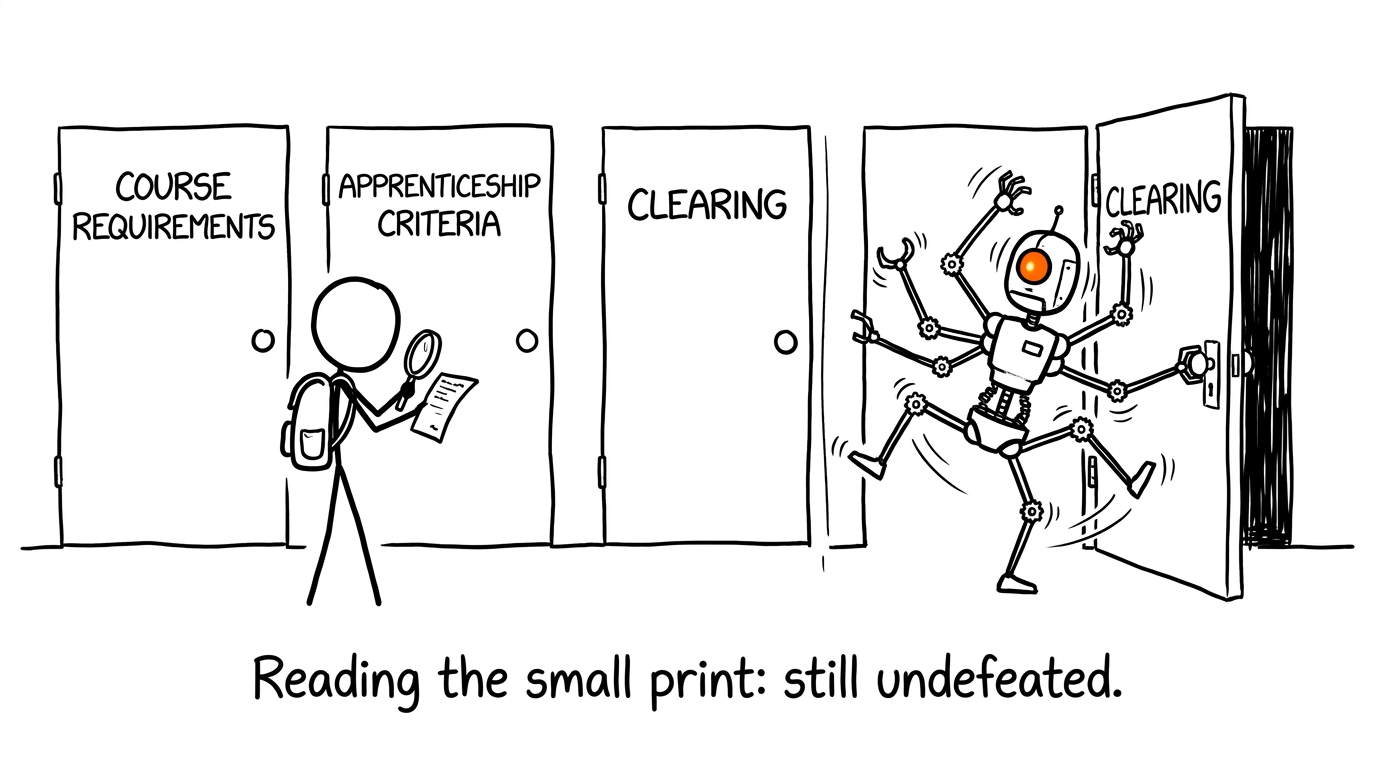 A calm student reads the small print while a robot panics
Build the next option, not the perfect prediction
A Computer Science result matters, but what follows matters too. Choose a route that fits your grades, interests, preferred way of learning and financial circumstances. Then build evidence through projects, revision and informed applications.
MathsGenie can support that process from GCSE onwards. Use free revision lessons and practice questions to repair weak topics, then check progress with mini tests, past papers, predicted papers, mark schemes and video solutions. Start with the AQA A Level Computer Science resources or OCR A Level Computer Science papers, and turn an uncertain result into a clear next step.