A-Level Chemistry Resit UCAS Application Guide
A-level chemistry resit UCAS application advice: explain your retake honestly, show progress and present a credible plan when reapplying to university.
Results day can turn a carefully imagined future into a collection of hurried decisions. If Chemistry was below the grade you needed, however, a retake does not have to define your application.
For a strong A-level chemistry resit UCAS application, declare both attempts accurately, check that each course accepts resits, and explain the retake briefly through reflection, evidence and a credible improvement plan. Universities do not need an apology. They need an honest account of what changed and why your next result should be different.
Your resit application checklist
Before submitting your UCAS application:
- enter your original Chemistry result and the resit separately;
- show the resit result as pending;
- ask your referee to provide a predicted grade where applicable;
- check the current resit policy for every individual course;
- explain genuine mitigating circumstances through the appropriate channel;
- use the personal statement to demonstrate preparation, not repeat your grades;
- support every claim of improvement with something specific.
Resit rules can vary between universities and courses. Medicine, dentistry and veterinary science may have particularly detailed conditions, including requirements concerning first-sitting grades, the number of permitted retakes or mitigating circumstances. Always read the official course admissions policy for your application year and contact admissions if anything remains unclear.
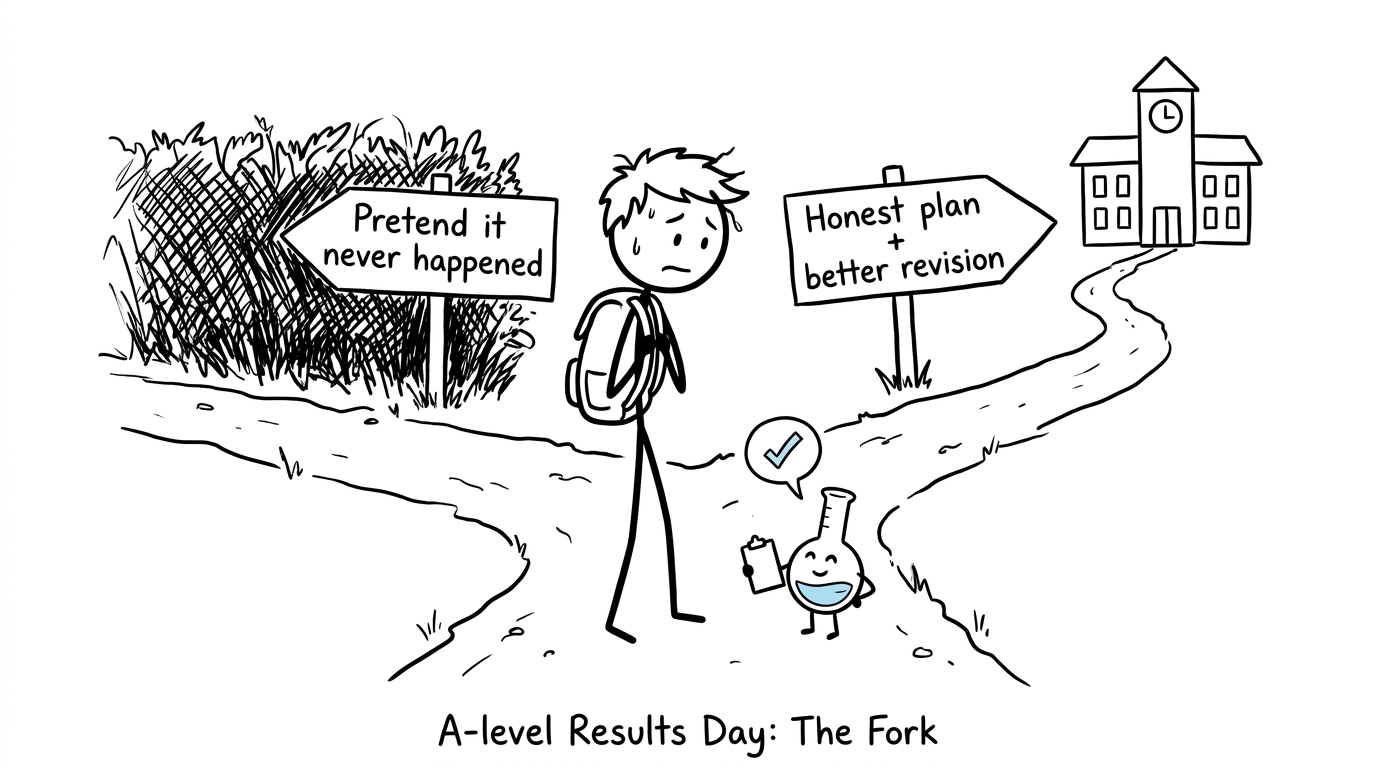 A student choosing honesty and a clear revision plan after results day
How to enter an A-Level Chemistry retake on UCAS
UCAS requires applicants to include all completed and pending secondary qualifications, including unsuccessful grades and resits. Enter your original A-Level Chemistry qualification with the grade achieved. Then enter the qualification again with the new examination date and a pending result.
Do not remove or disguise the first attempt. Apart from being inaccurate, an omission can create questions that a straightforward declaration would have avoided.
If you are sitting the retake through a different school, college or examination centre, make sure the education details and awarding organisation match your arrangements. Your referee should also know that Chemistry appears as pending so that the appropriate predicted grade can be supplied.
Explaining a resit on your UCAS application
From applications for 2026 entry onwards, the UCAS personal statement uses three questions. The second asks how your qualifications and studies have prepared you for the course. That is usually the most natural place to mention relevant learning from a Chemistry retake, although you do not need to force it in if your referee can provide the necessary context more effectively.
The entire statement still has a maximum of 4,000 characters, including spaces, with at least 350 characters required for each answer. A long defence of one grade would therefore waste valuable space. Aim for three moves:
State the decision without drama
Use one direct sentence. Avoid sounding ashamed, defensive or entitled to special treatment.
Example wording:
I chose to retake A-Level Chemistry after my original result did not reflect the standard required for my intended course.
Explain what you changed
“Working harder” is too broad. Identify the practical difference: more timed papers, systematic use of mark schemes, targeted revision of weak topics or better management of calculation questions.
Example wording:
Reviewing my first attempt showed that I needed a more disciplined approach to quantitative questions and unfamiliar applications, so I now use timed practice, error analysis and repeated topic testing.
For structured preparation, the AQA A-Level Chemistry revision hub brings together lessons, question banks, papers and revision tools. Students following Edexcel can use the corresponding Edexcel A-Level Chemistry revision resources.
Connect the experience to university readiness
The useful lesson is not merely that the grade was disappointing. It is that you responded intelligently.
Example wording:
Rebuilding my understanding has strengthened my independence, made my revision more evidence-led and confirmed my commitment to studying the subject at a higher level.
Adapt these sentences to your real circumstances. Do not copy claims that you cannot support.
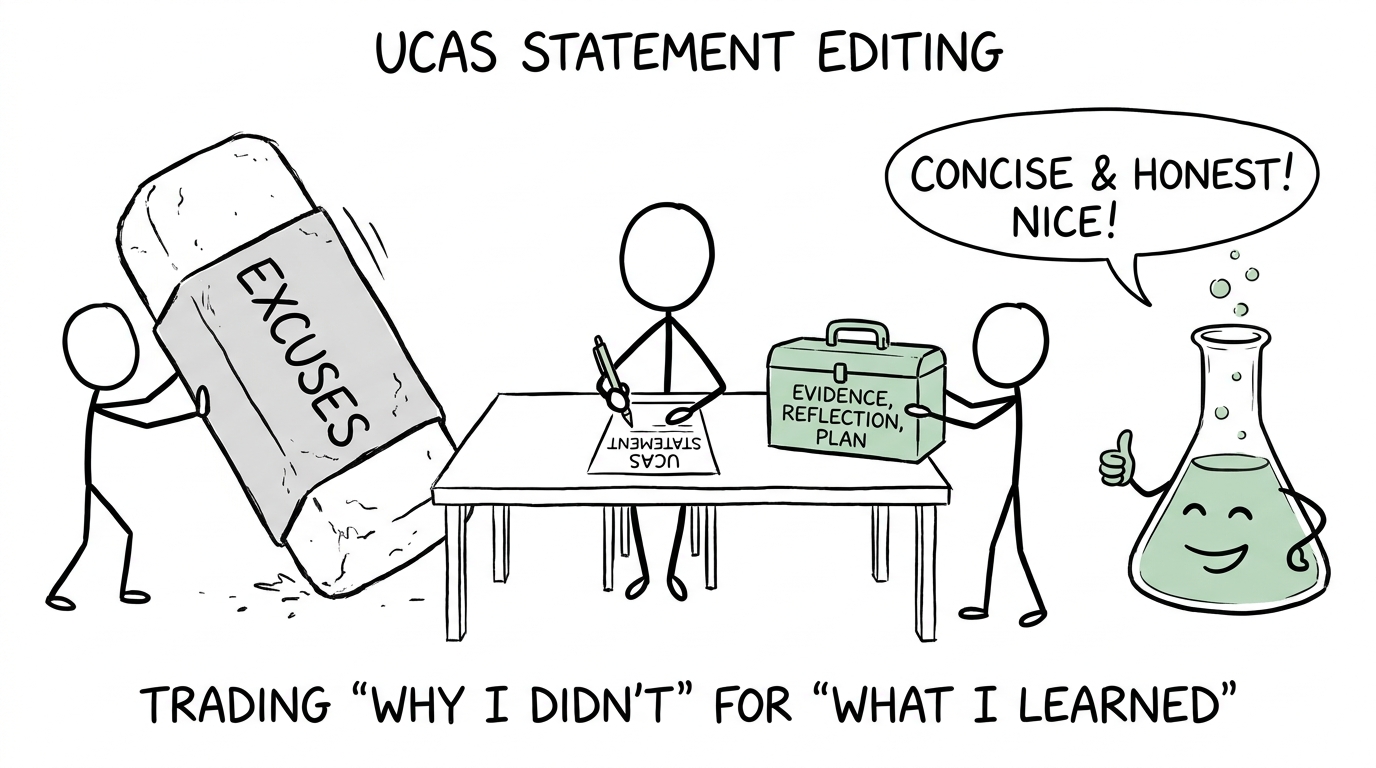 A student replacing excuses with evidence, reflection and a plan
Turn your revision plan into evidence
A convincing A-Level Chemistry retake application is supported by visible action. Build a weekly cycle:
- revise one precisely defined topic;
- answer exam-style questions without notes;
- mark them strictly;
- classify each lost mark;
- revisit the same weakness within a few days;
- complete timed papers as the examination approaches.
AQA students can use the topic-by-topic Chemistry revision guides before moving into questions. Edexcel students can build exam stamina with A-Level Chemistry past papers and mark schemes.
Chemistry retakes often expose underlying weaknesses in ratios, graphs, logarithms, rearranging equations or interpreting data. If calculation skills are limiting your progress, the GCSE Maths revision hub can rebuild the foundations, while A-Level Maths past papers offer more demanding practice where appropriate.
Where mitigating circumstances belong
If illness, bereavement, caring responsibilities or another serious disruption affected your first sitting, explain the facts accurately. Do not exaggerate, diagnose yourself or turn the personal statement into supporting evidence.
Ask your referee to confirm relevant educational context, and check whether the university requires a separate mitigating-circumstances form or supporting documents. Procedures and deadlines differ. The safest approach is to read each university’s current policy and ask its admissions team before applying.
Your personal statement can then remain focused on academic suitability and what you have done since the disruption.
Common mistakes when explaining a resit
Hiding the original result: UCAS requires completed qualifications and retakes to be declared.
Writing a long apology: Admissions teams need relevant evidence, not self-punishment.
Blaming teachers or the exam board: Even where circumstances were difficult, focus on facts and your response.
Making unsupported promises: “I know I will achieve an A” is weaker than evidence from timed papers, improved topic scores and a predicted grade.
Assuming every university has the same policy: Check each course individually, especially for highly selective professional degrees.
Using all your statement space on the retake: Your motivation, subject knowledge and preparation for the degree still matter most.
Make the next result the clearest explanation
A resit is one line in an application, not its whole meaning. Declare it correctly. Explain it briefly. Then spend most of your energy producing evidence that the second attempt is built on a better system.
Start with the relevant MathsGenie AQA A-Level Chemistry resources or Edexcel A-Level Chemistry resources. Use revision lessons to repair understanding, practice questions to test it, and past papers, predicted papers, mini tests and mark schemes to make progress measurable. A calm application helps, but disciplined preparation is what gives the application weight.