

A-Level Chemistry Resit: Your Results Day Plan
A-level chemistry resit guidance with clear milestones, targeted revision, past-paper practice and practical advice for preparing after results day.
A disappointing result can make two years of work feel as though they have been reduced to one letter. They have not. An A-level chemistry resit is a chance to diagnose what cost you marks, change the way you prepare and return with a clearer understanding of the exam.
The practical answer is simple: first investigate your result and confirm the resit arrangements; then rebuild weak topics through active recall and targeted questions; finally move towards timed papers and careful mark-scheme analysis. Resitting A-level chemistry should not mean repeating the same year in the same way.
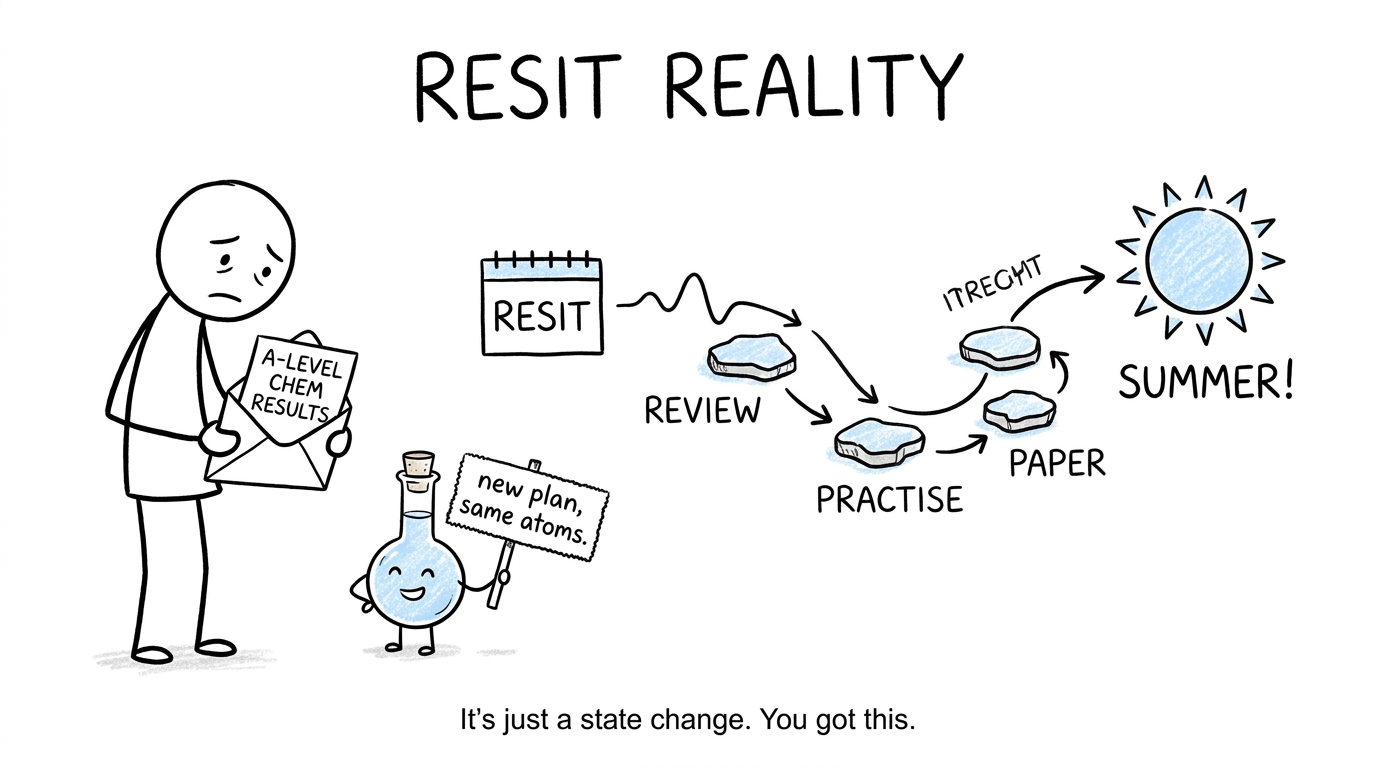 A student turns a chemistry result into a new revision plan
Your a-level chemistry resit checklist
Before beginning revision, make sure you can answer these questions:
- Which exam board and specification are you entering: AQA, Edexcel, OCR or Eduqas?
- Will your original school or college accept your entry, or do you need another approved centre?
- Can your practical endorsement be carried forward?
- Were your lost marks mainly caused by knowledge, application, calculations, practical questions or timing?
- Does your university or course accept resit results under its current admissions policy?
- When are your centre's entry and payment deadlines?
In England, reformed A Levels are linear qualifications. A resit normally means taking all written components again in the relevant summer examination series rather than keeping individual paper marks. A previously awarded science practical endorsement can normally be carried forward, including in certain cases between awarding bodies, but the centre must make the correct entry. Confirm this with its examinations officer rather than assuming.
Results day to early September: make the decision carefully
Do not begin by ordering new textbooks. Begin with evidence.
Speak to your chemistry teacher and ask for a component-level breakdown if one is available. If the result appears inconsistent with your previous performance, discuss access to scripts or a review of marking promptly. Reviews have deadlines, may involve a fee and can cause marks to rise, remain unchanged or fall.
If university entry is involved, check your UCAS status and contact the institution directly. Admissions policies on resits vary between courses, particularly for competitive subjects, so written confirmation is more reliable than general online advice.
Once a retake is the right choice, secure an examination centre early. Ask about entry fees, deadlines, your specification, access arrangements and the practical endorsement. Private candidates still sit written examinations in person.
September: diagnose where the marks went
Your first paper should be diagnostic, not a performance. Complete it without notes, mark it strictly and classify every lost mark.
| Error type | Your next action |
|---|---|
| Knowledge | Relearn the precise specification point and retrieve it later without notes |
| Application | Practise questions that place familiar chemistry in unfamiliar contexts |
| Calculation | Isolate the underlying method, units and significant figures |
| Practical | Review variables, measurements, uncertainty, safety and evaluation |
| Exam technique | Compare your wording with the minimum required by the mark scheme |
| Timing | Use shorter timed sections before attempting another complete paper |
AQA students can start with the AQA A Level Chemistry past papers. OCR students should use the corresponding OCR A A Level Chemistry past papers. If you need to find resources by board, use the wider A Level past-paper collection.
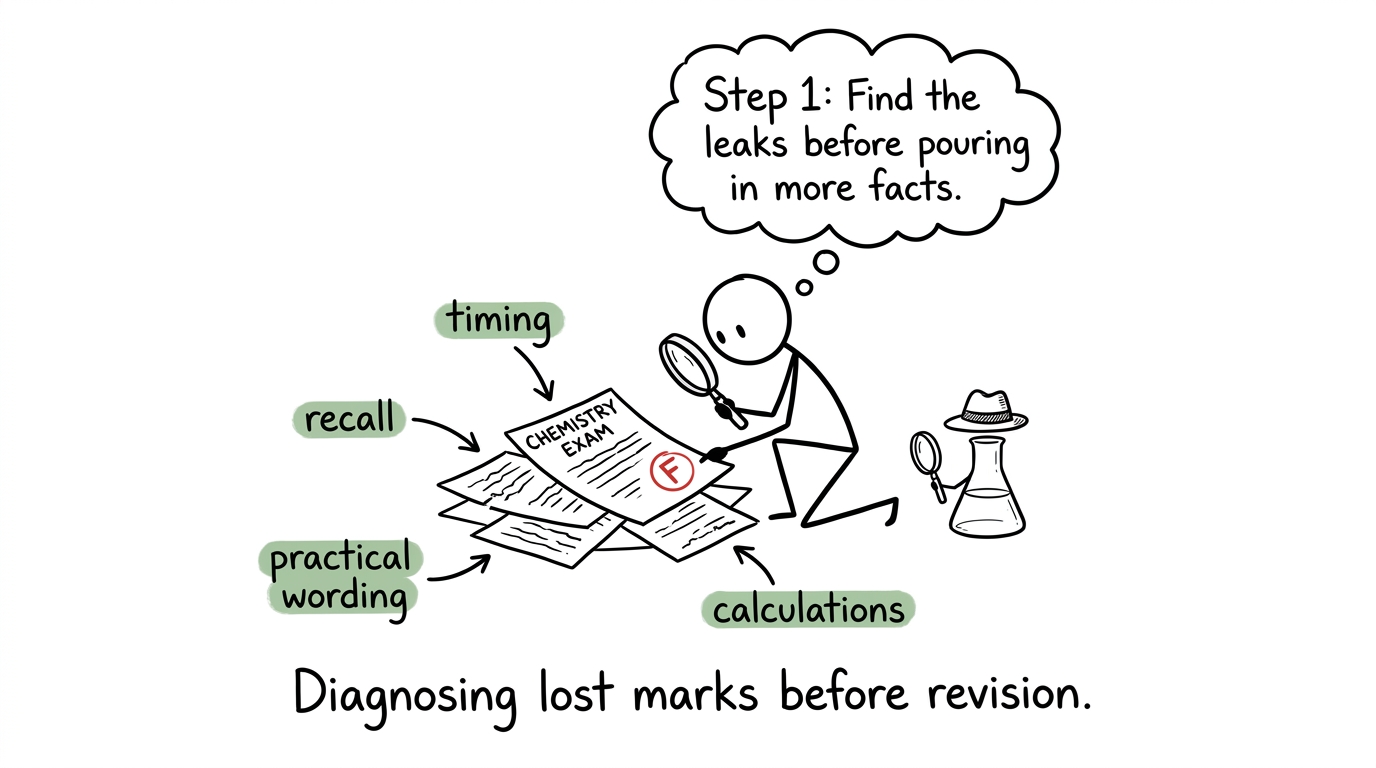 A chemistry revision detective investigates where marks disappeared
October to December: rebuild the foundations
The middle of the autumn term is for depth. Divide your specification into physical, inorganic, organic and practical chemistry, then label each topic red, amber or green using question evidence rather than confidence.
Use a repeatable weekly structure:
- two sessions for weak-topic learning and retrieval;
- two sessions of exam-style questions;
- one calculation and data-handling session;
- one short cumulative test covering older material;
- one review of your mistake log.
For AQA, the A Level Chemistry revision guides provide specification-matched explanations. Follow each review with the AQA Chemistry question bank, rather than waiting until every topic feels complete. OCR candidates can use the OCR A Chemistry question bank, while Edexcel students can organise their work from the Edexcel A Level Chemistry revision hub.
Chemistry recall matters, but calculations also require fluency with proportional reasoning, logarithms, graphs, rearranging expressions and units. Keep a separate list of calculation errors. When checking an answer, ask whether the chemistry, the mathematical method or the presentation caused the lost mark.
January to March: turn knowledge into exam answers
Knowing a topic and scoring from it are different skills. During this phase, increase mixed practice because real papers do not announce which method to use.
Complete timed sections, mark them on the same day and rewrite only the answers that need improvement. Record the exact reason for each lost mark and schedule a fresh question testing the same skill. Simply copying the mark scheme creates recognition; answering a new question creates retrieval.
Definitions and conditions need regular recall. The AQA A Level Chemistry flashcards can support this, but flashcards should complement extended questions rather than replace them.
Practical work must remain part of written-paper revision even if your endorsement is carried forward. Specifications assess practical knowledge through written examinations, including methods, data analysis, uncertainties and evaluation. Review the required or core practicals for your own board and connect each one to the chemistry behind it.
April to the examinations: rehearse the full performance
Now shift from repairing isolated topics to reproducing exam conditions. Alternate complete papers with targeted repair days. Preserve some recent papers for this stage rather than using everything in September.
After each paper:
- calculate your raw mark accurately;
- identify the topics and question styles losing marks;
- repair the largest recurring weakness;
- reattempt missed questions after several days;
- compare your wording with the mark scheme;
- update your timing plan.
Use predicted papers and mini tests as extra rehearsal, not as forecasts of exact questions. Their value lies in switching between topics and working under pressure.
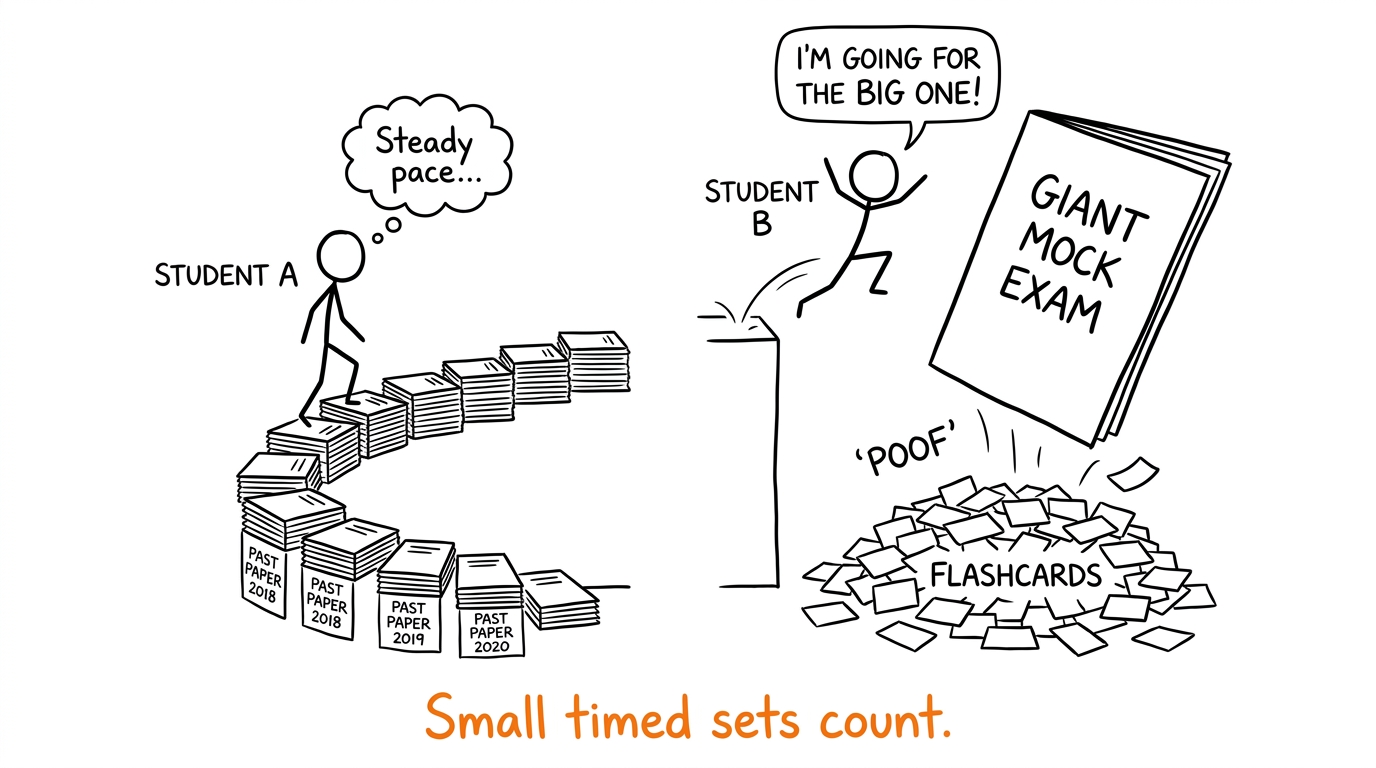 Small timed question sets become steps towards a full chemistry paper
Common mistakes when resitting A-level chemistry
Repeating the original revision method
More hours do not automatically produce a different grade. If the first approach relied on rereading and highlighting, replace it with retrieval, marked questions and scheduled reattempts.
Mixing exam boards casually
The underlying chemistry overlaps, but specifications, required practicals and assessment language differ. Use resources matched to your entry.
Doing papers without repairing mistakes
A completed paper is only useful when it changes the next week's work. Every recurring error needs a specific action.
Ignoring practical questions
Carrying forward a practical endorsement does not remove practical knowledge from written papers. Methods, observations, analysis and evaluation still require revision.
Leaving centre arrangements too late
Exam centres set their own administrative deadlines and fees. Confirm your entry, access arrangements and endorsement status early.
Make the second attempt different
An A-level chemistry retake is not won through one dramatic month. It is built through a calmer sequence: investigate, repair, practise, mark and repeat.
Begin with your board's free AQA Chemistry revision hub, OCR A Chemistry revision hub or Edexcel resources on MathsGenie. Use revision lessons to rebuild understanding, question banks to target weaknesses, and past papers, predicted papers, mini tests and mark schemes to develop exam readiness. Start with one diagnostic paper today, then let the evidence determine tomorrow's revision.











